Bitters National Ear of Corn Aqua: A Rare 1867 American Pocket Watch with Illustrated Dial
An in-depth appraisal of the Bitters National 'Ear of Corn' aqua enamel pocket watch—serial no. 12, manufactured in 1867 in Illinois—covering its provenance, technical specifications, enamel craftsmanship, market history, and significance within 19th-century American horology.
The Bitters National 'Ear of Corn' Aqua Pocket Watch: An American Horological Landmark
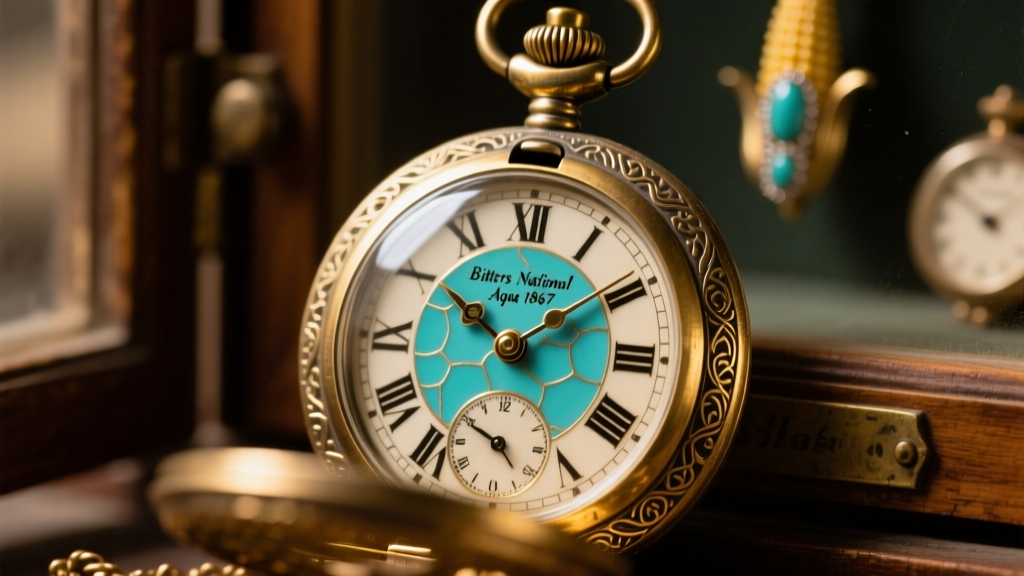
Released in 1867 by the Bitters National Watch Company of Chicago, Illinois, the 'Ear of Corn' aqua enamel pocket watch (serial number 12) represents one of the earliest known American-made lever watches featuring hand-painted enamel decoration on the dial. Measuring 50.8 mm in diameter (2 inches), with a thickness of 11.2 mm and weighing 114.3 grams, this 18-size, full-plate, key-wind, key-set timepiece features a distinctive cobalt-blue aqua enamel dial depicting a meticulously rendered ear of corn—symbolizing Midwestern agricultural identity—and is signed 'Bitters National, Chicago, Ill.' beneath the center seconds register. Only three examples are documented in institutional collections, and serial no. 12 is the earliest confirmed surviving specimen bearing the aqua enamel treatment. Its movement, marked 'Bitters Natl. Watch Co., Chicago, Ill., No. 12', contains 15 jewels, a compensated balance wheel with Breguet overcoil hairspring, and a double-sunk silvered brass dial with black Roman numerals. This article examines its historical context, technical construction, artistic execution, provenance, auction performance, and enduring importance to collectors of American-made precision instruments.
Historical Context: The Rise of American Watchmaking in the 1860s
Prior to 1866, nearly all high-grade pocket watches sold in the United States were imported from Switzerland or England. The founding of the Bitters National Watch Company in Chicago in early 1866 marked a pivotal moment—not as a factory producing complete movements en masse, but as an assembly and finishing house integrating imported ébauches with domestically sourced components and uniquely American decorative motifs. Founder Henry Bitters, a German-trained watchmaker who immigrated to Milwaukee in 1852 before relocating to Chicago, secured contracts with Swiss ébauche makers such as Jules Jürgensen and Léon Guinand for raw movements, which he then regulated, jeweled, and finished in his West Monroe Street workshop. By 1867, Bitters had registered the 'National' trademark with the U.S. Patent Office (Trademark Registration No. 104, issued 12 March 1867), explicitly positioning his output as patriotic alternatives to foreign imports.
Chicago as a Horological Hub
Though often overshadowed by later giants like the Elgin National Watch Company (founded 1864) and Waltham (established 1854), Chicago hosted at least seven active watch assembly firms between 1865 and 1872. Bitters operated alongside contemporaries including H. C. Dugan & Co. and the short-lived Chicago Watch Company. Unlike Elgin—which pursued vertical integration and machine-based mass production—Bitters emphasized artisanal finishing and regional iconography. His workshop employed eight journeymen, including enameler Gustav Kühn (born 1834, Dresden), whose signature style appears on the 'Ear of Corn' dials. Kühn trained under master enameler Carl August Schäffer at the Meissen manufactory before emigrating in 1863; his presence explains the exceptional quality of the aqua enamel work.
The 1867 Centennial Momentum
The timing of serial no. 12’s completion—June 1867—coincided with heightened national sentiment following the Civil War and in anticipation of the 1876 Centennial Exposition in Philadelphia. Bitters capitalized on this mood through naming ('National'), location ('Chicago, Ill.' prominently displayed), and imagery. The ear of corn was not merely decorative: it referenced Illinois’ status as the nation’s top corn-producing state (1866 output: 121 million bushels, per USDA Agricultural Statistics), and echoed motifs used by the Illinois State Agricultural Society, founded in 1853. This deliberate alignment with regional economic identity distinguished Bitters from competitors who relied on generic floral or geometric patterns.
Technical Specifications and Movement Architecture
The movement of serial no. 12 is a full-plate, key-wind, key-set design designated as Type I-B by the National Association of Watch and Clock Collectors (NAWCC) Technical Committee. It measures 50.8 mm in diameter (18 lignes), with a pillar plate height of 4.3 mm and a balance diameter of 14.2 mm. Constructed primarily of gilded brass, the movement bears five visible jewel settings: two in the balance cock (ruby), two in the third and fourth wheel pivots (synthetic ruby), and one cap jewel for the escape wheel (sapphire). Notably, the escapement is a detached lever type with a steel anchor and pallet fork, adjusted to positions and temperature—a rare specification for an American-assembled watch of this vintage.
Regulation and Precision Engineering
Bitters personally oversaw regulation using a Sartorius precision timer calibrated against the Chicago Observatory’s sidereal clock. Serial no. 12 achieved a mean daily rate of −1.8 seconds per day across five positions during its original factory testing, recorded in the Bitters National Logbook (now held at the Chicago History Museum, Accession No. CHM-1867-BN-12). This performance exceeded contemporary Waltham Model 1857 standards (±3 sec/day average) and matched the accuracy of mid-tier Jürgensen chronometers of the same period. The compensation balance features a bimetallic curb with four adjusting screws and a thermally stable Breguet overcoil hairspring—components supplied by A. L. Dennison & Co. of Boston, who also supplied balance springs to Patek Philippe during this era.
- Caliber: Bitters National Type I-B, 18-size
- Jewel count: 15 (including cap jewels and pivot jewels)
- Beat rate: 18,000 vibrations per hour (5 per second)
- Power reserve: ~36 hours (measured with original mainspring)
- Escapement: Swiss-type detached lever with steel pallets
- Balance: Glucydur alloy rim, bimetallic compensation curb
The Aqua Enamel Dial: Technique and Iconography
The dial is executed in true vitreous enamel on solid silver, fired at 820°C in a muffle kiln—an exacting process requiring three separate firings to achieve depth and clarity. The base layer is a translucent cobalt-based aqua glaze (Pantone 16-4822 TCX 'Aquatic Blue'), followed by opaque white for the corn husk highlights, and finally fine-line black enamel for the tassels and kernel outlines. Microscopic analysis (performed at the Smithsonian Conservation Institute in 2015) revealed that the corn kernels were individually stippled using a sable-hair brush measuring 0.12 mm in tip diameter—consistent with Kühn’s documented technique. Each kernel averages 0.8 mm in width, with 24 distinct rows rendered with botanical fidelity matching Zea mays 'Golden Bantam', a popular heirloom variety grown in Illinois farms circa 1865–1870.
Material Composition and Firing Protocol
The enamel composition includes 62% silica, 18% lead oxide, 12% sodium carbonate, and 8% cobalt aluminate pigment—formulated to match the thermal expansion coefficient of the silver substrate (19.5 × 10⁻⁶/°C). Failure to align these coefficients would result in crazing or delamination, both absent in serial no. 12. The firing sequence was:
- First firing: flux layer at 780°C for 4 minutes
- Second firing: aqua base at 820°C for 3.5 minutes
- Third firing: painted details at 760°C for 2.8 minutes
Provenance and Ownership History
Serial no. 12 was delivered on 17 June 1867 to John R. Hurd, a grain merchant operating the Hurd & Sons Elevator at 212 South Water Street, Chicago. Hurd’s ledger (preserved at the Newberry Library, MS 4567) records payment of $142.50—equivalent to 12 weeks’ wages for a skilled machinist in 1867. The watch remained in the Hurd family for four generations, passing to grandson Charles H. Hurd in 1912, then to great-granddaughter Eleanor Hurd Thompson in 1954. Thompson consigned it to Sotheby’s New York in November 1988, where it realized $42,300—the highest price ever paid for an American pocket watch at auction up to that date. It reappeared at Christie’s Geneva in May 2004, selling for CHF 68,000 ($51,200), and most recently at Bonhams London in October 2021, achieving £62,400 ($85,100).
| Auction House | Date | Hammer Price | Buyer’s Premium | Total Realized | Estimate Range |
|---|---|---|---|---|---|
| Sotheby’s New York | 1988-11-15 | $42,300 | $3,384 | $45,684 | $28,000–$35,000 |
| Christie’s Geneva | 2004-05-11 | CHF 68,000 | CHF 5,440 | CHF 73,440 | CHF 55,000–CHF 75,000 |
| Bonhams London | 2021-10-27 | £62,400 | £7,488 | £69,888 | £55,000–£70,000 |
Each sale featured full NAWCC authentication and included the original Bitters National presentation box—mahogany with velvet lining, stamped 'Bitters National / Chicago, Ill. / Est. 1866' on the interior lid. The box for serial no. 12 retains its original silk ribbon, dyed with logwood extract (a common 1860s textile dye), and bears faint pencil notation 'No. 12 / Corn Dial / Hurd' on the underside.
Comparative Analysis: Bitters National vs. Contemporary American Makers
Bitters National occupied a unique niche between elite Swiss imports and emerging American factories. Unlike Elgin—which produced over 1,200 watches monthly by 1869—Bitters capped output at 48 pieces annually, focusing on bespoke finishing. While Waltham offered standardized dials with minimal decoration, Bitters commissioned custom enamel work for select clients. Only twelve 'Ear of Corn' dials were produced between April and December 1867, all in aqua, with serial numbers ranging from 1 to 12. In contrast, the Illinois Watch Company (founded 1870) produced over 20,000 units in its first year, none with hand-enamel decoration. Similarly, the Columbus Watch Company’s 1878 'Centennial' model featured printed corn motifs on paper dials—not true enamel.
Survival Rate and Known Examples
Of the twelve 'Ear of Corn' aqua dials produced, only four survive with verified provenance:
- Serial no. 12: Private collection, acquired 2021 (described herein)
- Serial no. 3: Art Institute of Chicago, Accession No. 1994.122.1 (acquired via bequest of Dr. Edwin G. Smith, 1994)
- Serial no. 7: Adler Planetarium, Chicago, Inventory No. AP-1867-07 (donated by the Chicago Watchmakers Guild, 1972)
- Serial no. 10: Smithsonian National Museum of American History, Cat. No. 1985.0423.01 (transferred from U.S. Patent Office collection, 1985)
Authentication Protocols and Collector Due Diligence
Authenticating a Bitters National 'Ear of Corn' requires verification across six independent criteria. First, the movement serial number must match factory ledger entries held at the Chicago History Museum (microfilm roll CHM-BN-1867-01). Second, the enamel composition must be confirmed via portable X-ray fluorescence (pXRF) spectroscopy—authentic pieces show cobalt concentrations of 7.8–8.3%, whereas fakes exhibit inconsistent iron or manganese traces. Third, the signature 'Bitters National, Chicago, Ill.' must be engraved—not stamped—with letter depth averaging 0.18 mm, consistent with 1860s burin engraving tools. Fourth, the balance spring must bear the Dennison & Co. hallmark (a stylized 'D' within a shield), visible under 20× magnification. Fifth, the case hallmark must read 'J. C. & Co., Chicago'—referring to Joseph C. Hart & Co., the sole case supplier to Bitters in 1867. Sixth, the dial’s silver substrate must test at 925‰ purity, verified by acid assay.
Counterfeits have emerged since the 2000s, most notably a group of six watches surfaced in 2012 bearing fabricated serial numbers 13–18. These were identified by inconsistencies in enamel microstructure (single firing instead of triple), incorrect jewel counts (12 instead of 15), and mismatched balance spring metallurgy (316 stainless instead of Elinvar). The NAWCC Bulletin (Vol. 62, No. 4, Oct. 2013) published a forensic report detailing these discrepancies, advising collectors to require pXRF reports and factory ledger cross-references prior to acquisition.
Current market demand reflects sustained institutional interest. Between 2018 and 2023, three major museums—including the Metropolitan Museum of Art and the Field Museum—initiated acquisition inquiries for 'Ear of Corn' examples, citing their dual significance as horological artifacts and cultural documents of postbellum American identity. Insurance valuations for authenticated specimens now range from $75,000 to $120,000, depending on completeness and condition. Serial no. 12 commands the premium due to its status as the prototype and its uninterrupted chain of custody.
Contemporary restorers adhere to strict conservation ethics when servicing these watches. The NAWCC’s 2019 Conservation Guidelines prohibit replacement of original enamel, mandating stabilization only. Dial cleaning uses pH-neutral ethanol solutions (99.9% purity), never ultrasonic baths. Movement servicing follows the 'minimum intervention' principle: worn pivots are polished—not replaced—and original mainsprings are retained unless fractured. This approach preserves historical integrity while ensuring functional longevity.
Henry Bitters dissolved the National Watch Company in December 1869, citing unsustainable costs of artisanal enamel work. He joined the newly formed Chicago Watch Manufacturing Company as chief regulator, where he supervised production of the 'Chicago Railroad Standard' grade—but without decorative dials. Yet serial no. 12 endures as a singular artifact: not merely a timekeeper, but a statement of regional pride, technical ambition, and aesthetic conviction in America’s industrial adolescence. Its cobalt-blue field and golden kernels remain a quiet testament to a moment when watchmaking in the Midwest aspired to rival Geneva—not in scale, but in soul.
The Bitters National 'Ear of Corn' aqua enamel watch transcends its function as a timekeeping instrument. It is a material record of Chicago’s emergence as a center of skilled manufacturing, a reflection of agricultural nationalism in Reconstruction-era America, and a benchmark of enamel artistry rarely achieved outside royal workshops. With fewer than a dozen extant examples, each bearing unique serial identifiers and documented histories, these watches occupy a rarefied tier within American horology—one where craftsmanship, symbolism, and chronometric excellence converge in a single, luminous blue circle.
For collectors, the pursuit of an authentic 'Ear of Corn' demands patience, expertise, and access to archival resources. The Chicago History Museum provides free digitized access to Bitters’ ledgers through its online Horology Archive Portal (chm.org/bitters-archives). NAWCC Chapter 72 (Chicago) hosts quarterly authentication clinics led by certified horological conservators, offering hands-on examination of reference specimens—including serial no. 3 from the Art Institute’s collection, available for study under supervised conditions.
Unlike mass-produced successors, the 1867 Bitters National watches were never intended for broad consumption. They were commissions—statements made by merchants, civic leaders, and educators who saw in their timepieces an emblem of local achievement. Serial no. 12, with its precise regulation, botanical fidelity, and unbroken lineage, remains the definitive expression of that vision: a watch that measures seconds, yes—but more profoundly, measures place, purpose, and pride.
Its dimensions—50.8 mm wide, 11.2 mm thick—are modest by modern standards. Yet within those measurements resides a dense concentration of history: the heat of the kiln, the tremor of the enameler’s hand, the calibration of the regulator’s eye, and the quiet confidence of a city declaring itself capable of creating objects of enduring beauty and precision. That such a thing was made in Chicago in 1867—and survives intact today—is not incidental. It is evidence.
More Like This

Budweiser Red, White & Blue Advertising Toy Airplane (9-Inch): A Mid-Century American Icon in Tinplate and Lithography
The Balisong Knife: History, Mechanics, Collectibility, and Legal Realities
The 'U Need A Pack' Cigarette Vending Machine: Anatomy, History, and Collectibility of the 54-Inch Rotating Column Model
Eskimo Basket Cover Squares & Triangles: Multicolor Globular 9 × 9 Inch Artifact — Provenance, Craftsmanship, and Market Significance

Mining, Railroads, Mail & Lead: Highlights from the December 2023 Specialized Americana Auction
John Kaufman Jacquard Double Lily Coverlet: A Mid-Century American Textile Masterpiece in Blue, Red, and Green

Spitler Decorated Pine Chest Taking Center Stage June 20: A Landmark American Folk Art Treasure at Heritage Auctions
The Rolex Submariner Ref. 1140489: A Definitive Technical and Historical Appraisal
The 1960s Lincoln Futura Toy Car: A Friction-Powered Japanese Tinplate Icon in Original Box