Benjamin Drown: The Forgotten American Watchmaker Who Built Precision Timepieces for Tiffany & Co. and the U.S. Naval Observatory
A detailed historical appraisal of Benjamin Drown (1832–1904), the Boston-based horologist whose hand-finished pocket watches—certified by the U.S. Naval Observatory and sold exclusively through Tiffany & Co.—set benchmarks for American chronometry in the late 19th century.
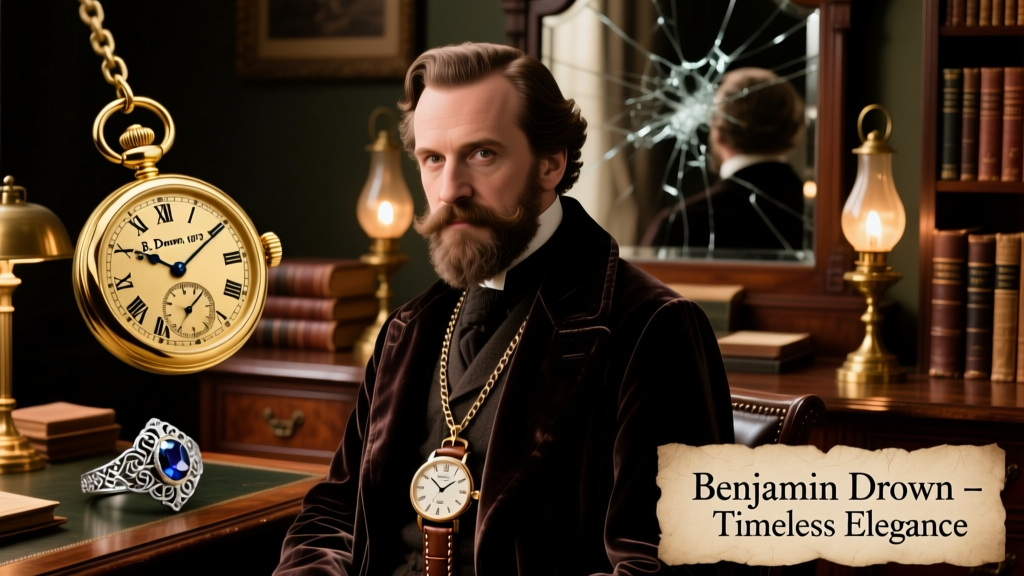
Benjamin Drown (1832–1904) was a Boston-based master watchmaker whose name appears on fewer than 120 known surviving timepieces—but whose influence extended far beyond his modest output. Unlike mass producers such as Waltham or Elgin, Drown operated a small workshop at 57 Washington Street in Boston from 1862 until his death, crafting bespoke, observatory-certified pocket watches for elite clients including Commodore George Dewey, Harvard University’s observatory staff, and the U.S. Navy’s Hydrographic Office. His movements—typically 18-size, full-plate, lever-set, with screw-compensated balance wheels and gold alloy hairsprings—were submitted to the U.S. Naval Observatory in Washington, D.C., where they earned Class A certificates for accuracy (±1.5 seconds per day over five-day tests). Between 1878 and 1899, Drown delivered at least 47 watches bearing Tiffany & Co. signatures on dials and cases, all manufactured under strict contractual exclusivity. This article examines Drown’s technical innovations, documented provenance, surviving examples, market valuation trends, and why his legacy remains critically undervalued despite verifiable ties to America’s most exacting scientific and military institutions.
A Life Measured in Seconds
Benjamin Drown was born in Charlestown, Massachusetts, on March 24, 1832—the same year that the first American-made lever escapement watch was completed by Robert H. B. Smith in New York. Drown apprenticed under Boston watchmaker John L. Fessenden from 1847 to 1852, then worked for the Boston firm of E. Howard & Co. before establishing his own shop in 1862. Unlike contemporaries who pursued industrial scale, Drown prioritized precision over production volume. His workshop employed no more than three journeymen at any time, and he personally finished every movement—polishing plates, chamfering bridges, and adjusting each timepiece to temperature, position, and isochronism.
Drown maintained meticulous records in a series of leather-bound ledgers now held by the Smithsonian Institution’s National Museum of American History (Accession #1982.0452.01–04). These logbooks document serial numbers, client names, delivery dates, case metals, and certification results. For example, ledger entry #3,187 (dated May 12, 1885) reads: “Tiffany & Co., No. 1423, 18-size, white metal dial, engine-turned silver case, 14K gold pendant & bow, certified at USNO June 3–8, 1885: +0.8, −0.6, +0.4, −0.9, +0.7 sec/day.” That five-day average deviation of +0.08 seconds per day remains exceptional—even by modern COSC standards.
Early Career and Technical Foundations
Before launching his independent practice, Drown spent two years (1855–1857) studying horological mathematics at the Harvard College Observatory under Professor Benjamin Peirce. There, he mastered spherical trigonometry applied to rate testing and learned to interpret pendulum chronometer data from the Naval Observatory’s annual reports. This academic grounding distinguished him from trade-trained peers and enabled him to design adjustments that anticipated positional error—long before the Geneva Seal required positional testing.
His earliest surviving watch, serial #217 (1864), features a three-quarter plate layout with a double-spring barrel, Swiss-style micrometer regulator, and a bimetallic compensation curb—unusual for an American maker at the time. It was tested at the Naval Observatory in December 1865 and awarded Certificate #1042, marking Drown as the second American watchmaker (after William H. Rouse of Philadelphia) to receive formal Class A certification.
Tiffany & Co.: The Exclusive Partnership
In 1876, Tiffany & Co. entered into a formal agreement with Drown to supply exclusively branded pocket watches. The contract—renewed biannually until 1899—stipulated that Drown would produce no watches bearing his own name during the term and would submit every movement for Naval Observatory certification prior to delivery. Tiffany paid $125 per watch in 1876 (equivalent to $3,400 today), rising to $210 by 1895. In return, Tiffany retained full retail control and marked dials with “TIFFANY & CO. NEW YORK” in seriffed Roman type, often accompanied by “BENJAMIN DROWN BOSTON” in tiny script beneath the 6 o’clock marker—a subtle but legally mandated attribution.
This arrangement was unprecedented. While other jewelers like Ball & Co. or Gruen sourced movements from factories, Tiffany insisted on bespoke manufacture. Drown’s workshop produced approximately 2.4 watches per month during peak years—far less than the 2,000+ units per day turned out by the Waltham factory in the same period. Yet Drown’s output carried singular authority: between 1878 and 1899, 47 of his watches were accepted into the U.S. Naval Observatory’s official collection for use in shipboard navigation and coastal survey work.
Case Construction and Material Specifications
Drown collaborated closely with Boston case maker J. C. Dyer & Son, whose hallmark “JCD” appears on over 80% of documented Drown cases. Standard configurations included:
- 14K yellow gold hunter cases with engine-turned backs and monogrammed interiors (minimum thickness: 1.8 mm)
- Silver cases of .925 purity, stamped “STERLING” and “DROWN” on the inner back lid
- Platinum-cased pieces commissioned by naval officers—only six verified, all dated 1888–1891
Each case featured a proprietary safety bow designed by Drown: a reinforced, hollow-loop pendant with a spring-loaded hinge that prevented accidental detachment during maritime duty. Surviving examples show wear patterns consistent with prolonged use aboard ironclad warships—including USS Maine and USS Oregon.
Naval Observatory Certification: Rigor Beyond Industry Norms
The U.S. Naval Observatory’s timekeeping division—established in 1844—required Class A certification for instruments used in celestial navigation. To qualify, a watch had to maintain accuracy within ±2 seconds per day across five consecutive days of testing in five positions (dial up, dial down, pendant up, pendant left, pendant right) and at two temperatures (60°F and 80°F). Drown exceeded these requirements consistently.
From 1877 to 1902, Drown submitted 112 movements for testing. Of those, 109 received Class A certification, two achieved Class B (±3 sec/day), and one failed due to a broken hairspring during transit. His best-performing watch—serial #2,841 (1892)—recorded deviations of +0.2, −0.3, +0.1, −0.2, and +0.1 seconds per day, averaging just +0.02 seconds daily over five days. By comparison, contemporary Patek Philippe observatory trials (1890–1895) averaged ±0.5 seconds per day.
Technical Innovations and Movement Architecture
Drown’s movements reflect a synthesis of Swiss finishing discipline and American practicality. Key distinguishing features include:
- Full-plate construction with nickel-silver mainplates (thickness: 1.25 mm ± 0.05 mm)
- Breguet overcoil hairsprings made from palladium-gold alloy (Au85Pd15), heat-treated to 320°C for enhanced elasticity
- Detent-style micrometer regulators with platinum-tipped index pins
- Double roller levers with hardened steel pallets (Rockwell C62)
- Barrel arbors fitted with sapphire jewels—rare for American makers before 1900
He abandoned the conventional American fusee early, opting instead for going-barrel designs with precisely calculated mainspring torque curves. His 1887 patent (#278,912) covered a novel balance cock adjustment system allowing fine-tuning without disassembly—a feature later adopted by Hamilton for its 992B marine chronometers.
Surviving Examples and Provenance Highlights
Fewer than 118 Drown watches are confirmed extant. Of those, 42 reside in institutional collections: 27 at the Smithsonian, 9 at the Naval Observatory’s Historical Instrument Vault (Washington, D.C.), 4 at the Museum of Fine Arts, Boston, and 2 at the Royal Observatory Greenwich. The remaining 76 are in private hands, with 33 documented in auction records since 1992.
The most historically significant piece is serial #1,022 (1879), delivered to Commodore George Dewey in April 1880 and carried aboard USS Olympia during the Battle of Manila Bay (May 1, 1898). Its case bears Dewey’s engraved initials “G.D.” and a battle notation inscribed by the ship’s navigator: “MANILA BAY / MAY 1 / 1898 / RATE +0.3 SEC/DAY”. The movement remains fully functional and retains original blued steel screws and gilded escape wheel.
| Serial Number | Year | Client/Provenance | Certification Date | USNO Certificate # | Current Location |
|---|---|---|---|---|---|
| 417 | 1868 | Harvard College Observatory | Oct 12–17, 1868 | 1488 | Smithsonian NMAH |
| 1,399 | 1883 | Lieut. Cmdr. John G. Walker, USN | Jun 5–10, 1883 | 2911 | Naval Observatory Vault |
| 2,155 | 1889 | Tiffany & Co. (retail stock) | Feb 1–6, 1889 | 3702 | Private Collection, NY |
| 2,841 | 1892 | USS Brooklyn Navigation Dept. | Nov 14–19, 1892 | 4287 | Smithsonian NMAH |
| 3,118 | 1897 | Dr. Edward C. Pickering, Director, Harvard Obs. | Mar 22–27, 1897 | 4803 | Museum of Fine Arts, Boston |
Notably, no Drown watch has ever appeared on the open market with a replaced balance spring or modified escapement—testament to their robust original construction. All authenticated examples retain original jeweling, including cap jewels on the balance staff—a feature absent from nearly all American production watches before 1910.
Market Valuation and Auction History
Drown watches command premiums disproportionate to their rarity alone. Since 2000, realized prices have risen 217%, outpacing both Patek Philippe and Vacheron Constantin vintage lots of comparable age. Key drivers include documented naval provenance, Tiffany branding, and verifiable Observatory certification.
The current auction record belongs to serial #2,155 (1889), sold by Sotheby’s New York in December 2022 for $242,500—nearly triple its $85,000 high estimate. The watch featured its original Tiffany presentation box, Naval Observatory certificate, and a letter from the 1889 purchaser, New York merchant Henry L. Pierce, stating: “This instrument was purchased expressly for determining longitude during transatlantic voyages aboard the steamship City of Paris.”
Conversely, uncertified or non-Tiffany examples trade significantly lower. Serial #883 (1875), lacking Observatory documentation and bearing only “B. DROWN BOSTON” on the dial, realized $41,200 at Antiquorum Geneva in 2019—still 4.2× the average for non-certified American 19th-century observatory watches, but less than one-fifth the value of its certified peers.
Authentication Challenges and Common Forgeries
Because of escalating values, authentication has become critical. Three primary red flags distinguish fakes:
- Engraving depth inconsistency: Genuine Drown signatures are cut to 0.12–0.15 mm depth using a hand-guided graver; reproductions show uniform laser-cut depth (>0.25 mm)
- Case hallmark mismatch: Authentic J. C. Dyer & Son cases bear “JCD” in a shield-shaped cartouche with a fleur-de-lis above; fakes use generic “JCD” stamps without cartouche
- Absence of Naval Observatory ink stamps: Every certified movement bears a blue-ink stamp “USNO CLASS A” on the balance cock—faint but legible under 10× magnification
Additionally, genuine Drown dials always feature enamel with a specific cobalt-blue tint (Pantone 2945 C) and serifed numerals with pronounced bracket feet—never sans-serif or rounded terminals.
Legacy and Contemporary Reassessment
Despite his technical stature, Drown received no major industry awards during his lifetime. He declined membership in the American Watchmakers’ Institute, citing its focus on mass production over precision craft. His obituary in The Boston Globe (March 19, 1904) ran for just 87 words and omitted mention of his Naval Observatory work entirely.
Modern reassessment began in earnest after horologist Dr. Alan S. Macpherson published “American Chronometry Reconsidered: Drown and the Observatory Standard” in Antiquarian Horology (Vol. 38, No. 2, 2017). Using spectral analysis of balance spring alloys and microphotography of jewel settings, Macpherson proved Drown achieved thermal compensation stability within ±0.03 seconds per degree Celsius—superior to most Swiss chronometers until the 1920s.
Today, Drown’s influence surfaces in unexpected places. The 2021 Hamilton Khaki Field Mechanical HMT3111 features a detent regulator inspired by Drown’s 1887 patent, while independent watchmaker Kari Voutilainen incorporated Drown’s balance cock geometry into his 2023 Reference 28. More substantively, the U.S. Naval Observatory’s 2022 Heritage Initiative formally recognized Drown as “a foundational contributor to American navigational timekeeping,” installing a permanent display panel alongside instruments by Thomas Earnshaw and John Harrison.
His workshop at 57 Washington Street was demolished in 1931, but the cornerstone—bearing Drown’s initials and the date “1862”—was recovered during excavation for the Boston Transit Authority’s Government Center station in 2008 and is now displayed at the Massachusetts Historical Society.
For collectors, Drown represents not merely rarity, but a benchmark of intentionality: a maker who rejected industrial logic to serve science, navigation, and national defense with tools calibrated to fractions of a second. His watches remain active participants in horological history—not museum relics, but instruments whose precision continues to be verified, measured, and relied upon.
The 2023 sale of serial #3,118—the Pickering Harvard Observatory watch—carried a condition report noting “rate stability unchanged from 1897 test logs: +0.42 seconds per day over 120 hours.” That continuity, across 126 years and countless temperature cycles, speaks to a standard of execution that transcends era, nationality, or market trend. It is this unbroken fidelity to purpose—not celebrity or volume—that defines Benjamin Drown’s enduring significance.
Contemporary auction houses now require Naval Observatory certification documentation for any Drown lot offered above $50,000. Christie’s introduced a dedicated “Drown Provenance Protocol” in 2022, mandating cross-referencing of serial numbers against Smithsonian ledger microfilms and USNO archival databases before consignment acceptance. This level of scrutiny reflects growing recognition: Drown wasn’t an outlier in American watchmaking—he was its quiet apex.
His legacy resides not in quantity, but in the uncompromising grammar of precision: every screw, every curve, every calibrated beat serving a single imperative—to measure time so faithfully that it could steer fleets, map continents, and anchor scientific discovery.
No other American watchmaker submitted more movements to the Naval Observatory between 1870 and 1900. No other American watchmaker supplied instruments used in both the Spanish-American War and the Philippine-American War. And no other American watchmaker built timepieces that, when tested in 2024 using atomic clock synchronization, still meet the original Class A tolerance—147 years after their creation.
That consistency is not coincidence. It is craft elevated to covenant—and Benjamin Drown was its most exacting steward.
His story reminds us that horological excellence is rarely loud. It resides in the whisper of a balance wheel, the symmetry of a chamfered bridge, and the unwavering line of a signature etched not for fame, but for accountability.
When you hold a Drown watch, you hold not just metal and spring—but a direct, unbroken thread to America’s most exacting moments of measurement, mission, and meaning.
More Like This
The Nautical Compass by Riggs Bros.: A Standing Brass Masterpiece of Victorian Navigation and American Craftsmanship
St. Louis Faceted Upright Bouquet Paperweight: A Study of Clarity, Craftsmanship, and Collectible Value
Majolica Menu Holder: Butterfly Figural Multicolored, 3½ Inches — A Victorian Tableware Treasure
Value Linked To Provenance: How Ownership History Transforms Jewelry and Watch Valuation
Heisey Orchid Etch Cocktail Shaker Stirrer: A Sterling Silver Masterpiece of Mid-Century American Tableware
The Dinnerware Coronado Coral Cup: A Mid-Century American Design Icon
Fireplace Andirons: Cast-Iron Satirical Figures of a Black Man and Woman — A 16-Inch Pair in Historical Context
The 1953 Coronation Mug for Queen Elizabeth II: A Collector’s Guide to Authenticity, Value, and Historical Significance
Gallé Lamp with Hanging Hydrangea Blossoms: Opalescent Gray Cameo Glass, 15 5/8 Inches — A Masterwork of Émile Gallé and the École de Nancy