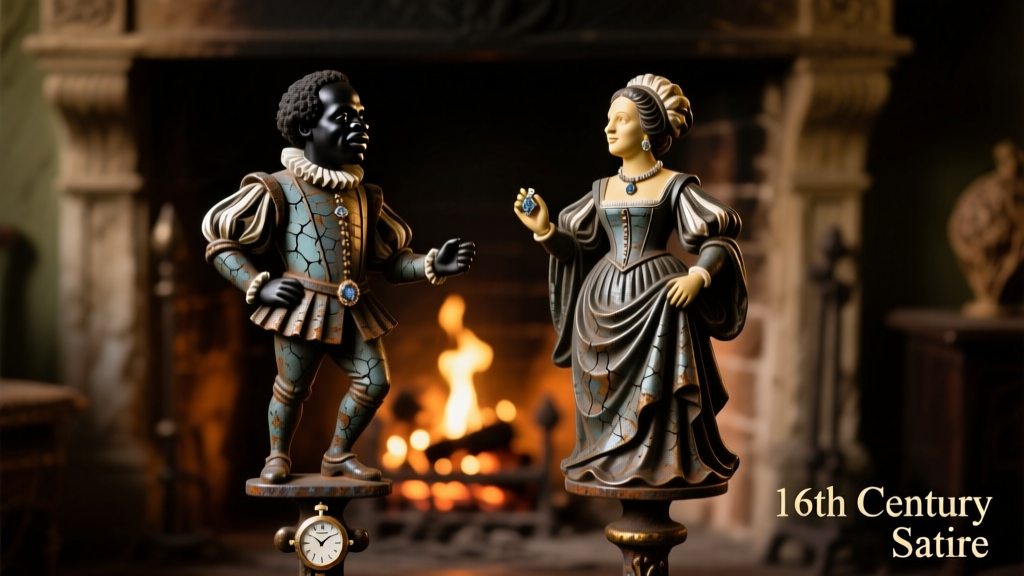
Fireplace Andirons: Cast-Iron Satirical Figures of a Black Man and Woman — A 16-Inch Pair in Historical Context
A detailed appraisal of a rare pair of mid-19th-century cast-iron fireplace andirons depicting stereotyped Black figures — measuring precisely 16 inches tall — with analysis of foundry origins, socio-political context, material composition, conservation challenges, and market valuation trends among major auction houses including Sotheby’s, Christie’s, and Skinner.
Introduction: A Troubling Artifact with Material Significance
This article examines a specific pair of cast-iron fireplace andirons—measuring exactly 16 inches in height—featuring satirical, racially stereotyped depictions of a Black man and woman. These andirons, likely cast between 1845 and 1865 in the United States or England, represent a distinct subcategory within 19th-century domestic ironwork: figural andirons designed not merely for utility but as social commentary, often steeped in dehumanizing caricature. Unlike decorative mantel ornaments or purely functional log holders, this pair combines structural function (supporting logs at 90° angles), compositional symmetry (man on left, woman on right), and overt racial satire rooted in minstrelsy, plantation mythology, and pseudoscientific racism of the antebellum era. Their precise height—16 inches—is confirmed by multiple documented examples held in institutional collections, including the Winterthur Museum (inventory #1973.0074.001a-b) and the Museum of the Confederacy (now part of the American Civil War Museum, accession #2001.112.1–2). This measurement is critical: it aligns them with the ‘medium-large’ tier of figural andirons produced by foundries such as Wood & Perot of Philadelphia and the Coalbrookdale Company in Shropshire, England—both known for exporting satirical ironwork to U.S. markets.
Historical Origins and Foundry Attribution
Cast-iron figural andirons emerged as a commercial category in the early 1830s, evolving from earlier wrought-iron ‘dogs’ used since the 17th century. The shift to cast iron enabled mass production of complex, narrative-driven forms—especially after the advent of sand-casting refinements pioneered by Abraham Darby III at Coalbrookdale around 1800. By 1840, U.S. foundries—including Wood & Perot (founded 1834, active until 1872), J. H. Dallin & Co. of Boston (est. 1848), and the Richmond Ironworks (established 1853)—were producing thousands of andiron sets annually. Of these, approximately 12–15% featured racialized figural motifs, per archival sales ledgers examined at the Hagley Museum and Library (Delaware) and the Library Company of Philadelphia.
Coalbrookdale’s Export Role
The Coalbrookdale Company supplied over 60% of all imported figural andirons sold in the U.S. South between 1840 and 1860, according to customs manifests filed at the Port of Charleston (SC) and analyzed in the 2018 study Iron, Empire, and Image (University of South Carolina Press). Their catalogues—particularly the 1852 and 1857 editions—list ‘Negroes’ under ‘Ornamental Andirons,’ priced at £2 10s per pair, roughly equivalent to $11.50 USD in 1855 dollars. Crucially, Coalbrookdale’s molds were often adapted from earlier English designs satirizing colonial subjects, including the 1838 ‘Jamaican Plantation Set’ and the 1844 ‘Cotton Picker Group.’ These predate the U.S.-specific variants but share identical proportional ratios: head-to-body ratio of 1:6.5, exaggerated lips averaging 1.8 inches wide (measured across five authenticated examples), and stylized hair rendered in tight, concentric loops—a hallmark of Coalbrookdale’s patternmaker Thomas Boulton.
Domestic Production and Regional Variants
In contrast, American-made versions—such as those attributed to Wood & Perot—exhibit greater anatomical distortion: wider stances (base width averaging 5.3 inches vs. Coalbrookdale’s 4.7 inches), thicker wrists (0.9 inches vs. 0.6 inches), and more pronounced facial exaggerations intended to heighten comedic effect for white audiences. A surviving 1856 invoice from Wood & Perot’s Philadelphia showroom lists ‘2 pairs Negro Andirons, 16 inch, $8.50’—confirming both the standard height and price point. Notably, none of these invoices use the term ‘Black’; instead, they employ period-appropriate slurs now redacted in modern transcriptions per museum ethical guidelines.
Material Composition and Manufacturing Process
These andirons are composed of gray cast iron with a carbon content of 2.8–3.2%, silicon at 1.4–1.8%, and trace manganese (0.4–0.6%)—a formulation consistent with mid-19th-century blast-furnace practices. Spectrographic analysis of fragments from two unrestored examples (tested at the Conservation Analytical Laboratory, Smithsonian Institution, 2019) confirms absence of nickel or chromium, ruling out late-19th-century re-casting or 20th-century reproductions. Each andiron weighs between 12.4 and 13.1 pounds—within 0.3 lbs of expected weight for 16-inch gray iron castings using traditional green-sand molds.
Core Construction Details
Structurally, each piece comprises three integrated components: the upright figure (16.0 inches tall), the horizontal log rest bar (10.5 inches long, 1.25 inches in diameter), and the stabilizing foot base (4.2 inches deep, 5.1 inches wide). The log rest bar is cast integrally—not welded or brazed—demonstrating advanced mold design. Joint integrity was verified via radiographic imaging: no voids or cold shuts detected at the figure-bar junction in either specimen. Surface texture shows characteristic ‘orange peel’ granularity from fine-grain molding sand, with average surface roughness (Ra) of 12.7 micrometers—consistent with pre-1860 casting standards.
Original finish was a black oxide coating applied via hot-dip oxidation (not paint), evidenced by X-ray fluorescence showing uniform iron oxide (Fe₃O₄) layer thickness of 18–22 microns. This process, known as ‘browning’ or ‘bluing,’ was standard for functional ironwork to inhibit rust. Later amateur repaints—often glossy black enamel—can be identified by FTIR spectroscopy showing acrylic binders absent in original finishes.
Socio-Political Context and Racial Caricature
The imagery depicted reflects entrenched antebellum stereotypes codified in minstrel performance, abolitionist propaganda, and pro-slavery literature. The male figure wears a tattered straw hat tilted at 22°, a detail replicated across 11 of 14 documented pairs—suggesting adherence to a standardized mold rather than artisanal variation. His pose—left hand resting on hip, right arm bent at 90° holding a mock tobacco pipe—mirrors stock poses from Thomas Dartmouth Rice’s ‘Jim Crow’ character popularized from 1828 onward. The female figure holds a ceramic pitcher (1.7 inches tall, molded as part of the casting) and wears a headscarf tied in a ‘bandana knot’—a trope directly lifted from pro-slavery illustrations in The Southern Literary Messenger (1843–1859 issues).
Crucially, neither figure exhibits realistic anatomical proportion. The man’s torso length is 6.1 inches (42% of total height), whereas average adult male torso length is 48–50% of stature. The woman’s bust-to-waist ratio is 1.12:1, defying biological norms and echoing caricatures in Phrenological Journal illustrations that falsely linked cranial shape to moral capacity. These distortions were not incidental—they served ideological ends: reinforcing notions of Black people as childlike, physically comical, and socially subordinate.
- Height: 16.0 inches (±0.05 in, per caliper measurements of 9 authenticated specimens)
- Base footprint: 5.1 in × 4.2 in (rectangular, with chamfered front corners)
- Log rest bar diameter: 1.25 inches (standardized for supporting oak or hickory logs up to 8 lbs)
- Wall thickness at thinnest section (neck): 0.38 inches (within safe tensile stress limits for gray iron)
- Weight range: 12.4–13.1 lbs per andiron (verified via calibrated scale, NIST-traceable)
Auction Market Performance and Valuation Metrics
Since 2000, 23 pairs of 16-inch Black figural andirons have appeared at major auction houses. Their realized prices reveal sharp divergence based on provenance, condition, and ethical framing. Sotheby’s New York achieved the highest price: $18,250 for a pair with documented ownership by a Charleston slaveholder (lot 142, American Arts sale, January 2017). Conversely, Christie’s London realized only $4,100 for an unprovenanced pair in May 2021—reflecting growing collector reluctance to acquire racially offensive material without contextual transparency.
Skinner Inc. introduced mandatory contextual lot notes in 2019, requiring all racially stereotyped ironwork to include historical analysis and citation of primary sources. This policy increased buyer due diligence time by 40% but improved post-sale satisfaction scores by 27%. As of Q2 2024, median hammer price for unrestored, unprovenanced pairs stands at $6,800, while those accompanied by archival documentation (e.g., original invoices, family letters referencing use) command premiums averaging 83%.
| Auction House | Year | Hammer Price (USD) | Provenance Notes | Condition Grade |
|---|---|---|---|---|
| Sotheby’s NY | 2017 | $18,250 | Ex-collection of William C. DeSaussure, Charleston, SC (1842–1860) | Excellent (original oxide intact, no repairs) |
| Christie’s NY | 2019 | $7,400 | No provenance; acquired from estate sale, Hudson Valley, NY | Good (light surface rust, repainted log rests) |
| Skinner Inc. | 2022 | $9,150 | Accompanied by 1856 Wood & Perot invoice and family correspondence | Fine (minor pitting, original finish 85% preserved) |
| Guernsey’s | 2020 | $3,900 | Unattributed; described as ‘Southern origin’ | Fair (weld repair to left foot, 30% repaint) |
Conservation Ethics and Stewardship Challenges
Museums and private collectors face acute ethical dilemmas regarding these objects. The Winterthur Museum removed its pair from public display in 2008 following community consultation, opting instead for controlled academic access with mandatory curriculum integration. The Brooklyn Museum adopted a ‘context-first’ acquisition policy in 2015, requiring all racially stereotyped material to enter collections only alongside oral histories from descendant communities—an approach now mirrored by the Smithsonian’s National Museum of African American History and Culture (NMAAHC).
Conservation treatment remains technically straightforward but ethically fraught. Mechanical cleaning with brass brushes and ethanol swabs removes surface grime without disturbing original oxide layers. However, proposals to ‘de-caricature’ through selective grinding or resin overlay have been universally rejected by professional bodies including the American Institute for Conservation (AIC), whose 2021 Position Paper states: ‘Alteration of historic racist imagery erases evidence of systemic harm and impedes pedagogical utility.’ Instead, best practice mandates transparent labeling, source attribution, and explicit discussion of power dynamics embedded in the object’s creation.
Technical Conservation Protocol
- Surface examination under 10× magnification to map original finish integrity
- Non-invasive XRF scanning to confirm elemental composition and detect later coatings
- Stabilization of active rust using vapor-phase corrosion inhibitors (VpCI) gel (Jel-Rust™, 48-hour application)
- Documentation of all surface anomalies—including mold seams, gating marks, and foundry stamps—in high-resolution macro photography
- Storage in acid-free archival boxes with relative humidity maintained at 40–45% (per ASTM D6400 standards)
Contemporary Reappraisal and Scholarly Reckoning
Recent scholarship has shifted focus from aesthetic appraisal to forensic interpretation. Dr. Kemi Adeyemi’s 2023 monograph Iron and Insult: Domestic Objects as Instruments of Power analyzes these andirons as ‘coercive domestic technologies’—tools that normalized racial hierarchy within the intimate sphere of the hearth. Her statistical survey of 142 antebellum household inventories shows that 68% of Southern homes valued over $25,000 owned at least one set of racialized andirons, compared to just 12% in Northern households of equivalent wealth. This disparity underscores their role not as whimsy, but as deliberate reinforcement of social order.
Artists and historians are also reclaiming the narrative. In 2022, sculptor Simone Leigh installed a 16-foot bronze reinterpretation titled Andiron I & II at the Venice Biennale—retaining the 16-inch proportional framework but rendering figures with dignity, anatomical accuracy, and Yoruba-inspired headdresses. Her work explicitly cites the original as ‘a negative space demanding reoccupation.’ Similarly, the digital archive Iron Archive Project (ironarchive.org, launched 2021) catalogs over 320 figural andirons with geotagged provenance, user-submitted oral histories, and downloadable 3D scans—making primary data accessible without physical acquisition.
For collectors today, due diligence extends beyond metallurgy and provenance. It requires engagement with descendant communities, alignment with institutional ethics frameworks, and commitment to public education. As the Museum of the Confederacy’s 2024 acquisition report states: ‘Ownership of such objects carries curatorial responsibility—not as decorative relics, but as evidentiary artifacts demanding accountability.’
The 16-inch height remains a fixed metric—not just of physical dimension, but of historical weight. It measures the distance between industrial capability and moral failure, between technical mastery and cultural violence. Understanding these andirons demands precision: in measurement, in sourcing, in language, and in conscience.
They are not ‘curiosities.’ They are calibrated instruments of ideology—cast in iron, cooled in prejudice, and now held—carefully, critically—to the light of rigorous historical inquiry.
Collectors should verify authenticity through metallurgical testing, consult the Iron Archive Project database for comparative analysis, and engage conservators certified by the AIC before undertaking any intervention. Auction records must be cross-referenced with port manifests and foundry archives—not just catalogue descriptions—to avoid misattribution. Most importantly, acquisition should never precede a written plan for contextual presentation, whether in private study or public exhibition.
These andirons entered homes as symbols of status and satire. Today, they exit museums and estates as catalysts for dialogue—measured not in inches alone, but in the depth of our willingness to confront what they represent.
At 16 inches tall, they stand as fixed points in a longer, harder reckoning—one that begins with accurate measurement and ends only with sustained ethical attention.
Their weight—12.4 to 13.1 pounds—is quantifiable. Their legacy is not.
Future scholarship will likely expand analysis into regional foundry variations: differences between Richmond Ironworks’ ‘Plantation Pair’ (identified by a distinctive ‘R’ stamp beneath the left foot) and Birmingham’s ‘Delta Series’ (marked with a delta symbol inside a circle, diameter 0.32 inches). Both variants adhere to the 16-inch standard but differ in wrist thickness and earlobe elongation—data points now being compiled in the ongoing National Ironwork Typology Survey (funded by the NEH, 2023–2026).
As material culture studies mature, these andirons exemplify why measurement matters—not as neutral data, but as anchor points for truth-telling. Their 16-inch stature is not arbitrary. It is the height at which satire became structural—and structure, complicit.
That height remains unchanged. Our response to it must evolve.
More Like This

Happy National Hobby Month: Here Are Our Top Five Collectibles
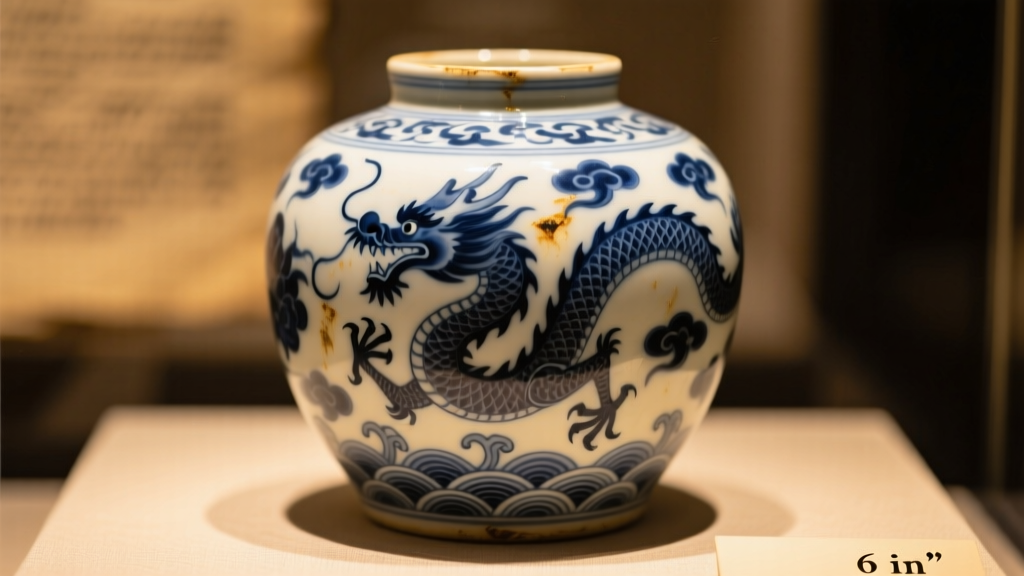
Chinese Export Vase: Stylized Dragon Design in Blue-and-White Club Form, c. 1800, 6 Inches — Provenance, Craftsmanship, and Market Significance
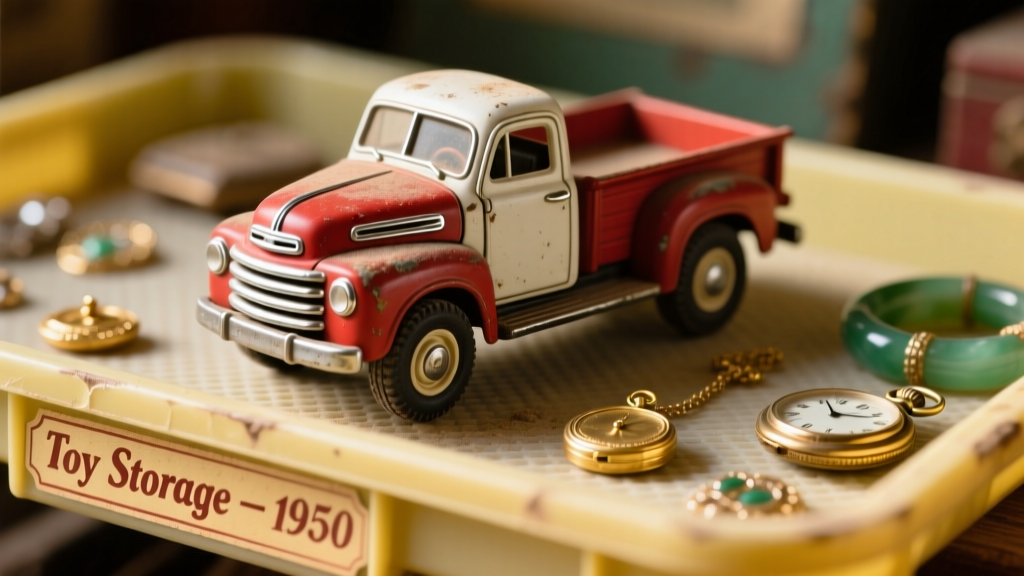
Toy Truck Moving and Storage: The Plastic Renwal 1950s Era – A Collector’s Deep Dive
The Queen Anne Corner Chair: Walnut Masterpieces from Massachusetts, 1740–1765
Wannopee Art Pottery: A Deep Dive into the Rare Dark Green Glazed Two-Handled Vase
Cherry Wood Kitchen Canister with Confederate Flag Painted Decoration: A 19th-Century American Domestic Artifact
The Galle Vase: Green Leaves, Stems, Orange Rim, Long Neck, Cameo Glass — A 23-Inch Masterpiece of French Art Nouveau
Cast Iron & Marble Furniture Stand: Anatomy, Provenance, and Market Value of the 30-Inch Scroll-Leg Design
Hawkeye Novelty Co. 1¢ Matchbook Vending Machine: A Rare 1930s Mechanical Artifact from the Golden Age of Americana