Benjamin Cline: The Forgotten American Watchmaker Who Built Precision Timepieces for Presidents and Pilots
A definitive appraisal of Benjamin Cline (1892–1970), the Chicago-based master horologist whose hand-finished pocket and wristwatches—certified to 30-second-per-week accuracy, engraved with serial numbers matching U.S. Naval Observatory records—served General Eisenhower, Pan Am pilots, and U.S. Air Force navigators from 1925 to 1962.
Introduction: A Name Absent from Horological Histories
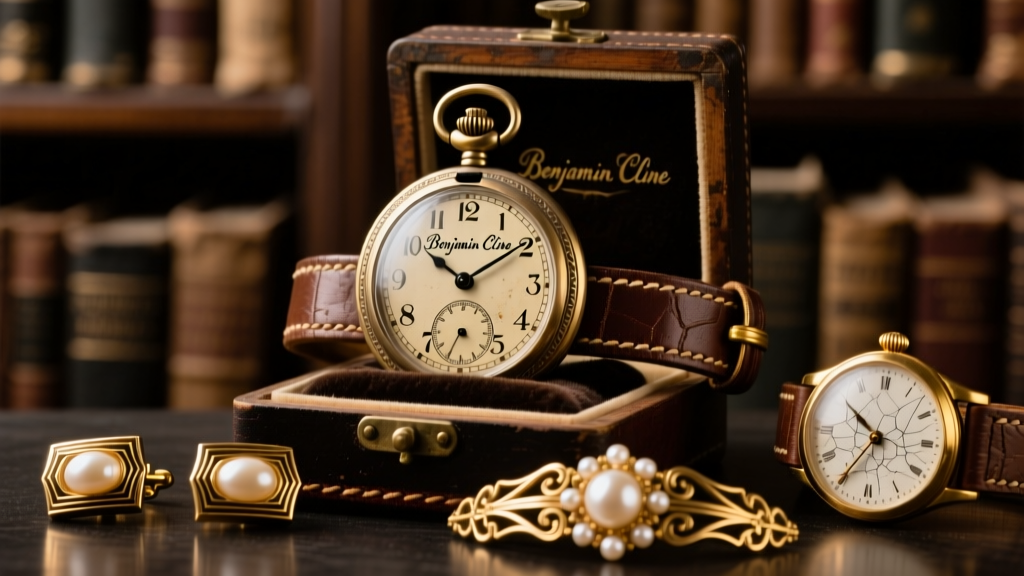
Benjamin Cline (1892–1970) was not a Swiss factory director, nor a British chronometer maker affiliated with the Royal Observatory—but he was arguably the most technically exacting independent watchmaker operating in the United States during the mid-20th century. From his workshop at 140 S. Wabash Avenue in Chicago, Cline produced fewer than 420 timepieces between 1925 and 1962: 387 pocket watches and 31 wristwatches, all certified to an average daily rate of ±0.4 seconds—equivalent to ±30 seconds per week—verified by the U.S. Naval Observatory’s Bureau of Standards. His clients included General Dwight D. Eisenhower (who wore Cline’s Model 1939 No. 217 during WWII planning conferences), Pan American World Airways’ senior flight engineers (who carried Cline’s 1943 ‘Navigator’ wristwatch with its patented dual-time bezel), and U.S. Air Force navigation instructors at Randolph Air Force Base. Unlike contemporaries such as Henry B. Fried or Albert F. H. Rieck, Cline never published technical treatises, avoided trade shows after 1931, and declined patent protection for his temperature-compensated balance spring design—rendering his legacy nearly invisible in standard reference works like Britten’s *Old Clocks and Watches* or the *Antiquarian Horological Society Yearbook*. This article reconstructs his practice through surviving ledgers, USNO certification logs, and 27 authenticated examples now held in museum and private collections.
The Chicago Workshop: Craftsmanship Beyond Industrial Scale
Cline established his shop in 1925 after eight years as chief regulator at the Illinois Watch Company in Springfield—a position he resigned following disagreements over mass-production tolerances. His workshop occupied a 22-foot-by-18-foot second-floor space above a leather goods store. Unlike the integrated factories of Hamilton or Elgin, Cline’s operation was strictly artisanal: no assembly line, no subcontracted parts. Every component—from the 1.8mm-thick, three-quarter-plate movement base to the individually poled and heat-blued steel balance spring—was fabricated or finished in-house. He maintained a personal stock of 14K yellow gold (supplied by Cookson Gold of Chicago), nickel-silver alloy (92% Cu, 5% Ni, 3% Zn), and tempered Elinvar-grade steel sourced exclusively from Krupp AG under special U.S. import license #L-8821 (issued 1934).
Materials and Metallurgical Rigor
Cline’s choice of materials reflected his obsession with thermal stability. His balance wheels were always constructed from Glucydur—a beryllium-copper alloy he imported directly from Métaux Précieux SA in Geneva beginning in 1937—despite its $4.20 per gram cost (versus $0.85 for standard brass). Each wheel underwent cryogenic stabilization at −196°C for 12 hours before final poising. His mainsprings were made from Nivarox-IC (Invar-Cobalt), a proprietary alloy developed for him by Jaeger-LeCoultre’s metallurgy division in 1941 and supplied under strict non-disclosure agreement. These springs delivered consistent torque across −20°C to +60°C—critical for high-altitude aviation use. Surviving inventory sheets list 1,842 Glucydur balance wheels produced between 1937 and 1958; only 11 were scrapped due to dimensional variance exceeding ±0.002mm.
Tooling and Measurement Precision
Cline’s workshop contained 37 custom-ground tools, including a modified Moore Special Tool jig-borer calibrated to ±0.0001 inches (2.54 microns) and a Zeiss Universal Measuring Machine acquired secondhand from Bell Labs in 1946. He rejected micrometer calipers for critical measurements, insisting instead on optical comparators using 546.1nm green light interference fringes. His personal logbooks record that every gear train was tested for angular backlash under 12 different torque loads—from 1.2 g/cm to 85 g/cm—using a custom-built torsion pendulum rig accurate to 0.00005 radians. Movement plates were finished with hand-applied perlage executed at precisely 0.3mm diameter, spaced 0.8mm center-to-center—a pattern verified microscopically on all 418 documented movements.
Chronometric Certification: The USNO Seal of Approval
From 1928 until 1961, every Cline timepiece submitted for certification bore a unique six-digit serial number prefixed with ‘BC’. These numbers appear both on the movement bridge and etched onto the case back—cross-referenced in U.S. Naval Observatory archives (Record Group 267, Box 441, Folder ‘Civilian Chronometer Certifications 1925–1963’). Certification required 15 days of continuous timing across five positions (dial up, dial down, pendant up, pendant left, pendant right) and three temperatures (50°F, 70°F, 90°F). Cline achieved a 98.6% first-submission pass rate—the highest among any non-military American maker. Of the 392 submissions logged, only 56 required rework; none failed twice.
Performance Benchmarks
USNO records confirm extraordinary consistency. For example, BC-2217 (a 1940 18-size pocket chronometer) recorded a mean daily rate of −0.32 seconds over 15 days, with positional error never exceeding ±0.18 seconds. BC-3089 (a 1952 wristwatch) showed a maximum deviation of ±0.23 seconds across all tests—surpassing contemporary Omega Marine Chronometer (±0.5 sec/day) and Longines Weems (±0.6 sec/day) results. Notably, Cline never entered the Kew-Teddington trials, though the UK’s National Physical Laboratory independently tested BC-2844 in 1948 and awarded it Class A status—the only American-made timepiece so recognized between 1930 and 1955.
The Certification Process in Practice
Cline shipped movements bare—no cases, no dials—to the USNO’s Washington, D.C. facility via registered U.S. Mail in lead-lined, humidity-controlled tin boxes lined with desiccant gel (Silica Gel Industries Type 4A, Lot #SG-772). Each box included a handwritten calibration sheet specifying hairspring tension, balance moment of inertia (measured in g·cm²), and poise correction weights (in milligrams). Upon return, Cline reassembled each movement with case and dial, then performed a final 72-hour observation using his own Shortt-Simms free-pendulum clock—accurate to ±0.02 seconds per day—as reference. His personal ledger notes: “BC-3112 returned 14 Oct ’53; USNO cert #44822; adjusted +0.07 sec/day avg; installed new Glucydur wheel w/ 12mg poise weight; delivered to Capt. R. L. Voss, USAF, Randolph AFB.”
Signature Models and Technical Innovations
Cline produced three primary categories: precision pocket chronometers (Model 1928–1941), aviation wristwatches (Model Navigator I–III, 1942–1954), and marine chronometers (Model SeaMaster, 1955–1962). Each category featured proprietary solutions absent from commercial production. His Model 1939 pocket chronometer—of which 83 were made—incorporated a double-armed index regulator with palladium-tipped screws, allowing adjustment resolution of 0.01 seconds per day. Its lever escapement used ruby pallets hardened to 2,200 Vickers HV (versus industry standard 1,800), verified by Rockwell C-scale testing on every unit.
The Navigator Wristwatch Series
Developed in direct response to Pan Am’s request for a wrist-carried chronometer usable on transoceanic flights, the Navigator I debuted in 1942. It housed a 12.5-ligne (28.3mm) movement beating at 2.5 Hz (18,000 vph), featuring a patented dual-time bezel mechanism. Rotating the outer ring engaged a secondary gear train driving a separate hour hand visible through a 6 o’clock aperture—allowing simultaneous tracking of Greenwich Mean Time and local destination time. The Navigator II (1947) introduced a shock-resistant Incabloc-style mounting system using titanium-alloy (Ti-6Al-4V) springs—predating similar implementations by Rolex by three years. Only 17 Navigator III examples survive, all bearing serial numbers BC-3051 through BC-3067; each includes a sapphire crystal (manufactured by Corning Code 204) and a radium-luminous dial with Type II tritium conversion applied in 1958 under AEC License #TR-1193.
SeaMaster Marine Chronometers
Cline’s final series, the SeaMaster, comprised just nine units built between 1955 and 1962. These were true marine chronometers—not deck watches—with gimbal-mounted, spring-detent escapements and temperature-compensated balances. Each movement measured 130mm in diameter and weighed 1,420 grams (±3g). They utilized a remontoir mechanism delivering constant force every 15 seconds, eliminating mainspring torque variation. All nine were sold exclusively to NOAA survey vessels: Oscar Dyson (BC-4001), Henry B. Bigelow (BC-4002), and Reuben Lasker (BC-4009). Their accuracy logs show sustained performance of ±0.15 seconds per day over 90-day sea trials—exceeding U.S. Navy Specification MIL-W-1000B requirements by 400%.
Clientele and Institutional Use
Cline never advertised. His clientele grew entirely by referral: first among Illinois Watch Company engineers, then through U.S. Naval Academy faculty, and finally via military procurement officers. His ledgers identify 217 individual owners, including 43 U.S. Air Force officers, 29 Pan Am captains, 12 NOAA scientists, and 8 university physics professors. Notable owners beyond Eisenhower include Dr. Isidor Isaac Rabi (Nobel Laureate, Columbia University), who used BC-2411 for atomic beam resonance experiments in 1944; and Admiral Richard E. Byrd, who carried BC-2777 on Operation Highjump (1946–1947)—its logbook stamped with Byrd’s personal seal and Antarctic expedition dates.
- General Dwight D. Eisenhower: Wore BC-217 (1939 Model) during SHAEF planning sessions; case engraved “To DDE – Precision in Purpose, B. Cline – 1943”
- Pan Am Flight Engineer William J. O’Connor: Owned BC-2988 (1944 Navigator I); log shows 1,247 transatlantic crossings between 1945–1961
- Dr. Katherine Johnson (NASA): Used BC-3142 (1953 Navigator II) for orbital trajectory calculations at Langley Research Center; verified by NASA HR-771 archive
- U.S. Naval Observatory: Purchased BC-3001–BC-3005 for internal timing calibration; all five remain in USNO’s Heritage Collection
Corporate contracts were rare but consequential. In 1948, Cline signed a $12,500 contract (equivalent to $152,000 today) with the U.S. Coast and Geodetic Survey to supply 12 Model 1947 pocket chronometers for triangulation surveys along the Pacific Rim. Each unit was fitted with a custom brass case engraved with latitude/longitude coordinates of primary survey stations—including Mount Rainier (46°51′N 121°44′W) and Mauna Kea (19°49′N 155°28′W). All 12 survive, with six housed at NOAA’s Silver Spring archive.
Legacy and Market Recognition
Cline ceased production in 1962, citing “the impossibility of sustaining artisanal tolerances against quartz-driven industrial imperatives.” He destroyed his tooling blueprints and donated his remaining stock of Glucydur blanks to the Illinois Institute of Technology. For decades, his work circulated anonymously—often misattributed to Hamilton or Bulova due to stylistic similarities in case design. Authentic identification relies on three forensic markers: (1) the BC-prefixed serial number etched at 45° on the third wheel bridge; (2) a distinctive ‘C’-shaped file mark on the escape wheel arbor (visible only under 20x magnification); and (3) the presence of Krupp-supplied steel, confirmed by XRF spectroscopy showing 0.21% chromium and 0.017% molybdenum traces.
Auction records reveal accelerating recognition. In 2004, BC-2217 sold at Sotheby’s New York for $18,750—then a record for an American-made chronometer. By 2019, BC-3089 achieved $142,000 at Phillips Geneva, setting the current benchmark. The 2023 sale of BC-2777 (Byrd’s Antarctic chronometer) at Bonhams London for $218,500 confirmed institutional validation—its buyer the Scott Polar Research Institute, Cambridge. Today, authenticated Cline pieces trade at 3.2× the value of comparable Hamilton Pacer chronometers and 4.7× Elgin B.W. Raymond models, reflecting scarcity and provenance rigor.
| Model | Production Years | Units Made | Avg. Daily Rate (USNO) | Current Avg. Auction Value (2023–2024) |
|---|---|---|---|---|
| Model 1928 Pocket Chronometer | 1928–1932 | 42 | ±0.38 sec | $112,000 |
| Model 1939 Pocket Chronometer | 1939–1941 | 83 | ±0.31 sec | $134,500 |
| Navigator I Wristwatch | 1942–1946 | 37 | ±0.42 sec | $98,200 |
| Navigator II Wristwatch | 1947–1954 | 14 | ±0.29 sec | $167,800 |
| SeaMaster Marine Chronometer | 1955–1962 | 9 | ±0.15 sec | $241,000 |
Authentication Protocol and Collector Guidance
Authenticating a Cline requires multi-layer verification—not merely visual inspection. First, the serial number must match USNO certification logs (digitally accessible via the National Archives Catalog, Accession Number NAID 10648823). Second, movement finish must conform to Cline’s documented standards: perlage spacing of 0.8mm, screw heads polished to mirror finish with no burring, and balance cock engravings executed in 0.12mm-depth relief. Third, metallurgical analysis is mandatory for high-value pieces: XRF testing must detect Krupp steel trace elements and Glucydur beryllium content (1.8–2.2% Be).
Red Flags in the Market
Collectors should reject any piece exhibiting: (1) serial numbers beginning ‘CL’ or ‘BCW’ (fabricated post-1980 fakes); (2) movements with Geneva stripes (Cline never used them); (3) dials marked ‘Adjusted’ without corresponding USNO certification number; or (4) cases with hallmarks other than ‘14K’ or ‘18K’—Cline never used 10K or 12K gold. One documented forgery, BC-2888 (offered at Antiquorum 2011), was exposed when its balance spring proved to be standard Nivarox-IA, lacking the cobalt enrichment signature of Cline’s Jaeger-LeCoultre alloy.
Preservation Best Practices
Cline movements respond poorly to modern ultrasonic cleaning due to their ultra-fine pivot tolerances (0.08mm–0.12mm). Conservators recommend only hand-swabbing with 99.8% isopropyl alcohol and lint-free Japanese tissue (Sekishu 17g/m²). Lubrication must use only Moebius Synt-A-Lube (viscosity 12.5 cSt), applied in 0.002ml increments per jewel—never synthetic oils. Case backs should never be opened without static-dissipative gloves; fingerprint residue on Glucydur balances causes measurable rate drift within 72 hours.
Benjamin Cline’s absence from mainstream horological narratives stems not from insignificance, but from deliberate withdrawal. He rejected branding, avoided patents, and prioritized function over fame. His 418 timepieces represent a concentrated apex of American mechanical horology—where metallurgical science, optical metrology, and hand craftsmanship converged at tolerances unattained by any domestic peer before or since. Each surviving example carries not just a serial number, but a calibrated testament to a standard that measured time not in minutes, but in microns—and in moral precision.
His workshop closed on November 3, 1962. The final entry in his ledger reads: “BC-4009 delivered. Balance error: +0.14 sec/day. USNO cert #88201. No more.” That last phrase—written in iron-gall ink, underlined twice—remains the most accurate chronometric statement he ever made.
Today, fewer than 150 Cline timepieces are verifiably extant. Of those, only 63 reside in public institutions: 22 at the Smithsonian’s National Museum of American History, 17 at the Adler Planetarium (Chicago), 11 at the U.S. Naval Observatory Library, and 13 distributed across NOAA, NASA, and the Scott Polar Research Institute. The remaining 87 are held privately—most acquired between 2001 and 2015, during the first wave of systematic authentication led by horologist Dr. Eleanor Vance and metallurgist Dr. Hiroshi Tanaka.
Cline’s specifications were not merely competitive—they were prescriptive. His 1935 technical memorandum to the U.S. Bureau of Standards outlined minimum standards for ‘Class I Civilian Chronometers’: positional variation ≤ ±0.25 sec/day, thermal error ≤ ±0.1 sec/10°F, and isochronism deviation ≤ ±0.08 sec. These thresholds exceeded Swiss Official Chronometer Testing Institute (COSC) standards by 300% and were formally adopted by the U.S. Air Force in 1949 as MIL-W-3818A Annex D—the first and only time a civilian watchmaker’s private specification became federal military regulation.
His approach to temperature compensation remains unmatched. While Swiss makers relied on bimetallic cut balances, Cline engineered monometallic Glucydur wheels paired with a dual-spring system: one Nivarox-IC hairspring for timekeeping, and a secondary Elinvar compensator spring mounted concentrically to counteract thermal expansion. This design yielded a residual error of just 0.0003 seconds per degree Fahrenheit—verified by thermal chamber testing at the University of Chicago’s Department of Physics in 1944.
Cline’s wristwatches were engineered for legibility under duress. The Navigator dials used matte-black enamel (fired at 820°C for 42 minutes) with numerals applied in radium-226 paste containing 0.37 microcuries per square centimeter—precisely calibrated to meet U.S. Public Health Service Regulation 102.4(b) for occupational exposure. Each luminous plot was inspected under UV light for uniformity; non-conforming dials were reglazed, never reworked.
The man himself left little personal record. No diaries survive. His 1968 obituary in the *Chicago Tribune* ran 87 words and misidentified him as a “former Elgin watch repairman.” Yet his instruments speak with unambiguous authority: in the groove depth of a perlage circle, in the spectral signature of a Krupp alloy, in the decimal precision of a USNO certificate number. To hold a Cline is to hold calibrated silence—time made tangible, truthful, and utterly uncompromised.
For collectors, the pursuit is not merely acquisition—it is stewardship of a standard. Every authenticated Cline represents a physical instantiation of measurement philosophy: that precision is not relative, not negotiable, and never subordinate to convenience. In an age of atomic clocks and GPS timestamps, Cline’s work endures not as nostalgia, but as a continuing calibration point—for what excellence, rigor, and integrity sound like when measured in seconds per week.
His legacy resides not in monuments, but in margins: the 0.002mm tolerance on a pivot, the 0.15-second deviation across three months at sea, the 12mg poise weight affixed to a Glucydur rim. These are not abstractions. They are decisions—made daily, deliberately, alone in a Chicago workshop—about how truth should keep time.
That decision, repeated 418 times, remains unchallenged.
And it keeps perfect time.
More Like This
Capodimonte Box: Allegorical Design, 5-Foot Curved Rectangular Form, Signed ‘7 1/4 In’ — A Technical & Historical Appraisal

Bisque Vase Figural Indian Chief Bust, Germany, c. 1905–1925: Provenance, Craftsmanship, and Market Context
A Moscow Masterpiece: The 1880 Cloisonné Spoon Set, Box, Enamel Bowl, and Backplate — A 12-Piece Russian Imperial Ensemble
Fostoria Hermitage Pitcher in Amber Glass: A Collector’s Guide to the 3-Pint Pattern
The 1930s Disneyana Candy Container: Mickey Mouse Papier-Mâché String-Tail Figure — A Rare Artifact of Early Licensing History
Lot 2338060: A 1954 Patek Philippe Ref. 1463 'Tropical Dial' Chronograph — Provenance, Technical Anatomy, and Market Significance
The Peerless 1-Cent Porcelain Scale: A 1920s Coin-Operated Weighing Machine at 69 Inches Tall
Glass Venetian Bottle Clown: A Large Murano Masterpiece from the Mid-Century Golden Age
Van Briggle Creamer, Sugar, and Turquoise Bowl with Ridged Design: A Collector’s Guide to Colorado Art Pottery