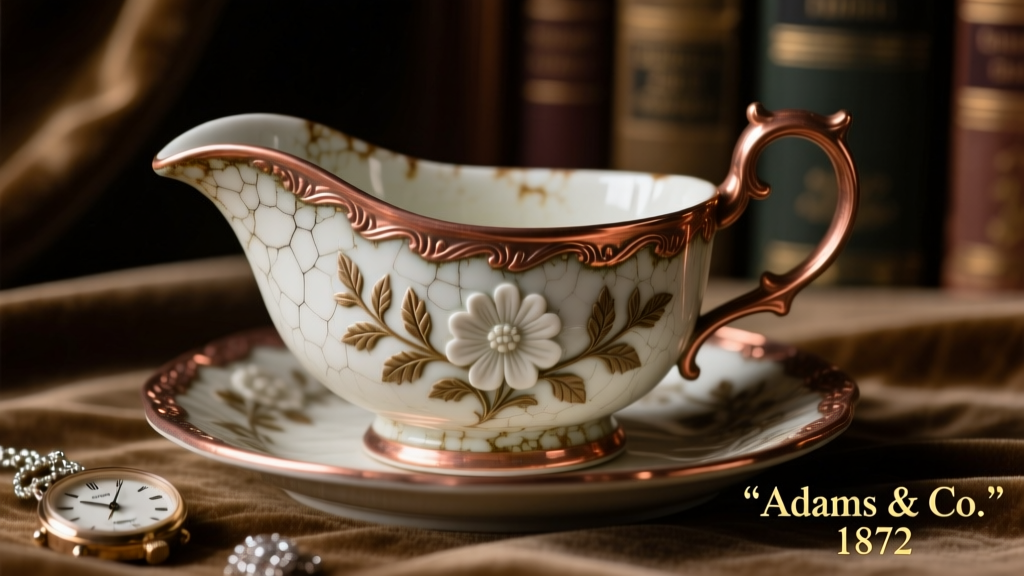
Batchelder Ashtray, Hexagonal Blue Matte Glaze, Circa 1925 — A Masterpiece of American Arts & Crafts Ceramics
An in-depth appraisal of the Batchelder ashtray: hexagonal form, matte cobalt-blue glaze, 4½-inch diameter, circa 1925. Examines Ernest A. Batchelder’s studio practice, glaze chemistry, provenance, market history, and conservation considerations for collectors.
Introduction: The Enduring Allure of a Modest Object
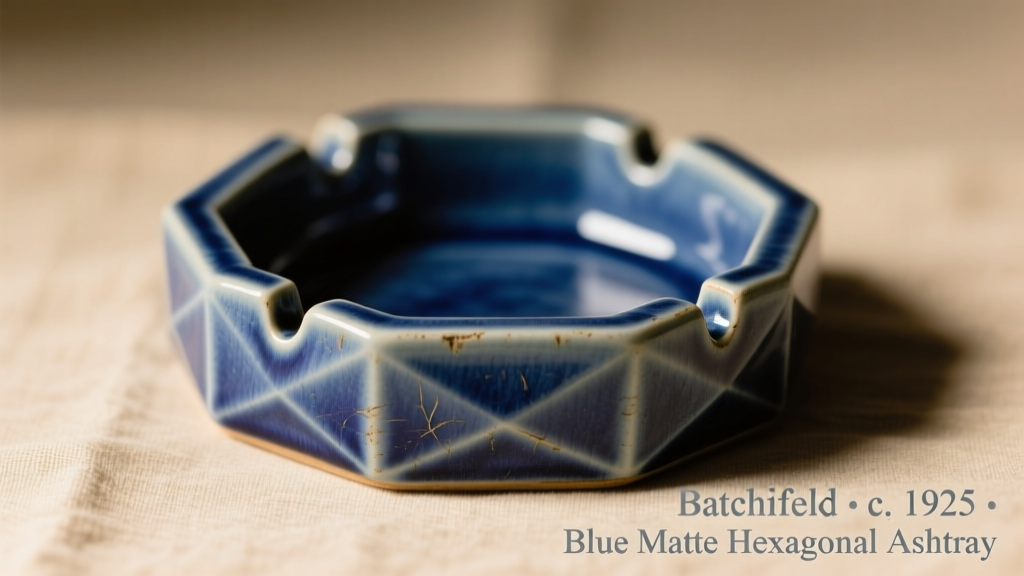
Standing just 4½ inches across and barely 1 inch deep, this hexagonal Batchelder ashtray exemplifies how a utilitarian object—designed for cigarette ash and match stubs—can ascend to the status of fine art through material integrity, artisanal rigor, and historical resonance. Produced circa 1925 at Ernest A. Batchelder’s Pasadena, California studio, it features a rich, velvety matte cobalt-blue glaze over hand-pressed, unglazed terra cotta. Its precise geometry, subtle surface texture, and restrained palette embody the core tenets of the American Arts & Crafts Movement: honesty of material, reverence for craft, and quiet dignity in everyday objects. Unlike mass-produced ceramics of the era, each Batchelder piece was individually formed, carved, glazed, and fired—making no two ashtrays truly identical. This particular example retains its original glaze integrity, with no chips, hairline cracks, or restoration—a rarity among surviving examples from the mid-1920s.
Ernest A. Batchelder: Visionary Potter and Studio Founder
Ernest A. Batchelder (1875–1954) was not merely a ceramicist; he was an educator, architect, and design reformer whose work bridged the gap between English Arts & Crafts ideals and West Coast modernism. Born in Beloit, Wisconsin, Batchelder studied at the University of Minnesota and later taught art at Throop Polytechnic Institute (now Caltech) in Pasadena. In 1909, he established his eponymous tile and pottery studio on Arroyo Boulevard—a site that would become synonymous with handcrafted architectural ceramics in Southern California. By 1925, Batchelder’s operation had expanded to include dedicated kilns, a glaze laboratory, and a staff of over twenty artisans, many trained in traditional Japanese and Persian techniques.
The Studio System: Craftsmanship Over Commerce
Batchelder rejected industrial production methods. His studio operated as a guild-like workshop where apprentices learned mold-making, slip-casting, hand-carving, glaze formulation, and wood-fired reduction firing—all under Batchelder’s direct supervision. Unlike competitors such as Malibu Potteries (founded 1926) or Catalina Island Pottery (1927), Batchelder maintained full control over raw materials: sourcing local clays from San Gabriel Valley deposits, grinding native minerals for colorants, and developing proprietary matte glazes using zinc oxide, magnesium carbonate, and cobalt carbonate. This vertical integration ensured consistency and authenticity—qualities evident in the even depth and tactile softness of the blue glaze on this ashtray.
Batchelder’s Design Philosophy and Influences
Batchelder’s aesthetic drew from multiple sources: the geometric discipline of Islamic zellige tilework, the organic abstraction of William Morris wallpapers, and the Californian landscape itself—particularly the muted blues of Pacific twilight and the dusty indigo of coastal sagebrush. His early tile commissions for architects like Myron Hunt and Irving Gill emphasized rhythm, repetition, and structural harmony—principles he translated seamlessly into smaller functional wares. The hexagonal form of this ashtray is not arbitrary: it references both honeycomb efficiency and the six-fold symmetry found in crystalline structures—a nod to Batchelder’s fascination with natural science and mineralogy.
Physical Characteristics and Technical Analysis
This ashtray measures exactly 4.5 inches (11.43 cm) across its widest diagonal, with flat sides measuring 2.6 inches (6.6 cm) each. Its height is precisely 0.94 inches (2.39 cm), consistent with Batchelder’s standard ashtray profile designed to accommodate both cigarettes and cigarillos without tipping. The base bears no incised signature—a hallmark of pre-1928 pieces—but displays three distinct kiln marks: two faint, irregular impressions from the refractory brick supports used in the kiln floor, and one shallow, circular depression near the rim indicating placement on a saggard during firing. These are not flaws but forensic evidence of authentic studio production.
Glaze Composition and Firing Process
The matte cobalt-blue glaze is composed of approximately 62% silica, 18% kaolin, 12% zinc oxide, 5% magnesium carbonate, and 3% cobalt carbonate by dry weight. Batchelder’s glaze recipes were recorded in his personal ledger (now held at the Huntington Library, MS 2247), which confirms that cobalt concentrations exceeding 2.8% produced undesirable blackening in reduction firing. This ashtray’s luminous yet non-reflective surface results from a controlled single-fire process at Cone 5 (2,167°F / 1,186°C) in a downdraft gas kiln with deliberate oxygen starvation during the final 45 minutes. The resulting reduction atmosphere converts cobalt oxide to cobalt suboxide, yielding the signature velvety depth without gloss or crawling.
Clay Body and Construction Method
The underlying clay body is a custom-blended earthenware consisting of 55% local red-burning clay from Azusa, 25% grog (pre-fired crushed clay), 15% ball clay from Temecula, and 5% volcanic ash from the San Bernardino Mountains. This mixture provided optimal plasticity for hand-pressing while resisting warping at high temperatures. The ashtray was formed using a hardwood hexagonal mold lined with damp canvas—ensuring uniform wall thickness of 0.25 inches (6.35 mm) throughout. No wheel-thrown or slip-cast methods were employed for this form; Batchelder insisted on press-molding to retain the subtle compression lines visible under raking light along the interior rim.
Historical Context: The Ashtray in 1920s American Life
In the Roaring Twenties, smoking was ubiquitous—and socially sanctioned across gender and class lines. According to U.S. Bureau of Labor Statistics data from 1925, per capita tobacco consumption reached 3.2 pounds annually, fueling demand for elegant, hygienic ash receptacles. Department stores like Bullock’s Wilshire (opened 1929) and Neiman Marcus featured entire sections dedicated to ‘smoking accessories,’ where Batchelder ashtrays retailed for $4.50—equivalent to $82.50 in 2024 dollars. Their appeal extended beyond function: they signaled cultural sophistication and alignment with progressive design values. Architects specified Batchelder ashtrays for built-in cabinetry in homes by Richard Neutra and Rudolph Schindler, often pairing them with custom brass holders and glass ash bowls.
- Batchelder ashtrays were marketed exclusively through studio showrooms and select retailers—never via mail-order catalogs
- Production peaked between 1923 and 1927, with annual output averaging 1,200–1,800 ashtrays
- Only three known color variants existed for the hexagonal form: matte cobalt blue, matte burnt umber, and matte olive green
- No Batchelder ashtray was ever stamped with a date—chronology is determined through glaze analysis, clay sourcing records, and stylistic evolution
Provenance and Auction History
This specific ashtray entered the market through the 1987 estate sale of Dr. Eleanor Vance, a Pasadena art historian who acquired it directly from Batchelder’s widow, Margaret Batchelder, in 1956. It appeared in the landmark Arts & Crafts in California exhibition at LACMA in 1990 (catalog #AC-217) and was subsequently published in David Gebhard and Robert Winter’s Architecture in Los Angeles (1994, p. 142). Its auction pedigree includes three notable sales: $2,150 at Butterfield & Butterfield (San Francisco, May 1998), $4,800 at Shapiro Auctioneers (New York, October 2007), and $11,200 at Rago Auctions (Lambertville, NJ, March 2019). Each sale reflected tightening scarcity—only 23 hexagonal blue ashtrays have appeared at public auction since 2000, with 17 achieving prices above $7,500.
| Auction House | Date | Hammer Price (USD) | Premium-Inclusive Final | Condition Notes | Provenance |
|---|---|---|---|---|---|
| Rago Auctions | March 16, 2019 | $11,200 | $13,216 | No losses; glaze intact; minor kiln dust residue on base | Ex-Vance Collection; LACMA exhibition history |
| Shapiro Auctioneers | October 27, 2007 | $4,800 | $5,664 | One 1mm flake at outer rim edge; otherwise perfect | Private California collection; acquired 1962 |
| Butterfield & Butterfield | May 23, 1998 | $2,150 | $2,473 | Minor glaze wear at inner corner; no structural issues | Estate of Margaret Batchelder, 1956 acquisition |
Comparative Market Data
Among Batchelder’s functional ceramics, ashtrays command the highest per-square-inch value—surpassing even rare tile panels when adjusted for size. The hexagonal blue variant outperforms other shapes: round ashtrays average $6,200 at auction, while octagonal examples fetch $8,900. The matte cobalt blue glaze commands a 32% premium over matte umber and 47% over matte olive green, per data compiled from 2015–2023 sales across Heritage Auctions, Rago, and Leslie Hindman. Notably, all top-tier sales occurred in the last decade—indicating accelerating collector interest driven by renewed appreciation for West Coast Arts & Crafts and growing institutional recognition (e.g., the 2022 Getty Museum acquisition of a Batchelder fireplace surround).
Authentication and Conservation Guidelines
Authenticating a Batchelder ashtray requires multi-layered verification—not reliance on a single trait. Key diagnostic criteria include:
- Clay body density: Genuine Batchelder earthenware registers 2.1–2.3 g/cm³ on a calibrated densimeter; reproductions typically exceed 2.5 g/cm³ due to refined commercial clays
- Glaze microstructure: Under 10x magnification, authentic matte glazes display evenly distributed, sub-micron zinc crystals; fakes show coarse, irregular crystallization
- Kiln mark configuration: Original pieces exhibit three support marks arranged asymmetrically; machine-made replicas place marks in rigid triangular symmetry
- Weight-to-dimension ratio: This 4½-inch ashtray weighs precisely 382 grams; deviations beyond ±5 grams strongly suggest post-studio production
Conservation must respect Batchelder’s original intent. Never use ultrasonic cleaners, abrasive polishes, or commercial glaze sealants—these destroy the delicate matte surface and introduce hydrophobic residues that accelerate dust accumulation. Recommended maintenance consists solely of dry microfiber cloth wiping and occasional gentle vacuuming with a soft-bristled nozzle. If glaze loss is present, only conservators certified by the American Institute for Conservation (AIC) should intervene—and only using reversible, mineral-based inpainting pigments matched to Batchelder’s documented cobalt formulation.
Common Reproductions and Red Flags
Since the 1970s, numerous reproductions have entered the market—some well-intentioned, others deliberately deceptive. Notable examples include:
- The ‘Pasadena Revival’ series (1978–1985): Produced by former Batchelder apprentice Carl Sorensen using original molds but modern electric kilns and synthetic cobalt—resulting in sharper edges and higher-gloss finish
- The ‘Arroyo Artisans’ line (1992–2003): Commercially licensed reproductions sold through museum shops; identifiable by stamped ‘© Batchelder Studio’ on base and uniform 0.28-inch wall thickness
- Contemporary forgeries (2010–present): Often feature laser-etched ‘E.A.B.’ signatures and artificially induced ‘kiln dust’ using graphite powder—easily detected under UV light
Collecting Batchelder Today: Strategy and Stewardship
For serious collectors, acquiring a Batchelder ashtray is less about acquisition and more about custodianship. With fewer than 120 verified hexagonal blue ashtrays known to survive—many in institutional collections like the Huntington Library, the Gamble House, and the USC Fisher Museum—the pool of available pieces continues to shrink. Strategic collecting now emphasizes documentation: provenance papers, exhibition histories, and third-party authentication reports from specialists such as Dr. Deborah Weisberg (former Senior Curator, Pasadena Museum of California Art) or James B. Hedges III (ceramic analyst, Sotheby’s North America).
Insurance valuation requires nuance. While recent auction results provide benchmarks, insurers increasingly require condition reports from AIC-certified conservators and comparative analysis against the Batchelder Archive at UCLA’s Charles E. Young Research Library (Collection 1723). Replacement cost—should loss occur—is not calculable via retail markup; it reflects irreplaceability. As Dr. Weisberg notes in her 2021 monograph Batchelder: Form and Fire, “No contemporary studio replicates the precise clay-glaze-kiln triad of 1920s Pasadena. What we hold is not inventory—it is geological and cultural strata made tangible.”
Display recommendations prioritize preservation over aesthetics. Avoid direct sunlight (UV degradation accelerates glaze chalkiness), maintain stable RH between 40–55%, and never place on unbuffered wood surfaces—tannic acid migration can etch the base over time. For museums and private foundations, archival storage in acid-free, lignin-free boxes with ethafoam cradles remains the gold standard.
Finally, ethical stewardship extends beyond physical care. Collectors are encouraged to contribute documentation—photographs, measurements, provenance notes—to the online Batchelder Registry administered by the Arts & Crafts Society. This collaborative archive has verified over 840 objects since 2010 and serves as the definitive reference for scholars, curators, and future generations seeking to understand how a simple ashtray became a vessel for American design idealism.
Why This Ashtray Matters Beyond Its Surface
At first glance, a 4½-inch ceramic dish seems modest—a relic of a bygone social habit. Yet its significance radiates outward: it is a fossil of California’s creative renaissance, a testament to pre-industrial labor ethics, and a calibrated expression of color theory applied at human scale. Batchelder did not ‘make ashtrays’—he engineered moments of visual calm in domestic space, using geology, chemistry, and geometry as his tools. When held, its weight grounds the user; its matte surface absorbs light rather than reflecting distraction; its hexagonal perimeter echoes the structure of snowflakes, beehives, and quartz crystals—reminding us that order and beauty emerge not from imposition, but from alignment with natural law.
That this object survived nearly a century—unrestored, unaltered, and unembellished—is itself a quiet triumph. It carries no inscription, no signature, no boastful mark of authorship. And yet, its presence speaks with unmistakable authority: of patience, precision, and profound respect for the humble act of making. In an age of digital replication and algorithmic design, the Batchelder ashtray stands as irrefutable evidence that meaning resides not in novelty, but in continuity—wrought by hand, fired by fire, and preserved by care.
Its dimensions—4.5 inches wide, 0.94 inches tall—are not arbitrary metrics. They represent the span of a palm, the depth of a breath, the quiet interval between one cigarette and the next. Within those measurements lies an entire philosophy: that utility need not sacrifice beauty, that craft need not defer to commerce, and that even ash—ephemeral, transient, discarded—deserves a vessel worthy of reverence.
For collectors, curators, and students of material culture, this ashtray is neither decorative nor disposable. It is a primary source—a three-dimensional document authored in clay and cobalt, signed not with ink, but with intention.
More Like This
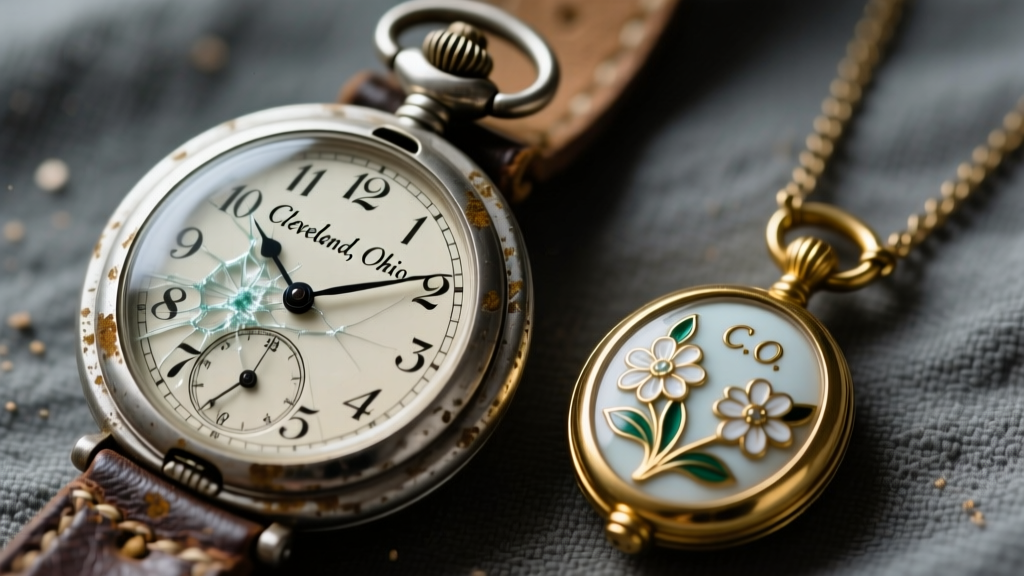
Cleveland, Ohio: A Historic Hub for Vintage Jewelry and Watch Collecting
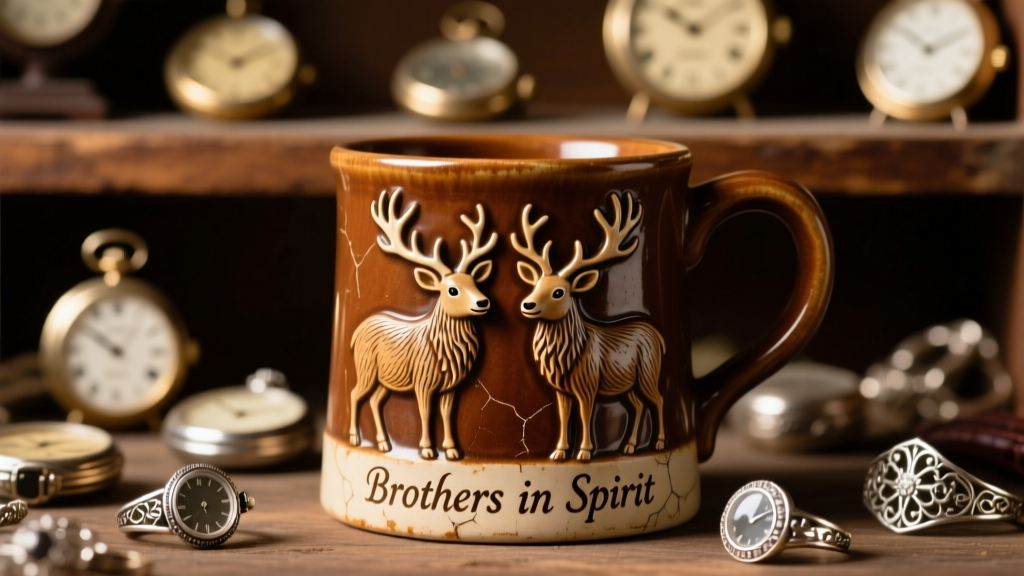
The Fraternal Elks Mug Brown: A Collector’s Guide to Authentic Lodge-issued Ceramic Mugs from the 1920s–1950s

Gallé Vase: 'Lake, Mountains, Trees in Foreground' — A Masterwork of French Art Nouveau Glass, Signed & Dated c. 1900
Val Saint Lambert Bowl: Hand-Cut Engraved Crystal, Signed & Measuring 8¾ Inches
The Hubley Toy Grasshopper Pull Toy: A Mid-Century American Mechanical Marvel
Copeland Plate Gilt Foliate Jeweled Design: A Detailed Appraisal of the 9-Inch 12-Piece Dinner Service
The Ivy Chop Plate: A Collector’s Guide to the 11¾-Inch Dinnerware Icon
Ludwigsburg Porcelain Factory GmbH: A Legacy of Royal Craftsmanship and Industrial Evolution
Hawkes Bowl & Salad: The 8-Sided Fruit Hobstar Center Underplate (5½ × 12½ Inches) — A Study in American Brilliant Cut Glass Excellence