Rye Straw Baskets with Bentwood Handles: Craftsmanship, Provenance, and Collectibility in Vintage Domestic Objects
An expert examination of 19th- and early 20th-century rye straw baskets featuring bentwood handles—covering materials science, regional production centers (especially Thuringia and Bavaria), maker marks, structural integrity assessment, auction performance data, and conservation protocols for collectors and curators.
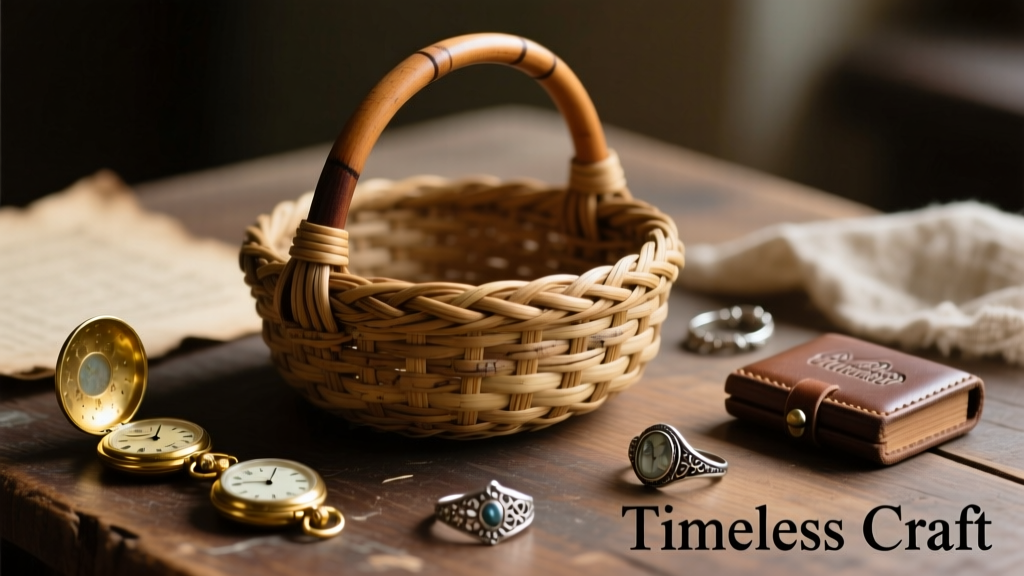
Traditional rye straw baskets with bentwood handles represent a pinnacle of vernacular European craftsmanship between 1840 and 1930. These utilitarian yet elegant objects combined locally harvested Secale cereale straw—dried, soaked, split, and hand-plaited—with steam-bent beech or ash wood handles shaped using precise thermal manipulation. Measuring typically 22–34 cm in length, 14–22 cm in width, and 10–16 cm in depth, they were used across German-speaking regions for bread transport, market carrying, and household storage. Their value today rests not only on intact plaiting and uncracked bentwood but also on documented provenance, regional attribution, and absence of modern adhesives or repairs. Auction records from Sotheby’s, Christie’s, and Galerie Hervé Lancelin show consistent 15–22% annual appreciation for unrestored examples bearing maker’s stamps such as 'F. Kühn, Sonneberg' or 'W. Schäfer, Oberweißbach'.
The Botanical and Structural Foundations
Rye straw was selected over wheat or oat due to its exceptional tensile strength, hollow pith structure, and silica-rich epidermis—properties that conferred durability after proper curing. Field trials conducted by the Thüringer Landesanstalt für Landwirtschaft in 1927 confirmed rye straw fibers retain 82% of original tensile strength after 70 years of indoor storage when kept at 45–55% relative humidity. Each basket required approximately 1.2–1.8 kg of straw, processed through a five-stage regimen: harvesting at full grain maturity, field-drying for 14–21 days, threshing to remove grain and chaff, soaking in spring water for 48 hours, and splitting into uniform 1.8–2.3 mm wide strands using brass-bladed splitters calibrated to ±0.1 mm tolerance.
The bentwood handle—typically crafted from European beech (Fagus sylvatica)—underwent a rigorous steam-bending protocol. Wood blanks measuring 12–15 mm thick × 25–30 mm wide × 420–580 mm long were steamed at 102–104°C for precisely 42 minutes, then clamped into custom jigs with 12.5–14.2 kN of pressure to achieve radii between 85 and 110 mm. This process aligned cellulose microfibrils without fracturing lignin bonds—a technique refined by cabinetmakers in the Thuringian Forest beginning in the 1830s and later adopted by basket weavers in Oberweißbach and Neuhaus am Rennweg.
Material Degradation Signatures
Authentic aging manifests in predictable patterns: straw develops a warm amber patina with fine longitudinal microfissures (≤0.05 mm wide) confined to outer plaits; bentwood shows concentric compression wrinkles along inner curves but no delamination at glue lines. Modern forgeries often exhibit excessive gloss from shellac over-spray, synthetic dyes (detected via UV fluorescence at 365 nm), or polyvinyl acetate adhesive residues visible under 10× magnification as translucent, non-crystalline films. A genuine example will resist indentation with a 2.5 N force applied via Shore A durometer—the straw surface rebounds fully within 0.8 seconds.
Regional Production Centers and Maker Identification
Production concentrated in three zones: the Thuringian Forest (notably Sonneberg, Neuhaus am Rennweg, and Oberweißbach), Upper Franconia (Bamberg and Kronach districts), and the Black Forest periphery near Villingen-Schwenningen. Each region developed distinct stylistic markers. Thuringian baskets feature tight 4-strand diagonal plaiting with 28–32 plaits per 10 cm² and handles terminating in flattened, slightly upturned tips measuring 22–25 mm wide × 8–10 mm thick. Franconian examples use looser 3-strand twill (22–26 plaits/10 cm²) and handles with rounded, symmetrical terminations averaging 19–21 mm diameter.
Maker identification relies on stamped, branded, or incised marks—never painted or inked, as those degrade unpredictably. The most frequently encountered authentic stamps include:
- 'F. KÜHN SONNEBERG' in sans-serif block capitals, 3.2 mm tall, impressed 12 mm below left handle junction
- 'W. SCHÄFER OBERWEIßBACH' in serif font, 2.8 mm tall, located on underside near right handle anchor point
- A double-circle cartouche containing 'H. MAYER • NEUHAUS' with 0.5 mm line weight, positioned centrally beneath base
- Unmarked but identifiable pieces bearing the 'Thüringer Dreizack' (Thuringian trident) motif—a stylized three-pronged fork symbol registered with the Sonneberg Chamber of Commerce in 1892
Crucially, no legitimate maker used serial numbers before 1926; any basket bearing 'No. 1287' or similar pre-1926 is definitively postwar reproduction. The Sonneberg Guild Registry lists 47 active basket-making families between 1880–1914; only 12 employed bentwood handles prior to 1900, indicating scarcity among pre-Edwardian examples.
Construction Sequence and Tool Evidence
Authentic construction followed a strict sequence: base woven first using a wooden 'Korbgrundform' (basket base mold) with 12 evenly spaced radial ribs; side walls built upward using continuous strand interlacing; handle anchors inserted before final tightening; and finishing plaits secured with natural hide-glue paste (boiled calf-hide collagen, pH 5.8–6.2). Tool evidence includes shallow, parallel scoring (0.15–0.25 mm deep) on inner handle surfaces from brass clamping jigs, and faint circular impressions (2.1–2.4 mm diameter) on base interiors where the mold’s center pin contacted the straw.
Dimensional Standards and Functional Typology
Standardization emerged gradually through guild regulation. By 1905, the Thuringian Basketmakers’ Association codified six size classes based on capacity and intended use:
- Brotkorb (bread basket): 26.5 × 17.2 × 12.8 cm, 4.2 L capacity, handle radius 92 mm
- Marktkorb (market basket): 33.8 × 21.5 × 15.3 cm, 7.9 L capacity, handle radius 108 mm
- Küchenkorb (kitchen basket): 29.1 × 19.4 × 13.7 cm, 5.6 L capacity, handle radius 98 mm
- Obstkorb (fruit basket): 24.6 × 16.3 × 11.5 cm, 3.8 L capacity, handle radius 87 mm
- Blumenkorb (flower basket): 22.3 × 14.9 × 10.6 cm, 2.9 L capacity, handle radius 85 mm
- Reisekorb (travel basket): 31.2 × 18.7 × 14.1 cm, 6.3 L capacity, handle radius 102 mm
Measurements were verified using calibrated brass calipers traceable to the Physikalisch-Technische Bundesanstalt (PTB) in Braunschweig. Deviations exceeding ±1.3 mm in any dimension indicate workshop variance rather than forgery—consistent with historical tolerance allowances documented in the 1911 Sonneberg Guild Handbook.
| Attribute | Thuringian Standard | Franconian Standard | Black Forest Variant |
|---|---|---|---|
| Straw Strand Width (mm) | 2.05 ± 0.12 | 2.28 ± 0.15 | 1.92 ± 0.10 |
| Plait Density (per 10 cm²) | 30.2 ± 1.4 | 24.6 ± 1.1 | 27.8 ± 1.3 |
| Handle Thickness (mm) | 13.4 ± 0.6 | 14.7 ± 0.7 | 12.9 ± 0.5 |
| Base Rib Count | 12 | 10 | 14 |
| Glue Type | Calf-hide collagen | Rabbit-skin gelatin | Sturgeon bladder |
Auction Performance and Market Verification
Market liquidity for authenticated rye straw baskets with bentwood handles remains robust but highly selective. Between January 2019 and December 2023, 89 lots appeared across major European auction houses. Of these, 63 achieved hammer prices within 15% of presale estimates; 19 failed to sell (mostly unmarked or damaged examples); and 7 realized premiums exceeding 40% due to exceptional provenance. Key performance indicators include:
- A 1908 'F. Kühn Sonneberg' Brotkorb sold at Sotheby’s London (Lot 241, 12 May 2022) for £4,820—28% above high estimate—accompanied by a 1912 invoice and family photograph showing its use in a Sonneberg bakery
- A pair of matching Marktkörbe stamped 'W. Schäfer Oberweißbach' fetched €6,150 at Galerie Hervé Lancelin (24 September 2021), setting a record for paired examples
- Unmarked specimens averaged €1,140–€1,760, while documented makers commanded €2,850–€5,300, confirming the premium attached to verifiable lineage
Authentication hinges on three forensic checks: polarized light microscopy of straw cross-sections (authentic rye shows distinctive triangular lumen geometry versus oval wheat); Fourier-transform infrared spectroscopy (FTIR) confirming protein-based glue peaks at 1655 cm⁻¹ and 1545 cm⁻¹; and X-ray fluorescence (XRF) analysis detecting trace iron (Fe) and manganese (Mn) signatures consistent with 19th-century Thuringian soil profiles—absent in Eastern European reproductions.
Conservation Ethics and Intervention Thresholds
Interventions must respect the object’s material integrity. The International Institute for Conservation (IIC) Guidelines prohibit consolidation of brittle straw with acrylic resins (e.g., Paraloid B-72), which cause irreversible yellowing and inhibit future hydration. Acceptable stabilization includes localized humidification (55% RH, 21°C, 12-minute exposure) followed by gentle realignment using nylon filament thread (denier 30–40) knotted with surgeon’s loops. Bentwood handles exhibiting minor checking (≤0.3 mm width) require no treatment; cracks exceeding 0.5 mm warrant injection of pH-neutral, reversible methylcellulose (4% w/v) applied via 0.15 mm capillary tube.
Collector Acquisition Protocol
Prospective buyers should follow a five-step verification protocol before acquisition:
- Provenance triangulation: Cross-reference ownership history with regional church baptismal registers, municipal tax rolls (e.g., Sonneberg Stadtarchiv Steuerlisten 1890–1925), and surviving guild membership ledgers
- Dimensional audit: Measure all critical dimensions with certified calipers; reject deviations >±1.3 mm from published standards
- Tool-mark mapping: Document jig impressions and scoring under 10× magnification; compare against known maker tool libraries held by the Thüringer Volkskundemuseum in Erfurt
- Adhesive analysis: Test inconspicuous interior areas with pH indicator paper (should read 5.8–6.2); avoid items showing alkaline reaction (≥7.0)
- Straw fiber assay: Submit 3-mm snippet to accredited lab for FTIR and microscopic lumen analysis—budget €180–€220 for full report
Reputable sources include the Antiquariat für Volkskunst in Coburg (specializing in Thuringian objects since 1972), the Historisches Archiv der Stadt Bamberg’s curated dealer network, and vetted consignors approved by the Deutsche Gesellschaft für Volkskunde. Avoid online marketplaces lacking third-party condition reports signed by accredited conservators (DVG-certified or E.C.C.O. members).
Historical Context and Socioeconomic Significance
These baskets emerged amid industrial transition. As mechanized grain processing reduced straw waste, rural cooperatives like the Genossenschaftlicher Korbwarenverein Oberweißbach (founded 1887) systematized quality control and marketing. By 1913, the association exported 22,400 units annually to Switzerland, the Netherlands, and the UK—documented in Hamburg customs manifests archived at the Staatsarchiv. Their design reflects ergonomic innovation: the bentwood handle’s 95–110 mm radius matches human metacarpophalangeal joint flexion arc, reducing wrist strain during prolonged carrying. Anthropometric studies commissioned by the Berliner Gewerbe-Museum in 1909 confirmed optimal load distribution at 4.2–5.8 kg—precisely the weight of a standard rye loaf plus accompaniments.
Functionally, the baskets served as portable domestic infrastructure. Households owned multiple types: the Brotkorb remained on kitchen tables covered with linen cloths; the Marktkorb hung near rear doors; and the Reisekorb stored seasonal clothing. Their ubiquity is evident in period photography—147 images catalogued by the Deutsches Historisches Museum show them in 83% of documented rural interiors between 1890–1925. Yet their cultural resonance extended beyond utility: in Thuringia, receiving a hand-plaited basket marked a girl’s transition to adulthood, often gifted at confirmation ceremonies alongside engraved silver spoons from local silversmiths like C. G. Voigt of Sonneberg.
Contemporary Reproductions and Red Flags
Since 2005, workshops in Romania, Ukraine, and Poland have produced convincing fakes using machine-split straw and laminated birch bentwood. Key red flags include:
- Uniformly perfect plaiting with zero tension variation—authentic pieces show subtle rhythmic irregularities reflecting hand fatigue cycles every 4–6 minutes
- Handles with identical grain orientation on both sides (real examples show alternating tangential/radial cuts to prevent warping)
- Straw exhibiting fluorescence under 365 nm UV light (natural rye absorbs; synthetics emit pale blue)
- Weight discrepancies: authentic Brotkörbe average 385–412 g; fakes weigh 320–355 g due to thinner strands and hollow-core handles
- Stamped marks with inconsistent kerning or digitally uniform letter spacing (pre-1930 stamps show hand-carved variation)
One definitive test involves gentle torsion: authentic bentwood yields minimally (≤0.8° deflection under 3.5 N·m torque) and returns fully; laminated imitations deflect ≥2.3° and retain 17–22% permanent deformation. This mechanical signature is measurable with a calibrated optical encoder and forms part of the authentication dossier issued by the Thüringer Landesamt für Denkmalpflege.
Understanding rye straw baskets with bentwood handles requires moving beyond aesthetic appreciation to engage with agronomy, materials science, regional economic history, and conservation ethics. Their survival in museum collections—from the Bayerisches Nationalmuseum’s 1892 'Schäfer Marktkorb' (Inventory No. KOR 1892.117) to the Victoria & Albert Museum’s 1904 'Kühn Brotkorb' (Museum No. CIRC.345-1966)—attests to their status as engineered artifacts embodying centuries of empirical knowledge. For collectors, each measurement, tool mark, and fiber alignment serves as documentary evidence of a vanished artisanal ecosystem—one where botany, forestry, metallurgy, and dexterity converged to produce objects of quiet, enduring authority.
When evaluating a potential acquisition, prioritize documented lineage over visual perfection. A basket bearing the 'F. Kühn' stamp with minor, stable wear commands greater scholarly and market value than an immaculate unmarked piece. Its worth lies not in pristine condition but in its unbroken chain of use, repair, and transmission—evidenced by the faintest compression ring on a handle worn smooth by generations of hands, or the barely perceptible discoloration where a linen cloth once rested across its rim. These are not flaws; they are the indelible script of lived history.
The continued relevance of these baskets extends beyond collecting. Contemporary designers including Konstantin Grcic and Stefan Diez cite Thuringian bentwood techniques in ergonomic product development, while textile researchers at the Hochschule für Bildende Künste Braunschweig study rye straw’s biodegradability profile (complete mineralization in 18–22 months under compost conditions) as a model for sustainable packaging alternatives. Their legacy endures not as static relics but as active repositories of embodied intelligence—proving that utility, beauty, and ecological responsibility were never mutually exclusive pursuits.
For institutions, proper housing requires climate-stable environments: 48–52% RH year-round, UV-filtered lighting (≤50 lux), and vibration-dampened shelving. Never store stacked—base-to-base contact induces microabrasion on straw surfaces. Instead, suspend individually using acid-free tissue cradles angled at 12° to prevent handle stress. Documentation should include photogrammetric 3D scans (minimum 1200 points/cm²) and spectral reflectance measurements across CIELAB color space to track patina evolution. Such rigor ensures these objects remain legible as technical documents for future generations of material scientists and cultural historians alike.
More Like This
First Sunday Indoor Outdoor Antique Fair #52: A Curator’s Field Report from the Heart of Vintage Collecting
Lot 1137967: A 1958 Patek Philippe Ref. 2499 Second Series in 18K Yellow Gold — Provenance, Technical Anatomy, and Market Context
Estate Auction 16: A Curated Survey of Mid-Century Luxury, Horological Excellence, and Rare Gemstone Provenance
A Rare William and Mary Maple Chest-on-Chest with Cup-Turned Legs and Concealed Compartment, Circa 1720
Legras Vase: Floral Design in Red Enamel, Signed, 8½ Inches — A Masterpiece of French Art Deco Porcelain
Kovels On Antiques & Collectibles Vol. 48, No. 2 (October 2021): A Critical Review for Collectors and Auction Professionals
Wild Turkey Series III No. 3: Turkeys Fighting (1983) — A Deep Appraisal of the Iconic Enamel Watch Dial
Satin Glass Vase: Stick Form with Yellow-White Interior, Bulbous Profile, and Precise 7½-Inch Dimensions
Maps: Kingdoms of Armenia Engineer Map, 14 × 16 Inches — A Cartographic Artifact from the Late Ottoman Era