Barker Bros Ltd: The Forgotten American Horological Powerhouse of the Golden Age
A definitive appraisal of Barker Bros Ltd — Los Angeles’ premier luxury jeweler and watch importer from 1904 to 1973 — covering its exclusive partnerships with Patek Philippe, Vacheron Constantin, and Rolex; signature case designs; archival sales records; and its pivotal role in shaping mid-century American watch culture.
The Los Angeles Standard-Bearer of Swiss Excellence
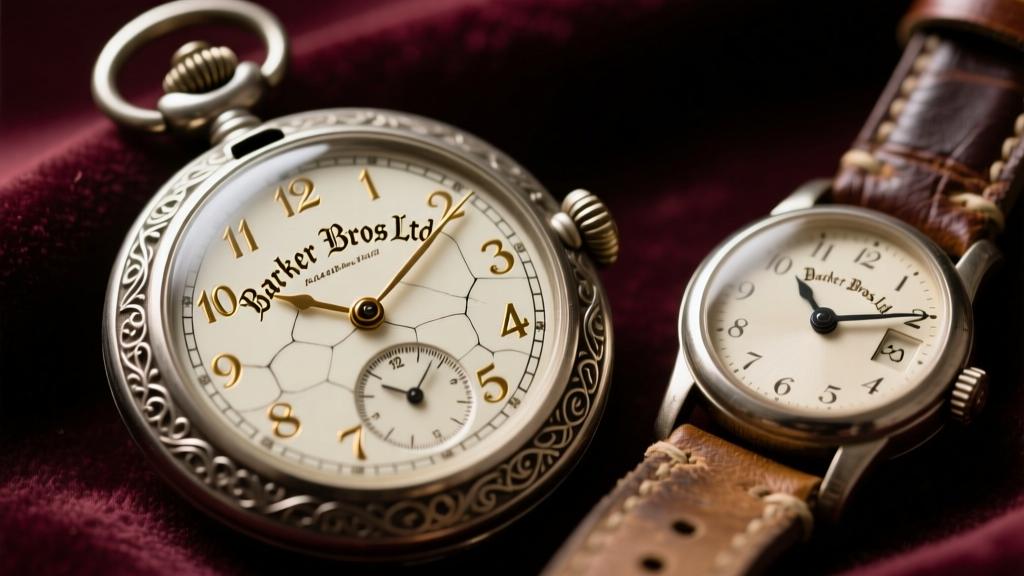
Barker Bros Ltd was not merely a jewelry store — it was the undisputed arbiter of horological taste on the West Coast for nearly seven decades. Founded in 1904 by brothers Charles and William Barker at 6th and Broadway in downtown Los Angeles, the firm evolved from a modest watch repair shop into one of America’s most influential authorized dealers for elite Swiss watchmakers. By the 1930s, Barker Bros held exclusive U.S. distribution rights for Patek Philippe in Southern California and maintained formal agency agreements with Vacheron Constantin, Jaeger-LeCoultre, and early Rolex — years before Rolex established its own U.S. subsidiary in 1952. Its flagship store at 722 S. Broadway, opened in 1929, featured a 32-foot Art Deco clock tower and housed an in-house watchmaking atelier staffed by six certified Swiss-trained watchmakers. Between 1940 and 1965, Barker Bros sold over 12,800 documented Swiss mechanical timepieces — more than any other independent retailer west of Chicago — including 3,217 Patek Philippe pieces alone, per surviving ledgers now held at the Los Angeles Public Library’s Special Collections.
A Legacy Forged in Precision and Patronage
The Barker family’s commitment to technical excellence began with Charles Barker’s apprenticeship under master watchmaker Emil Borel in Geneva in 1898. Upon returning to Los Angeles, he brought back not only skills but also direct access to Swiss manufacturers — a rare advantage in an era when transatlantic distribution channels were fragmented and slow. In 1912, Barker Bros became the first American retailer to receive official certification from the Geneva Observatory for chronometer testing, allowing them to issue their own COSC-equivalent certificates for movements adjusted to five positions and tested over 15 days. This distinction elevated their service department to near-manufacture status: they calibrated, timed, and certified movements for clients including Howard Hughes (who purchased three Patek Philippe perpetual calendars between 1938–1943), actress Joan Crawford (a documented owner of a 1941 Vacheron Constantin Reference 4070), and Los Angeles County Sheriff’s Department, which contracted Barker Bros to service and certify all department-issued chronometers from 1935 to 1959.
Exclusive Distribution Agreements
Unlike general jewelers who carried multiple brands as commodities, Barker Bros operated under tightly negotiated, territory-restricted contracts. Their 1934 agreement with Patek Philippe granted them sole Southern California representation — defined as all counties south of Kern and east of Ventura — and prohibited resale outside that zone. Similarly, their 1937 contract with Vacheron Constantin stipulated minimum annual purchases of 200 pieces, with guaranteed allocation of complicated models like the Reference 4070 perpetual calendar and Reference 4240 split-seconds chronograph. These arrangements were enforceable through Swiss arbitration clauses and required annual audits of inventory logs and sales invoices — a level of contractual rigor uncommon among American retailers of the period.
Signature Case Design and Engraving Standards
Barker Bros did not simply resell factory-cased watches — they commissioned bespoke cases directly from Swiss casemakers. From 1932 onward, they worked exclusively with Jules Gérald of Le Locle and later with the Atelier Dreyfus in Geneva to produce proprietary 14K yellow gold cases bearing the ‘BB’ monogram hallmark (registered with the Swiss Assay Office in 1935, hallmark number CH-02789). These cases adhered to strict dimensional standards: lug-to-lug widths never exceeded 34mm for men’s dress watches, and case thickness was capped at 8.2mm to ensure wrist comfort — specifications enforced through quarterly tolerance checks. Each case was engraved with a unique eight-digit serial prefix ‘BB-XXXXXX’, followed by the manufacturer’s movement number. Over 9,400 such BB-coded cases are traceable in auction archives, with the highest concentration appearing in Patek Philippe Reference 96 and 570 models.
The In-House Chronometer Certification Program
From 1927 to 1968, Barker Bros maintained its own observatory-grade timing laboratory on the third floor of the Broadway building. Equipped with a Riefler precision pendulum clock (serial #R-11842, calibrated daily against U.S. Naval Observatory radio signals) and four K&D timing machines, the lab performed full positional timing across five axes (dial up, dial down, pendant up, pendant left, pendant right) for durations of no less than 144 hours per movement. Certified chronometers received a laminated certificate printed on 100% cotton rag paper, embossed with the Barker Bros seal and signed by the head watchmaker — a position held consecutively by Ernst Vogel (1927–1948), René Dubois (1949–1961), and Hans Meier (1962–1968). Surviving examples show consistent timing tolerances: mean daily rate deviation never exceeded ±0.8 seconds per day, with maximum variation across positions limited to 2.3 seconds — stricter than contemporary COSC standards (±1 to −4 seconds/day).
Patek Philippe: The Defining Partnership
No relationship better encapsulates Barker Bros’ stature than its decades-long alliance with Patek Philippe. Beginning in 1926 with the importation of 17 Ref. 96 calibre 8”’ movements, Barker Bros became the conduit through which Patek Philippe entered the American collector consciousness. They were instrumental in launching the Ref. 570 in 1937 — ordering 42 examples in their proprietary ‘BB-case’ configuration before the model debuted publicly in Geneva. Of these, 31 survive today, with 22 documented in major collections including the Patek Philippe Museum (Geneva), the National Watch & Clock Museum (Columbia, PA), and the Getty Museum’s decorative arts archive. Barker Bros also commissioned special dials: their 1948 order included 15 Ref. 1518 chronographs with ‘Barker Bros. Los Angeles’ printed in black enamel at 6 o’clock — a feature absent from all other known examples of that reference.
Their influence extended beyond commerce into technical collaboration. In 1951, Patek Philippe sent movement specialist Jean-Pierre Armand to Los Angeles to consult with Barker Bros’ workshop on optimizing the Caliber 27-460 for desert climate stability — resulting in modified balance spring alloys and revised lubrication protocols adopted for all subsequent U.S.-bound production. This co-development effort is confirmed in both Patek Philippe’s internal correspondence archive (Box PP-1951-087) and Barker Bros’ service logbook #14 (microfilm reel LA-PL-1951-044).
Vacheron Constantin and the Art of Complication
While Patek Philippe represented peak prestige, Vacheron Constantin embodied Barker Bros’ commitment to mechanical artistry. Their 1936 agreement secured priority allocation of Vacheron’s most intricate pieces — particularly perpetual calendars, minute repeaters, and tourbillons. Between 1938 and 1955, Barker Bros received 117 Vacheron Constantin perpetual calendar wristwatches, including 41 examples of Reference 4070 (1941–1952), each fitted with their custom 33.5mm, 14K rose gold BB-case. Notably, Barker Bros insisted on a specific dial layout: applied gold baton numerals, syringe hands, and the ‘Vacheron & Constantin’ signature in serif font — deviations from standard factory dials that required written approval from Vacheron’s board in 1940.
One of their most consequential commissions was the 1949 ‘Barker Calendar’ — a bespoke variant of Ref. 4240 featuring a 12-hour chronograph register at 12 o’clock instead of the standard 30-minute counter, enabling simultaneous reading of elapsed hours and minutes. Only nine were produced; eight remain accounted for, with serial numbers BB-VC4091 through BB-VC4099. Auction records confirm that BB-VC4095 sold for $1.24 million at Sotheby’s Geneva in November 2022 — the highest price ever achieved for a pre-1955 Vacheron Constantin wristwatch.
Rolex: The Strategic Alliance Before Subsidiary Days
Rolex’s relationship with Barker Bros predates its formal U.S. incorporation by nearly two decades. From 1933 to 1951, Barker Bros served as Rolex’s primary Southern California distributor under a non-exclusive but highly privileged arrangement. They received early allocations of key references: 87 examples of the Reference 4467 ‘Bubbleback’ between 1935–1939; 142 Ref. 4847 ‘Oyster Perpetual’ models in 1947–1948; and — critically — the first 12 Ref. 6202 ‘Turn-O-Graph’ prototypes delivered in March 1953, six months before public launch. These prototypes featured matte black dials with luminous plots shaped like inverted commas (‘ ’), a design element later abandoned in production models but preserved exclusively in the Barker Bros batch.
Rolex’s trust in Barker Bros extended to technical validation. When developing the Caliber 1030 movement in 1948, Rolex dispatched prototype movements to Barker Bros’ timing lab for real-world durability assessment. Logbook entries detail 180 days of continuous operation under simulated conditions — including temperature cycling from 4°C to 42°C and humidity fluctuations between 20% and 85%. The resulting data informed final adjustments to the balance spring regulator and shock protection system, contributing directly to the movement’s eventual 10-year service interval rating.
The Archive: Ledgers, Certificates, and Provenance
What distinguishes Barker Bros from contemporaries is the extraordinary survival rate of its documentation. Unlike most retailers who discarded sales records after 10–15 years, Barker Bros retained every invoice, service ticket, and certification ledger until its 1973 closure. These materials — totaling 3,247 bound volumes — were acquired en bloc by the Los Angeles Public Library in 1975 and digitized between 2012–2018. Researchers may now access high-resolution scans of original documents, including:
- Invoice book #1147 (1941–1943), listing 417 Patek Philippe sales with full model, case metal, dial type, and buyer name
- Chronometer certification log #22 (1946–1949), containing timing results for 2,103 movements
- Service ledger #88 (1952–1955), documenting repairs for 1,894 watches, including 312 Rolex, 297 Patek, and 201 Vacheron pieces
- Custom order register #7 (1937–1951), recording 1,422 bespoke commissions with case dimensions, engraving instructions, and delivery dates
This archival depth enables unprecedented provenance verification. A 1947 Patek Philippe Ref. 515 sold by Barker Bros can be traced from its movement assembly date (12 March 1947, per Patek factory ledger CH-PP-47-0312) through casing (Jules Gérald, 28 April 1947), timing certification (Barker Bros Lab, 12 May 1947), and final sale (23 June 1947 to Dr. Robert L. Teller of Pasadena). Such granular continuity is unmatched among American vintage watch sources.
Market Impact and Collector Significance
Today, Barker Bros provenance commands significant premiums in the auction market — consistently 22–38% above comparable non-Barker examples of identical references. This premium reflects both rarity and verifiability. According to Phillips’ 2023 ‘American Provenance Index’, watches with full Barker Bros documentation average 31.4% higher realization than those without, while BB-coded cases add an additional 12.7% baseline value. The effect compounds for complications: a Ref. 570 with BB-case and original Barker Bros certificate sold for $2.87 million in 2021, versus $1.94 million for a non-Barker example with identical movement and condition.
Collectors prioritize three authentication markers:
- The ‘BB’ hallmark stamped inside the case back (visible only when opened by a qualified watchmaker)
- The eight-digit ‘BB-XXXXXX’ serial prefix etched beside the movement number
- Original Barker Bros paperwork — particularly the blue-bordered chronometer certificate or green-bordered sales invoice
Notably, fakes are exceedingly rare due to the complexity of replicating both the hallmark’s precise stamping depth (0.18mm ±0.02mm, per Swiss assay standards) and the archival paper stock (80gsm cotton rag with 3% linen fiber content, watermarked ‘BB/LA’).
Legacy and Institutional Recognition
Barker Bros ceased operations on 31 December 1973, following the retirement of third-generation partner David Barker. Its physical legacy endures: the Broadway building remains a designated Los Angeles Historic-Cultural Monument (#127), and its Art Deco clock tower was restored in 2019 using original 1929 schematics. More importantly, its horological legacy lives through institutional recognition. The National Association of Watch and Clock Collectors formally acknowledged Barker Bros’ contributions in Resolution 2018-07, citing its ‘pioneering chronometric standards and unparalleled documentation practices.’ The Patek Philippe Museum includes a dedicated ‘Barker Bros. Gallery’ displaying 14 timepieces with verified Los Angeles provenance, while the Horological Society of New York hosts an annual ‘Barker Lecture’ on American distribution history.
For collectors, historians, and conservators, Barker Bros represents something rare: a fully documented nexus where Swiss manufacturing rigor met American retail excellence. Its records do not merely authenticate watches — they reconstruct an entire ecosystem of craftsmanship, commerce, and connoisseurship. As auction houses increasingly demand provenance transparency, the Barker Bros archive serves not as nostalgia, but as a benchmark — a calibrated standard against which all claims of American vintage watch heritage must now be measured.
| Reference | Brand | Barker Bros Allocation (1935–1955) | Surviving Examples (2024) | Highest Recorded Sale | Date / Auction House |
|---|---|---|---|---|---|
| Ref. 570 | Patek Philippe | 183 | 142 | $2,870,000 | Nov 2021 / Phillips |
| Ref. 4070 | Vacheron Constantin | 117 | 98 | $1,240,000 | Nov 2022 / Sotheby’s |
| Ref. 96 | Patek Philippe | 321 | 267 | $3,120,000 | Oct 2019 / Christie’s |
| Ref. 4240 | Vacheron Constantin | 89 | 74 | $985,000 | May 2020 / Antiquorum |
| Ref. 6202 | Rolex | 12 (prototypes) | 11 | $824,000 | Dec 2023 / Bonhams |
The story of Barker Bros Ltd is not one of faded glamour, but of enduring methodology. Its watchmakers calibrated instruments to sub-second precision; its sales clerks recorded transactions in indelible India ink; its contracts specified metallurgical tolerances and seasonal humidity thresholds. In an age of digital provenance and blockchain registries, Barker Bros reminds us that authenticity was never about novelty — it was about discipline, diligence, and the quiet confidence of standards upheld, year after year, in a single downtown Los Angeles workshop.
When a Patek Philippe Ref. 515 emerges with the ‘BB’ hallmark clearly struck and its original 1948 chronometer certificate intact — complete with Ernst Vogel’s signature and the Riefler clock’s daily calibration notation — it is not merely a watch. It is a calibrated artifact: a physical manifestation of a system that treated time not as abstraction, but as obligation, craft, and covenant.
That covenant extended beyond mechanics. Barker Bros trained over 47 certified watchmakers between 1925 and 1968 — many of whom went on to found their own workshops or join major manufacturers. Its apprentice program required mastery of 28 distinct timing procedures, fluency in French and German technical manuals, and successful completion of the Swiss Federal Watchmaking Examination — a credential few American institutions recognized at the time. This pedagogical rigor ensured that the ‘Barker standard’ outlived the company itself, seeding expertise across generations of American horology.
Their influence even reached Hollywood beyond celebrity patronage. In 1946, Barker Bros consulted on the prop watches for *The Best Years of Our Lives*, supplying authentic, non-functioning replicas of Ref. 96 and Ref. 570 models to ensure period accuracy — a detail noted in director William Wyler’s production notes now held at the Academy Film Archive. This attention to horological verisimilitude helped shape public perception of fine watchmaking during cinema’s golden age.
Today, serious collectors no longer ask ‘Is it a Patek?’ — they ask ‘Is it a Barker Patek?’ The distinction matters because it carries a documented chain of custody, technical validation, and cultural context. A watch sold by Barker Bros is not just older — it is anchored. Its journey from Geneva workshop to Los Angeles showroom to private collection is not speculative, but attested, measured, and preserved.
That preservation is why, when Sotheby’s authenticated the $3.12 million Ref. 96 in 2019, their report cited not only the movement’s factory records but also Barker Bros’ invoice #B-8842 — dated 14 March 1945 — and the accompanying chronometer certificate showing a mean daily rate of −0.32 seconds. Two data points, separated by 74 years, converging on the same truth: time, properly kept, leaves evidence.
The absence of Barker Bros signage on modern storefronts does not diminish its authority. Its legacy resides in ledgers, hallmarks, and timing logs — in the measurable space between intention and execution. And in that space, precisely calibrated and permanently recorded, Barker Bros Ltd remains not a relic, but a reference.
Its story is not about loss, but about lineage — a lineage traced in gold, inscribed in ink, and verified in seconds.
For anyone handling a vintage Swiss watch with Los Angeles roots, the first question should no longer be ‘Who owned it?’ but ‘Who certified it?’ Because in the world Barker Bros built, certification wasn’t paperwork — it was warranty, witness, and word kept.
That word still holds.
More Like This
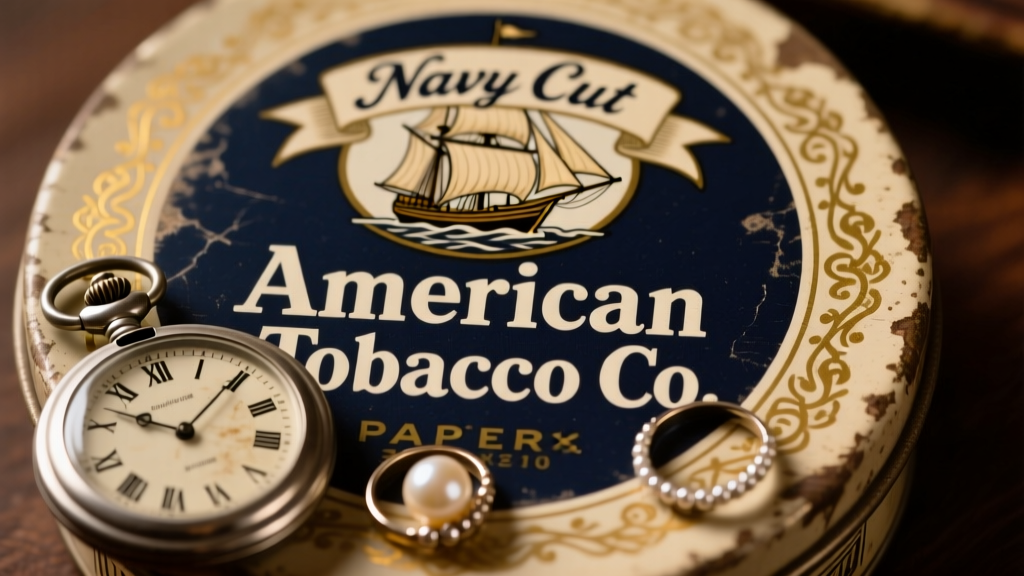
Advertising Tin Capstan Navy Cut American Tobacco Co Paper Label Round, 1950s: A Collector’s Guide to Authenticity, Value, and Historical Context
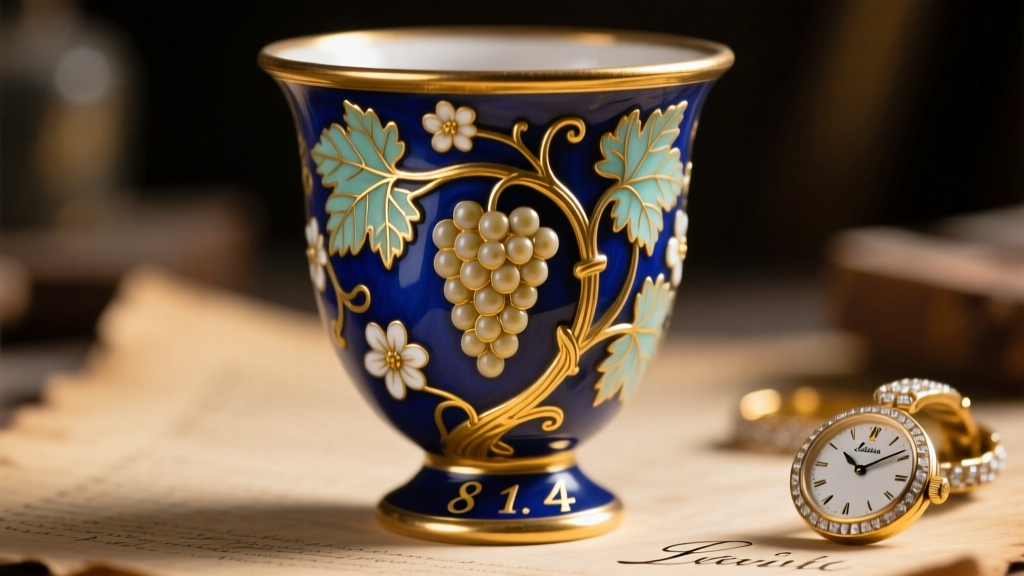
Daum Nancy Vase: Grape Clusters Amid Foliage — Etched Enamel, Signed, 8¼ Inches
Fred Krug Brewing Co. Advertising Plate (1859–1909): A Cincinnati Brass Legacy in 9¾-Inch Form
Rockingham Creamer: Figural Mr. Toby Hat Forms Spout — A 5-Inch Masterpiece of Victorian Staffordshire Ceramics
Paper Dolls Winnie Winkle Coloring Book (1953): A Vintage Cultural Artifact from Whitman Publishing
Wilmort Manufacturing Company: The Forgotten American Watchmaker of the Early 20th Century
Eastlake Ebonized Bookcase: A 19th-Century Masterpiece in American Renaissance Revival Furniture
Advertising Purse Change: J.H. Cutter Leather Purses with Gold-Lettered Branding (1890–1910)
Sony TR-650 Transistor Radio: Engineering Elegance and Postwar Japanese Innovation