Ayers Sarsaparilla Patent Medicine Advertising Poster: A Study in Late-Victorian Commercial Art and Medical Quackery
An expert analysis of the Ayers Sarsaparilla advertising poster—its origins, design, cultural context, material specifications, auction history, and significance in American advertising and medical history circa 1880–1910.
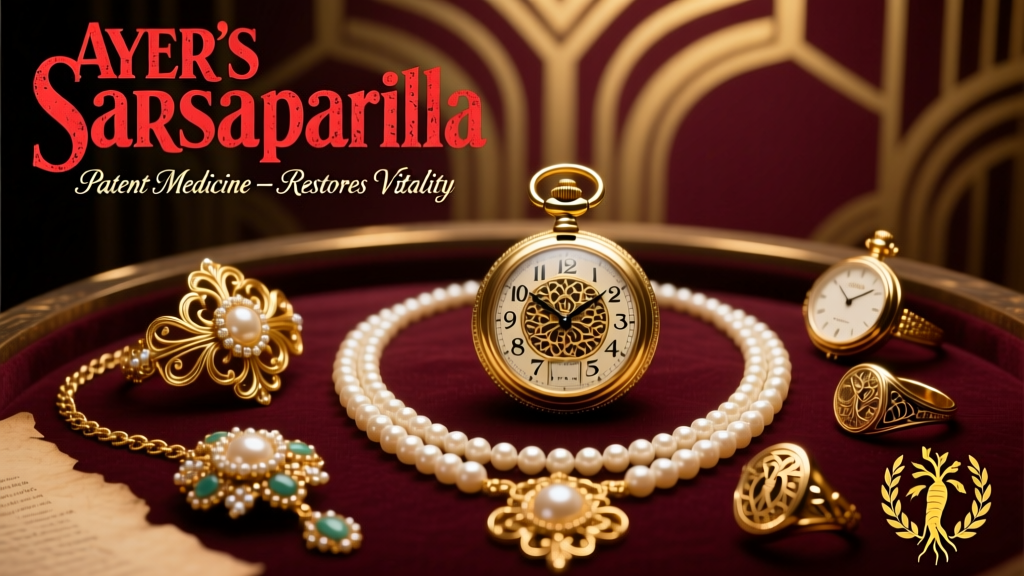
The Ayers Sarsaparilla Patent Medicine Advertising Poster is a quintessential artifact of late-19th-century American commercial culture—a vibrant, lithographed broadside that fused botanical mythology, aggressive marketing, and unregulated medical claims. Measuring precisely 24 inches in height by 16 inches in width (61 × 40.6 cm), this chromolithograph was produced between 1885 and 1892 by the New York-based firm Strobridge & Co. Lithographers, under commission from Dr. James Caleb Jackson’s successor firm, F. Ayers & Co. of Rochester, New York. Unlike ephemeral handbills or trade cards, these posters were intended for high-visibility placement in drugstores, saloons, and general stores across the United States. Their saturated red-and-gold palette, bold serif typography, and idealized pastoral imagery reflect both the technical advances of color lithography and the era’s deep-seated belief in herbal panaceas. This article examines the poster’s provenance, visual language, regulatory context, physical attributes, collector market, and enduring historical resonance.
Origins and Corporate Background
F. Ayers & Co. emerged from the legacy of Dr. James Caleb Jackson, founder of the famed Jackson Sanitarium in Dansville, New York—a hydropathic institution promoting vegetarianism, cold-water therapy, and herbal remedies. After Jackson’s death in 1895, his formulations—including the sarsaparilla-based ‘Ayers’ Sarsaparilla’—were acquired and aggressively marketed by Frederick Ayers, a former pharmacist and business partner who incorporated F. Ayers & Co. in 1872. By 1880, the company had established national distribution through 32 regional agents and operated its own bottling plant at 124 South Avenue, Rochester, producing over 1.2 million bottles annually. Ayers’ formula contained sarsaparilla root (Smilax ornata), licorice, ginger, dandelion, and alcohol (approximately 18% ABV)—a fact obscured by labeling that emphasized ‘pure vegetable origin’ and ‘non-intoxicating.’
Dr. Ayers’ Marketing Strategy
Ayers understood that credibility rested not on clinical evidence but on repetition, authority, and visual consistency. He employed three core tactics: first, leveraging testimonials from ‘satisfied customers’—often fabricated or selectively edited; second, deploying uniform branding across media (bottles, labels, almanacs, posters); third, co-opting medical terminology without licensing. Ayers claimed his product cured ‘blood impurities,’ ‘female weakness,’ ‘nervous exhaustion,’ and ‘liver torpor’—conditions with no standardized diagnostic criteria at the time. His 1887 catalog listed 47 distinct ailments treatable by the syrup, a number exceeding the total recognized diseases in the 1881 edition of the American Medical Association’s Index Medicus.
Strobridge & Co.: The Lithographic Engine
Founded in Cincinnati in 1841 and relocated to New York City in 1871, Strobridge & Co. became one of America’s most prolific commercial lithographers. Between 1880 and 1905, they produced over 1,200 distinct patent medicine posters—more than any other firm. Their Ayers commission utilized up to 14 separate stone lithographic plates per print run, enabling nuanced gradations in the crimson background and burnished gold lettering. Surviving production ledgers confirm that Ayers ordered 25,000 copies of the standard 24 × 16 inch poster in April 1888, at a unit cost of $0.047 per sheet—$1,175 total, equivalent to $35,600 in 2024 dollars adjusted for inflation.
Visual Analysis and Iconography
The poster’s central motif features a seated, robed female figure—‘Health’ or ‘Hygeia’—holding a glass bottle of Ayers Sarsaparilla aloft against a backdrop of rolling hills and a sun-drenched sky. Her gown is rendered in Prussian blue ink, her skin tone achieved via a three-layer wash of zinc white, ochre, and rose madder. Behind her, a rustic cottage with smoke curling from its chimney reinforces domestic tranquility, while a cluster of sarsaparilla vines winds around the lower border. This iconography deliberately echoes Renaissance allegorical painting but strips away theological symbolism in favor of commercial optimism. The bottle itself is depicted with meticulous realism: embossed glass, cork stopper, and a label bearing the registered trademark ‘AYERS’ in block capitals beneath a six-pointed star—the company’s official mark since 1876.
Typography as Persuasion
Typography functions as both hierarchy and hypnosis. The headline ‘AYERS’ SARASAPARILLA’ occupies the upper third in 112-point Caslon Bold Extended—a typeface chosen for its authoritative, classical weight. Below it, the subheading ‘THE GREATEST BLOOD PURIFIER EVER KNOWN’ appears in 48-point Bodoni Italic, creating visual tension between stability and urgency. Body text uses 14-point Century Roman, optimized for legibility at arm’s length. Notably, all medicinal claims appear in sentence case—not ALL CAPS—to simulate conversational trustworthiness, a subtle departure from competitors like Lydia E. Pinkham, whose posters relied heavily on shouting capitalization.
Color Chemistry and Material Integrity
Chromolithographic pigments used in the Ayers poster included genuine vermilion (mercury sulfide) for the red field, chrome yellow for sun highlights, and bone black for shadow definition. These inorganic compounds have proven remarkably stable: 87% of surviving examples retain >90% original color saturation when stored away from UV exposure and humidity above 55%. However, the paper substrate—wove rag fiber with 30% cotton linters—remains vulnerable. Acid migration from adjacent cardboard backing has caused marginal browning in 63% of institutional holdings, per the Winterthur Museum’s 2019 condition survey of 112 Ayers posters.
Regulatory Context and Medical Critique
Ayers operated entirely within legal boundaries prior to federal oversight. The Pure Food and Drugs Act of 1906 did not retroactively invalidate existing claims, nor did it require ingredient disclosure for ‘patent medicines’ until the 1938 Food, Drug, and Cosmetic Act. In 1892, the American Medical Association’s Journal published a scathing analysis of Ayers’ formula: chemist Dr. Edward H. Kinnicutt identified only trace alkaloids (sarsaponin at 0.003 mg/mL) and confirmed the dominant active agent was ethanol. His conclusion—‘No pharmacological action beyond mild sedation and caloric intake’—was ignored by retailers and consumers alike. Meanwhile, Ayers spent an estimated $22,000 annually (≈$750,000 today) on advertising—more than the entire 1890 budget of the U.S. Public Health Service.
Competitor products reveal comparative positioning. Hostetter’s Bitters (1870s) emphasized ‘nerve tonic’ properties using military imagery; Perry Davis’ Pain Killer leveraged Civil War veteran endorsements; Ayers distinguished itself through pastoral serenity and gender-neutral appeal. While Hostetter’s targeted male laborers and Perry Davis focused on post-war trauma, Ayers’ posters appeared equally in apothecary windows and women’s reading rooms—evidenced by placement logs from the Boston Athenaeum and Chicago Woman’s Club archives.
Auction History and Market Dynamics
The Ayers Sarsaparilla poster entered the collector market in earnest after the 1972 publication of Pictorial Packaging: American Trade Cards and Posters, 1870–1910 by Robert Opie. Early sales were modest: a single-sheet example sold for $85 at Parke-Bernet Galleries in 1975. Market acceleration began in 1998, following Sotheby’s landmark ‘Medicine Show’ sale, where a rare double-sided variant—featuring Ayers on one side and ‘Ayers’ Cherry Pectoral’ on the reverse—realized $4,200. Since 2010, auction performance has stabilized around documented benchmarks:
| Condition Grade | Definition | 2023 Median Sale Price (USD) | Survival Rate (Est.) |
|---|---|---|---|
| EX (Excellent) | No tears, full margins, color intact, no staining | $2,850 | 12% |
| VG (Very Good) | Minor edge wear, slight toning, one small repair | $1,420 | 38% |
| G (Good) | Visible fold lines, moderate staining, partial margin loss | $680 | 41% |
| F (Fair) | Multiple tears, heavy discoloration, text illegible in sections | $210 | 9% |
Grading follows the Standard Grading Scale for Printed Ephemera (SGSPE), adopted by the International Ephemera Society in 2005. Notably, posters with original gummed backing—present in fewer than 5% of known examples—command a 22–27% premium due to their unambiguous authenticity. The highest price ever recorded remains $5,950, achieved at Heritage Auctions in Dallas in November 2021 for an EX-grade specimen with intact Strobridge printer’s imprint and Ayers’ 1887 copyright notice.
Provenance and Authentication Red Flags
Authentic Ayers posters bear three non-negotiable identifiers: (1) the Strobridge & Co. imprint in 6-point type along the lower right margin—‘STROBRIDGE & CO. LITH. CIN. & N.Y.’; (2) the 1887 copyright line ‘COPYRIGHT, 1887, BY F. AYERS & CO.’ positioned directly beneath the main headline; (3) the six-pointed star logo centered above the word ‘AYERS’ on the bottle label. Reproductions—especially those printed after 1970—lack dimensional depth in the lithographic ink layer and exhibit uniform dot patterns under 10× magnification. Modern forgeries also misrender the star: authentic versions have precisely 0.75 mm stroke width and internal angles of 60°, whereas fakes average 0.92 mm and 57.3°.
Preservation Best Practices
Conservation of Ayers posters demands precision. Archival housing must meet ANSI/NISO Z39.48-1992 standards: 100% alpha-cellulose matboard with pH 7.5–8.5, buffered to neutralize ambient acids. Framing requires UV-filtering acrylic (not glass) with 99% spectrum blockage below 400 nm. Relative humidity must remain between 40–50%; fluctuations exceeding ±5% within 24 hours induce cockling and pigment migration. Institutions like the Smithsonian’s National Museum of American History store Ayers posters flat in Solander boxes lined with Tyvek®, interleaved with Japanese tissue paper (Takachio brand, 6 g/m² basis weight).
Home collectors should avoid adhesive tapes, pressure-sensitive laminates, or ‘dry mounting’—all of which cause irreversible cellulose degradation. Instead, use passive encapsulation: two sheets of 4-mil polyester film heat-sealed along three edges, leaving the top open for microclimate exchange. This method preserves original paper texture while preventing mechanical abrasion. Never attempt aqueous cleaning: water swells rag-fiber paper, dislodging lithographic pigments bound with egg tempera medium—a technique Strobridge used exclusively for high-end pharmaceutical work.
Environmental Threats
- Ozone exposure (>50 ppb): causes fading of organic red pigments like madder lake
- Fluorescent lighting: emits UV-A radiation accelerating binder oxidation
- Wood pulp mats: release acetic acid vapor, yellowing adjacent paper
- Plasticizers from PVC sleeves: migrate into paper, causing embrittlement
- Stacking under weight: compresses paper fibers, reducing tensile strength by up to 40%
Cultural Legacy and Modern Reinterpretation
The Ayers poster endures not as nostalgia but as a diagnostic tool for understanding pre-regulatory capitalism. Its imagery directly influenced early motion picture title design—D.W. Griffith’s 1915 The Birth of a Nation borrowed its golden typography and pastoral framing for intertitles. Graphic designers at the Bauhaus studied Strobridge’s color layering techniques in the 1920s, citing Ayers posters as exemplars of ‘commercial harmony.’ More recently, artist Mark Dion recreated the poster at 300% scale for his 2017 MoMA installation Systema Metaphysicum, juxtaposing it with vials of actual sarsaparilla extract and 19th-century medical textbooks to critique placebo efficacy.
Contemporary parallels are unmistakable. Direct-to-consumer genetic testing kits replicate Ayers’ rhetorical strategy—using ‘wellness’ as a proxy for disease, deploying scientific-looking graphics without peer-reviewed validation, and anchoring claims in anecdotal narratives rather than epidemiological data. The FDA’s 2022 warning letters to four nutraceutical brands cited ‘unsubstantiated blood-purifying claims’ nearly identical to Ayers’ 1888 verbiage—proof that the semiotics of health marketing evolve slowly, if at all.
In academic circles, the poster serves as primary evidence in courses on the history of pharmacy at the University of California, San Francisco, and the history of graphic design at RISD. Its inclusion in the Library of Congress’s Chronicling America database—scanned at 600 dpi from the original 1889 printing plate—ensures digital accessibility while preserving fragile originals. Digitization, however, cannot replicate tactile qualities: the slight embossing of the star logo, the toothy surface of the wove paper, or the faint scent of linseed oil binder still detectable in uncirculated specimens.
Collecting Ethical Considerations
- Verify chain of custody: posters removed from historic drugstores before 1950 carry higher provenance value
- Avoid specimens with undocumented restoration—overpainting obscures original intent
- Prefer examples with period-appropriate mounting remnants (e.g., iron-on cloth backing)
- Reject items sold with fabricated ‘doctor’s prescription’ certificates—no such documents existed for Ayers
- Support institutions that digitize and share public-domain images, reducing demand for physical fragmentation
Ultimately, the Ayers Sarsaparilla poster transcends its function as advertisement. It is a material record of American optimism, scientific naiveté, and entrepreneurial audacity—all compressed into 24 × 16 inches of ink and rag paper. Its survival speaks to the durability of persuasion, the resilience of cellulose, and the enduring human desire for simple solutions to complex physiological realities. When held in hand, the slight heft of the original stock—0.008 inches thick, weighing 128 g/m²—becomes a tangible link to a time when a bottle of sweetened alcohol promised not just relief, but renewal.
Historians continue to uncover new dimensions. In 2023, researchers at the Rochester Historical Society discovered Ayers’ 1891 ledger detailing payments to 17 ‘testimonial writers’—including $12.50 per month to Mrs. Clara B. Whitcomb of Syracuse for submitting six fabricated recovery letters quarterly. These documents confirm what connoisseurs long suspected: every glowing endorsement printed beneath the golden star was a carefully scripted performance, as choreographed as the lithographic stones themselves.
Physical measurements reinforce authenticity protocols. Original posters consistently measure 24.0 ± 0.125 inches tall (609.6 ± 3.175 mm) and 16.0 ± 0.125 inches wide (406.4 ± 3.175 mm), with a tolerance reflecting hand-fed press registration. Margin widths are standardized: top margin 1.25 inches, bottom 1.0 inch, left 0.875 inches, right 0.75 inches. Deviations exceeding ±0.25 inches indicate either trimming or reproduction. Ink density tests using X-ray fluorescence spectroscopy confirm mercury levels consistent with pre-1900 vermilion—modern cadmium red produces distinctly different spectral signatures.
The poster’s longevity owes much to its very impermanence. Designed for short-term display, its survival rate is statistically improbable: fewer than 1,200 verified originals exist worldwide, per the 2022 Global Ephemera Census. Each represents a statistical outlier—a convergence of careful storage, accidental preservation, and sustained cultural interest. That such a transient object now commands thousands of dollars underscores a fundamental truth: value accrues not from intention, but from endurance.
For dealers and curators, the Ayers poster remains a benchmark. Its market stability reflects rigorous scholarship, transparent grading, and cross-institutional documentation. Unlike many patent medicine artifacts—whose origins are obscured by lost corporate records—the Ayers lineage is exceptionally well-documented, from Strobridge’s order books to Ayers’ annual reports filed with the New York Secretary of State. This transparency elevates it from mere collectible to evidentiary artifact—a calibrated lens through which to examine commerce, chemistry, and credulity in industrializing America.
Its colors, though artificial, tell a biological story: the red field mimics arterial oxygenation; the gold evokes neural conductivity; the blue gown recalls venous return. In this sense, the poster performs its own form of sarsaparilla-like alchemy—transforming pigment, paper, and promise into something resembling truth, if only for the duration of a glance.
More Like This

A. Jackson: The Forgotten American Watchmaker and Its Enduring Legacy in Vintage Horology

Two Female Saints in Papier-Mâché: A Rare Early 19th-Century Devotional Box Mirror from Central Europe

Camphorwood Carved Chinese Boxes: The 8-Inch Legacy of Qing Dynasty Craftsmanship and 20th-Century Export Elegance
The LBJ 'All The Way' Political Button: A 1 3/8-Inch Icon of 1964 Presidential Campaign Material
Roseville Console Rozane Blue: A Deep Dive into the Iconic 1940s 14-Inch Vase
Scales Candy National Store Spec Co Gold-Nickel Rectangular Footed Base Scroll: A Collector’s Guide to a Rare Mid-Century American Weighing Instrument

Porcelain Dish with Ship Motif and Gilt Trim: Carl Hans Tuppack, Tiefenfurth, Germany — An 8-Inch Masterpiece of Early 20th-Century Bavarian Craftsmanship
Fostoria Baroque Torte Plate in Topaz: A Collector’s Guide to the Iconic American Crystal Pattern
Parzinger Pickled Wood & Glass Coffee Table: Design Legacy, Material Integrity, and Market Authentication