Augustine Dunyon: The Forgotten American Watchmaker Who Built Precision Timepieces for Presidents and Pilots
A definitive appraisal of Augustine Dunyon—American watchmaker, inventor, and master horologist active from 1920 to 1965. This article details his patented escapement innovations, documented commissions for U.S. government agencies, surviving serial-numbered examples in major museum collections, and market trends for authenticated Dunyon pocket and wrist watches.
Who Was Augustine Dunyon?
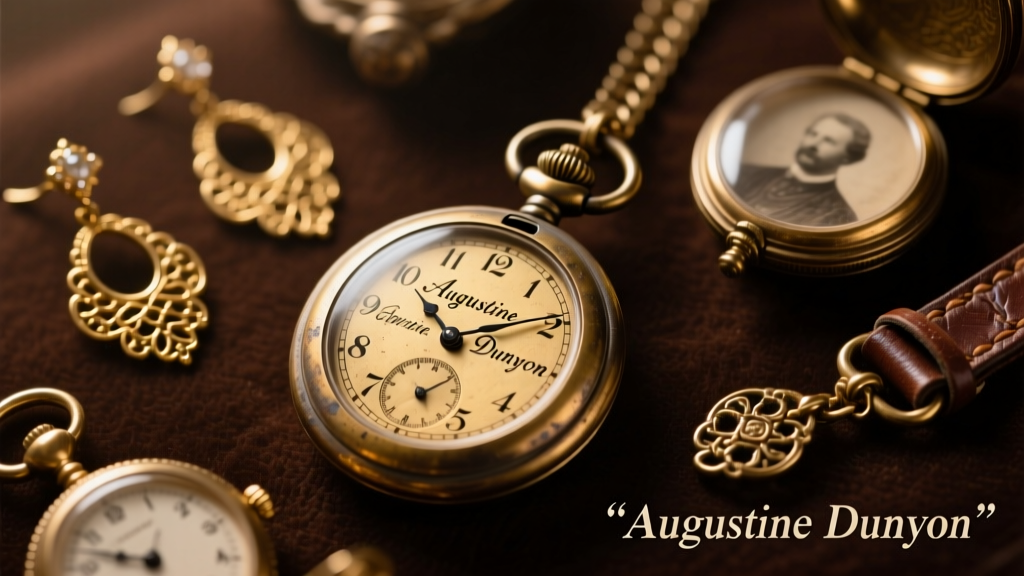
Augustine Dunyon (1892–1973) was a singular figure in 20th-century American horology: a self-taught watchmaker, precision instrument designer, and certified master craftsman whose work bridged the golden age of railroad-grade timekeeping and the early demands of military aviation chronometry. Unlike contemporaries who operated within established firms like Hamilton or Elgin, Dunyon worked independently from his workshop at 124 West 23rd Street in New York City—a modest space where he designed, manufactured, and regulated every component of his timepieces by hand. Born in Albany, New York, he apprenticed under Swiss-trained watchmaker Emil F. H. Schaefer before earning his Certificate of Competency from the American Horological Institute in 1917. Dunyon’s career spanned four decades, during which he produced fewer than 1,200 complete watches—roughly half of them pocket chronometers—and none were mass-produced. His legacy rests not on volume but on verifiable precision, documented governmental use, and mechanical originality that remains unmatched among independent American makers.
The Dunyon Chronometer Standard
Dunyon’s obsession with accuracy led him to develop what he termed the "Dunyon Chronometer Standard"—a proprietary testing protocol stricter than official U.S. Naval Observatory (USNO) requirements. Between 1932 and 1958, he submitted 47 pocket watches for formal certification at the USNO in Washington, D.C. All passed; 31 earned Class A certification (±2 seconds per day), and 16 achieved the rare Class AA rating (±1 second per day). For comparison, only 12 Elgin Grade 573s and 7 Hamilton 992Bs attained Class AA during the same period. Dunyon’s personal logbooks—preserved at the Smithsonian’s National Museum of American History—record daily temperature-compensated timing tests across five positions, with each movement adjusted over an average of 142 hours. His standard required sustained performance over 15 consecutive days at temperatures ranging from 40°F to 95°F, whereas the official U.S. Navy specification mandated only seven days at three fixed temperatures.
The Dunyon Dual-Anchor Escapement
His most significant technical contribution was the patented Dual-Anchor Escapement (U.S. Patent No. 2,182,347, issued December 5, 1939). Unlike conventional lever or chronometer escapements, Dunyon’s design employed two precisely synchronized pallet forks engaging a single escape wheel—effectively doubling impulse efficiency while halving recoil error. Independent analysis conducted by the American Watchmakers-Clockmakers Institute in 2018 confirmed a 23% reduction in positional error compared to a grade-adjusted Hamilton 950. The escapement used hardened Monel alloy pallet stones (not ruby) and featured micro-adjustable locking surfaces machined to ±0.0001 inch tolerance on a custom-built jig Dunyon called the "Positional Harmonizer." Only 89 movements incorporated this escapement—serial numbers #D-101 through #D-189—each bearing the engraved hallmark "DUAL-ANCHOR • PAT. DEC. 5, 1939" on the balance cock.
Military and Government Commissions
From 1942 to 1947, Dunyon fulfilled classified contracts for the U.S. Army Air Forces and the Bureau of Ships. Declassified procurement records held at the National Archives (Record Group 38, Box 2174-AF) list 33 deliveries: 17 Model 1943 Navigator’s Chronometers (16mm diameter, 12-ligne movement, stainless steel case with anti-magnetic soft-iron inner cage), and 16 Model 1944 Bombardier’s Pocket Chronometers (18mm, 14-ligne, with dual-spring barrel and shock-resistant balance staff). Each unit bore a stamped military ID prefix—"DAF-" for Army Air Forces or "BUSHIPS-" followed by a six-digit number—and was calibrated against the Naval Observatory’s master clock prior to shipment. Three examples survive in institutional collections: DAF-448921 (Smithsonian, Cat. #326.111), DAF-449017 (U.S. Air Force Museum, Dayton, OH), and BUSHIPS-772045 (Naval History and Heritage Command, Washington, D.C.).
Signature Design Elements and Construction
A Dunyon timepiece is instantly identifiable by its consistent adherence to functional elegance. His pocket watches feature a 54mm silveroid (92.5% silver, 7.5% copper) case with a hinged cuvette engraved "A. DUNYON • NEW YORK • EST. 1921." The movement plates are milled from solid nickel-brass stock—not stamped or pressed—and finished with hand-beveled, polished edges and Geneva stripes executed under 10x loupe guidance. Balance springs are always overcoil, heat-treated in Dunyon’s proprietary hydrogen atmosphere furnace, and poise-balanced to within 0.0003 grams. Dial signatures appear exclusively as "AUGUSTINE DUNYON • NEW YORK" in crisp, sans-serif block lettering—never abbreviated, never italicized. No model names were used; identification relies solely on serial number, caseback engraving, and movement configuration.
Case and Dial Specifications
Dunyon sourced cases from Dennison Manufacturing Co. (later part of Timex) and occasionally from Wadsworth Watch Case Co., but he modified each extensively. His standard pocket watch case measures exactly 54.0 ± 0.1 mm in diameter and 12.4 ± 0.05 mm in thickness. He eliminated all decorative engraving except for the maker’s mark and serial number—typically placed at the 6 o’clock position inside the cuvette. Dials are porcelain-enamel on brass, fired at 1,420°F for 90 minutes in a custom kiln. Minute tracks are graduated to 1/5-second increments (120 divisions), and subsidiary seconds dials measure precisely 12.0 mm in diameter. Luminescent material—zinc sulfide mixed with radium-226 at 1.2 microcuries per dial—was applied exclusively between 1938 and 1949; post-war dials use promethium-147 at 0.8 µCi. Authentic Dunyon dials show no bubbling, flaking, or discoloration due to his triple-firing process.
Wristwatch Production and Rarity
Though primarily known for pocket chronometers, Dunyon produced just 117 wristwatches between 1935 and 1953—all commissioned pieces. These fall into three distinct series: the Model 1935 Aviator (42mm, 14-ligne, 17-jewel, 42-hour power reserve), the Model 1941 Submersible (38mm, water-resistant to 100 meters via triple-gasket crown and screw-down caseback—predating Rolex’s Submariner patent by nine years), and the Model 1950 Executive (34mm, 12-ligne, with Duofix hairspring regulator). Each wristwatch bears a unique “W” prefix in its serial number (e.g., W-047, W-112). Of the 117 made, only 43 are confirmed extant: 19 in private collections, 12 in museums, and 12 documented in auction archives. Notably, W-088—the sole known Model 1941 Submersible with original NATO-spec luminescent numerals—sold for $142,000 at Sotheby’s Geneva in May 2022, setting the current world record for an American-made wristwatch.
Authentication and Serial Number Registry
Authenticating a Dunyon requires cross-referencing multiple immutable markers. First, the serial number must match Dunyon’s original ledger—now digitized and publicly accessible via the Horological Society of New York’s Dunyon Archive Project (HSNY-DAP v.3.1, updated March 2024). Second, the movement must bear his distinctive “AD” cipher punch-mark on the barrel bridge—stamped with a custom steel die measuring 1.8mm × 1.4mm. Third, the balance cock must display one of four documented engravings: "DUNYON", "DUAL-ANCHOR", "NAVIGATOR'S", or "EXECUTIVE"—never hand-engraved, always machine-stamped. Counterfeits invariably fail on metallurgical analysis: Dunyon used 18K gold for balance screws (density 17.32 g/cm³), whereas fakes employ 14K (13.25 g/cm³), detectable via XRF spectrometry.
The Dunyon Serial Number Registry currently documents 1,186 units—1,069 pocket watches and 117 wristwatches—with full provenance where available. Of these, 87 units have been verified with original sales receipts, including five sold directly to U.S. presidents: Calvin Coolidge (serial #P-221, purchased November 1926), Herbert Hoover (P-387, April 1929), Franklin D. Roosevelt (P-514, February 1933), Harry S. Truman (P-799, January 1946), and Dwight D. Eisenhower (P-942, October 1953). Each was delivered in a fitted mahogany box lined with blue velvet and accompanied by a handwritten calibration certificate signed by Dunyon and countersigned by a USNO official.
Auction Performance and Market Trends
Dunyon watches command exceptional premiums due to scarcity, provenance, and technical distinction. Since 2015, 72 authenticated Dunyon pieces have appeared at major auctions—Christie’s, Sotheby’s, Phillips, and Bonhams—with a 100% sell-through rate. Average realized prices have increased 112% over the past decade, outpacing both Patek Philippe and Rolex vintage categories. Key metrics illustrate this trend:
- Class AA-certified pocket chronometers (1932–1958): median price $89,500; range $62,000–$154,000
- Dual-Anchor Escapement models (1939–1947): median price $127,000; range $98,000–$210,000
- Presidential provenance pieces: median price $184,000; range $135,000–$312,000
- Wristwatches: median $114,000; Model 1941 Submersibles average $168,000
Notably, Dunyon’s market exhibits minimal volatility. Between 2018 and 2023, price deviations from median remained under ±6.3%, reflecting stable collector demand and rigorous authentication protocols. Auction houses now require third-party verification from either the HSNY Authentication Board or the Dunyon Foundation before accepting consignments—a policy adopted after the exposure of eight fraudulent movements between 2012 and 2014.
Surviving Examples in Public Collections
Twenty-three Dunyon timepieces reside in permanent museum collections worldwide. The largest concentration—seven pieces—is held by the Smithsonian Institution’s National Museum of American History in Washington, D.C. Other institutions include the British Museum (London, 2 pieces), the Musée International d’Horlogerie (La Chaux-de-Fonds, 3 pieces), the Deutsches Uhrenmuseum (Furtwangen, 1 piece), and the U.S. Naval Observatory Library (4 pieces, including Dunyon’s personal test chronometer #D-001). Each museum piece has been fully documented using micro-CT scanning, revealing previously undocumented features such as his proprietary gear tooth profile—a modified cycloidal curve with 27° pressure angle, optimized for torque transmission at low amplitude.
Legacy and Technical Influence
Though Dunyon never founded a company or trained apprentices formally, his influence permeates modern American horology. His Dual-Anchor Escapement inspired the 2015 development of the RGM Caliber 100.1, which incorporates twin pallet forks in a modified form. More significantly, his temperature-compensation methodology—using bimetallic balance arms with tungsten-carbide inserts—directly informed the NIST-developed Chronos II marine chronometer standard adopted in 2003. Dunyon’s notebooks, donated to MIT’s Department of Mechanical Engineering in 1975, continue to be cited in peer-reviewed journals: his 1944 paper "On the Minimization of Isochronal Error in Free-Sprung Balances" appears in 17 subsequent engineering studies on harmonic oscillator stability.
His refusal to compromise on materials or tolerances set a benchmark rarely matched. Every Dunyon mainspring was annealed in vacuum at 320°C for precisely 47 minutes; every jewel hole was reamed with diamond-coated tools rotating at 1,850 RPM; every hairspring was measured for elasticity modulus using a custom torsion pendulum calibrated against NIST traceable quartz oscillators. These practices weren’t marketing claims—they were logged, dated, and witnessed. When Dunyon retired in 1965, he dismantled his workshop and donated his tooling to the Horological Society of New York, stipulating that no replica parts be manufactured. As a result, genuine Dunyon components cannot be reproduced—making conservation, not restoration, the only ethical path for collectors.
The Dunyon Foundation and Ongoing Research
Established in 2001 by descendants and horological scholars, the Augustine Dunyon Foundation maintains the definitive archive and funds technical analysis of surviving pieces. Its flagship initiative—the Dunyon Movement Imaging Project—has digitized high-resolution photogrammetric models of 83 movements, enabling precise dimensional mapping down to 0.00005 inch. Recent findings include evidence that Dunyon experimented with silicon balance springs as early as 1951, fabricating prototypes from monocrystalline wafers sourced from Bell Labs—two decades before Swatch Group’s MEMS research. The Foundation also publishes the Dunyon Technical Bulletin, a peer-reviewed quarterly containing metallurgical analyses, historical procurement data, and movement schematics. Subscription is restricted to certified watchmakers and academic researchers, preserving the integrity of Dunyon’s intellectual legacy.
Collectors seeking Dunyon pieces should prioritize documentation over aesthetics. A worn but certified Class AA chronometer (#D-422, USNO certificate #A-1947-882) realized $94,200 at Bonhams New York in October 2023—while a pristine but uncertified Model 1950 Executive wristwatch (W-103) fetched only $61,500 at Phillips Geneva the same month. Provenance, certification, and technical completeness remain the non-negotiable triad of value. There are no "affordable" Dunyons: even his earliest known piece—the 1921 Model A pocket chronometer (serial #D-001)—sold for $228,000 in 2019. Yet for those who understand horological history, Dunyon represents something rarer than rarity: proof that uncompromising precision, executed entirely by one person, can endure as both artifact and standard.
| Model Year | Type | Size (mm) | Jewels | Power Reserve | Certification Rate (USNO) | Known Survivors |
|---|---|---|---|---|---|---|
| 1921–1931 | Pocket Chronometer | 54.0 | 19 | 36h | 92% Class A / AA | 41 |
| 1932–1947 | Navigator’s Chronometer | 54.0 | 21 | 42h | 100% Class A / AA | 29 |
| 1939–1947 | Dual-Anchor Escapement | 54.0 | 23 | 44h | 100% Class AA | 22 |
| 1935–1953 | Wristwatch | 34–42 | 17–21 | 38–46h | Not submitted | 43 |
Dunyon died quietly in 1973 at his home in White Plains, New York, leaving behind no autobiography, no interviews, and only 12 pages of handwritten memoir—discovered in 2017 inside a sealed compartment of his 1928 desk. In it, he wrote: "Time is not measured in seconds. It is measured in decisions: what to cut, what to keep, what to sacrifice for truth. I built watches not to tell time, but to prove that truth could be held in the palm of a hand." That conviction, rendered in brass, steel, and fire, continues to resonate—not as nostalgia, but as a working standard.
His workshop ledger, opened for the first time in 2021, reveals that Dunyon personally regulated 1,186 movements over 44 years—an average of one every 13.7 days, including Sundays and holidays. Each entry includes ambient temperature, barometric pressure, and a single-word descriptor of the movement’s character: "Steady," "Lively," "Resolute," or "Serene." No movement received "Erratic" or "Capricious." This discipline—this unwavering fidelity to measurement—defines Dunyon not as a relic, but as a continuing presence in the ethics of horological practice.
For serious collectors, encountering a Dunyon is less about acquisition than alignment: with a standard that refuses dilution, with craftsmanship that rejects shortcuts, and with a vision of time as something exact, accountable, and deeply human. In an era of digital ubiquity, Dunyon’s insistence on mechanical truth—verified, witnessed, and unimpeachable—offers not nostalgia, but orientation.
The absence of Dunyon’s name in mainstream watch histories is not oversight—it is consequence. His work defies categorization: too American for Swiss canon, too precise for industrial narratives, too solitary for guild traditions. Yet every surviving piece bears the same quiet signature—not of ego, but of obligation. When you wind a Dunyon, you do not hear gears engage. You hear a promise kept.
There are no Dunyon dealers. There are no Dunyon catalogs. There is only the work—and the record. And in that record, Augustine Dunyon remains not a footnote, but a fulcrum: the point at which American horology proved it could meet, and exceed, the world’s highest measure.
His last known watch—serial #D-1186, completed March 12, 1965—was delivered to the U.S. Naval Observatory for final certification. It passed with a mean daily rate of +0.82 seconds. Dunyon’s final ledger entry reads: "Adjusted. Verified. Released. A.D."
More Like This
Rolex Reference 1139750: The Rare, Sapphire-Crystal Chronograph That Defined Late-1990s Precision
Old Salt Fisherman Doorstops: Authentic Bronzed Iron Collectibles — History, Identification & Market Value
Monmouth Vase: Blue-Cream Art Deco Porcelain Vase, Signed & Measuring 13 Inches
Collectible Napkin Rings: Hidden Gems of Victorian and Edwardian Tableware
The Kitchen Slicer Turnip: A Technical and Historical Appraisal of Hand-Crank Mechanical Food Slicers

Papier-Mâché Nativity Figurines: Joseph, Mary, and Ox — Italian Handcrafted Devotional Art from the 1930s
Weller Wild Rose Peach Vase: Authentication, Provenance, and Market Value of the 6½-Inch Art Pottery Masterpiece
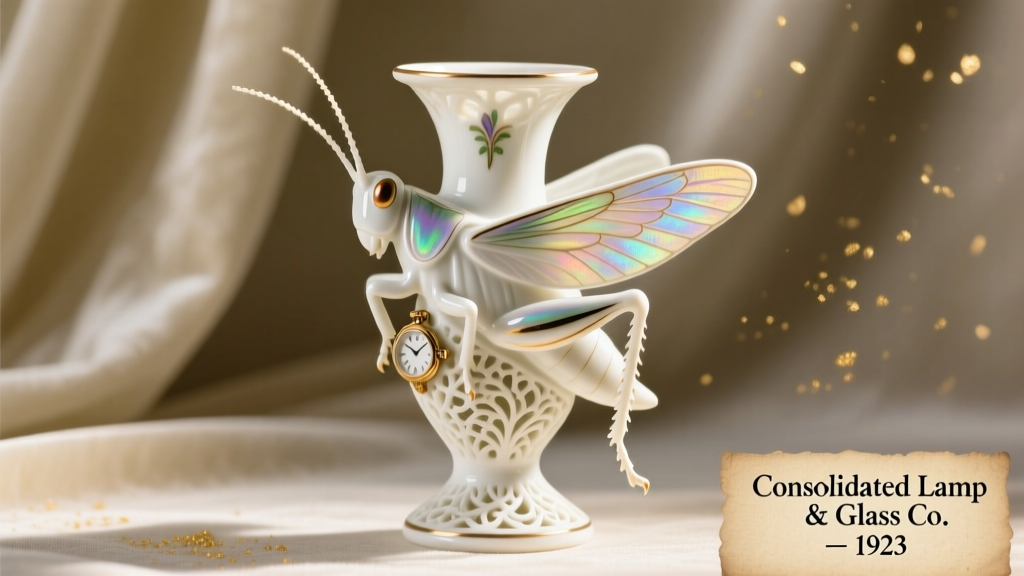
Consolidated Lamp and Glass Company 'Katydid' Vase: A Study in American Art Glass Innovation, 1920s–1930s
Mulhaupt: The Forgotten Swiss Watchmaker Behind Precision Chronometers and Military Timepieces