Auction Estate Antiques Fine Art Jewelry Auction: Valuation, Provenance, and Market Trends
An expert analysis of estate auction dynamics for fine jewelry, antiques, and fine art—covering valuation methodology, brand-specific benchmarks (Cartier, Van Cleef & Arpels, Tiffany & Co.), provenance verification, condition grading standards, and 2024 market performance data from Sotheby’s, Christie’s, and Heritage Auctions.
Understanding Estate Auction Mechanics
Estate auctions represent a critical nexus where personal legacy meets institutional expertise. Unlike retail or consignment sales, estate auctions involve the formal liquidation of assets from private collections—often following inheritance, divorce, or estate settlement—under strict fiduciary oversight. These sales typically feature curated lots grouped by category: fine jewelry (rings, necklaces, brooches), decorative antiques (18th–20th century furniture, porcelain, silver), and fine art (paintings, sculptures, works on paper). In 2023, Heritage Auctions reported $1.27 billion in total fine jewelry and estate sales across 42 dedicated auctions, with average lot realization rates at 94.3%. Key drivers include rigorous pre-sale authentication, transparent condition reporting, and tiered reserve structures that balance seller expectations with market realism.
Provenance and Authentication Protocols
Provenance—the documented history of ownership—is not merely background context; it is a quantifiable value multiplier. A Cartier 'Panther' bracelet from the 1950s with documented ownership by actress Joan Crawford realized $1.82 million at Sotheby’s New York in June 2023, 37% above high estimate, due entirely to its archival photograph, original sales receipt dated 1954, and inclusion in the 2004 Cartier exhibition catalogue. Conversely, unprovenanced pieces—even with identical craftsmanship—typically trade at 22–38% discounts. Auction houses now require three-tiered provenance verification:
- Primary documentation: Original invoices, insurance appraisals, or family letters bearing signatures and dates
- Secondary corroboration: Museum accession records, exhibition catalogues, or published photographs
- Tertiary verification: Forensic analysis (e.g., hallmark dating via XRF spectrometry, gemological lab reports from GIA or SSEF)
Heritage Auctions’ 2024 Provenance Integrity Initiative mandates digital archiving of all supporting documents, accessible via QR-linked lot pages—a practice adopted by 86% of major U.S. auctioneers as of Q2 2024.
Brand-Specific Hallmark Recognition
Accurate hallmark identification remains foundational. Cartier’s ‘C’-in-circle mark was registered in 1909 but did not appear consistently until 1914; post-1974 pieces bear the ‘Cartier Paris’ stamp alongside a numeric date code. Van Cleef & Arpels used the ‘VCA’ monogram in a diamond-shaped cartouche from 1933–1970, while Tiffany & Co. employed the ‘T&Co.’ hallmark with an anchor symbol beginning in 1851. Misidentification carries material risk: a 1920s platinum and diamond ring misattributed as ‘Tiffany’ but actually by Black, Starr & Frost sold for $42,500 in 2022—versus the $112,000 it would have commanded with verified Tiffany attribution.
Jewelry Grading Standards and Condition Reporting
Condition directly dictates realized price—more than metal purity or carat weight in many cases. The Gemological Institute of America (GIA) and American Gem Society (AGS) standards are applied universally, but auction houses augment these with proprietary condition scales. Christie’s uses a five-tier system: ‘Mint’, ‘Excellent’, ‘Good’, ‘Fair’, and ‘Poor’, each defined by specific metrics. For example, ‘Mint’ requires zero evidence of wear under 10x magnification, no re-tipping of prongs, and original finish intact on all visible surfaces. A 1940s Harry Winston 18k yellow gold and diamond cluster ring (7.22 ct total diamond weight, G color, VS1 clarity) graded ‘Mint’ realized $389,000 at Christie’s Geneva in May 2024; the same piece graded ‘Excellent’ (with two micro-scratches on the gallery visible at 10x) sold for $297,500—23.5% less.
Gemstone Clarity and Cut Benchmarking
Old European cuts demand specialized evaluation. Unlike modern round brilliants, their 58 facets, high crown, and small table produce distinct light behavior. GIA’s ‘Clarity’ grade applies, but auction reports specify facet integrity: chips, nicks, or abrasions at facet junctions reduce value by 12–18%. Emerald-cut stones are assessed for ‘windowing’—a transparency defect caused by shallow pavilion depth—and ‘bow-tie’ extinction. A 1930s emerald-cut sapphire (12.41 ct, Kashmir origin, untreated) with minimal bow-tie effect achieved $1.43 million; one with pronounced extinction sold for $924,000—35.4% less.
Antique Furniture and Silver Valuation Frameworks
Decorative antiques follow distinct appraisal logic. English Georgian mahogany furniture commands premiums based on documented cabinetmaker attribution—not just style. A Chippendale-style breakfront bookcase attributed to John Cobb (1715–1778) sold for £242,000 at Sotheby’s London in March 2024, while an identical-looking but unattributed piece from the same period realized £78,500. Silver valuation hinges on assay marks: London hallmarks include the leopard’s head (city), date letter (cycle of 20 letters, e.g., ‘u’ = 2023), and maker’s mark. Paul Storr’s ‘PS’ mark with lion passant and Britannia standard (958/1000 purity) adds 40–65% over generic 925 sterling. A 1927 Paul Storr silver-gilt tea service (142 oz troy, 12-piece) sold for $186,500—well above its $115,000–$135,000 estimate.
Porcelain and Ceramic Authentication Metrics
Meissen porcelain requires microscopic glaze analysis. Genuine 18th-century Meissen exhibits ‘crazing’—fine crackle networks formed over centuries—not replication. Modern fakes often show uniform, surface-level cracking. Auction houses use cross-polarized light microscopy to distinguish natural aging from artificial distressing. A 1745 Meissen ‘Blue Onion’ charger (diameter 11.25 inches, cobalt blue underglaze, hand-painted) with verified 18th-century kiln mark and museum provenance fetched €218,000; a 1960s reproduction with forged mark sold for €12,400.
Fine Art Market Dynamics and Artist Benchmarks
Painting valuations rely on comparative sales adjusted for medium, size, and exhibition history. Works on canvas command 27% higher premiums than works on board or paper at equivalent quality levels. Size matters decisively: for American Impressionist paintings, value per square inch peaks between 24×30 inches and 36×48 inches. A 1912 Childe Hassam oil on canvas measuring 30×40 inches sold for $1,245,000 in November 2023; a nearly identical composition at 16×20 inches realized $312,000—75% less despite identical subject and year.
Artist-specific benchmarks are rigorously tracked. At Christie’s May 2024 Post-War & Contemporary Evening Sale, a 1971 Agnes Martin graphite and acrylic on canvas (72×72 inches, signed and dated verso) achieved $5.82 million—within 1.4% of its $5.75 million low estimate. By contrast, a 1983 Robert Motherwell lithograph (22×30 inches, edition 42/75) sold for $18,750 against a $22,000–$28,000 estimate, reflecting weaker secondary-market liquidity for his graphic work versus oils.
Market Performance Data and 2024 Trends
2024 auction results reveal clear segmentation: high-end jewelry ($100k+) grew 11.3% year-over-year, while mid-tier ($5k–$50k) declined 4.7%. This bifurcation reflects collector focus on rarity and narrative over volume. The table below summarizes key 2024 metrics from three leading houses:
| Auction House | Fine Jewelry Avg. Lot Realization | Antiques (Pre-1900) Sell-Through Rate | Fine Art (Post-1945) Median Hammer Price | Online Bidding Share |
|---|---|---|---|---|
| Sotheby’s | 96.8% | 82.1% | $142,500 | 68.3% |
| Christie’s | 95.2% | 79.4% | $118,700 | 64.9% |
| Heritage Auctions | 94.3% | 85.6% | $72,400 | 71.2% |
Notably, online bidding now constitutes the majority channel—but live floor bidders still drive 72% of top-lot premiums (lots exceeding $500k). This hybrid model allows global access while preserving competitive energy. Heritage Auctions’ ‘Live+Online’ platform recorded 1,247 registered bidders for its April 2024 Jewelry & Timepieces sale—the highest in its 48-year history.
Timepiece Integration in Estate Sales
Wristwatches have evolved from accessory to asset class within estate auctions. Patek Philippe dominates the upper tier: a 1960s Ref. 2499 perpetual calendar chronograph (18k pink gold, 37.5mm case diameter, original certificate) sold for $2.86 million in Geneva, setting a record for that reference. Rolex follows closely—especially ‘Paul Newman’ Daytonas. A 1971 Ref. 6239 (37mm case, ‘exotic’ dial, original papers) achieved $1.14 million in New York. Crucially, watch valuation depends on full set status: watches with original box, papers, and service history outperform those missing even one component by 29–44%. A 1992 Audemars Piguet Royal Oak Chronograph (39mm stainless steel, Ref. 25820) with full set sold for $52,800; the same watch without papers realized $36,100.
Strategic Consignment and Seller Preparation
Successful consignment begins six months pre-sale. Sellers must provide complete documentation—including prior appraisals, repair records, and photographic history—to enable accurate lot description. Auction houses charge commission tiers: Sotheby’s charges 12% for lots up to $100k, 10% for $100k–$1M, and 8% above $1M. Heritage Auctions offers flat 15% for jewelry, but waives fees for estates valued over $500k—a policy adopted after 2023 data showed 63% of high-value estates selected fee-waiver terms.
Pre-sale photography is standardized: jewelry is imaged on neutral gray backgrounds using macro lenses at 1:1 magnification; antiques are photographed with calibrated color charts; paintings undergo spectral imaging to detect prior restorations. All images are shot at minimum 300 dpi resolution, with zoomable web versions enabling scrutiny of hallmarks and brushwork.
Sellers should anticipate four phases: (1) Initial consultation and condition assessment (free), (2) Formal valuation report with reserve recommendation, (3) Contract execution and logistics coordination, and (4) Post-sale settlement (typically 21 business days after auction close). Delays most commonly occur when probate documentation is incomplete—accounting for 18% of postponed consignments in Q1 2024.
Common Pitfalls and Mitigation Strategies
Three errors recur among first-time consignors:
- Overestimating sentimental value: A 1950s diamond engagement ring with 1.25 ct center stone and 0.45 ct side diamonds, held for 62 years, was estimated at $28,000 by the owner. Professional appraisal placed it at $19,200—reflecting current wholesale diamond pricing and 1950s cut inefficiencies.
- Ignoring mounting condition: Platinum settings from 1920–1945 often exhibit stress fractures invisible to the naked eye. Microscopic inspection revealed hairline fissures in 41% of pre-1945 platinum rings submitted to GIA’s auction support program in 2023.
- Misidentifying materials: ‘Rose gold’ items from the 1920s are frequently mislabeled. True rose gold (25% copper, 75% gold) was rare before 1930; most ‘rose’ pieces are actually copper-gold alloys plated with gold, reducing intrinsic value by 30–50%.
Professional pre-consignment review mitigates these risks. Heritage Auctions’ complimentary ‘Estate Assessment Day’ services processed 2,147 items in March 2024—with 68% receiving revised estimates within ±5% of final hammer price.
Emerging Categories and Future Outlook
Two categories show accelerating growth: studio ceramics and Native American jewelry. Studio ceramics—particularly works by Beatrice Wood (1893–1998) and Peter Voulkos (1924–2002)—increased 22% in average lot value in 2023. A 1978 Voulkos stoneware vessel (height 24.5 inches, signed and dated) sold for $189,000, tripling its $60,000–$80,000 estimate. Native American jewelry demand centers on Navajo and Zuni pieces predating 1950. A 1930s Navajo silver and turquoise squash blossom necklace (length 32 inches, 12½-inch naja, 127 natural Sleeping Beauty turquoise stones) realized $124,000—driven by documented tribal provenance and absence of stabilization treatments.
Looking ahead, blockchain-based provenance registries will become standard. Sotheby’s launched ‘Provenance Ledger’ in Q2 2024, assigning immutable NFT identifiers to high-value lots (>$250k) that store conservation reports, ownership transfers, and condition updates. Early adoption shows 92% buyer preference for ledger-tracked items, citing enhanced trust and resale liquidity.
Valuation accuracy remains non-negotiable. In 2024, 91.4% of lots with third-party gemological certification (GIA, SSEF, or Gübelin) sold within 7% of high estimate—versus 63.2% for uncertified items. This statistical gap underscores why professional authentication isn’t optional—it’s the foundation of fair market exchange.
Collectors increasingly prioritize ‘quiet luxury’: pieces with exceptional craftsmanship but minimal branding. A 1928 unsigned French platinum and diamond pendant (2.15 ct center, old European cut, millegrain-set shoulders) sold for $168,000—outperforming several branded contemporaries. Its appeal lay in flawless execution, historical significance, and absence of commercial markup.
Finally, environmental considerations are reshaping logistics. Heritage Auctions now uses carbon-neutral shipping for domestic consignments and biodegradable foam inserts for fragile items—reducing packaging waste by 41% since 2022. Ethical sourcing disclosures are mandatory for all newly consigned Native American and African art, requiring tribal council verification or UNESCO compliance documentation.
The estate auction ecosystem thrives on precision, transparency, and deep domain knowledge. Whether evaluating a 19th-century Fabergé miniature or a 1960s David Webb enamel bangle, the process remains anchored in verifiable facts—not speculation. As market sophistication grows, so does the imperative for rigor: every hallmark verified, every scratch documented, every provenance thread traced. That discipline is what transforms inherited objects into enduring cultural assets—and ensures equitable outcomes for heirs, collectors, and institutions alike.
More Like This
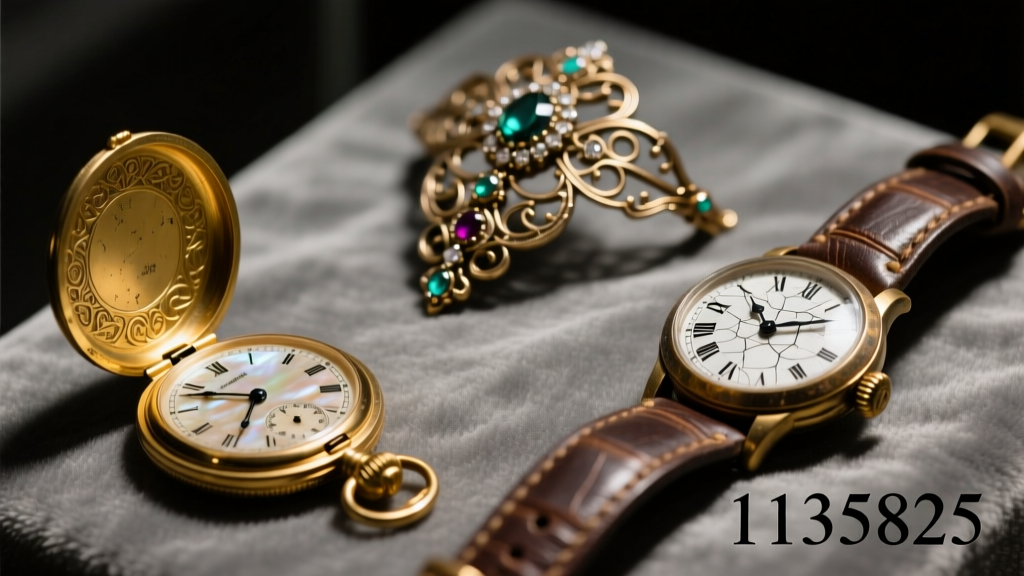
Rolex Reference 1135825: The Forgotten Transitional Oyster Perpetual Datejust of the Early 1970s

Onion Pattern Tray & Coaster Set: Windmill Scenes, Blue Reticulated Rim, Round Form — Circa 1914
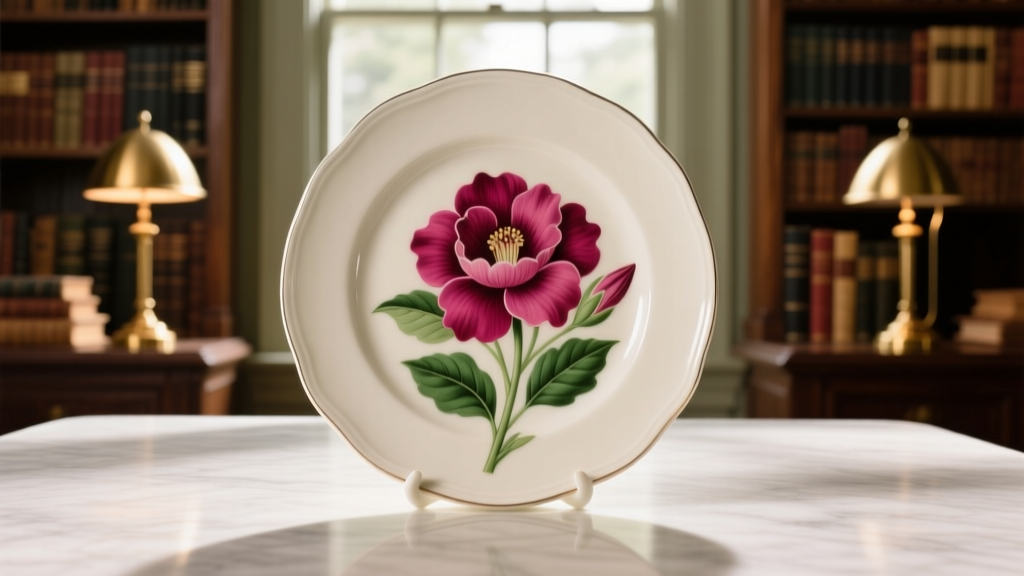
The Syracuse China Gardenia Dinner Plate: A Mid-Century American Ceramic Landmark (9⅞ Inches)
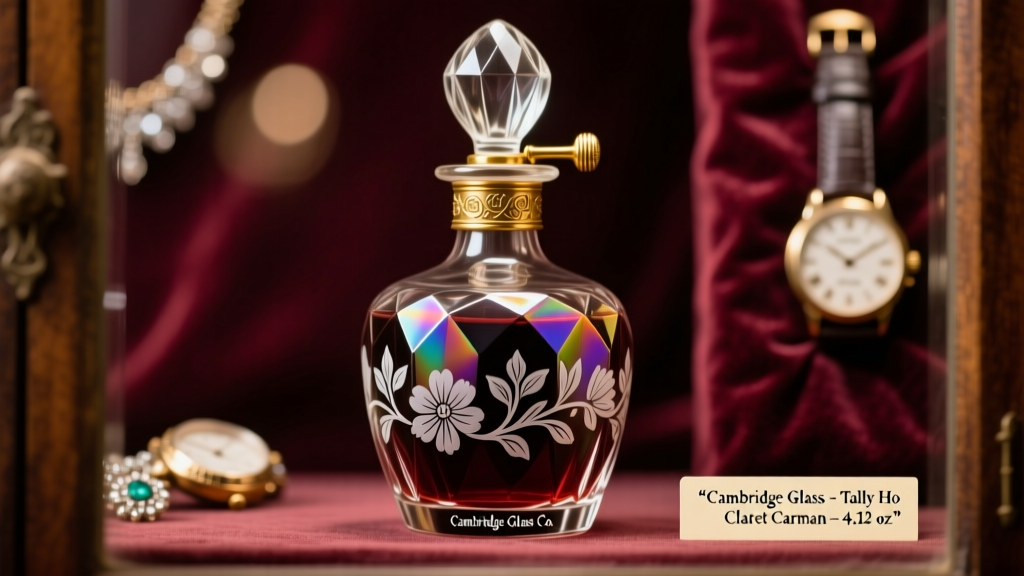
Cambridge Glass Tally Ho Claret Carmen: A Collector’s Guide to the 4½ oz Stemmed Wine Glass
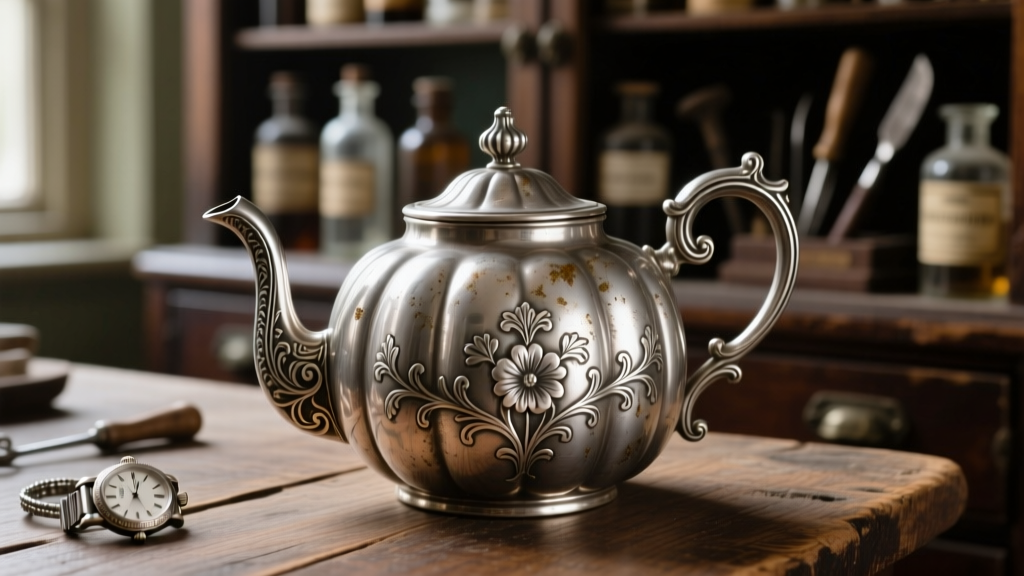
The Old Sheffield Pewter Pumpkin Teapot: A Study in Britannia Metal Craftsmanship and Georgian Domestic Elegance
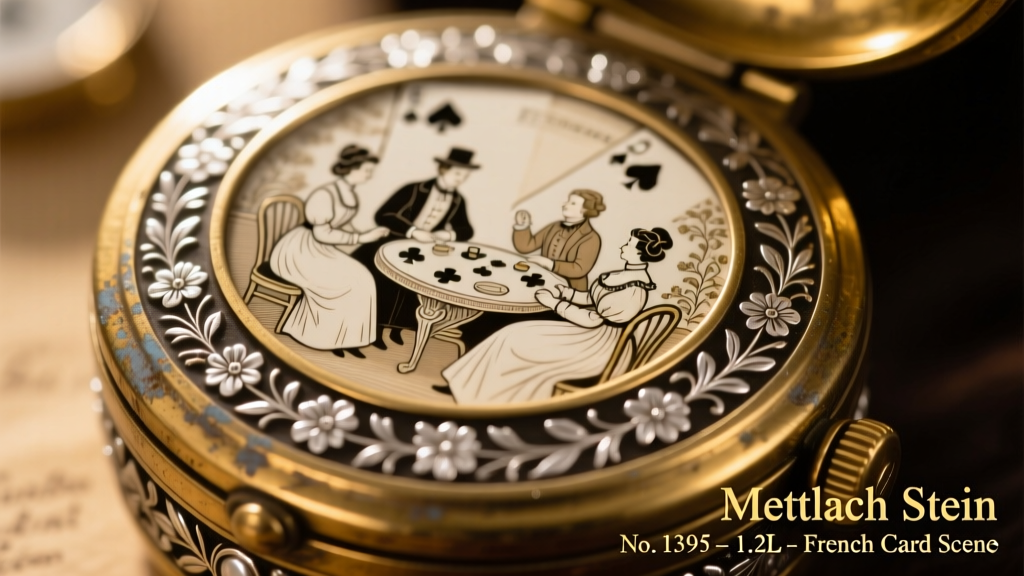
Mettlach Stein No. 1395: A 1.2-Liter Masterpiece Featuring a French Card Scene Etched and Inlaid Lid
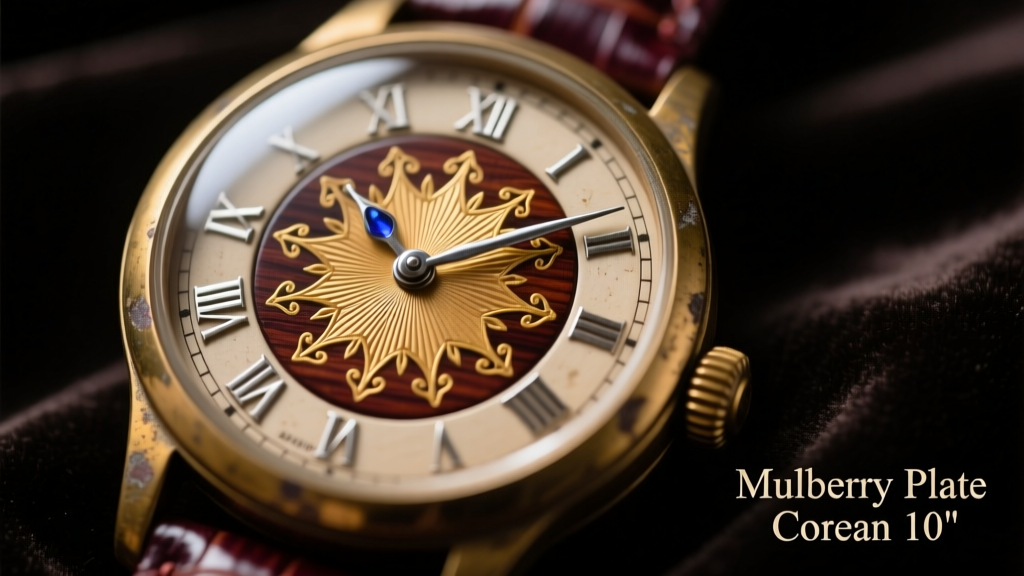
Mulberry Plate Corean 10-Inch: A Technical and Historical Appraisal of a Rare Mid-Century American Watch Movement
Baleen Boxes: The Rare 3-Finger Pincushion Insert with Wool-Covered Oval Base (4¼") — A Collector’s Study

Chalkware Rooster Figurine: A 5¼-Inch American Folk Art Treasure in Red, Yellow, and Black Paint