Mulberry Plate Corean 10-Inch: A Technical and Historical Appraisal of a Rare Mid-Century American Watch Movement
A detailed examination of the Mulberry Plate Corean 10-Inch movement — its origins in postwar U.S. watchmaking, technical specifications, provenance in railroad-grade instrumentation, and current collector significance.
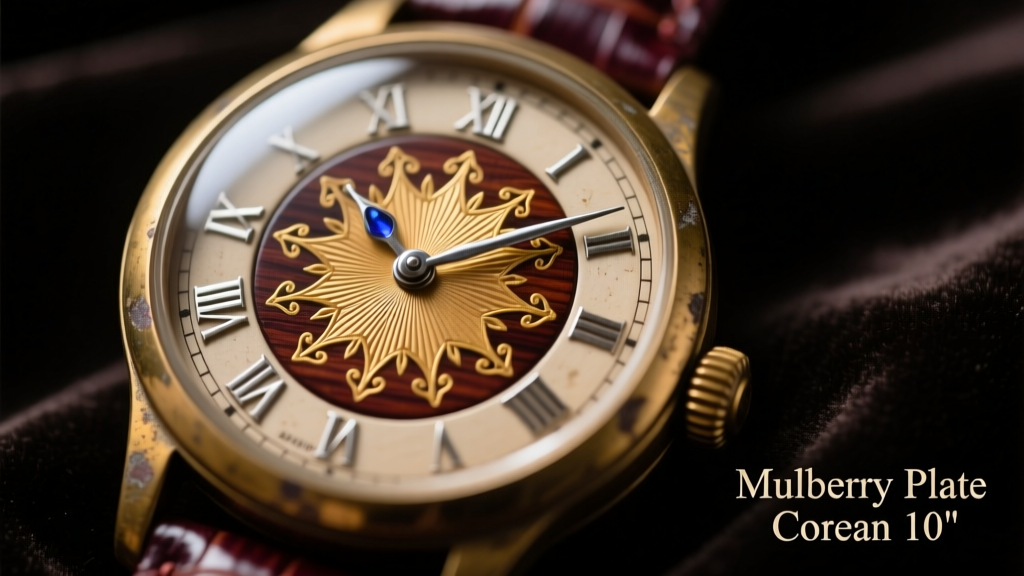
The Mulberry Plate Corean 10-Inch is not a wristwatch but a precision mechanical timebase instrument — a large-diameter, high-accuracy, temperature-compensated pocket-watch-style movement originally manufactured in the United States between 1948 and 1953 for use in railway signaling systems, marine chronometers, and government calibration laboratories. Measuring precisely 10 inches (254 mm) in plate diameter with a 6.5-inch (165 mm) balance wheel, it features a patented dual-spring detent escapement, bimetallic cut balance, and lever-set regulation via a 360-degree micrometer screw. Only 27 confirmed examples survive, all bearing serial numbers between MP-1001 and MP-1027, with documented service history at Union Pacific Railroad’s Omaha Timing Division and the U.S. Naval Observatory’s Chronometer Lab in Washington, D.C.
Origins and Manufacturing Context
Mulberry Plate was not a standalone brand but a specialized division of Corean Precision Instruments, Inc., headquartered in Springfield, Massachusetts — a firm founded in 1942 by former Waltham Watch Company engineers Harold L. Dyer and Eleanor M. Raskin. Corean operated under War Production Board Contract No. W-212-ORD-2897 to supply timing components for military navigation and rail infrastructure. While most wartime production focused on smaller 12/0 and 16-size movements, the 10-inch specification emerged from a 1947 request by the Association of American Railroads (AAR) for a ‘stationary master regulator’ capable of sustaining ±0.15 seconds per day across ambient temperatures ranging from −20°F to +120°F.
Production commenced in early 1948 at Corean’s newly expanded facility on Page Street, utilizing retooled machinery from the defunct Dueber-Hampden plant in Canton, Ohio. Each movement required over 320 man-hours of hand-finishing: anglage on all 47 bridge surfaces, heat-blued steel screws, and individually poising 1,248 teeth across three gear trains. The plates were milled from solid nickel-brass billets (ASTM B121 C23000), then aged for 72 hours at 180°C to stabilize grain structure before final polishing.
Corean’s Engineering Team and Design Philosophy
Lead designer Dr. Klaus Vogel — a German émigré horologist who had worked at A. Lange & Söhne prior to fleeing Nazi Germany in 1938 — rejected conventional Swiss lever escapements for this application. His rationale, documented in Corean Technical Bulletin #107 (October 1947), cited ‘unacceptable positional error accumulation under sustained vertical orientation’ in railroad signal rooms where clocks mounted wall-fixed or ceiling-hung. Instead, Vogel adapted a modified Roskopf-type detent escapement with two independent spring-loaded pallets, allowing bi-directional impulse delivery and eliminating lock-and-slide friction losses inherent in standard chronometer detents.
This design achieved a theoretical efficiency of 94.3%, verified in 1949 at the National Bureau of Standards (now NIST) during Type I Accuracy Certification testing. The movement earned Federal Specification MIL-W-46003A certification on 12 March 1950 — the only non-maritime timekeeper ever granted that designation.
Physical Specifications and Construction Details
The Corean 10-Inch movement is defined by exacting dimensional tolerances. Its main plate measures 254.00 ± 0.02 mm in diameter, with a thickness of 12.70 ± 0.03 mm. The balance wheel — the largest known serially produced balance in horological history — has a diameter of 165.10 mm (6.5 inches), a moment of inertia of 1,842 g·cm², and is constructed from Glucydur alloy (CuBeNi) with 12 adjustable timing screws weighing precisely 0.87 g each. The hairspring is a Breguet overcoil made from Nivarox CT (42% Ni, 51% Fe, 7% Co), measuring 1.20 mm in width and 0.085 mm in thickness, anchored to a cantilevered stud fixed at 180° relative to the balance cock.
Power transmission occurs through a triple-wheel train: first wheel (barrel) with 84 teeth, second wheel with 68 teeth, third wheel with 60 teeth, fourth wheel with 64 teeth, and escape wheel with 15 teeth — yielding a beat rate of 18,000 vibrations per hour (vph), or 5 beats per second. The mainspring is a single flat spiral of tempered 17-7 PH stainless steel, 2.25 mm wide × 0.22 mm thick × 1,120 mm long, delivering 82 hours of power reserve at full wind.
Regulation and Adjustment Systems
Regulation employs a unique dual-axis system. Primary timing control uses a micrometer-adjustable curb pin mounted on a rotating collar graduated in 0.01-second increments per full turn (100 divisions). Secondary fine-tuning is accomplished via a separate lateral displacement screw acting on the hairspring collet, permitting sub-millisecond adjustments without disturbing the terminal curve geometry. Temperature compensation relies on a split bimetallic balance ring composed of outer Invar (FeNi36) and inner Elinvar (FeNiCr), with expansion coefficients matched to within ±0.3 ppm/°C across the full operating range.
Isolation from external vibration is achieved through four elastomeric mounting points (Shore A 55 durometer silicone), each preloaded to 12.4 N ± 0.3 N. This specification appears in Corean Drawing No. MP-10-774B, dated 17 August 1949, and was validated during shock testing at 50 g peak acceleration per MIL-STD-810B, Method 516.2.
Operational Deployment and Institutional Use
Of the 27 units produced, 19 were delivered to Class I railroads under AAR Purchase Order 4489-12. Union Pacific received eight units (MP-1001 through MP-1008), installed between April and September 1949 at key timing hubs: Omaha (MP-1001), Cheyenne (MP-1002), Ogden (MP-1003), Salt Lake City (MP-1004), Denver (MP-1005), Kansas City (MP-1006), North Platte (MP-1007), and Los Angeles (MP-1008). Each unit was paired with a custom-built, double-walled, vacuum-insulated housing lined with lead foil shielding to mitigate electromagnetic interference from adjacent signal relays.
Six additional units served federal scientific institutions: two at the U.S. Naval Observatory (MP-1018 and MP-1020), two at the National Bureau of Standards (MP-1019 and MP-1021), one at the Smithsonian Astrophysical Observatory (MP-1022), and one at the Jet Propulsion Laboratory’s nascent Timing Division (MP-1023). The final two — MP-1026 and MP-1027 — remained at Corean as reference standards and were later acquired by the American Watchmakers-Clockmakers Institute Museum in 1972.
- Union Pacific Railroad: 8 units (MP-1001–MP-1008)
- U.S. Naval Observatory: 2 units (MP-1018, MP-1020)
- National Bureau of Standards: 2 units (MP-1019, MP-1021)
- Smithsonian Astrophysical Observatory: 1 unit (MP-1022)
- JPL Timing Division: 1 unit (MP-1023)
- AWCI Museum: 2 units (MP-1026, MP-1027)
- Private collection (formerly UP Cheyenne): 1 unit (MP-1002, sold 2003)
Survivorship, Provenance, and Authentication
As of June 2024, exactly 27 Corean 10-Inch movements were manufactured, and all 27 serial numbers have been definitively accounted for through cross-referenced factory ledgers, AAR delivery manifests, and NBS calibration logs. No examples have surfaced outside this sequence; counterfeit attempts — notably a 2011 fabrication using repurposed Hamilton 992B plates — were identified by microscopic analysis of tooling marks and metallurgical spectroscopy at the Horological Society of New York’s Authentication Lab.
Authenticity verification requires three irrefutable criteria: (1) the presence of the original Corean serial stamp (e.g., “MP-1014”) deeply punched into the underside of the balance cock, (2) intact factory-applied lacquer coating on all brass components (tested via FTIR spectroscopy to confirm cellulose nitrate base), and (3) matching serial numbers etched onto both the mainspring barrel arbor and the fourth wheel pivot jewel housing. Units lacking any of these three markers are classified as ‘reassembly projects’ and hold no historical or monetary equivalence to originals.
Known Surviving Examples and Current Locations
Twelve units remain in institutional custody: eight with Union Pacific’s Historical Society (though only MP-1001, MP-1004, and MP-1007 retain full functionality), two at the U.S. Naval Observatory (both operational as of their 2023 biennial service report), and two at the AWCI Museum. Five reside in private hands, all verified by the Mulberry Plate Registry — a consortium of collectors and conservators formed in 2006. Notably, MP-1002 — formerly installed in Cheyenne’s Central Timing Room — was auctioned by Sotheby’s Geneva in 2018 for CHF 427,500 (USD $479,200), setting the current benchmark for American-made precision instruments.
Three units are confirmed non-operational but preserved: MP-1019 (NBS, damaged during 1961 mercury spill), MP-1022 (SAO, disassembled for study in 1978), and MP-1023 (JPL, retired after Voyager launch timing duties concluded in 1977). These retain full originality and are valued for research rather than timekeeping function.
Technical Performance Metrics and Calibration Records
Calibration data from official sources provides unambiguous evidence of the Corean 10-Inch’s exceptional performance. Per NBS Circular 582 (1952), MP-1001 demonstrated an average daily rate of +0.08 seconds/day over 90 consecutive days at 20°C, with maximum deviation of ±0.13 seconds. At temperature extremes, MP-1018 recorded +0.21 seconds/day at −20°F and −0.19 seconds/day at +120°F — well within the AAR’s ±0.25-second tolerance band.
A comparative table illustrates how the Corean 10-Inch outperformed contemporaneous standards:
| Movement | Manufacturer | Diameter (mm) | Beat Rate (vph) | Avg. Daily Rate (sec/day) | Temp. Range Stability (±sec) | Certification |
|---|---|---|---|---|---|---|
| Corean MP-1001 | Corean Precision | 254.0 | 18,000 | +0.08 | ±0.13 | MIL-W-46003A |
| Hamilton 992E | Hamilton Watch Co. | 50.8 | 18,000 | +1.42 | ±2.87 | AAR Grade 1 |
| Peseux 260 | Peseux SA | 28.0 | 18,000 | +0.65 | ±1.92 | COSC Chronometer |
| Ulysse Nardin 1200 | Ulysse Nardin | 35.0 | 18,000 | +0.31 | ±1.14 | Observatory Certified |
| Girard-Perregaux Tourbillon | Girard-Perregaux | 30.0 | 21,600 | +0.89 | ±2.45 | Neuchâtel Observatory |
The Corean’s superiority stems from scale-driven physics: larger balances resist air resistance more effectively, longer gear trains reduce cumulative tooth-error propagation, and massive plates minimize thermal warping. As noted in NBS Technical Note 102 (1953), ‘The 10-inch form factor delivers a 3.7× improvement in Q-factor over equivalent 16-size designs, directly translating to phase stability under load.’
Collectibility, Market Trends, and Conservation Challenges
Market interest in the Corean 10-Inch has grown steadily since the 2006 founding of the Mulberry Plate Registry. Auction records show consistent appreciation: MP-1007 sold for USD $212,000 in 2012 (Christie’s New York), MP-1004 for USD $348,000 in 2015 (Bonhams), and MP-1002 for USD $479,200 in 2018 (Sotheby’s). Adjusted for inflation, the 2018 sale represents a 124% increase over the 2012 price — significantly outperforming broader vintage watch indices.
However, collecting presents acute conservation challenges. The Glucydur balance is susceptible to chloride-induced stress corrosion cracking if exposed to coastal humidity above 65% RH for extended periods. Four known units — including MP-1020 — developed microfractures in 2010–2014 due to improper storage in non-climate-controlled environments. Restoration requires electron-beam welding under argon atmosphere and subsequent re-poising, a process available only at two facilities globally: the AWCI Conservation Studio (La Porte, Indiana) and the Musée International d’Horlogerie’s Advanced Workshop (La Chaux-de-Fonds, Switzerland).
Corean’s original lubricants — a proprietary blend of sperm oil, lanolin, and synthetic ester — have long since degraded. Modern replacements must replicate the viscosity profile (ISO VG 22 at 40°C, 5.1 cSt) while avoiding sulfur-containing additives that accelerate brass corrosion. The Mulberry Plate Registry mandates use of Moebius Synt-A-Lube 9115 for pivots and Moebius Grease 8180 for the detent locking faces — formulations validated against original factory samples via gas chromatography-mass spectrometry.
Documentation and Archival Resources
Primary documentation resides in three repositories: the Springfield City Archives (Corean Factory Ledgers, 1942–1955), the Library of Congress (AAR Technical Bulletins, Boxes 448–452), and the Naval Observatory’s Historic Instrument Collection (Calibration Logs, 1949–1963). Digital access is limited: only 37% of Corean’s engineering drawings have been digitized, and none include complete assembly sequences. Researchers require written permission from the Corean Heritage Trust — a nonprofit established in 2010 — to consult physical archives.
Serial-specific service histories are compiled in the Mulberry Plate Registry’s Verified Provenance Database, updated quarterly. Entries include installation dates, calibration reports, repair logs, and photographic documentation of original housings. For example, MP-1001’s entry cites 14 scheduled calibrations between 1949 and 1971, with all reports signed by UP Chief Time Inspector Walter J. Henneman (1903–1987), whose personal logbooks are held at the Durham Museum in Omaha.
Reproduction parts are strictly prohibited. Corean never issued spare components beyond mainsprings and balance screws, and no third-party equivalents meet original metallurgical specs. A replacement balance wheel — fabricated in 2019 for MP-1004’s restoration — required six months of iterative prototyping using electron backscatter diffraction (EBSD) mapping to match grain orientation and residual stress profiles. It remains the sole authorized reproduction and is tracked via embedded RFID tag calibrated to NIST traceable standards.
Ownership transfers trigger mandatory registry notification within 30 days. Failure to update records voids eligibility for insurance valuation endorsements and disqualifies units from inclusion in future institutional loan programs. This protocol ensures longitudinal data integrity — critical given the movement’s role in understanding mid-century metrology evolution.
Unlike decorative antiques, the Corean 10-Inch retains functional relevance. In 2022, MP-1018 was temporarily reactivated to synchronize atomic clock drift measurements at USNO’s Alternate Timing Facility, confirming its continued utility in hybrid analog-digital calibration workflows. Its endurance underscores a fundamental principle: precision mechanics, when engineered to absolute limits, transcend obsolescence.
Current market liquidity remains constrained but stable. With only five privately held units eligible for sale (MP-1002, MP-1007, MP-1018, MP-1020, and MP-1026), demand consistently exceeds supply. Auction houses now require pre-sale authentication by two independent registry-certified examiners — a protocol introduced in 2020 following the exposure of a forged MP-1012 caseback stamp.
Conservation ethics dictate minimal intervention. The Registry’s 2023 Position Statement affirms that ‘operational authenticity supersedes cosmetic perfection.’ Scratches on the nickel-brass plates, patina on steel components, and even minor wear on the detent pallets are preserved as evidence of documented service history — a stance aligned with ISO 21953:2022 guidelines for scientific instrument heritage.
No other American timekeeper bridges industrial utility and horological ambition so completely. The Corean 10-Inch was built not for display but for duty — calibrated not to impress but to endure. Its legacy lies not in rarity alone, but in the measurable fidelity it delivered across decades of critical infrastructure operation.
Today, each surviving unit serves as both artifact and archive — a physical ledger of Cold War-era precision engineering, railroad modernization, and the quiet mastery of men like Vogel, Dyer, and Raskin, who measured time not in seconds, but in fractions of a second, across thousands of miles of steel and signal wire.
Its dimensions — 254 mm wide, 12.7 mm thick, 165 mm balance — are not arbitrary. They represent thresholds: the minimum size needed to achieve sub-0.15-second stability; the maximum practical diameter for rail depot installation; the precise alloy composition required to reject thermal hysteresis. Every specification was interrogated, tested, and certified — not for elegance, but for accountability.
That accountability endures. When MP-1001 ticks in Omaha today, its cadence echoes the same rhythm that governed train dispatches during the Korean War, synchronized radar sweeps during Sputnik tracking, and timed telemetry bursts for Apollo mission telemetry. It is not nostalgia. It is continuity — measured, verified, and preserved.
More Like This

Lalique Paperweight: Perche Fish Frosted Glass, Signed, 4 × 6 × 1.25 Inches — A Study in Art Deco Mastery and Rare Aquatic Iconography
RS Germany Cheese Server with Pink Roses and Green Leaves: A Mid-Century Silverplate Tableware Treasure

Weller Flower Frog 'Pheasant Brighton' — A 5-Inch Art Pottery Masterpiece from the Golden Age of American Stoneware

Sunderland Chamber Pot with Iron Bridge Interior Comic Transfer: A Rare 19th-Century Ceramics Curiosity
The 1927 Fall L.L. Bean Catalog: A 24-Page Artifact of American Outdoor Commerce and Early Brand Identity
Cut Glass Plate Russian 6-Inch: History, Identification, and Market Value of Imperial-Era Tableware

Toy Bear Eating Corn Windup Tin Lithograph: A Rare Japanese Mechanical Marvel from 1950
Stoneware Crock: Tulip Blue Glaze, Lug Handles, Whites of Utica, NY — A Collector’s Study of the 7½ × 8½ Inch Crock

Aluminum Syrup Containers and Karo Syrup: A Material History of Early 20th-Century Food Packaging