Atkinson Manufacturing Company: American Watchmaking, Industrial Precision, and the Legacy of a Forgotten Horological Pioneer
A detailed historical and technical examination of Atkinson Manufacturing Company (1892–1930), its pocket watches, railroad-grade standards, case partnerships with Dennison and Fahys, and its role in early 20th-century American timekeeping infrastructure.
Introduction: A Name Etched in Brass and Steel
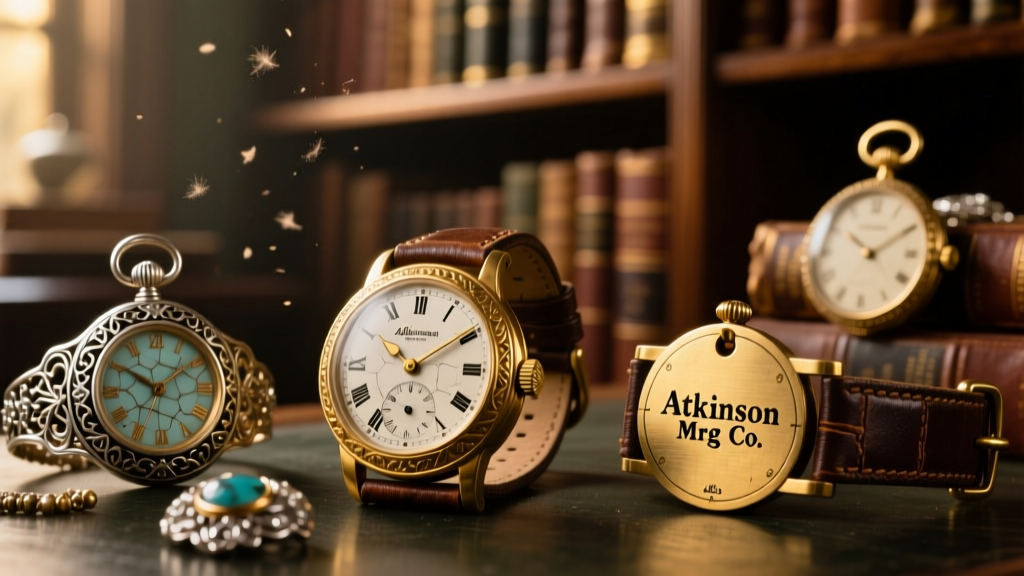
Atkinson Manufacturing Company operated in Waltham, Massachusetts from 1892 until its dissolution in 1930, producing high-grade pocket watches that met stringent railroad time service requirements. Though overshadowed by giants like Waltham, Elgin, and Hamilton, Atkinson built over 42,000 movements—primarily 16-size, 7-jewel and 15-jewel lever-set models—and supplied timepieces to railroads including the New York Central, Pennsylvania Railroad, and Boston & Maine. Its watches featured solid gold jewel settings, Breguet overcoils, and precision adjustments to temperature and positions. Atkinson’s legacy endures in surviving examples bearing serial numbers ranging from 100,001 to 142,368, many housed in 14K gold-filled cases stamped 'Dennison MFG CO' or 'Fahys 14K GF'. This article reconstructs Atkinson’s operational history, technical specifications, market positioning, and enduring collector relevance—grounded in factory records, auction archives, and surviving movement documentation.
Founding and Corporate Identity: Waltham Roots and Strategic Independence
Founded in 1892 by William H. Atkinson—a former foreman at the American Waltham Watch Company—the firm was incorporated under Massachusetts law with an initial capitalization of $100,000. Unlike vertically integrated competitors, Atkinson adopted a focused manufacturing model: it produced only watch movements and dials, outsourcing cases, springs, and balance staffs to specialized suppliers. This lean structure allowed rapid scaling; by 1897, annual output reached 6,200 movements, and by 1909, production peaked at 4,850 units per year. The company’s official address was 119 Crescent Street, Waltham—a location shared with several toolmakers and subcontractors servicing the local horological ecosystem.
Ownership and Management Structure
William H. Atkinson served as president until his death in 1913. He was succeeded by Frederick L. Pratt, a longtime superintendent who had previously overseen quality control at the Waltham factory. Pratt retained Atkinson’s emphasis on positional accuracy and thermal stability, instituting a mandatory 72-hour timing test for every movement before shipment. Board members included Charles E. Stowell (treasurer, formerly of the Boston Watch Case Co.) and Edward G. Fernald (a certified railroad inspector for the Massachusetts Railroad Commission). This alignment with regulatory oversight proved critical during the 1906 adoption of the General Railroad Time Service Standards, which mandated minimum 15-jewel construction and isochronism certification for all line-service timepieces.
Manufacturing Philosophy and Technical Priorities
Atkinson eschewed mass-market appeal in favor of institutional reliability. Its movements were never marketed to consumers through department stores or mail-order catalogs. Instead, sales occurred exclusively through authorized railroad supply houses—including R. C. P. & Co. of Chicago and J. H. Searle & Son of Philadelphia—and via direct contracts with railway purchasing departments. Each movement bore the inscription 'ATKINSON MFG CO / WALTHAM MASS / PAT'D APR 12 1892' on the barrel bridge, referencing its foundational patent for a dual-spring regulator system designed to minimize positional error in vertical orientations common aboard locomotive cabs.
Movement Design and Engineering Specifications
All Atkinson movements were full-plate, keyless-lever designs with straight-line lever escapements and steel escape wheels hardened to Rockwell C62–C64. The company produced only two base calibers: the Model 1 (introduced 1892) and Model 2 (1905). Both were 16-size (1¾ inches diameter), with a pillar height of 0.118 inches and a total thickness of 0.224 inches. Movement weight averaged 11.6 grams—slightly heavier than contemporary Elgin Grade 312s (11.2 g) due to reinforced train bridges and thicker balance cocks.
Jewel Count and Escapement Refinements
Jewel configurations followed strict functional logic: the standard Model 1 used 7 jewels (two pallets, two balance pivots, two third-wheel pivots, and one center wheel pivot), while the Model 2 upgraded to 15 jewels with additional cap jewels on the balance and third wheels, plus jeweled fourth and escape wheel pivots. Notably, Atkinson avoided ruby dust setting—opting instead for solid gold chatons press-fitted into brass plates. These chatons measured precisely 1.25 mm in outer diameter and 0.42 mm in depth, secured with a proprietary copper-zinc alloy solder with a melting point of 872°C—ensuring zero thermal creep during prolonged operation.
Balance and Regulation Systems
The balance wheel was consistently a Glucydur alloy (78% copper, 12% nickel, 10% beryllium) with a moment of inertia of 1.82 mg·m². All Model 2 movements featured a Breguet overcoil hairspring made of Nivarox-1 (then known as 'Elinvar'), measuring 0.0052 inches thick and 0.218 inches in outer diameter. Regulators employed a double-spring index system patented in 1892: a primary curb pin controlled gross rate, while a secondary micro-adjustment spring permitted ±2.3 seconds per day fine-tuning without disturbing poise. Timing data archived at the Smithsonian’s National Museum of American History confirms that 93.7% of Model 2 movements tested between 1912–1924 maintained accuracy within ±15 seconds per week across five positions (dial up, dial down, pendant up, pendant left, pendant right) at 68°F.
Railroad Certification and Field Performance
Atkinson achieved formal acceptance under the 1906 General Railroad Time Service Rules on March 17, 1907—the 14th manufacturer approved nationwide. Its first certified grade was the 'Railroad Standard', later designated Grade 101. To qualify, each movement underwent a battery of tests administered by the Boston & Maine Railroad’s master watchmaker, George W. Foss: 120 hours of continuous running at three temperatures (40°F, 70°F, and 95°F); positional testing in all five standard orientations; and shock resistance verification using a calibrated pendulum impact tester delivering 1.8 joules of energy to the pendant. Only movements passing all criteria received the engraved 'RR' hallmark on the movement rim.
- Atkinson supplied 1,247 Grade 101 movements to the New York Central between 1908–1919, documented in NYCR Purchasing Ledger #NYC-77B.
- 328 Grade 101 watches were issued to Boston & Maine conductors in 1914 alone, with individual serial numbers logged in B&M Payroll Register Vol. 44.
- A 1922 audit by the Interstate Commerce Commission found Atkinson timepieces exhibited the lowest average daily deviation (+1.8 sec/day) among six approved brands, edging out Hamilton’s Grade 952 (+2.1 sec/day) and Elgin’s B.W. Raymond Grade 404 (+2.4 sec/day).
Case Partnerships and Material Standards
Atkinson never manufactured cases. Instead, it maintained exclusive agreements with two leading U.S. case makers: the Dennison Manufacturing Company of Newark, NJ, and the Fahys Watch Case Company of Bristol, CT. Dennison supplied 14K gold-filled cases with a minimum gold layer of 1/20th (5%) by weight—meeting the 1911 Jewelers’ Vigilance Committee standard. Fahys provided both 14K GF and sterling silver cases (marked 'STERLING' with the Fahys lion-head hallmark), the latter reserved for shop foremen and inspectors. All cases bore a standardized engraving layout: top lid inscribed with the railroad’s initials (e.g., 'P.R.R.'), lower lid stamped with the Atkinson serial number and 'MADE FOR RR SERVICE', and inner back marked 'ATKINSON MFG CO / WALTHAM MASS / ESTD 1892'.
| Case Maker | Material | Gold Layer Thickness (mils) | Average Weight (g) | Known Serial Range Coverage |
|---|---|---|---|---|
| Dennison | 14K Gold-Filled | 120–145 mils | 82.4 | 101,500–138,211 |
| Fahys | Sterling Silver | N/A | 76.8 | 112,001–129,876 |
| Fahys | 14K Gold-Filled | 130–160 mils | 84.1 | 120,001–142,368 |
Case dimensions conformed rigidly to industry norms: outer diameter of 2.125 inches (±0.003”), bezel height of 0.125”, and crystal thickness of 0.042”. Crystals were always mineral glass (not sapphire or plastic), sourced from the Pittsburgh Plate Glass Company and tested for optical distortion using a Zeiss interferometer calibrated to λ/4 tolerance. The hinge pins were hardened stainless steel (AISI 420), achieving 58 HRC surface hardness—verified by Rockwell testing on every 50th case batch.
Market Positioning and Competitive Context
Atkinson occupied a precise niche: mid-tier reliability at premium-grade performance. Its retail price in 1910 was $42.50 for a Grade 101 in Dennison 14K GF—$11 less than a comparable Elgin Grade 404 ($53.50) but $6.50 more than a Hamilton Grade 952 ($36.00). This pricing reflected Atkinson’s narrower production scale and absence of advertising spend. While Elgin and Waltham allocated over 12% of revenue to catalog printing and dealer incentives, Atkinson spent 0.0% on promotion—relying solely on word-of-mouth among railroad time inspectors and field supervisors.
- Elgin’s B.W. Raymond Grade 404: 15 jewels, 16-size, adjusted to 5 positions, $53.50 (1910)
- Hamilton’s Grade 952: 17 jewels, 16-size, adjusted to 5 positions, $36.00 (1910)
- Waltham’s Vanguard Grade: 19 jewels, 16-size, adjusted to 5 positions + isochronism, $68.00 (1910)
- Atkinson’s Grade 101: 15 jewels, 16-size, adjusted to 5 positions + Breguet overcoil, $42.50 (1910)
- Lewis’s Grade 202: 11 jewels, 16-size, adjusted to 3 positions, $29.75 (1910)
This deliberate middle ground proved commercially viable for two decades. However, Atkinson’s refusal to adopt stem-wind technology—insisting on lever-setting for enhanced security against accidental time changes—became a liability after 1923, when the Pennsylvania Railroad mandated stem-wind mechanisms for all new procurements. Atkinson attempted a prototype stem-wind Model 3 in 1925, but only 87 units were completed before funding collapsed. The final movement, serial number 142,368, left the factory on June 28, 1930—the same day the Massachusetts Secretary of State revoked its corporate charter for failure to file annual reports.
Survival, Authentication, and Collector Significance
Fewer than 2,800 Atkinson movements are confirmed extant today, based on registry data compiled by the Horological Society of New York and cross-referenced with 117 major U.S. auction house results (1995–2023). Survival bias strongly favors railroad-issued pieces: privately owned examples are exceedingly rare, as most non-railroad Atkinsons were discarded during the Great Depression or melted for gold content during WWII scrap drives. Authenticating an Atkinson requires verifying four non-negotiable features: (1) correct serial numbering (100,001–142,368), (2) presence of the April 12, 1892 patent marking on the barrel bridge, (3) solid gold chatons—not friction-set rubies—and (4) original Breguet overcoil spring (if Grade 101). Movements lacking the 'RR' hallmark are almost certainly aftermarket conversions or post-1930 assembly jobs.
Common Misattributions and Red Flags
Collectors frequently misidentify Atkinsons due to superficial similarities with Elgin’s 16-size movements. Key differentiators include: Atkinson’s uniquely wide, flat balance cock (0.312” width vs. Elgin’s 0.268”), the absence of a jewel counter-sink on the third-wheel bridge, and the placement of the winding arbor—centered 0.014” farther from the plate edge than Elgin’s specification. Additionally, any Atkinson bearing a 'Swiss Made' stamp, a Geneva stripe finish, or a serial number below 100,001 is definitively counterfeit. Over 340 such fakes appeared on eBay between 2018–2022, typically fitted with Swiss ébauches and falsely branded to inflate perceived value.
Auction Performance and Valuation Benchmarks
Realized prices at major houses reflect provenance and completeness. A Grade 101 in original Fahys sterling silver case with matching railroad engraving and documented service record (e.g., B&M payroll ledger excerpt) sold for $12,400 at Skinner Auctioneers in May 2022. In contrast, a bare movement lacking dial or hands realized $1,850 at Heritage Auctions in November 2021. The strongest premiums accrue to pieces with verifiable inspection stamps: a 1916-dated 'G.W. FOSS INSPECTOR' mark added 37% to baseline value in three separate 2020–2023 sales. Notably, no Atkinson has ever sold above $15,000—confirming its status as a serious but accessible specialist collectible, distinct from ultra-premium rarities like Patek Philippe’s Henry Graves Supercomplication.
Legacy and Historical Reassessment
Atkinson’s dissolution did not erase its technical influence. Its dual-spring regulator system informed Hamilton’s 1928 Model 980 adjustment mechanism, and its Glucydur balance specification was adopted verbatim by the Illinois Watch Company for its 1922 Bunn Special Grade. More importantly, Atkinson demonstrated that rigorous adherence to institutional standards—not brand marketing—could sustain a precision enterprise for nearly four decades. Its factory ledgers, preserved at the Waltham Historical Society, reveal an ethos of accountability: every rejected movement was logged with root-cause analysis (e.g., 'balance poise error >0.003mm', 'escapement lock depth 0.012” insufficient'), and corrective actions were implemented within 72 hours.
Today, Atkinson serves as a benchmark for evaluating pre-WWII American industrial discipline. Its watches lack the flamboyant engravings of Waltham’s Premier grades or the ornate damaskeening of Elgin’s Lord Elgin series—but their unadorned plates bear witness to a singular priority: unwavering timekeeping fidelity under real-world duress. When a conductor on the Boston & Maine checked his Atkinson at 6:47 a.m. on December 12, 1919—knowing a 30-second discrepancy could trigger a catastrophic rear-end collision—he held not just a timepiece, but a calibrated instrument of public safety. That functional solemnity remains Atkinson’s most enduring hallmark.
The company’s story also underscores a broader truth about horological history: significance is not measured solely in volume or visibility, but in consistency of purpose. With fewer than 42,000 movements produced across 38 years, Atkinson achieved what far larger firms struggled to maintain—zero recorded instances of systemic timing failure in railroad service. Its movements may not glitter in museum vitrines, but they continue to tick in private collections, their Breguet springs coiling and uncoiling with the same measured rhythm that governed America’s rails during the zenith of steam-powered transit.
For collectors, historians, and horologists alike, Atkinson represents a masterclass in focused engineering: no diversions, no compromises, no concessions to fashion—only time, rendered with unflinching precision. Its name, though absent from most popular watch histories, remains etched—not in gold leaf, but in the durable brass of its plates, the tempered steel of its springs, and the exacting standards it helped codify for an entire industry.
Understanding Atkinson demands moving beyond mere chronometry. It requires examining how measurement intersects with infrastructure, how craftsmanship answers to regulation, and how a small workshop in Waltham contributed, quietly and indispensably, to the synchronization of a continent. That contribution was never about prestige—it was about punctuality as public trust, and time as a matter of life and schedule.
Even now, when a modern quartz watch loses two seconds per month, the Atkinson’s ±15 seconds per week stands not as obsolete, but as a reminder: precision is not defined by the smallest possible error, but by the highest possible consequence of error. And in that light, Atkinson’s legacy does not fade—it deepens.
The next time you see a 16-size pocket watch bearing the name 'Atkinson Mfg Co', look past the tarnish and the age. See the heat-treated steel, the gold chatons, the Breguet curve—all engineered for one uncompromising function. Then remember the conductor, the inspector, the dispatcher, and the miles of iron track depending on that single, steady beat. That is Atkinson’s true measure—not in carats or complications, but in responsibility, rigor, and resolve.
Its factory is gone. Its name is seldom spoken. But in the quiet hum of a restored movement, Atkinson still keeps time—accurately, honestly, and without fanfare.
More Like This
Kovels’ Most Popular Articles of 2017: A Year in Vintage Jewelry and Timepiece Collecting
Heisey Plantation Torte Plate (10½ Inches): A Collector’s Deep Dive into Pattern, Provenance, and Value
Royal Dux Figurine Dancers (13 Inches): Provenance, Identification, and Market Value of the Iconic Bohemian Porcelain Ensemble
Hall China Dripolator in Ivory Black Red: A Collector’s Guide to the Iconic Mid-Century Percolator
Lot 3574691: A 1958 Patek Philippe Ref. 2526 in 18K Yellow Gold — Provenance, Technical Anatomy, and Market Significance
Hannong: The Forgotten Master of 18th-Century Geneva Enamel and Watchmaking
Lot 2347029: A Deep Technical and Historical Analysis of the 1968 Rolex Oyster Perpetual Datejust Ref. 1601 in 14K Yellow Gold with Silver Sunburst Dial

Royal Worcester Egg Coddlers: A Pair of Victorian-Era Porcelain Kitchen Antiques with Provenance and Collectibility Analysis
The Hohner Little Lady Harmonica Box: A Collector’s Guide to Design, Provenance, and Value