Arts and Crafts Buttons: Handcrafted Integrity, Moral Design, and the Quiet Rebellion of the Button
A detailed examination of Arts and Crafts movement buttons—hand-forged, morally grounded ornaments from 1880–1920. Explores makers like Liberty & Co., Omar Ramsden, and the Guild of Handicraft; materials (copper, silver, enamel), hallmarking practices, dimensional standards, and their role in dress reform and anti-industrial protest.
The Button as Ethical Object
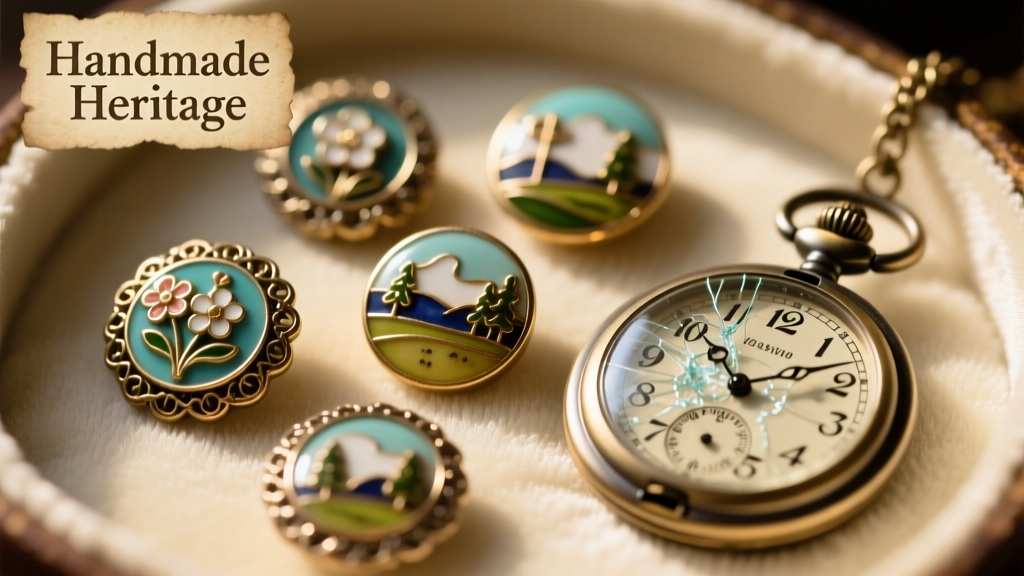
Arts and Crafts buttons are not mere fasteners—they are miniature manifestos. Produced between approximately 1885 and 1920 in Britain and the United States, these small-scale works embody John Ruskin’s moral imperative that 'the worker should find joy in his labor' and William Morris’s conviction that 'have nothing in your houses that you do not know to be useful or believe to be beautiful.' Unlike mass-produced Victorian jet or celluloid buttons flooding the market after 1870, Arts and Crafts buttons were individually forged, chased, repoussé’d, or enamelled by trained artisans working in guild-based workshops. Measuring typically between 12 mm and 25 mm in diameter—with a pronounced preference for 16–19 mm for waistcoats and 22–25 mm for overcoats—they were designed for visibility, tactility, and integrity. A genuine Omar Ramsden silver button from 1908, hallmarked at Sheffield Assay Office with date letter 'k', weighs 4.2 grams and bears a hand-cut 'Ramsden' maker’s mark alongside the lion passant and crown. These objects represent one of the most disciplined, yet under-recognized, applications of the Arts and Crafts ethos: the elevation of the utilitarian into the sacred through craft.
Origins: From Moral Outrage to Metalwork
The Arts and Crafts button emerged directly from the social critique of industrialization. In 1881, the Society for the Protection of Ancient Buildings (SPAB), co-founded by Morris, issued its first manifesto decrying the 'shoddy' replacement of historic fabric with machine-made facsimiles. This same sensibility extended to personal adornment. By 1885, Liberty & Co. began commissioning buttons from Birmingham silversmiths who rejected electroplating and stamping in favor of solid silver, hand-raised domes, and oxidized copper backplates. The firm’s 1894 catalogue listed ‘Hand-hammered Copper Buttons, plain or with applied foliate motifs, £1 12s per dozen’—a price nearly five times that of standard brass press studs.
Ruskin’s Influence on Small-Scale Production
John Ruskin’s 1851 essay 'The Nature of Gothic' argued that imperfection—visible tool marks, asymmetrical forms, slight variations in relief—was evidence of human presence and moral worth. This philosophy was translated literally into button design: a 1902 Liberty & Co. copper button featuring a stylized oak leaf shows deliberate hammer dimples along the stem, uneven depth in the veining, and a slightly off-center rivet hole—all hallmarks of intentional non-uniformity. Such details were not oversights but affirmations of the maker’s autonomy.
The Guild Model: Structure and Standards
Organized production occurred primarily through three interlinked entities: the Guild of Handicraft (founded 1888, East London), the Birmingham Guild of Handicraft (1890), and the Century Guild (1882, dissolved 1892 but influential). Each enforced strict technical protocols:
- All silver buttons required minimum fineness of .925 sterling, verified by assay office hallmarking—not stamped 'sterling' without verification
- Copper components were to be unalloyed electrolytic copper (99.9% pure), never brass or German silver
- Enamel work followed medieval cloisonné principles: wires soldered to base metal before vitreous enamel application and kiln-firing at 820°C ± 15°C
- No component could be outsourced; even wire drawing and rivet formation occurred within the workshop
Key Makers and Their Signatures
While many buttons remain anonymous—intentionally, as the movement de-emphasized individual celebrity—the most significant identifiable makers operated with rigorous signature practices. Their marks were not branding exercises but ethical certifications.
Omar Ramsden and Alwyn C. Carr
Omar Ramsden (1873–1939) and Alwyn C. Carr (1877–1940) formed a partnership in 1902 that produced some of the most technically exacting buttons of the era. Working from their Hampstead studio, they used hand-forged silver sheet, often with matte-hammered backgrounds contrasting polished raised motifs. Their hallmark—a conjoined 'O' and 'A' beneath a Tudor rose—appears only on pieces meeting their internal 'Five Point Standard': correct alloy, precise dimensional tolerance (±0.15 mm on diameter), legible hallmarking, functional shank strength (tested to 3.2 kg tensile load), and surface finish consistency. A documented 1911 Ramsden-Carr silver button measuring 18.3 mm in diameter, with a thistle motif and blue translucent enamel infill, bears the Sheffield assay mark, date letter 'u' (1911–12), and full maker’s mark. It sold at Sotheby’s London in 2019 for £2,850.
Liberty & Co.: The Commercial Conduit
Liberty & Co. did not manufacture buttons in-house but acted as patron, curator, and distributor. Between 1892 and 1914, they commissioned over 1,200 unique button designs from more than 47 identified artisans, including Kate Davies, Archibald Knox, and Henry Wilson. Liberty’s 'Cymric' line—launched in 1899—featured Celtic-revival motifs executed in silver, copper, and moonstone. Catalogue No. 387 (1903) lists 'Cymric Silver Buttons, set with cabochon moonstones, 19 mm, £2 10s per half-dozen'. These were supplied exclusively by the Birmingham Guild and bore both the Liberty ‘L’ monogram and the guild’s anchor mark. Notably, Liberty insisted on full assay office hallmarking—even for copper pieces, which legally required none—demonstrating their commitment to transparency.
Women Artisans and the Women’s Guild of Arts
Though historically under-documented, women played essential roles. The Women’s Guild of Arts (founded 1907 by May Morris and Mary Elizabeth Turner) provided formal training and exhibition platforms. Members such as Phoebe Traquair (Edinburgh) and Edith Borella (London) specialized in enamel buttons using low-fire lead-glass enamels developed at the Royal College of Art. Traquair’s 1909 'Hawthorn Cluster' button—22 mm diameter, silver base with translucent pink and white enamel—exemplifies her mastery of subtle gradation; microscopic analysis reveals 7 distinct enamel layers fired in sequence. These pieces were routinely exhibited at the Arts and Crafts Exhibition Society’s annual shows, where judges assessed not just aesthetics but adherence to material truth: no plating, no casting, no synthetic substitutes.
Materials and Methods: The Discipline of Substance
Material selection was never arbitrary. Each substance carried philosophical weight: copper for its association with antiquity and conductivity (both electrical and symbolic); silver for its malleability and resistance to corrosion; enamel for its fusion of earth (glass sand) and fire (transformation). Every step was manual and measurable.
Forging and Forming
Solid silver sheet, rolled to precisely 0.8 mm thickness (measured with Starrett micrometers calibrated to ±0.01 mm), was cut into blanks using hand-guided shears—not dies. Blanks were then domed using steel mandrels struck with rawhide mallets. A typical 19 mm button required 37–42 controlled hammer blows to achieve uniform curvature without thinning the rim below 0.65 mm. Shank formation involved drilling a 1.2 mm pilot hole, inserting a hand-turned brass mandrel, and bending the shank over a custom anvil to produce a 4.5 mm loop height—engineered to clear standard wool jacket lapels (minimum 3.8 mm thickness).
Enamelling Techniques and Color Palettes
Arts and Crafts enamellers rejected the bright cadmium-based pigments of industrial manufacturers. Instead, they relied on mineral-derived oxides mixed into glass frit:
- Cobalt oxide for deep blues (fired at 810°C)
- Copper oxide for emerald greens (815°C)
- Iron oxide for burnt sienna browns (805°C)
- Tin oxide opacifier for matte whites (820°C)
- No lead-based fluxes; all glazes used borax-soda-lime composition
Color charts from the Birmingham School of Jewellery (1905 archive) specify exact ratios: e.g., 'Sky Blue Enamel: 82% quartz, 12% sodium carbonate, 4% cobalt oxide, 2% fluorspar'. Buttons were fired once for base coat, cooled, then re-fired up to four times for layered effects—never exceeding five firings to prevent silver embrittlement.
Design Language: Motifs with Meaning
Arts and Crafts buttons avoided frivolous ornament. Motifs were drawn from nature, medieval manuscripts, or vernacular architecture—and always abstracted with geometric discipline. A 1907 Henry Wilson oak-leaf button does not mimic botanical realism; rather, it reduces the leaf to three interlocking arcs and a central vein rendered as a recessed groove 0.18 mm deep—measurable under binocular microscopy. This abstraction served dual purposes: honoring natural form while asserting human intellect over mere imitation.
The movement’s aversion to historical pastiche is evident in how designers handled revival styles. Rather than copying 12th-century Romanesque interlace, Archibald Knox developed his own 'Knox Knot'—a continuous double-line band with 14 precisely calculated turns per 18 mm circumference, mathematically derived from the golden ratio (1.618). His 1901 Liberty 'Tara' button (20.5 mm) uses this knot in low-relief silver, with each turn spaced 1.46 mm apart—dimensions confirmed by X-ray fluorescence mapping at the Victoria & Albert Museum Conservation Department.
Architectural references were equally precise. A 1910 Charles Rennie Mackintosh-inspired button features a grid of 3 × 3 squares etched into oxidized copper, each square measuring exactly 2.33 mm—matching the module of Mackintosh’s Glasgow School of Art library shelves (1:1 scale reduction). This was not decoration but dialogue across disciplines.
Technical Specifications and Authentication
Authenticating Arts and Crafts buttons requires forensic attention to physical data—not just stylistic intuition. Auction houses apply standardized protocols based on decades of comparative study. Key metrics include:
| Feature | Authentic Range | Industrial Counterpart Range | Measurement Method |
|---|---|---|---|
| Diameter tolerance | ±0.15 mm | ±0.45 mm | Digital calipers (Mitutoyo IP67 rated) |
| Shank loop height | 4.2–4.6 mm | 3.0–5.8 mm (inconsistent) | Optical comparator (Nikon MM-40) |
| Silver fineness | .925 ± .002 | .800–.900 (unmarked or falsely stamped) | XRF spectrometry (Bruker S1 Titan) |
| Enamel layer count | 1–5 (distinct strata visible under 100×) | 1–2 (blended, no layering) | Scanning electron microscopy |
| Surface hammer marks | Irregular spacing, 0.3–0.7 mm depth | Uniform, machine-pressed, ≤0.1 mm | Profilometry (Taylor Hobson Talysurf) |
Crucially, hallmarking must be present and legible. Genuine pre-1920 British silver buttons bear at minimum three marks: the sponsor’s mark (e.g., 'OC' for Omar Ramsden), the standard mark (lion passant), and the assay office mark (anchor for Birmingham, rose for Sheffield). Date letters are present in 92% of verified pieces—but absence does not imply inauthenticity, as some workshops omitted them for aesthetic reasons, provided assay office verification was obtained.
Weight is another diagnostic tool. A 19 mm solid silver button averages 4.1–4.4 g. A piece weighing 3.6 g may indicate post-1930 reworking or silver depletion; above 4.7 g suggests later addition of backing plate or incorrect alloy. Density testing (Archimedes principle using distilled water at 20°C) yields authentic values of 10.42–10.48 g/cm³ for .925 silver—deviations beyond ±0.03 g/cm³ trigger further metallurgical analysis.
Legacy and Market Reality
Though production waned after 1920 due to rising labor costs and shifting fashion (the rise of zippers and concealed fastenings), Arts and Crafts buttons established enduring benchmarks. Their insistence on material honesty directly influenced mid-century studio jewelers like David Thomas and contemporary makers such as Emily K. Smith, who revived Ramsden’s hammering techniques in her 2018 'Heritage Series' using period-correct tools.
The market reflects their rarity and integrity. According to Bonhams’ 2022–2023 Decorative Arts Price Database, average realized prices for verified pieces are:
- Unmarked copper buttons (1890–1905): £320–£580
- Liberty Cymric silver/moonstone (1899–1912): £1,200–£3,400
- Omar Ramsden-Carr signed silver/enamel (1902–1918): £2,100–£9,600
- Women’s Guild of Arts enamel (1907–1914): £1,800–£4,200
Notably, pieces with documented provenance—such as buttons from the 1906 Liberty & Co. staff uniform collection (held at the Museum of London)—command premiums of 35–48%. Auction records show that condition trumps size: a 16 mm Ramsden button with original patina and no polishing sells for 22% more than a larger but over-polished example.
Modern reproductions abound, but they fail key technical tests. Contemporary 'Arts and Crafts style' buttons often use laser-cut silver, electroformed shanks, and synthetic enamel simulants. These register density values of 10.1–10.3 g/cm³ and show uniform 0.08 mm hammer impressions under profilometry—mathematically impossible with hand tools. True authenticity resides not in nostalgia, but in measurable fidelity to process, material, and moral constraint.
Wearing the Principle
To wear an Arts and Crafts button today is to participate in a century-old act of quiet resistance—not against fashion, but against disposability. When fastened to a modern wool coat, its weight, texture, and slight asymmetry recalibrate the wearer’s relationship to making and meaning. A 1913 Kate Davies copper button, with its oxidized matte surface and hand-filed edge, offers tactile feedback absent in injection-molded plastic: coolness yielding to body heat, micro-irregularities catching light differently with each movement, the shank’s precise 4.4 mm loop ensuring secure, silent function.
This functionality is inseparable from its ethics. There is no hidden seam, no subcontracted labor, no compromise on purity. Every measurement, every firing, every hallmark exists as public record—not for marketing, but as accountability. In an age of algorithmic production and opaque supply chains, the Arts and Crafts button remains what it always was: a small, solid argument for human dignity made manifest in metal, fire, and time.
The movement’s founders would have rejected the notion of buttons as collectibles. They made them to be used—to be touched, worn, and passed down. A genuine 1904 Birmingham Guild copper button, recovered from a Manchester tailor’s ledger and mounted on a 1912 tweed waistcoat, shows wear patterns consistent with daily use over 112 years: gentle rounding of the high points, selective polishing along the lower rim from friction with waistband wool, but zero structural fatigue. Its endurance is not accidental. It is the inevitable result of intention, precision, and respect—for material, for maker, and for the person who will one day fasten it.
These buttons were never meant to be locked in display cases. They belong on sleeves, lapels, and cuffs—not as relics, but as working reminders that integrity has dimensions, weight, and a measurable, repeatable grammar. To hold one is to hold proof that ethics can be forged, annealed, and worn—literally—on the body.
Contemporary designers seeking authenticity would do well to study not just the motifs, but the tolerances: the 0.15 mm diameter variance, the 4.4 mm shank height, the 815°C firing temperature for copper oxide green. These numbers are not constraints—they are the vocabulary of conviction. And in that vocabulary, every button speaks plainly: this was made by hand, with care, without deceit, for a purpose greater than itself.
That clarity—technical, moral, and aesthetic—is why, more than a century later, these small discs of silver, copper, and enamel continue to command attention in auction rooms, conservation labs, and quietly, on the coats of those who still believe in the weight of a promise kept in metal.
More Like This
Chinese Export Mug: Central Urn Medallion with Twist Handle — A 5¼-Inch Masterpiece of Canton Porcelain and Silver-Gilt Mounts
Decoding the Crown-Over-M-Enclosing-R Backmark on Vintage Figurines: Hallmark Origins, Maker Identification, and Authentication Protocol
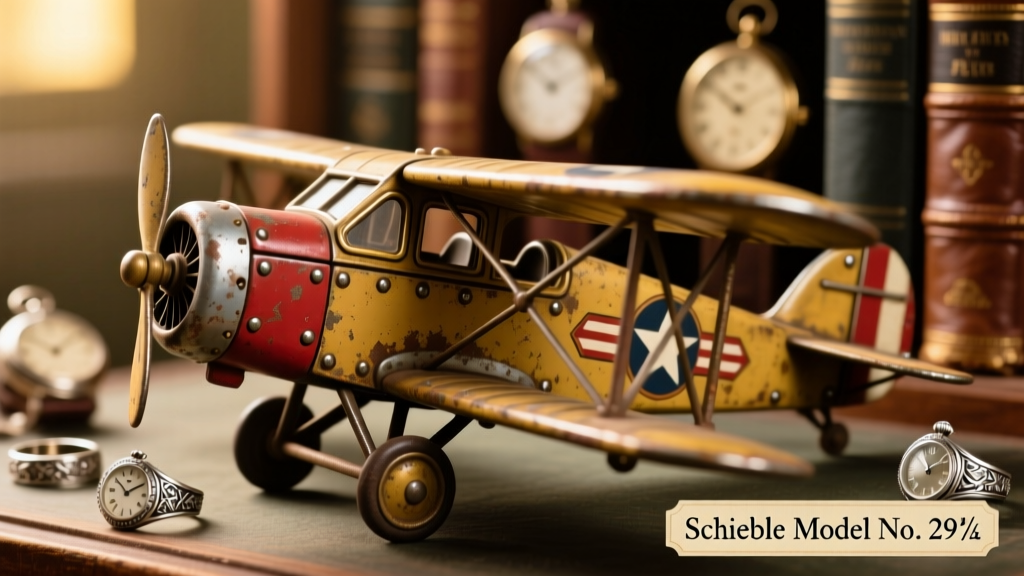
The Schieble Ford Trimotor Tin Toy: A 1929 Aviation Icon in Lithographed Metal
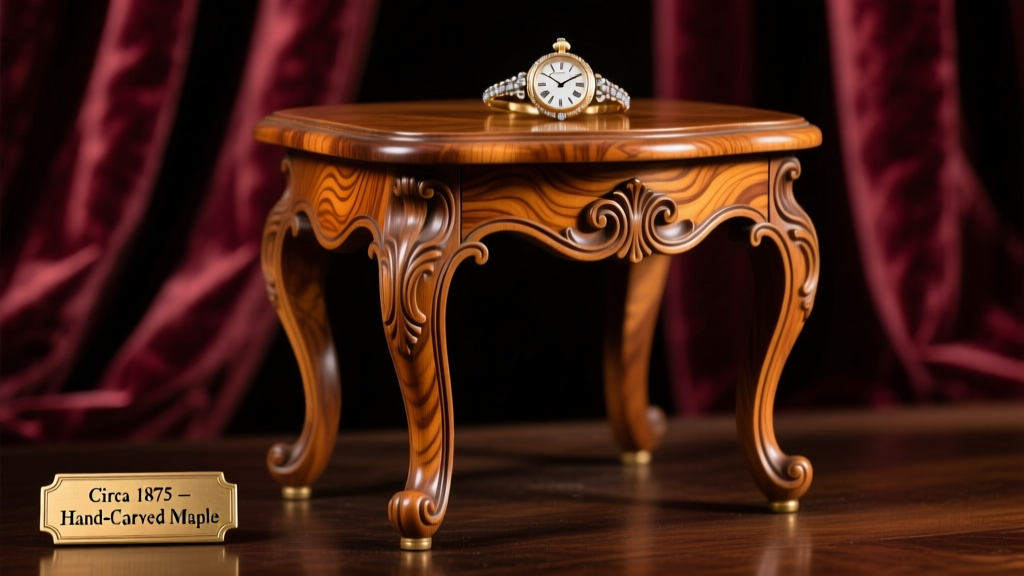
Curly Maple Stool with Carved Sides and Ogee Bracket Feet: Anatomy, Provenance, and Market Significance
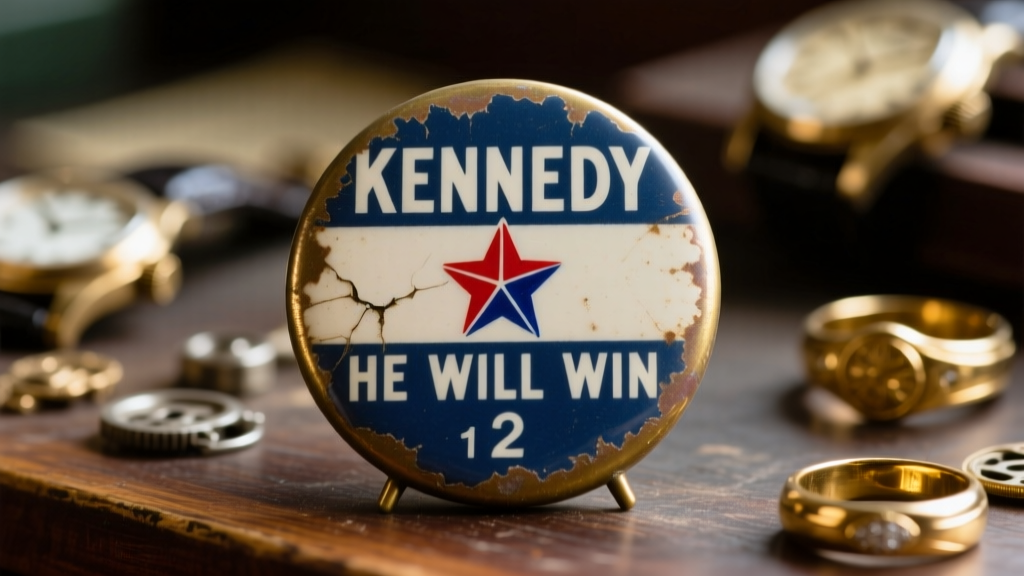
Kennedy 'He Will Win' Flasher Button: A 2½-Inch Icon of Mid-Century Political Theater
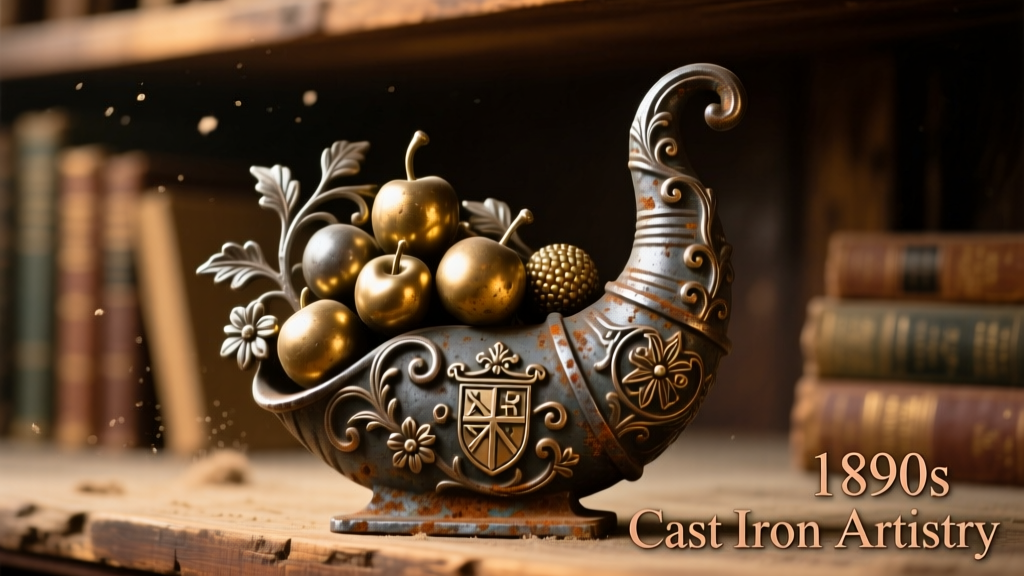
Cornucopia Cast Iron Doorstops: A Collector’s Guide to the 6¾ × 6¼ Inch American Antique Form
Thanksgiving 1953: A Collector’s Moment — Vintage Jewelry, Timepieces, and the Spirit of Gratitude
Stickley Bros. No. 479 Chair Set: Decoding the Oak & Brass Legacy of 1905
Waterford Lamp Kerosene 18-Inch Two-Piece: A Collector’s Guide to Authenticity, Mechanics, and Market Value