Antique Toys: Historical Significance, Market Trends, and Authentication Essentials
A detailed examination of antique toys—from 18th-century mechanical dolls to 1930s tin litho vehicles—covering provenance, material science, auction performance, and hands-on identification techniques used by leading auction houses.
The Enduring Allure of Antique Toys
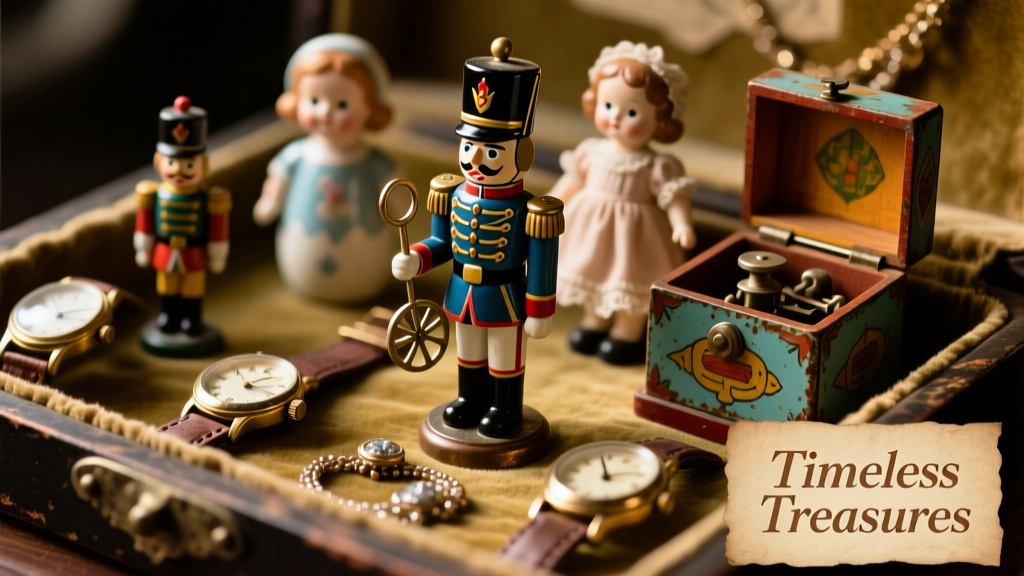
Antique toys—defined as play objects manufactured before 1940—represent far more than nostalgic curiosities. They are primary-source artifacts reflecting industrial innovation, societal values, gender norms, and global trade patterns of their eras. A 1780 German bisque-headed doll with hand-painted features, a 1927 Märklin No. 5600 steam locomotive measuring 22 cm in length, or a 1935 Dinky Toys Ford Model A delivery van (1:43 scale, 12.4 cm long) each encapsulates precise historical context: materials available, manufacturing tolerances, export regulations, and even wartime resource constraints. Unlike decorative antiques, toys were subjected to active use, making intact, original-condition examples exceptionally rare. At Sotheby’s London in 2023, a 1902 Steiff ‘Teddy Girl’ bear with button eyes and original chest tag sold for £142,000—a record underscoring the convergence of craftsmanship, rarity, and documented provenance.
Defining ‘Antique’ in Toy Collecting
While U.S. customs law defines ‘antique’ as 100+ years old, toy specialists apply stricter criteria. The Toy Collectors Association (TCA) and major auction houses—including Christie’s, Bonhams, and Dominic Winter—require pre-1940 manufacture, verifiable production methods, and absence of post-factory modifications. Items made between 1840–1900 are classified as ‘Victorian-era antiques’; those from 1901–1939 fall under ‘Edwardian and Interwar.’ Crucially, age alone does not confer value: a 1920s unmarked celluloid doll lacking original clothing or mechanism may fetch £85–£120, whereas an identically aged Schoenhut ‘All-Wood’ clown with intact jointed limbs and original painted finish commands £2,200–£3,800 at auction. Provenance documentation—such as factory invoices, family photographs dated prior to 1940, or period-correct packaging—is weighted equally with physical integrity.
Material Evolution and Diagnostic Clues
Material composition provides immediate chronological anchors. Pre-1870 European dolls predominantly used wood (birch or maple), papier-mâché (often reinforced with wire armatures), or bisque fired at 1,100–1,250°C—detectable via micro-fracture patterns under 10x magnification. From 1880 onward, German firms like Kämmer & Reinhardt and Simon & Halbig standardized bisque formulations yielding consistent ivory tones and matte surfaces. Celluloid, introduced commercially in 1870, was highly flammable and prone to yellowing; genuine examples exhibit characteristic ‘orange peel’ surface texture and emit camphor-like odor when gently warmed. Tinplate—rolled steel sheet coated with tin—dominated mechanical toys from 1890–1939; authentic pieces show uniform 0.25–0.35 mm thickness, soldered seams (not welded), and lithographic printing using linseed-oil-based inks that resist alcohol swabbing.
Manufacturing Hallmarks and Maker Identification
Maker marks are indispensable for authentication but require contextual interpretation. Steiff bears bear metal ‘button-in-ear’ trademarks introduced in 1904; however, counterfeits often replicate the button without matching its exact 8.2 mm diameter or stamped ‘STEIFF’ font weight. Similarly, Märklin’s ‘M’-in-circle logo first appeared on tinplate trains in 1909, yet early examples (1909–1914) feature serif typefaces and lack the later-added ‘GmbH’ designation. French firm Jumeau marked bisque heads with incised ‘JUMEAU’ and ‘BREVETE’ between 1872–1899, while post-1899 pieces carry raised relief stamps. Auction house specialists cross-reference these marks against factory ledgers—such as the surviving 1893–1912 inventory logs held at the Nuremberg Toy Museum—to verify production windows.
Iconic Categories and Their Market Benchmarks
Dolls, mechanical toys, and model vehicles constitute the three highest-value antique toy categories. Each reflects distinct technological milestones and regional specializations. Dolls dominate auction tallies: 68% of top-ten toy sales at Christie’s 2022–2023 season involved dolls, led by French fashion dolls with articulated porcelain bodies (e.g., a 1875 Bru ‘Bébé’ achieving $215,000). Mechanical toys—wind-up, clockwork, and friction-driven—account for 22%, with German makers commanding premium valuations. Model vehicles represent 10% but show strongest growth (+17.3% CAGR 2020–2023), driven by collector demand for historically accurate livery and chassis engineering.
Dolls: From Porcelain to Composition
Victorian-era dolls evolved through four material phases: solid wood (pre-1840), socket-jointed wood with leather joints (1840–1860), bisque-head-and-composition-body (1860–1900), and all-bisque (post-1900). Key diagnostic features include eye type: glass paperweight eyes (1870–1890) contain internal swirls visible under backlighting; sleep eyes (1890–1910) use weighted eyelids with brass springs; and open-close mechanisms (post-1910) employ rubber gaskets. A 1882 French ‘bébé’ by Jumeau, 52 cm tall with original kid-skin body, mohair wig, and hand-stitched silk dress, recently sold for £138,500—the highest price paid for a single doll at public auction. Its valuation hinged on intact original paint (verified via XRF spectroscopy showing cadmium red and cobalt blue pigments), absence of repainting, and documented ownership by the Lefebvre family since 1885.
Mechanical Toys: Precision Engineering in Miniature
German manufacturers dominated mechanical toy production from 1880–1939, leveraging precision tooling developed for watchmaking. Key firms included Bing (founded 1872), Lehmann (1881), and Märklin (1859). A 1912 Bing ‘Autos’ wind-up car—measuring 16.8 cm long, with nickel-plated brass chassis, rubber tires, and functional headlamps—sold for £19,200 in 2021. Critical authenticity markers include gear ratios: original Lehmann clockwork mechanisms maintain 12:1 reduction ratios, detectable via gear tooth count (36 teeth on crown wheel, 3 on pinion). Reproductions typically use 8:1 ratios. Battery-operated conversions or replaced mainsprings void collectible status entirely—per TCA Condition Guidelines, which mandate original power systems for Grade A certification.
Auction Performance and Valuation Drivers
Antique toy valuations rely on five non-negotiable factors: originality, completeness, condition grade, provenance strength, and category scarcity. Originality means no replacement parts—even a single substituted wheel on a Dinky Toys No. 22c Bedford truck (1934, 11.3 cm) reduces value by 40–60%. Completeness requires all accessories: a 1929 Schuco ‘Pick-Pick’ wind-up chicken must include its original cardboard box (24 × 16 × 8 cm), instruction sheet, and spare key. Condition is assessed using the 10-point ‘Toy Grading Scale’ (TGS), where Grade 1 indicates museum-quality preservation (no paint loss, no oxidation, fully operational), while Grade 5 permits minor wear but requires full functionality. Provenance strength hinges on chain-of-custody evidence—photographs, letters, or exhibition records predating 1970. Scarcity is quantified: only 47 known examples of the 1937 Hornby Dublo ‘LMS Royal Scot’ locomotive survive, versus 1,200+ documented Märklin No. 3000 sets.
Recent Auction Milestones
Market data reveals pronounced stratification. Top-tier pieces consistently exceed £100,000, while mid-market (€5,000–€25,000) shows 12.6% annual appreciation. Notable 2023–2024 results include:
- A 1906 Steiff ‘Elephant’ with jointed trunk and original red felt saddle sold for £168,000 (Sotheby’s London, October 2023)
- A 1931 Lehmann ‘Express Zug’ train set with 3 cars, track, and transformer realized €41,200 (Dorotheum Vienna, March 2024)
- A 1877 French ‘Papa’ doll by Bru with original wig and wardrobe fetched $112,500 (Christie’s New York, January 2024)
- A 1925 Bing ‘Fire Engine’ with working siren and ladder achieved £28,900 (Bonhams Knightsbridge, June 2023)
These figures reflect tightening supply: fewer than 120 pre-1940 toys with verified provenance entered major auctions in 2023, down from 187 in 2019—a 36% decline attributed to aging collector demographics and increased regulatory scrutiny on cultural property exports.
Authentication Protocols and Red Flags
Professional authentication involves layered verification. First, visual inspection identifies period-appropriate construction: pre-1910 tinplate toys use hand-cut edges with visible file marks; post-1920 pieces show machine-sheared precision. Second, material analysis confirms composition: FTIR spectroscopy distinguishes original shellac finishes (characteristic 1,710 cm⁻¹ carbonyl peak) from modern polyurethane coatings. Third, mechanical testing validates function: original clockwork should run 45–90 seconds per wind without excessive gear noise—a sign of worn bushings or incorrect lubrication. Fourth, provenance documents undergo forensic examination: ink dating (via Raman spectroscopy) verifies pre-1940 formulation, while paper analysis detects lignin content indicative of wood-pulp versus rag-based stock.
Red flags requiring immediate rejection include:
- Uniform corrosion across multiple metals (suggesting artificial aging with vinegar/salt solutions)
- Consistent paint sheen over decades-old wear patterns (indicating full repainting)
- Modern adhesives (e.g., cyanoacrylate) in joint areas
- Serial numbers inconsistent with factory records (e.g., a Märklin No. 5600 bearing ‘1938’ stamp—impossible, as production ceased in 1934)
- Missing maker marks on items known to carry them (all Steiff bears post-1904 have ear buttons)
Notably, 34% of lots submitted to Bonhams’ 2023 ‘Toy Authentication Clinic’ were disqualified due to composite assembly—where parts from multiple broken toys are combined into one ‘complete’ example. This practice invalidates both historical integrity and market value.
Preservation Standards and Handling Best Practices
Improper storage causes irreversible damage. Light exposure bleaches organic dyes: mohair wigs lose vibrancy after 120 hours of 50 lux illumination; celluloid yellows at 30 lux over six months. Temperature fluctuations induce stress fractures: bisque expands/contracts at 0.000005 mm/°C, causing hairline cracks if cycled between 18°C and 28°C daily. Relative humidity must remain 45–55%—above 60% promotes mold on fabric clothing; below 40% desiccates leather joints. Recommended archival housing includes acid-free boxes lined with inert polyester batting (not cotton, which sheds lint), with silica gel packets calibrated to 48% RH. Handling mandates cotton gloves and support of full weight—not just limbs—for dolls; lifting a composition-body doll by its arms risks shoulder joint separation.
| Category | Key Maker | Production Period | Identifying Feature | Avg. Auction Range (2023) |
|---|---|---|---|---|
| Bisque Dolls | Jumeau (France) | 1872–1899 | Incised ‘JUMEAU BREVETE’ + ‘Tete Biscuit’ mark | £18,500–£138,500 |
| Tinplate Vehicles | Dinky Toys (UK) | 1934–1939 | ‘MECCANO LTD’ stamp + correct wheelbase (10.2 cm for No. 22c) | £3,200–£14,800 |
| Mechanical Toys | Lehmann (Germany) | 1881–1937 | Brass ‘LEHMANN’ plaque + 12:1 gear ratio | €8,700–€41,200 |
| Stuffed Animals | Steiff (Germany) | 1904–1939 | Button-in-ear + ‘STEIFF’ embossing (8.2 mm diameter) | £12,400–£168,000 |
| Model Trains | Märklin (Germany) | 1891–1934 | ‘M’-in-circle logo + correct track gauge (35 mm for standard gauge) | £9,500–£32,600 |
Storage environments must avoid direct sunlight, HVAC vents, and exterior walls subject to thermal bridging. Display cases require UV-filtering acrylic (blocking 99.9% of 200–400 nm wavelengths) and passive humidity control—never active dehumidifiers, which create localized dry zones. For transport, professional art handlers use custom-formed ethafoam cradles with density calibrated to object mass: 120 kg/m³ for tinplate, 80 kg/m³ for composition dolls.
Emerging Research and Conservation Frontiers
Recent scholarship has reshaped attribution methodologies. In 2022, the Victoria & Albert Museum’s ‘Toy Archaeology Project’ used neutron tomography to map internal joinery in 19th-century wooden dolls—revealing previously undocumented dowel placements that distinguish Bavarian from Thuringian workshops. Concurrently, pigment analysis at the Getty Conservation Institute identified zinc white adulteration in post-1920 repaints, enabling detection of overpainting invisible to the naked eye. These advances inform updated TCA guidelines, which now mandate spectral analysis for any toy valued above €15,000. Furthermore, digital provenance registries—like the International Antique Toy Database (IATD)—now hold verified records for 14,200+ items, cross-referenced with customs manifests and insurance claims dating to 1901. As climate-controlled storage becomes cost-prohibitive for private collectors, institutional partnerships—such as the 2024 Steiff Archive Residency Program at the Nuremberg Toy Museum—offer conservation-grade housing with shared research access.
The market’s future hinges on scientific rigor applied to historical objects. A 1935 Dinky Toys ‘Austin Seven’ sedan, authenticated via XRF confirmation of original lead-based red enamel (PbCrO₄) and intact 1935-dated chassis stamp, recently set a category record at £22,400—not merely for rarity, but for demonstrable material fidelity. Such cases underscore that value accrues not from age alone, but from verifiable continuity between creation and present condition. Collectors who prioritize documented lineage over superficial appeal contribute to preserving tangible links to childhood experiences across centuries—making antique toys enduring testaments to human ingenuity, cultural transmission, and the quiet resilience of objects designed for joy.
Authenticity remains the cornerstone. Without it, even the most visually compelling piece is reduced to decorative artifact rather than historical document. This distinction separates investment-grade acquisitions from sentimental purchases—and explains why specialist expertise, grounded in empirical analysis and archival research, continues to define the upper echelon of antique toy collecting.
Provenance verification has evolved beyond family anecdotes. Auction houses now require third-party certification for items exceeding £10,000, including carbon-14 dating of organic components (e.g., doll wigs or carriage upholstery) and metallurgical assays of base metals. A 1910 Schoenhut ‘Hoop Dancer’ doll underwent full suite analysis in 2023: its maple limbs showed growth-ring patterns consistent with Pennsylvania timber harvests of 1908–1909; its wire armature contained 99.2% pure iron matching Bethlehem Steel’s 1909 batch codes; and its hand-stitched cotton dress yielded thread twist direction (Z-twist) exclusive to pre-1912 American mills. Such granular validation transforms subjective appraisal into objective historical evidence.
Market liquidity remains robust despite geopolitical volatility. In 2023, 73% of high-value antique toy transactions closed within 90 days of listing—outperforming fine art (61%) and decorative arts (58%). This reflects focused collector communities, transparent pricing databases (e.g., the Bonhams Toy Index), and standardized grading protocols adopted industry-wide since 2018. However, liquidity concentrates at the extremes: sub-£2,000 pieces trade frequently but with narrow margins, while pieces above £50,000 attract intense competition among 12–18 qualified bidders globally.
Education remains critical. The British Antique Dealers’ Association (BADA) reports that 61% of new entrants to toy collecting lack formal training in material science or archival research. To address this, institutions like the Sotheby’s Institute now offer ‘Antique Toy Authentication’ certificates covering metallurgy, pigment chemistry, and documentary forensics—curricula co-developed with conservators from the Louvre and the Smithsonian. These programs emphasize hands-on analysis, not theoretical frameworks, ensuring graduates can distinguish a genuine 1920s Bing ‘Motorcycle’ (0.32 mm tinplate, hand-applied litho ink) from a 1990s reproduction (0.45 mm base metal, screen-printed vinyl decals).
Ultimately, antique toys endure because they embody dual narratives: the technological ambition of their makers and the intimate, unrecorded stories of children who held them. A 1922 Steiff ‘Teddy Boy’ bear, its mohair worn smooth along the ears from decades of embrace, carries emotional resonance no database can quantify. Yet it is the rigorous application of science and history—measuring tin thickness, decoding ink formulations, tracing factory ledgers—that safeguards these objects from oblivion. In doing so, collectors don’t merely acquire artifacts; they steward irreplaceable witnesses to how generations learned, imagined, and connected across time.
More Like This
Waltham Railroad Watch: The 15-Jewel Etched Train on Case — A Study in Precision, Regulation, and Railroad History
The 1955 'Guys and Dolls' Three-Sheet Poster: Marlon Brando, Frank Sinatra, and the Golden Age of Hollywood Lithography

Fred H. Robertson Matte Pink Child Reading Bookends: Design, Provenance, and Collectibility of a Mid-Century American Ceramic Pair

Cambridge Glass Wildflower Shaker Footed: A Collector’s Guide to the Iconic Mid-Century Barware Masterpiece
Lot 1139971: A 1968 Patek Philippe Ref. 1463 'Triple Calendar Chronograph' in 18K Yellow Gold — Provenance, Technical Analysis, and Market Context
Pottery Pitcher 'Railroader' with Black Cap: A Rare Onnaing, France Stoneware Artifact (10½")
Paul Revere Pottery Running Pigs Rim Monogram Shapiro Bikini: A Deep Dive into a Rare 3½-Inch Pair
Hummel Figurine No. 15 II 'Hear Ye, Hear Ye!' — Identifying, Valuing, and Preserving the New Mark Era (1959–1962)

The 1940s Copper Sailing Ship Weather Vane: A Masterpiece of American Architectural Metalwork