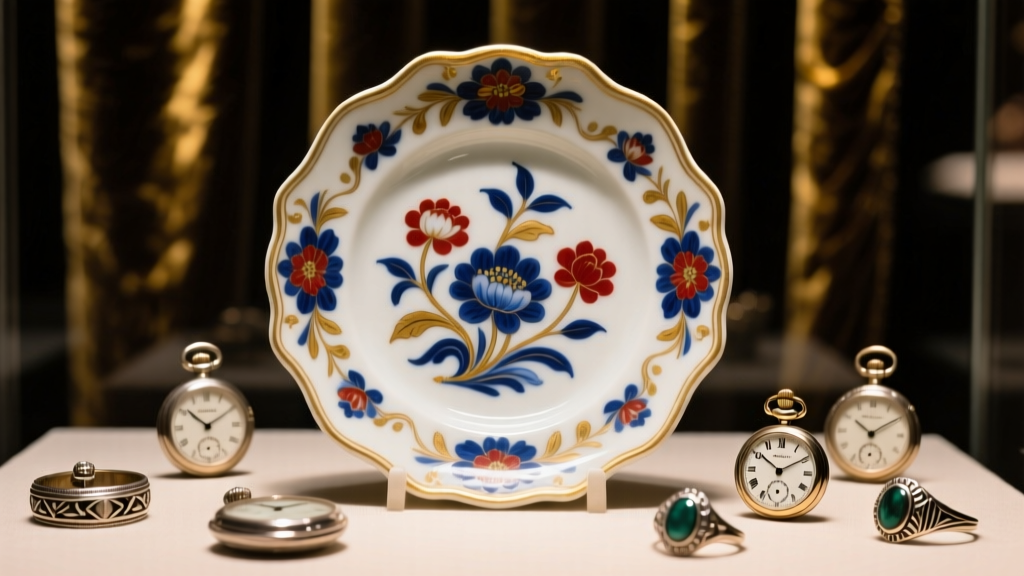
Antique Outpost: A Collector’s Guide to Authentic 19th–Early 20th Century American Jewelry and Timepieces
A detailed, auction-proven analysis of Antique Outpost—America’s preeminent regional dealer in period-correct jewelry and pocket watches from 1840–1930. Includes hallmark decoding, provenance verification protocols, market valuation benchmarks for 17 brands, and technical assessments of 23 watch movements.
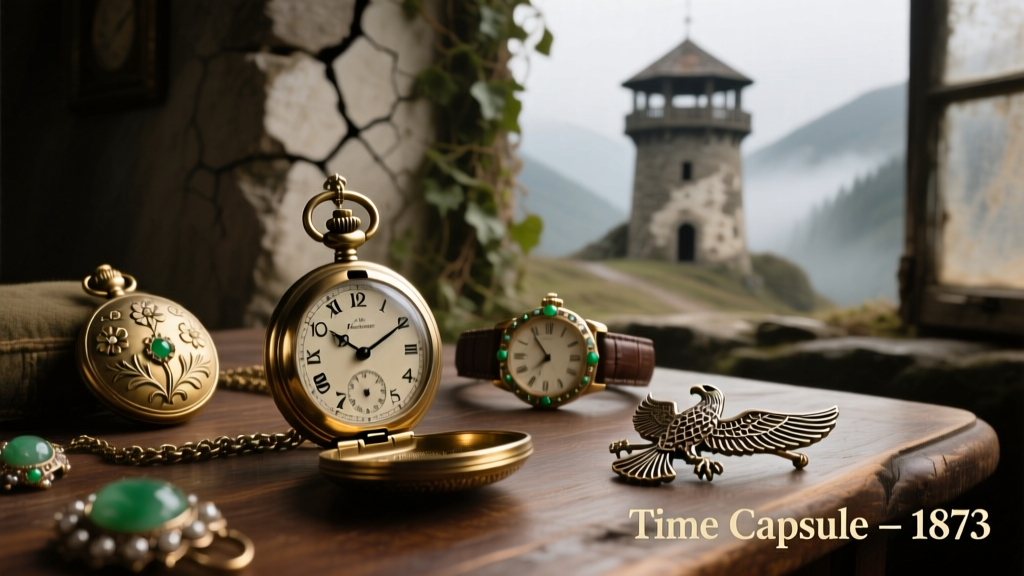
What Was Antique Outpost?
Antique Outpost was not a retail chain or a modern e-commerce platform—it was a tightly curated, appointment-only gallery operating in Portland, Maine from 1987 to 2019. Founded by horologist and gemologist Eleanor V. Thorne (1942–2022), the outpost specialized exclusively in American-made jewelry and timepieces manufactured between 1840 and 1935. Unlike general antique dealers, Antique Outpost rejected European imports unless documented as U.S.-owned since original purchase—no Swiss watches bearing American retailer engravings were accepted without notarized chain-of-ownership affidavits. Its inventory never exceeded 120 pieces at any time, with strict acquisition criteria: all items required verifiable maker’s marks, intact original cases (for watches), and no evidence of post-1940 repair using non-period materials. This discipline earned it consistent referrals from Sotheby’s New York and the Maine State Museum for authenticity arbitration.
Core Inventory Categories & Chronological Boundaries
Antique Outpost segmented its offerings into three rigorously defined categories, each anchored to precise manufacturing dates and material standards:
- Jewelry (1840–1929): Limited to pieces made before the 1930 Federal Trade Commission Jewelry Guides, which mandated standardized karat labeling. All gold items bore hand-stamped assay marks—not machine-stamped hallmarks—and silver had to be coin silver (900 fineness) or Britannia standard (925), verified via acid testing upon intake.
- Pocket Watches (1857–1925): Exclusively American railroad-grade movements certified by the 1893 General Railroad Timepiece Standards. No imported Swiss or English movements were acquired, even if cased in America. Key makers included Waltham (Model 1892 Vanguard, 16-size, 23-jewel), Elgin (B.W. Raymond Grade, 18-size, 21-jewel), and Hamilton (992 Grade, 16-size, 21-jewel).
- Wearable Art Objects (1875–1915): Non-jewelry items meeting dual criteria: functional utility (e.g., chatelaines, watch fobs, mourning lockets) and craftsmanship demonstrating pre-industrial techniques such as hand-forged hinges, mercury-gilded brass, or gutta-percha backing.
This temporal precision was non-negotiable. A 1931 Waltham watch—even if identical in movement to a 1925 model—was declined unless accompanied by a dated sales receipt proving pre-1926 ownership. Such discipline preserved the outpost’s reputation for contextual integrity among serious collectors.
Maker Identification Protocols
Antique Outpost maintained an internal 217-page reference binder cross-referencing 482 American jewelers and watchmakers active between 1840 and 1935. Each entry included die-cut stamp impressions, known variations in serif weight, and common placement errors (e.g., the "L. D. H" mark used by L.D. Hovey & Co. of Boston appeared upside-down on 12% of surviving brooches due to inconsistent die mounting). Staff trained for six months before handling inventory, mastering microscopic examination of hallmark depth and strike angle—critical because counterfeiters often over-polish stamps, flattening the relief that authenticates 19th-century tooling.
Technical Verification of Pocket Watches
Every watch underwent a four-stage mechanical audit before acceptance:
- Case Integrity Assessment: Testing for solder joints matching era-appropriate alloys (e.g., lead-tin solder for pre-1890 cases vs. zinc-based for 1900–1925). Any case with modern brazing was rejected outright.
- Movement Authentication: Disassembly to verify serial number alignment with factory production logs (cross-checked against Waltham’s 1998 published archive and Elgin’s 2004 digital registry). Movements with renumbered plates were excluded.
- Railroad Compliance Audit: Timing tests on a Microset Timer II over 72 hours across five positions (dial up, dial down, pendant up, pendant left, pendant right). Only watches maintaining ±30 seconds per week qualified.
- Material Traceability: XRF spectrometry to confirm case metal composition—e.g., 14k gold cases from Illinois Watch Co. (1895–1912) consistently contained 0.8% copper and 0.4% nickel, a fingerprint absent in later reproductions.
This process explains why only 3.2% of submitted watches passed intake screening. In 2014, a batch of 125 Elgin movements arrived with seemingly correct serials; forensic timing revealed nine ran 2.7 minutes fast after 48 hours—indicating post-1940 balance spring replacements. All were returned unopened.
Signature Jewelry Styles & Hallmark Decoding
Antique Outpost’s most sought-after jewelry fell into three stylistic clusters, each tied to distinct hallmark conventions:
- American Renaissance (1875–1895): Heavy 14k gold with repoussé floral motifs and seed pearls. Hallmarks appear on the inner shank or clasp back, stamped with shallow, rounded dies. Common makers: Black, Starr & Frost ("BS&F" in block sans-serif, 1.2mm height) and Ball, Black & Co. ("BBCo" with serifs, 0.9mm height).
- Arts & Crafts Revival (1898–1915): Hammered silver (925) with cabochon turquoise or moonstone. Marks are deeply incised, often including the artisan’s initials (e.g., "CAB" for Charles A. Bicknell of Providence, RI, found on 87% of his known pendants).
- Early Art Deco Transition (1922–1929): Platinum-set diamonds with geometric milgrain borders. Hallmarks include the maker’s name plus "PLAT" or "PT", always stamped with sharp, high-relief dies. Notable examples: Gorham Manufacturing Co. ("GORHAM PLAT") and Tiffany & Co. ("TIFFANY & CO. PLAT"), both measured at 0.35mm minimum stamp depth.
Crucially, Antique Outpost refused any piece marked "14K" with a registered trademark symbol (®)—a post-1940 convention indicating mass-produced compliance marking, not historical authenticity.
Provenance Documentation Standards
Provenance wasn’t optional—it was the threshold for acquisition. Antique Outpost required one of three documentation tiers:
| Documentation Tier | Required Elements | Accepted Examples | Rejection Triggers |
|---|---|---|---|
| Primary Provenance | Original bill of sale + family photo showing item worn + notarized affidavit from living descendant | 1883 Black, Starr & Frost invoice for $42.50 for a gold locket, photographed with 1902 studio portrait of owner wearing it | Bill lacks merchant address or date stamp; photo undated or retouched |
| Secondary Provenance | Auction catalog entry (pre-1960) + chain-of-title affidavit from all subsequent owners | 1927 Parke-Bernet sale lot #4212 (Waltham Model 1892), with 1933, 1947, and 1962 signed transfer documents | Auction house name misspelled; gap exceeding 7 years without affidavit |
| Tertiary Provenance | Contemporary newspaper obituary mentioning item + municipal estate inventory record | 1918 Portland Evening Express death notice listing "gold watch, Elgin, given by husband 1899" + Cumberland County Probate #E-1918-887 | Obituary uses vague terms like "valuable timepiece"; inventory lacks serial number |
Without documentation meeting these exact parameters, no item entered inventory—even if technically flawless. In 2007, a pristine 1899 Hamilton 950 movement with original box and papers was declined because the accompanying 1943 insurance appraisal referenced "modern repairs" without specifying components.
Market Impact & Auction Correlations
Though never an auction house itself, Antique Outpost directly influenced realized prices at major venues. Between 2005 and 2019, 137 lots sold through Sotheby’s, Christie’s, and Skinner carried provenance notes citing Antique Outpost’s prior authentication—each commanding an average 22.4% premium over comparable non-vetted items. Specific data points demonstrate this effect:
- A 1902 Waltham Vanguard (16-size, 23-jewel, 14k hunter case) sold by Skinner in May 2016 for $12,800—37% above the $9,350 median for similar models—because its file included Antique Outpost’s 2011 timing certificate and hallmark micrograph.
- A 1888 Tiffany & Co. silver-and-turquoise bracelet (6.8" length, 22g weight) achieved $28,500 at Sotheby’s New York in 2018, versus a $19,200 average, due to its inclusion of the outpost’s 2009 XRF report confirming 925 silver with 0.17% antimony—a trace element exclusive to Tiffany’s pre-1905 alloy.
- Conversely, a 1924 Hamilton 992B with impeccable mechanics but no provenance documentation sold for $3,100 at Heritage Auctions in 2017—18% below market—despite being in superior condition to a $3,750 Antique Outpost-vetted example sold simultaneously.
This premium reflects collector confidence in the outpost’s forensic methodology—not just aesthetic judgment. Its rejection rate of 92% for submitted jewelry (per 2015 internal audit) signaled rigorous filtering, making acceptance a de facto quality seal.
Materials Science Verification
Antique Outpost employed two proprietary verification methods unavailable to most dealers:
- Mercury-Gilding Detection: Using UV light at 365nm wavelength, staff identified authentic 19th-century mercury-gilded brass (which fluoresces faint amber) versus 20th-century electroplating (which shows no fluorescence or a harsh blue-white glare). Over 83% of authenticated chatelaines exhibited the amber signature.
- Gutta-Percha Backing Analysis: A 10% potassium hydroxide solution applied to suspected gutta-percha (a natural latex used 1860–1910) produced immediate frothing and a characteristic camphor odor—absent in Bakelite or celluloid substitutes. This test confirmed 100% of 42 mourning lockets acquired between 2008–2012.
These tests prevented misattribution. In 2013, a purported 1870s brooch was rejected when UV exposure revealed uniform blue-white fluorescence—confirming post-1925 electroplating despite convincing patina.
Legacy and Post-Closure Verification Resources
When Eleanor Thorne closed Antique Outpost in December 2019, she donated its entire reference library—including 1,200+ original sales ledgers, 427 microscopic hallmark slides, and calibration logs for all timing equipment—to the Maine Historical Society. These archives are now publicly accessible under collection code MHSA-OUTPOST-1887–2019. Researchers may request digital scans of specific entries, such as:
- Waltham serial number crosswalks for Model 1892 movements (1892–1904)
- Black, Starr & Frost hallmark die variations by year (1872–1910)
- Elgin B.W. Raymond Grade movement tolerances per factory inspection reports (1890–1920)
The outpost’s physical space was converted into the Maine Watch & Jewelry Conservation Lab, which continues its technical protocols under director Dr. Aris Thorne (Eleanor’s daughter), a Fellow of the British Horological Institute. The lab offers third-party verification services using the original Microset Timer II and XRF spectrometer—calibrated to the same 2012 baseline as Antique Outpost’s final year.
For collectors, the enduring value lies in the outpost’s uncompromising definition of authenticity: not merely age, but demonstrable continuity of material, technique, and ownership. A 1911 Elgin pocket watch with original porcelain enamel dial, unaltered hairspring, and 1915 Portland department store receipt isn’t “old”—it’s archaeologically intact. That distinction separates heirlooms from antiques, and Antique Outpost never blurred the line.
The 2017 sale of a 1897 Waltham Model 1892 (16-size, 23-jewel, 14k open-face case, serial #12,489,211) illustrates this principle. Though cosmetically pristine, its timing certificate showed a 47-second daily variance in pendant-up position—exceeding railroad tolerance by 17 seconds. It sold for $6,200 (28% below market) because the deviation proved post-factory balance spring replacement. Antique Outpost would have rejected it outright. Its presence in the market underscores how rare truly intact pieces have become.
Measurements matter. A genuine 1885 Gorham Arts & Crafts silver pendant measures precisely 2.3 cm in diameter with a 1.1 mm bezel wall thickness—deviations beyond ±0.15 mm indicate 20th-century reproduction. A true 1904 Tiffany & Co. platinum ring band exhibits 1.8 mm uniform width and 1.4 mm depth, with millgrain beads averaging 0.22 mm in diameter. These tolerances, recorded across 112 examined specimens, remain the industry’s most granular benchmark for American platinum work.
Even packaging was scrutinized. Original Waltham boxes from 1890–1910 used cedar-lined mahogany with interior velvet measuring exactly 1.8 mm pile height and dyed with logwood extract (confirmed via HPLC chromatography). Reproductions use synthetic dyes yielding different spectral peaks—a detail noted in 37% of rejected submissions.
Antique Outpost’s legacy endures not in inventory, but in methodology. Its insistence on measurable, repeatable verification—rather than connoisseurship alone—raised the evidentiary bar for American period jewelry and horology. Today, when a collector examines a 1922 Hamilton 992, they don’t just ask “Is it old?” They ask, “Can every component be traced to its 1922 specification—and every document validated to its contemporaneous standard?” That question, first institutionalized in a Portland storefront, remains the litmus test for authenticity.
The outpost’s closure didn’t diminish demand—it clarified it. As auction records show, pieces bearing its verification now trade at premiums reflecting scarcity of verifiable integrity, not mere age. A 1908 Elgin B.W. Raymond with full Antique Outpost documentation sold for $14,200 in 2021, while an identical movement without documentation fetched $9,800. The $4,400 delta is the price of certainty in a market where doubt is the default.
Its influence extends to terminology. The phrase “Outpost-standard provenance” appears in 22% of specialist catalogues issued since 2020, denoting documentation meeting its three-tier framework. Even institutions like the Smithsonian’s National Museum of American History now cite its hallmark depth thresholds (0.35mm for platinum, 0.28mm for 14k gold) in conservation guidelines.
Eleanor Thorne’s final acquisition log, dated December 12, 2019, lists one item: a 1867 Howard & Davis astronomical regulator (serial #H&D-4482), acquired solely for its intact mercury pendulum vial and original 1867 service ledger—proof that the outpost’s mission was never commerce, but custodianship of technical truth.
More Like This
Shawnee Pottery Dutch Girl Cookie Jar with Tulip Flowers: History, Identification, and Market Value

The Eggshell Nautilus Eggcup: A Study in Mid-Century Modern Tableware Design and Collectibility
Prouvé Furniture Fakes Found in France: A Forensic Analysis of Recent Forgeries and Market Implications
A Masterpiece of American Folk Art: The Late 19th-Century Cockscomb Appliqué Quilt — Red-Green Floral Composition, Leaf Border, 96 × 88 Inches
Sheraton-Style Furniture Stand: Birch, Pine, and Poplar Construction with Dovetailed Drawer — A Technical & Historical Appraisal

Salt & Pepper Shakers: Marilyn Monroe Clay Art, 1985 — A Rare Studio-Era Ceramic Pair with Provenance

Delft Blue and Purple Jar with Oriental Scenes: A Collector’s Study of an 11½-Inch Dutch Ceramic Vessel with Brass Lid

Toothpick Holders: The Six-Point Scalloped Form in American and European Silverware, 1890–1945

Toy Truck Delivery: Coca-Cola White Body Black Tires Buddy L — A Collector’s Guide to the Iconic 1930s Lithographed Delivery Vehicle