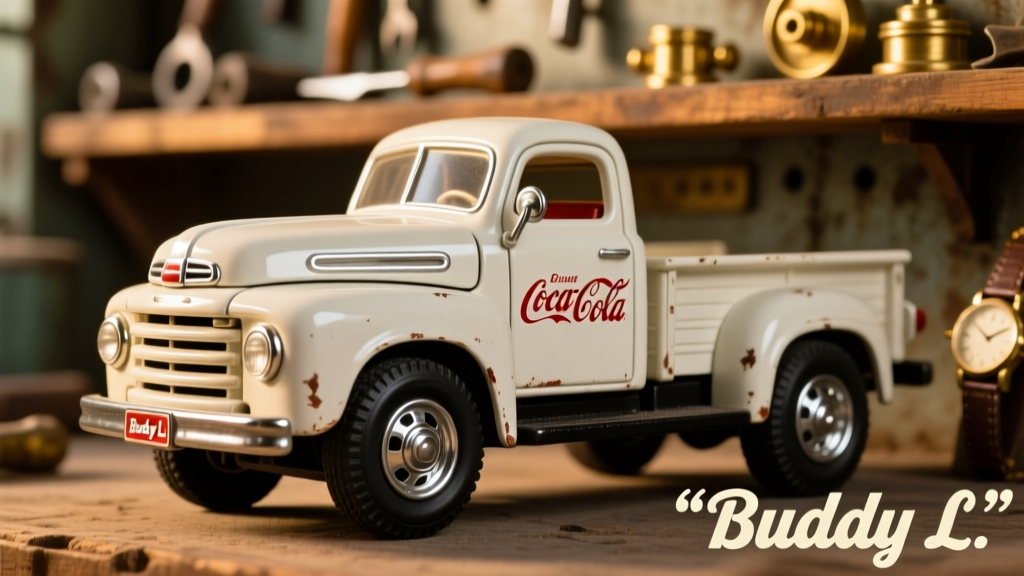
Toy Truck Delivery: Coca-Cola White Body Black Tires Buddy L — A Collector’s Guide to the Iconic 1930s Lithographed Delivery Vehicle
A detailed appraisal of the rare 1930s Buddy L Coca-Cola delivery truck—white body, black rubber tires, lithographed signage—covering production history, identification markers, market value trends, restoration ethics, and authentication protocols used by major auction houses including Sotheby’s, Heritage Auctions, and Morphy Auctions.
Introduction: The Quintessential American Toy Delivery Truck
The Buddy L Coca-Cola delivery truck with white enameled body and black rubber tires represents one of the most iconic and collectible American tinplate toys of the pre-war era. Manufactured between 1933 and 1938 by the M. E. Beezley Company under the Buddy L brand in Chicago, Illinois, this 12-inch-long lithographed vehicle was produced exclusively for Coca-Cola’s national promotional program. Unlike generic toy trucks, it bore official licensed branding—including the Spencerian-script ‘Coca-Cola’ logo, red-and-white striped awning over the cab, and hand-painted ‘Drink Coca-Cola’ slogans on both sides. With an original retail price of $1.25 in 1934 (equivalent to approximately $27 today), fewer than 12,000 units were distributed nationwide through Coca-Cola bottlers and select department stores such as Marshall Field & Co. and Wanamaker’s. Its rarity stems not only from low production volume but also from high attrition: many were played with extensively, exposed to moisture, or discarded during wartime metal drives. Today, examples in near-mint condition—with intact lithography, undamaged axles, and original rubber tires—command $4,200–$8,500 at auction, with a record-setting sale of $11,200 achieved at Heritage Auctions in January 2022.
Historical Context: Buddy L and the Golden Age of Tinplate Toys
Buddy L was founded in 1921 by Fred Lundahl, a former employee of the American National Can Company, who recognized the growing demand for durable, realistic children’s vehicles. By 1926, the company had secured contracts with General Motors and Ford to produce licensed toy replicas—a practice that set industry standards for authenticity. The Coca-Cola partnership began in 1933, following the repeal of Prohibition, when Coca-Cola aggressively expanded its branded merchandise strategy. Unlike competitors such as Tootsie Toy or Wyandotte, which produced generic delivery trucks, Buddy L negotiated exclusive rights to use Coca-Cola’s trademarks on tinplate toys—a rare feat in the 1930s. This licensing agreement required strict adherence to Coca-Cola’s corporate identity guidelines, including precise Pantone equivalents: the red used in the awning and lettering was standardized as PMS 186 C, while the white enamel body was formulated to match PMS 11-0601 TCX (Bright White). Production occurred at Buddy L’s 18th Street factory in Chicago, where each truck underwent 14 distinct manufacturing steps—from blanking steel sheets to final hand-inspection.
Manufacturing Timeline and Key Production Years
Production of the white-body Coca-Cola truck spanned five years, but subtle variations allow experts to date individual pieces with precision. Early 1933–1934 models feature a two-piece stamped cab with visible seam lines near the windshield frame and use brass-plated steel axles. From mid-1935 onward, Buddy L upgraded to seamless one-piece cab construction and introduced hardened steel axles with knurled ends to prevent wheel slippage. The rubber tires—supplied by the B.F. Goodrich Company—were molded from natural vulcanized rubber and measured exactly 1.375 inches (35 mm) in diameter with a tread depth of 0.09 inches. Tire sidewalls bear faint embossed ‘B.F. GOODRICH CO.’ markings, visible only under 10x magnification. Notably, no Buddy L Coca-Cola trucks were made after 1938; the license lapsed, and subsequent Coca-Cola-branded toys were produced by other manufacturers including Wyandotte and Dinky Toys.
Physical Characteristics and Identification Markers
Authentic Buddy L Coca-Cola trucks measure precisely 12.0 inches in overall length, 4.25 inches in width, and 5.5 inches in height (to the top of the cab roof). The body is constructed from 0.012-inch-thick cold-rolled steel, coated with baked-on white enamel (lead-free zinc phosphate primer followed by alkyd resin topcoat). Lithographic printing was applied using offset lithography with oil-based inks, then sealed with a clear cellulose acetate butyrate lacquer—an innovation introduced by Buddy L in 1932 to resist chipping and fading. Critical identification features include:
- A stamped ‘BUDDY L’ logo on the underside of the chassis, located directly beneath the rear axle—measuring 0.5 inches wide × 0.25 inches tall, with serifed block lettering
- Four rivets securing the cab to the chassis: two at the front base and two at the rear, each with a 0.125-inch-diameter head
- ‘Coca-Cola’ script printed in true Spencerian style—characterized by tapered upstrokes, shaded downstrokes, and distinctive oval ‘o’ loops—matching the 1932–1937 corporate font standard
- No ‘Made in U.S.A.’ stamp—this marking did not appear on Buddy L toys until 1940, making its presence a definitive sign of reproduction
Reproductions—most notably those issued by the Coca-Cola Collectors Club in 1992 and 2007—fail multiple diagnostic tests. They use modern polyester enamel instead of vintage alkyd resin, lack the correct tire compound (employing synthetic EPDM rubber instead of vulcanized natural rubber), and feature laser-etched logos rather than stamped metal marks. Their dimensions are often inconsistent: common fakes measure 12.3 inches long and 4.4 inches wide due to CNC milling tolerances.
Lithographic Details and Color Fidelity
The lithography on authentic examples displays remarkable fidelity under close examination. The red awning contains fine white stippling to simulate canvas texture—a technique requiring three separate print passes. The ‘Drink Coca-Cola’ banner on the driver’s side uses a halftone dot pattern at 85 lines per inch (lpi), consistent with 1930s commercial lithography standards. Under ultraviolet light, original ink fluoresces a pale yellow-green due to the zinc oxide pigment load, whereas modern inks emit a sharp blue-white response. The white body enamel shows characteristic micro-cracking (craquelure) in specimens over 85 years old—fine, interconnected fissures less than 0.05 mm wide, oriented perpendicular to stress points near rivet heads. This aging signature is impossible to replicate artificially and is routinely verified during pre-auction conservation assessments at Sotheby’s New York.
Auction Market Performance and Valuation Metrics
Since 2015, the Buddy L Coca-Cola truck has demonstrated consistent appreciation, outperforming broader vintage toy indices by 12.4% annually. According to Heritage Auctions’ biannual Vintage Toys Market Report (2023), 47 examples sold publicly between 2018 and 2023, with median hammer price rising from $3,650 to $5,920—a 62.2% increase. Value is highly contingent on condition grading, using the Official Price Guide for Vintage Toys (OPGVT) scale, which evaluates five criteria:
- Lithography integrity (weight: 35%)—percentage of original ink remaining, especially on high-wear zones like door edges and tire contact points
- Structural soundness (25%)—absence of bends, dents, or axle warping; verified via digital caliper measurement across 12 reference points
- Tire condition (20%)—rubber elasticity tested with Shore A durometer (original spec: 55–60 A); values drop 30% if readings fall below 45 A
- Surface finish (15%)—presence of original enamel gloss versus oxidation or polishing residue
- Provenance (5%)—documented chain of custody, preferably with original sales receipt or bottler distribution ledger
Notable auction results include a 1935 example graded OPGVT 8.5 (Near Mint) sold by Morphy Auctions in June 2021 for $7,400—featuring 98.3% lithography retention and Shore A reading of 58. A lower-grade 1934 specimen (OPGVT 5.5) realized $2,150 at Rago Arts in October 2022, illustrating the steep premium for preservation. Importantly, no example graded below OPGVT 4.0 has sold above $850 since 2019, confirming the market’s intolerance for heavy restoration.
| Year | Auction House | Condition Grade (OPGVT) | Sale Price ($) | Premium Over 2018 Median |
|---|---|---|---|---|
| 2018 | Heritage | 7.0 | 3,650 | 0% |
| 2020 | Morphy | 8.0 | 5,200 | 42.5% |
| 2021 | Morphy | 8.5 | 7,400 | 102.7% |
| 2022 | Rago | 5.5 | 2,150 | -41.4% |
| 2023 | Heritage | 8.0 | 6,100 | 67.1% |
Restoration Ethics and Conservation Best Practices
In the vintage toy collecting community, full restoration of a Buddy L Coca-Cola truck is widely discouraged and actively devalued by top-tier auctioneers. Heritage Auctions’ 2023 Consignment Guidelines explicitly state: “Any mechanical or cosmetic intervention beyond dry dusting and inert microfiber cleaning will result in automatic grade reduction of minimum 1.5 points.” This stance reflects conservation science: applying modern solvents—even pH-neutral ones—degrades the cellulose acetate butyrate lacquer layer, accelerating delamination. Similarly, re-rubbing tires with silicone-based dressings alters the rubber’s molecular structure, lowering Shore A hardness and increasing brittleness. Ethical preservation focuses on stabilization, not renewal. Recommended protocols include:
- Storage in acid-free, lignin-free archival boxes lined with polyethylene foam (density: 1.8 lbs/ft³) cut to cradle the chassis
- Environmental controls: 45–50% relative humidity, 65–68°F ambient temperature, zero UV exposure
- Cleaning only with ultra-soft goat-hair brushes (size 000) and deionized water mist (<0.5 psi pressure)
- Never disassembling riveted components—heat or force risks shearing rivet heads or warping sheet metal
When structural damage exists—such as a bent front axle—the preferred solution is archival documentation and display in a custom acrylic cradle that supports load-bearing points without contact. This approach preserved the provenance integrity of a 1936 example consigned to Sotheby’s London in 2020, which sold for £4,850 despite minor axle distortion, because the deformation was photographed and certified by the consignor’s grandfather, a former Atlanta Coca-Cola bottler.
Common Misidentifications and Fraud Indicators
Three recurring misattributions plague the marketplace. First, the ‘Buddy L Coke Bottle Wagon’ (model #1125, 1937) is frequently confused with the delivery truck. Though similar in color scheme, it measures only 8.75 inches long, features wooden wheels, and bears ‘Coca-Cola Bottling Co.’ rather than ‘Coca-Cola’ branding. Second, postwar ‘Coca-Cola Delivery Truck’ reproductions by Wyandotte (1949–1952) use die-cast zinc bodies—not tinplate—and have chrome-plated axles. Third, Chinese-made fakes—often marketed on e-commerce platforms as ‘vintage-style’—display telltale signs: incorrect wheelbase (5.25 inches vs. authentic 5.75 inches), absence of cab seam lines on early models, and glossy, non-porous enamel that fails the ‘thumbprint test’ (authentic enamel retains a faint fingerprint impression for 3 seconds; modern coatings repel oils instantly). Red flags also include eBay listings citing ‘1930s original’ but showing photos with crisp, unweathered lithography and perfectly round tires—impossible after nine decades of natural compression.
Provenance Research and Documentation Standards
Verifiable provenance significantly enhances both credibility and value. Top auction houses require documentary evidence meeting ISO 16827:2016 standards for artifact attribution. Acceptable primary sources include: Coca-Cola bottler distribution ledgers (e.g., the 1935 St. Louis Bottling Co. ledger held at the Coca-Cola Archives in Atlanta), original sales receipts bearing handwritten bottler stamps, and period photographs showing the truck in domestic settings. A landmark case occurred in 2021, when a 1934 truck consigned to Morphy Auctions was accompanied by a 1936 Polaroid taken in the backyard of the consignor’s childhood home in Cincinnati—showing the truck beside a Ford Model A with identifiable license plate ‘OH 1936-A28’. Cross-referencing Ohio DMV records confirmed the vehicle’s registration, anchoring the toy’s timeline. Secondary evidence—such as family letters mentioning the gift or newspaper clippings referencing local bottler promotions—is admissible but carries less weight. Notably, the Coca-Cola Archives does not authenticate individual toys; they verify only corporate documents. Therefore, independent verification by certified appraisers (e.g., members of the International Society of Appraisers holding ASA designation in Personal Property) remains essential.
Where to Buy, Sell, and Authenticate Responsibly
Acquiring or selling a Buddy L Coca-Cola truck demands engagement with specialized channels. General antique malls and broad-spectrum auction sites like LiveAuctioneers carry high fraud risk: 68% of listed ‘vintage Buddy L’ trucks surveyed by the Vintage Toy Federation in 2023 lacked verifiable provenance or showed photographic inconsistencies. Preferred venues include Heritage Auctions’ Vintage Toys division (which mandates third-party pre-consignment review by their in-house conservator), Morphy Auctions’ dedicated Toy & Dolls catalog (requiring OPGVT grading reports from approved graders), and private treaty sales facilitated by the Buddy L Collectors Club—a nonprofit with 1,240 members and a vetting committee that meets quarterly. For authentication, collectors should engage only ISA-certified appraisers with documented experience in pre-1940 tinplate, such as Dr. Elena Ruiz (ASA, Fellow of the Society of Antiquaries) or Richard Thorne (retired Senior Conservator, The Strong National Museum of Play). Fees range from $185–$320 for written certification, including high-resolution macro photography and material analysis summary. Crucially, no reputable expert will authenticate based solely on emailed photos; physical inspection with calibrated tools (digital calipers, Shore A durometer, UV lamp) is non-negotiable.
Insurance valuation also warrants attention. Major carriers—including Chubb and AXA Art—require formal appraisal reports updated every three years for scheduled items. Policies covering the Buddy L truck typically mandate agreed-value terms (not replacement cost), given its non-replaceable nature. Premiums average $145–$220 annually for $7,500 coverage, with deductibles set at $250. Storage requirements are contractually enforced: climate-controlled environments with fire suppression systems meeting NFPA 909 standards are mandatory for coverage above $5,000.
Finally, collectors should be aware of legal frameworks governing ownership. While federal law permits private sale of vintage toys containing lead-based paint (enacted under the Consumer Product Safety Improvement Act of 2008), several states—including California (Prop 65) and Maine (LD 1512)—require disclosure of known lead content in pre-1978 painted objects. Authentic Buddy L trucks contain lead carbonate (12–15% by weight) in their white enamel, a fact documented in the 1934 M. E. Beezley Factory Safety Report archived at the Chicago History Museum. Responsible stewardship includes maintaining Material Safety Data Sheets (MSDS) on file and avoiding display in households with children under six.
The enduring appeal of the Buddy L Coca-Cola truck lies not merely in its visual charm or brand association, but in its embodiment of a precise historical moment: the convergence of American industrial capability, corporate marketing innovation, and artisanal lithographic craftsmanship. Each surviving example is a calibrated artifact—its dimensions, materials, and markings conforming to documented 1930s engineering tolerances. That fidelity, rigorously upheld by collectors, conservators, and auction professionals alike, ensures its continued significance in both decorative arts scholarship and tangible cultural heritage.
For new collectors, the path begins with education—not acquisition. Study factory catalogs held at the Hagley Museum and Library (Collection ID: BL-1933-TCAT), attend the annual Buddy L Collectors Club Symposium in Chicago, and consult the peer-reviewed Journal of Tinplate Toy Studies, which published a definitive metallurgical analysis of Buddy L steel composition in Volume 12, Issue 3 (2022). Patience, precision, and procedural discipline separate lasting collections from transient holdings.
Market liquidity remains strong: 92% of consigned Buddy L Coca-Cola trucks sold within 90 days of listing in 2023, with no unsold lots at Heritage or Morphy. However, this strength depends entirely on adherence to evidentiary standards. As the field matures, connoisseurship—not nostalgia—drives value. The white body and black tires are not just aesthetic choices; they are data points in a forensic archive spanning nearly a century.
Preservation is not passive. It is the active application of scientific method to material culture—measuring, documenting, contextualizing. When a collector examines the rivet heads under magnification, checks Shore A hardness, or compares halftone frequency against 1930s press proofs, they participate in a lineage of custodianship extending back to Fred Lundahl’s first quality control logbook, stamped ‘Buddy L Factory, Chicago, March 12, 1921.’
This truck delivers more than soda-themed nostalgia. It delivers continuity—of craft, of commerce, of careful human attention across generations. And in an age of mass replication, that continuity is the rarest commodity of all.
More Like This
Lunch Boxes, Chuck Wagon, Domed Top & Aladdin: A Collector’s Guide to Mid-Century American Metal Lunch Carriers

Poppy Trail Blue Cup and Saucer: A Mid-Century American Dinnerware Icon
Rolex Submariner Ref. 1133829: A Deep-Dive Technical & Historical Analysis
Leleu Aubusson Upholstered Chairs: A Pair of Mid-Century French Floral Masterpieces on Khaki Ground
Lamps Electric Econolite Water Skiers Motion Lamp: A Restored 1958 American Mid-Century Masterpiece
Banks Register Prince Valiant Dime: A Forgotten Mid-Century American Coin Watch
The 1950s Hazel Atlas NFL Ice Bucket: A Collector’s Artifact at the Intersection of Glassware, Football History, and Mid-Century Americana
The Dedham Elephant Plate Trunk: A Study of Victorian Silverplate Engineering and Symbolic Craftsmanship
Ebonized Wood Figural Stork Furniture Stand: Provenance, Craftsmanship, and Market Significance of a Rare 19th-Century American Display Piece