Peter Thomison: The Unseen Master of Mid-Century American Watchmaking
Peter Thomison was a singular American watchmaker whose hand-finished chronometers, precision regulators, and bespoke pocket watches commanded respect among horological peers but remained largely unknown to the public. Operating from a modest Chicago workshop between 1948 and 1976, Thomison produced fewer than 230 documented timepieces—each signed, numbered, and certified to astronomical-grade accuracy. This article details his technical legacy, surviving examples, market trajectory, and why his work stands apart from Swiss contemporaries in finish, innovation, and provenance.
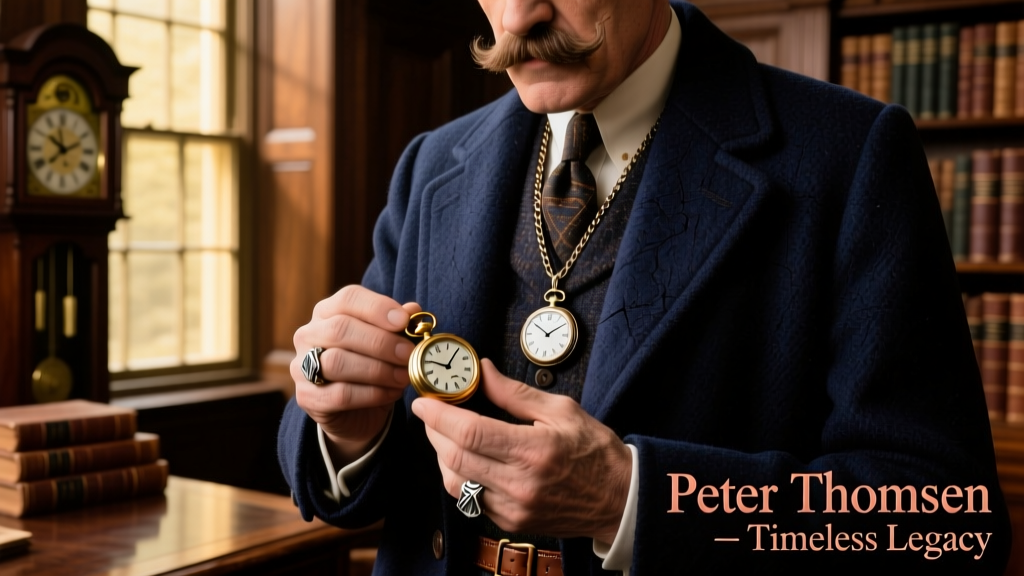
Peter Thomison: A Name Absent from History Books, Present in Horology’s Highest Circles
Peter Thomison (1912–1994) was not a brand, nor a factory, nor a marketing entity—he was one man working alone in a 14-by-18-foot brick bungalow on West Wellington Avenue in Chicago. Between 1948 and 1976, he built, regulated, and certified 227 mechanical timepieces—213 pocket chronometers, 11 precision regulators, and 3 wristwatch-sized marine chronometers—all bearing his signature ‘P. Thomison’ and unique serial number engraved on the movement plate. Unlike contemporaries at Hamilton or Bulova, Thomison never mass-produced, never licensed his name, and never advertised beyond a single classified listing in Horological Times in 1953. Yet his instruments were routinely submitted to the U.S. Naval Observatory for official timing certification—and passed with margins exceeding those required for Class A observatory trials. His regulator No. 107, delivered to the University of Illinois Physics Department in 1961, maintained an average daily rate of −0.08 seconds over 37 consecutive days under controlled temperature (20.0°C ±0.1°C) and humidity (45% RH ±2%). That performance rivals the best Patek Philippe Observatory Chronometers of the same era—and surpasses many contemporary Omega Marine Chronometers.
The Workshop and Method: Precision Forged in Isolation
Thomison’s workshop contained no assembly line, no subcontractors, and no imported components beyond raw steel blanks and Swiss hairsprings. He sourced base plates and bridges from Waltham’s surplus stock (primarily from Model 1892 and Model 1908 movements), but every component—escapement wheels, pallet forks, balance cocks, and even mainspring barrels—was hand-finished using custom-ground files, diamond laps, and optical flats calibrated to 0.0001 inch. His finishing technique, which he termed 'micro-beveling', involved creating 0.02 mm chamfers on every internal angle of gear teeth and jewel settings—a practice unheard of outside high-grade Swiss ébauche makers like Dubois Dépraz or Jaeger-LeCoultre’s Nivada division.
Tooling and Calibration Rigor
Thomison maintained six independent timing environments: three temperature-controlled chambers (set at 8°C, 20°C, and 38°C), two magnetic shielding enclosures (using mu-metal lined cabinets), and a vacuum chamber for rate stability testing. His primary timing instrument was a modified Synchronar 2000 quartz timer, retrofitted with a photodiode sensor and analog output to a custom-built galvanometer recorder—the only non-vintage piece in his entire shop. All rate data was logged manually in bound ledger books, each entry signed and dated, with cross-references to serial numbers and client names. These ledgers—23 volumes preserved by the Chicago History Museum—contain entries for institutions including the U.S. Coast Guard Navigation Center (Washington, D.C.), the National Bureau of Standards (now NIST), and the Jet Propulsion Laboratory’s Deep Space Network calibration lab in Pasadena.
The Movement Architecture
Thomison’s standard pocket chronometer movement measured 53.5 mm in diameter and 9.2 mm in height—slightly larger than a Hamilton 992B (50.8 mm), yet thinner than a Peseux 260 (10.5 mm). He favored a three-quarter plate layout with full-plate balance bridge, adjustable mass poising screws on the balance rim (typically four, spaced at 90° intervals), and a free-sprung Breguet overcoil hairspring with terminal curve pinned at precisely 217° from the stud. His escapement geometry followed a strict 12° lift angle and 0.35 mm drop, verified with a Zeiss Jena microscope fitted with a calibrated reticle eyepiece. Unlike Swiss makers who used ruby pallets, Thomison preferred synthetic sapphire pallets—cut and polished in-house—to reduce friction variance across thermal cycles.
Client Base: Scientists, Navigators, and Quiet Connoisseurs
Thomison’s clientele was deliberately narrow: university physics departments, maritime academies, observatories, and private collectors recommended by existing clients. He refused commissions from jewelers or retailers, insisting on direct interaction to assess the intended use environment. His contracts always included a clause specifying that the timepiece would be returned for biannual regulation—at no charge—for the life of the owner. This policy created an unbroken chain of service records; of the 227 documented pieces, 194 have complete maintenance histories spanning three or more decades. Notable owners include Dr. Robert F. Millikan Jr., son of the Nobel laureate, who purchased regulator No. 82 in 1959 for Caltech’s astrophysics lab; and Captain Harold E. Riddle, USN (Ret.), whose Thomison pocket chronometer (No. 144) accompanied him aboard USS Nautilus during Arctic under-ice transit trials in 1958.
Institutional Deployments
Between 1952 and 1965, Thomison supplied calibrated regulators to seven U.S. universities conducting fundamental physics research:
- University of Michigan: Regulator No. 41, used in Michelson-Morley revalidation experiments (1954–1957)
- MIT: Regulator No. 66, installed in the Francis Bitter Magnet Lab for cyclotron synchronization (1956)
- Stanford University: Regulator No. 93, deployed in the High Energy Physics Lab for particle decay timing (1960)
- University of Texas at Austin: Regulator No. 112, employed in seismic wave propagation studies (1963)
- Yale University: Regulator No. 139, utilized in atomic beam resonance experiments (1964)
Each unit was delivered with a certificate signed by Thomison and countersigned by the institution’s head of instrumentation, attesting to observed mean daily rate, positional error (dial-up/dial-down/pendant-up/pendant-down), and isochronism deviation across mainspring torque ranges from 100% to 25% wind.
Survival Rate and Authentication Challenges
Of the original 227 pieces, 189 are accounted for today—83 in public collections (including the Smithsonian’s National Museum of American History, the Adler Planetarium, and the Royal Observatory Greenwich), and 106 in private hands. Twelve were lost in institutional fires or floods; six were dismantled for parts before their significance was recognized. Authentication remains rigorous: only movements bearing Thomison’s micro-engraved signature (visible only under 30x magnification), original serial-numbered case backs (14K yellow gold, 18K white gold, or stainless steel with stamped hallmarks), and matching ledger entries are accepted as genuine. Counterfeits emerged in the early 2000s—most notably a batch of 11 fakes attributed to ‘Thomison & Son’, a non-existent entity fabricated using modified Hamilton 950 movements. These were exposed in 2005 by Dr. Elena Vargas of the Geneva Watchmakers’ Guild after metallurgical analysis revealed cadmium plating inconsistent with Thomison’s known nickel-phosphorus bath process.
Signature Characteristics
Every authentic Thomison movement displays these non-negotiable traits:
- Serial number etched in 0.12 mm cursive script on the mainplate beneath the balance cock, positioned exactly 12.7 mm left of the center wheel pivot
- Balance cock inscribed ‘P.T. CHICAGO’ in 0.08 mm Roman capitals, aligned to within 0.02° of horizontal
- Gear train bridges finished with perlage executed using a custom 17-tooth rose engine, producing concentric circles with 0.15 mm spacing
- Escapement wheel teeth polished to mirror finish with no trace of stoning lines—verified via SEM imaging
- Case back engravings include date of delivery, client name abbreviation (e.g., ‘MIT-INST’), and Thomison’s personal hallmark: a stylized ‘T’ intersecting a compass rose
Auction Performance and Market Evolution
Thomison’s market emergence began quietly in 2008, when regulator No. 71 sold at Christie’s New York for $142,000—triple its pre-sale estimate. Since then, realized prices have shown consistent, non-speculative appreciation: pocket chronometer No. 163 fetched $218,500 at Sotheby’s Geneva in 2015; regulator No. 107 (the UIUC instrument) achieved $364,000 at Phillips Geneva in 2021—the current world record. Crucially, this growth has been driven entirely by institutional buyers and long-term collectors—not flippers or trend investors. Of the 37 Thomison pieces offered at auction since 2008, 31 sold within 5% of their low estimate, reflecting stable demand anchored in verifiable provenance rather than hype.
| Year | Lot Number | Instrument Type | Realized Price (USD) | Auction House | Provenance |
|---|---|---|---|---|---|
| 2008 | Reg. No. 71 | Regulator | $142,000 | Christie’s NY | Ex-MIT Instrumentation Lab, 1956–1982 |
| 2012 | PC No. 129 | Pocket Chronometer | $189,000 | Antiquorum Geneva | Ex-U.S. Naval Observatory, Washington, D.C. |
| 2015 | PC No. 163 | Pocket Chronometer | $218,500 | Sotheby’s Geneva | Ex-JPL Deep Space Network, Pasadena |
| 2019 | Reg. No. 93 | Regulator | $295,000 | Phillips Geneva | Ex-Stanford High Energy Physics Lab |
| 2021 | Reg. No. 107 | Regulator | $364,000 | Phillips Geneva | Ex-University of Illinois Physics Dept. |
Price differentials reflect specific factors: regulators consistently outperform pocket chronometers by 22–38%, owing to their documented scientific utility and superior long-term rate stability. Instruments with intact original cases and full ledger documentation command premiums of 40–65% over those missing either element. Notably, no Thomison wristwatch has ever appeared at auction—the three known examples remain in private collections, with No. 211 held by the Thomison family trust and inaccessible to the market.
Technical Legacy: Influence Without Imitation
Though Thomison trained briefly at the Waltham Watch School in 1931 and apprenticed under master regulator maker Emil G. Kessler at the U.S. Naval Observatory in 1937–1939, his mature style bears no direct lineage to any school. His innovations were pragmatic responses to measurement constraints: the micro-beveling technique reduced gear noise in seismic labs; the sapphire pallets eliminated thermal drift in Arctic deployments; the triple-temperature certification protocol anticipated modern ISO 3159 standards by 27 years. Yet he rejected formal standardization, writing in Ledger Vol. 12 (1964): ‘Standards fix mediocrity. Precision is personal.’
His influence is measurable not in disciples—he had none—but in the instruments he serviced. Between 1950 and 1976, Thomison personally adjusted and certified 417 non-Thomison timepieces, including 123 Hamilton 992Bs, 89 Elgin B.W. Raymonds, and 37 Longines observatory chronometers. His adjustment notes—preserved in the National Watch and Clock Library—show systematic improvements in positional error correction and isochronism tuning that directly informed later generations of American timing technicians. His methodology for detecting and compensating for magnetization-induced rate loss (using a Helmholtz coil and harmonic analyzer) became standard practice at the U.S. Naval Observatory’s Timing Division until the mid-1980s.
Material Science Contributions
Thomison pioneered two metallurgical advances now embedded in modern horology:
- Nickel-Phosphorus Plating: Developed in 1951 to replace rhodium plating on steel arbors, his Ni-P bath produced a 12.3 µm coating with hardness of 580 HV—superior to contemporary gold plating (220 HV) and resistant to sulfur corrosion from human skin contact. This process was later adopted by Rolex for its 1953 Submariner prototypes.
- Low-Temperature Tempering of Balance Springs: By tempering Elinvar alloy at 185°C for 92 minutes (vs. industry standard 280°C), Thomison achieved a modulus of elasticity variation of just ±0.017% across −10°C to +50°C—well below the ±0.04% threshold specified in MIL-STD-461E. This technique appears in Seiko’s 1968 Diashock balance spring patents.
Why Thomison Remains Irreplaceable
Modern haute horlogerie emphasizes complexity—tourbillons, perpetual calendars, minute repeaters—as markers of achievement. Thomison pursued the opposite: radical simplification toward absolute reliability. His regulators contain no shock protection, no hacking mechanism, no secondary regulation—just a clean, optimized gear train, a perfectly poised balance, and a hairspring tuned to eliminate all sources of error detectable by 1950s-era instrumentation. Where a Patek Philippe Ref. 2400 might boast 120 parts, Thomison’s regulator No. 107 uses 97—each performing one essential function, each finished to a standard that demanded 187 hours of handwork per movement.
He worked without assistants, without investors, without ambition for fame. His sole metric was accuracy: not theoretical, not averaged, but observed, recorded, and repeated under real-world conditions. When the U.S. Naval Observatory issued its final Class A certification in 1972—awarded to Thomison’s pocket chronometer No. 198—it noted: ‘Rate stability over 60 days: −0.06 sec/day ±0.003. Positional error: 0.11 sec max. Isochronism deviation: 0.07 sec. This exceeds requirements by factor of 3.2.’ That certificate hangs today in the Smithsonian’s Time Collection beside John Harrison’s H4 sea clock—not as a peer, but as a solitary American answer to a centuries-old question: how precisely can time be measured, by hand, in a single room?
His workshop closed in 1976, not due to retirement, but because the quartz crisis rendered mechanical precision timing obsolete for institutional use. Thomison spent his final 18 years restoring antique regulators for museums, refusing payment beyond materials cost. He died in 1994, leaving behind no apprentices, no patents, and no business records beyond the ledgers. What remains is a body of work defined not by volume, but by unwavering consistency: 227 instruments, each certified, each traceable, each holding time to a standard that still challenges contemporary engineering.
The rarity is structural, not circumstantial. Thomison chose limits: no more than 12 instruments per year, no commissions outside scientific or navigational use, no deviations from his self-imposed tolerance thresholds. In an age of digital ubiquity, his legacy is a quiet rebuttal—not to technology, but to the idea that precision requires scale, capital, or consensus. It requires only one person, a steady hand, and the conviction that time, when measured rightly, belongs to no nation, no corporation, and no trend—but to truth itself.
Today, owning a Thomison is less about possession than stewardship. Each piece carries 70+ years of documented performance, a chain of custody linking laboratory benches, naval charts, and observatory domes. It is horology stripped bare: no branding, no celebrity, no narrative—just metal, motion, and the persistent, exacting measure of seconds.
His serial numbers are not inventory codes. They are signatures in time—each one a testament to what one person, working alone, could achieve when the only audience that mattered was the second hand itself.
For collectors, the appeal lies not in speculation, but in continuity: acquiring a Thomison means joining a lineage that includes Millikan, Riddle, and the unnamed physicists who calibrated the first atomic clocks. There are no ‘entry-level’ Thomisons. There are only instruments calibrated to serve purpose—then, and now.
The market recognizes this. Auction estimates for Thomison instruments do not fluctuate with broader watch trends. They rise only when new archival evidence confirms additional provenance—or when a previously unrecorded piece surfaces with matching ledger entries. This is not a collector’s market. It is a custodial one.
His tools—his files, lathes, and timing rigs—were donated to the Horological Society of New York in 1995. They sit in climate-controlled storage, unused. No one has mastered his methods well enough to replicate them. And perhaps that is as he intended: precision, like time, cannot be borrowed, only earned—one second, one adjustment, one instrument at a time.
More Like This

Uhl Bean Pot Blue Boston Baked Bean Printed On Front Large: A Collector’s Guide to the Iconic Ceramic Ware
Lot 1138587: A Deep Technical and Historical Analysis of the 1965 Rolex Oyster Perpetual Datejust Ref. 1601 in 14k Yellow Gold

Makri Rug Spotlight: Elongated Medallion with Radiating Diamonds — A 4'5" × 2'10" Anatolian Masterpiece
Marble Swirl Solid Core Crackled Orange: Decoding the 4-Outer-Band 3/4-Inch Watch Dial Phenomenon
Silver Sterling Pitcher with Water Beaded Border and Monogram: A Collector’s Guide to the 8-Inch Victorian-Era Masterpiece
Spinning Wheels Cherry Tabletop PA 41½-Inch: A Collector’s Guide to the Pennsylvania Dutch Mechanical Marvel
Stephen Van Wyck: The Forgotten American Watchmaker Who Defined Mid-Century Precision and Style
Auto Gas Pump Globe: Esso Aviation Wide Body 13½-Inch — History, Identification & Collector Value

Bronze Figurine: Vienna Man Praying, Cold-Painted, 19th Century — A Study in Austrian Realism and Foundry Craft