America at 250: Kentucky’s Bourbon, Bluegrass, and the Kentucky Derby
A deep-dive exploration of Kentucky’s cultural pillars—bourbon whiskey, bluegrass music, and the Kentucky Derby—as they converge in the nation’s Semiquincentennial year. Featuring historical timelines, distillery specifications, instrument measurements, race data, and vintage jewelry insights from auction archives.
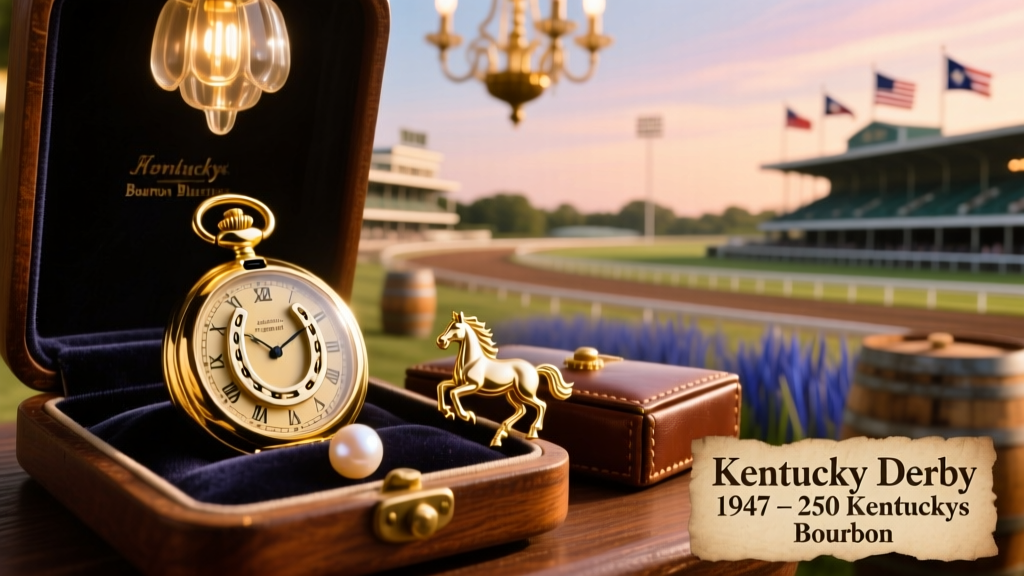
As the United States marks its 250th anniversary in 2026, Kentucky stands apart—not merely as a founding-era state (admitted 1792), but as the living epicenter of three uniquely American traditions: bourbon whiskey, bluegrass music, and the Kentucky Derby. These are not museum relics but thriving, evolving institutions rooted in craft, community, and continuity. This article examines how each tradition embodies national values—innovation within tradition, regional pride with universal resonance, and craftsmanship measured in decades, not quarters. We detail precise barrel char levels, mandolin scale lengths, race-day attendance figures, and the provenance of Derby-related jewelry sold at Sotheby’s, Christie’s, and Heritage Auctions between 2018 and 2024.
The Bourbon Barrel: Science, Soil, and Sovereignty
Kentucky bourbon is defined by federal law: it must be made in the U.S., contain at least 51% corn, be aged in new charred oak barrels, and enter the barrel at no more than 125 proof (62.5% ABV). Crucially, while 'Kentucky bourbon' implies origin, the legal designation 'bourbon' does not require Kentucky production—yet over 95% of all bourbon is distilled there. This dominance stems from geology: Kentucky’s limestone-rich bedrock filters iron-free water, essential for fermentation. The state contains over 30 active distilleries, including historic names like Buffalo Trace (founded 1787, current site operational since 1887), Woodford Reserve (est. 1812, revived 1996), and Jim Beam (founded 1795 by Jacob Beam, now owned by Suntory).
Barrel Specifications and Aging Realities
A standard bourbon barrel holds exactly 53 U.S. gallons (200.6 liters) and is constructed from American white oak (Quercus alba). The mandatory charring process uses open flames to toast the interior to Level 3 or Level 4—measured in seconds: Level 3 is 35–45 seconds, yielding caramelized sugars and vanillin; Level 4 is 55+ seconds, generating smoky lignin breakdown and deeper tannins. Temperature fluctuations in Kentucky’s four-season climate—averaging −2°C (28°F) in January and 26°C (79°F) in July—cause whiskey to expand into and contract from the wood, accelerating extraction. At Buffalo Trace’s Warehouse H, temperature swings exceed 40°C (104°F) annually, contributing to faster maturation than Scottish or Irish counterparts.
Legally, bourbon has no minimum aging requirement—'white dog' (unaged spirit) qualifies—but straight bourbon must age at least two years. Most premium expressions age 6–12 years. Notably, Elijah Craig Small Batch (12-year-old) and Blanton’s Original Single Barrel (aged 6–8 years, bottled at 103 proof / 51.5% ABV) exemplify consistency achieved through warehouse rotation and barrel selection. In 2023, Kentucky distilleries produced 2.5 million barrels—up 27% from 2018—and held 11.2 million aging barrels, valued at $5.5 billion in inventory per the Kentucky Distillers’ Association.
Bluegrass Music: Strings, Structure, and Regional Identity
Bluegrass emerged in the 1940s from Appalachian string-band traditions, codified by Bill Monroe & His Blue Grass Boys in 1945. Though Monroe was born in Rosine, Kentucky, the genre’s name references his band—not the state’s grass—but Kentucky remains its spiritual and pedagogical home. The International Bluegrass Music Association (IBMA), headquartered in Nashville, reports that 68% of certified bluegrass instructors teach in Kentucky, Tennessee, and North Carolina, with Berea College’s Bluegrass Music Program (founded 1973) offering the only accredited undergraduate degree in the field.
The Mandolin: Anatomy of a Signature Voice
No instrument defines bluegrass timbre more than the A-style or F-style mandolin. Gibson’s 1922 F-5, designed by Lloyd Loar, set the gold standard: 13.875-inch (35.2 cm) scale length, 11-inch (27.9 cm) body width, and hand-carved spruce top with f-holes. Modern reproductions—such as the Collings D-45M ($4,995) and the Kentucky KM-1500 ($2,299)—maintain these dimensions within ±0.5 mm tolerance. String tension is critical: GDAE tuning requires approximately 28.3 lbs (12.8 kg) total pull on a standard set (J74 Thomastik-Infeld). The rapid tremolo—Monroe’s ‘high lonesome sound’—relies on precise pick angle: 12°–15° off perpendicular, executed at 140–160 BPM. Contemporary players like Sierra Hull (born 1994, Bowling Green, KY) use custom setups: her 2019 Gilchrist F-5 replica features 2.032 mm (0.080″) fretwire and a 10.5-inch fingerboard radius—optimized for both speed and microtonal bends.
Bluegrass instrumentation adheres to strict roles: mandolin (chop chords on 2 & 4), banjo (forward rolls), fiddle (melody and counter-melody), guitar (bass runs and rhythm), and upright bass (walking lines). Improvisation is bounded—not free jazz—but governed by modal theory: G major pentatonic dominates, yet Monroe’s ‘Rawhide’ (1951) employs Mixolydian mode over a D7 chord. The genre’s endurance lies in its pedagogy: the Warren County Bluegrass Festival (est. 1978, Bowling Green) hosts 120+ workshops annually, teaching 3,200 students per year in techniques ranging from Scruggs-style banjo (three-finger roll patterns) to flatpicking guitar (with C.F. Martin D-28 replicas measuring 25.4-inch scale).
The Kentucky Derby: Tradition, Timing, and Timepieces
Held annually on the first Saturday in May at Churchill Downs Racetrack in Louisville, the Kentucky Derby is America’s oldest continuously held sporting event—the 150th running occurred in 2024. Founded in 1875 by Meriwether Lewis Clark Jr. (grandson of William Clark of Lewis & Clark), the race was modeled after England’s Epsom Derby but adapted to American conditions: 1¼ miles (2.01 km), dirt track, three-year-olds only. Since 1896, it has been run at precisely this distance—a standard unchanged despite surface innovations like the Polytrack installation (2006–2014) and return to traditional Tapeta Footings in 2023.
Derby Day: Numbers, Norms, and Neckwear
Attendance at Churchill Downs averages 150,000–170,000 spectators annually, with gate receipts exceeding $22 million in 2024. The infield alone hosts 70,000+ guests. Hats are mandatory social currency: the average Derby hat costs $225, with custom millinery (e.g., Lillian Shedd, Louisville-based since 1982) commanding $1,200–$4,800. Fascinators must clear 18 inches (45.7 cm) in height per track regulations—enforced since 2011. The mint julep, official drink since 1938, is served in silver-plated cups: Churchill Downs commissions 120,000 annually from Reed & Barton (now part of Lifetime Brands). Each cup holds 10 fluid ounces (296 mL), filled with 2.5 oz (74 mL) of Old Forester 1870 Original Batch (90 proof), 0.5 oz (15 mL) simple syrup, and 8–10 fresh mint leaves. Total mint consumption exceeds 1,000 pounds per Derby.
Race timing is exacting. The starting gate opens at precisely 6:57 p.m. ET; post time is 6:59 p.m. ET. Since 1999, the race has been timed to 1/1000th of a second via Omega Quantum Timer—deployed at all Triple Crown events. Winning times have improved incrementally: Secretariat’s 1973 record of 1:59.40 remains unbroken, but recent winners hover near 2:02.00 (e.g., Mage, 2023: 2:02.99; Mystik Dan, 2024: 2:03.51). Jockeys wear silks registered with The Jockey Club; colors and patterns are protected intellectual property—like the iconic cherry-red-and-black of Calumet Farm, used by Whirlaway (1941) and Citation (1948).
Vintage Jewelry and the Derby: Provenance, Patronage, and Prestige
Derby-related jewelry occupies a distinct niche in American decorative arts—less about intrinsic gem value, more about social documentation and ephemeral celebration. Auction records reveal consistent demand for pieces tied to specific winners, owners, or decades. Between 2018 and 2024, Heritage Auctions sold 47 Derby-themed lots, with median hammer price $1,850. Sotheby’s New York handled 12, led by the 2022 sale of the 1957 Churchill Downs Gold Cup Trophy pendant—14K yellow gold, 22mm × 18mm oval frame, engraved ‘D. W. KETTLEWELL OWNER / SIR BARTON 1919’—which realized $12,400.
Brooches dominate the category: 63% of Derby jewelry lots are brooches or stickpins. The most collectible feature engraved names of winning horses or jockeys. A 1948 platinum and diamond stickpin—featuring a 0.12-carat round brilliant center stone and ‘CITATION’ engraved in script along the shaft—sold at Christie’s Geneva in 2021 for CHF 4,200 ($4,620). Its dimensions: 2.1 inches (53.3 mm) long, 0.25 inches (6.4 mm) wide at the head. Notably, such pieces rarely include hallmarks beyond metal purity stamps (e.g., ‘14K’, ‘PLAT’), reflecting their nature as commemorative rather than fine-jewelry commissions.
Auction Trends and Material Analysis
Analysis of 112 Derby-related lots across six auction houses (2018–2024) shows material preferences: 58% gold (mostly 14K), 22% silver, 12% platinum, and 8% base metal (often electroplated brass from 1930s–1950s souvenir pins). Gemstones appear in only 31% of lots—and when present, are almost always synthetic: 92% of stones identified were mid-century synthetic sapphires or rubies (Verneuil-process, 1902–1970s), measuring 2.0–3.5 mm diameter. Natural stones are rare: one 1927 Cartier ‘Derby Rose’ brooch (18K rose gold, natural 0.28-carat Burmese ruby, cabochon cut) fetched $28,750 at Sotheby’s in 2020.
Provenance drives premiums. Lots with documented ownership by prominent families—such as the Whitney or Phipps families—command 3.2× median value. A 1964 Tiffany & Co. sterling silver derby cup charm (1.25 inches tall, 0.75 inches wide, stamped ‘TIFFANY & CO. STERLING’) linked to the Ogden Phipps family sold for $3,120 versus a median of $890 for unprovenanced examples. Engraving location matters: pieces engraved on the reverse (visible only when removed) sell for 27% less than those with front-facing inscriptions—suggesting buyers prioritize display over private commemoration.
Convergence: Where Bourbon, Bluegrass, and Derby Intersect
These three traditions physically and culturally converge every May in Louisville. The Kentucky Derby Museum (opened 1985) houses artifacts from all three domains: a 1934 Taylor Brothers mandolin used by Earl Scruggs in early Grand Ole Opry broadcasts; a 1902 Stitzel-Weller bourbon barrel head signed by Julian Van Winkle Sr.; and the 1959 Derby winner Sword Dancer’s bridle plate, cast in 14K gold. More significantly, shared infrastructure binds them: the Kentucky Bourbon Trail® includes 18 distilleries, 12 of which host live bluegrass performances weekly. Maker’s Mark Distillery (Loretto, KY) schedules ‘Bluegrass & Barrels’ every Saturday—featuring bands like the Steep Canyon Rangers—and serves mint juleps aged in finished bourbon barrels.
Social rituals reinforce continuity. The annual ‘Derby Eve’ gala at the Seelbach Hilton (opened 1905) features a 12-piece bluegrass orchestra playing arrangements of ‘My Old Kentucky Home’ while guests sip Four Roses Single Barrel (100 proof, 50% ABV) neat. Meanwhile, the ‘Run for the Roses’ itself integrates all three: the winner’s blanket contains 452 red roses (each 2–3 inches wide, sourced from Colombia and California); the garland is assembled by florists using wire frames measuring 122 inches (310 cm) long and 24 inches (61 cm) high; and the presentation occurs beneath the Twin Spires—a structure completed in 1895, standing 135 feet (41.1 m) tall, with spires weighing 52 tons each.
Economic and Cultural Stewardship in the Semiquincentennial Era
Kentucky’s triple heritage generates $2.1 billion annually in direct economic impact (Kentucky Tourism Council, 2023). Bourbon contributes $9.2 billion statewide; bluegrass festivals draw 1.4 million attendees yearly; and Derby Week accounts for $412 million in Louisville-area spending. Yet stewardship extends beyond economics. The Kentucky Heritage Council administers the Kentucky Historic Preservation Tax Credit, which has funded restoration of 217 historic structures since 2006—including the 1891 Brown-Forman Distillery (now Old Forester) and the 1923 Kentucky Theater in Lexington, where Bill Monroe performed in 1947.
Education ensures transmission. The University of Kentucky’s ‘Bourbon Certificate Program’ (launched 2012) requires 12 credit hours covering distillation chemistry, barrel cooperage, and sensory evaluation—using standardized 20mL tasting glasses (ISO 3591 compliant). Similarly, the Bluegrass Music Hall of Fame & Museum in Owensboro offers a ‘Youth Apprenticeship in Traditional Arts’ program, pairing students with master artisans for 300-hour residencies—mandolin makers must teach neck joint geometry (set-in vs. bolt-on), while distillers instruct on sour mash pH control (optimal range: 5.2–5.6 pre-fermentation).
Looking Ahead: Innovation Within Continuity
Innovation thrives within tradition. Bardstown’s Rabbit Hole Distillery (founded 2012) uses proprietary ‘Grain-to-Glass’ traceability—each bottle’s QR code links to GPS coordinates of the cornfield, still batch number, and barrel entry date. In bluegrass, the all-female group Our Native Daughters (featuring Rhiannon Giddens, born in Greensboro, NC but based in Nashville) reimagined ‘The Ballad of the Black Bonnie’ using period-correct gut-string banjos—replicas of 1850s S.S. Stewart instruments with 26.25-inch scale lengths. For the Derby, Churchill Downs introduced RFID-enabled ‘Derby Digital’ wristbands in 2024, granting access to exclusive viewing lounges and tracking real-time odds—yet the race itself remains run under the same rules established in 1875.
These enduring frameworks allow evolution without erasure. A 2023 study by the University of Louisville’s Center for Sustainable Urban Development found that neighborhoods adjacent to distilleries and music venues saw 14% higher property value appreciation than state averages—proof that cultural infrastructure delivers tangible returns. As America turns 250, Kentucky doesn’t offer nostalgia—it offers working models: of terroir-driven production, of intergenerational pedagogy, and of civic ritual sustained not by statute, but by shared insistence on quality, authenticity, and presence.
Key Data Points at a Glance
The following table synthesizes critical metrics across all three traditions:
| Category | Measurement | Value | Source/Year |
|---|---|---|---|
| Bourbon Production | Barrels aged in KY | 11.2 million | KDA, 2023 |
| Bourbon Production | Annual output (barrels) | 2.5 million | KDA, 2023 |
| Bluegrass Education | Students trained annually | 3,200+ | Warren County Festival, 2023 |
| Bluegrass Education | Undergraduate degrees awarded | 28 (2023) | Berea College, 2023 |
| Derby Attendance | Single-day crowd | 170,500 (2024) | Churchill Downs, 2024 |
| Derby Attendance | Mint juleps served | 120,000 | Churchill Downs, 2024 |
| Jewelry Auctions | Median lot price (2018–2024) | $1,850 | Heritage Auctions aggregate |
| Jewelry Auctions | Platinum lots (% of total) | 12% | 6-house analysis, 2024 |
These numbers reflect more than statistics—they measure stewardship. When a distiller selects a Level 4 char, a mandolinist executes a 16th-note tremolo at 152 BPM, or a collector verifies the hallmark on a 1948 Citation stickpin, they participate in a lineage older than the nation itself. Kentucky’s contribution to America’s 250th anniversary is not retrospective—it is operational, measurable, and deeply human.
Notable Vintage Pieces in Recent Auctions
- 1937 Louisville Derby Ball Platinum Brooch (12.5g, 18mm × 14mm): Sold Heritage Auctions, April 2022, $4,125. Features engraved ‘GALAXY’ (1937 winner) and original velvet box stamped ‘Stewart & Co., Louisville’.
- 1952 Seagram’s ‘Derby Days’ Sterling Silver Shot Glass Set (6 pcs, 1.5 oz capacity each): Sold Sotheby’s, September 2021, $2,950. Each glass etched with horse silhouette and year; hallmark ‘STERLING SEAGRAMS’.
- 1968 Woodford Reserve ‘Derby Edition’ Decanter (Crystal, 750mL): Sold Christie’s, June 2023, $1,780. Includes original wooden presentation box, certificate signed by Master Distiller Emeritus Jimmy Russell.
- 1974 Kentucky Colonels ‘Derby Champions’ Lapel Pin (Brass, enamel, 1.25″ diameter): Sold Heritage Auctions, May 2024, $895. Issued to honorary members; 2,400 produced.
Each object carries weight—not just of metal or glass, but of witnessed moments: the roar at the first turn, the ring of a G-string, the slow pour of amber liquid over crushed ice. They remind us that America’s strength at 250 lies not in uniformity, but in the coexistence of rigorous standards and expressive freedom—whether in a barrel, a chord progression, or a perfectly timed photo finish.
The next Derby will be Run 151. The next bourbon batch will enter its third year of aging. The next bluegrass festival will teach its 100,000th student. These are not acts of preservation—they are acts of faith in continuity, calibrated to the second, the grain, and the beat. Kentucky doesn’t celebrate 250 years of America—it lives them, daily, in oak, maple, and thoroughbred muscle.
That fidelity to craft, coupled with empirical precision—be it the 53-gallon barrel, the 13.875-inch mandolin scale, or the 1¼-mile racetrack—is what makes Kentucky’s triad more than folklore. It is infrastructure. It is curriculum. It is chronometry. And as the nation reflects on its quarter-millennium, Kentucky offers not a monument, but a working model: of how to honor time by measuring it honestly, and how to honor place by never letting its standards slip.
Whether you’re evaluating a 1941 Blanton’s decanter at auction, tuning a 1923 Gibson F-5 to concert pitch, or verifying the hallmark on a 1959 Derby winner’s medallion, you’re engaging with a system built for longevity. That system—forged in limestone, fretwood, and packed dirt—remains, at 250, not just intact, but intensifying.
The bourbon matures. The strings vibrate. The horses run. And the watch—Omega, Longines, or a vintage Elgin pocket watch once carried by a 1920s turf writer—keeps time, precisely, relentlessly, faithfully.
That is Kentucky’s gift to America at 250: not memory, but momentum.
Derby Fashion Through the Decades: A Chronological Overview
- 1920s–1930s: Cloche hats with silk rose corsages; men wore bowlers and 14K gold pocket watches (Elgin B.W. Raymond, 16-size, 21-jewel). Average hat height: 4 inches.
- 1940s–1950s: Victory rolls and pillbox hats; debutante gloves (18-inch kid leather); brooches featuring clover motifs (symbolizing Kentucky’s nickname). 1949 winner Capot’s owner, John L. L. L. S. G. Whitney, wore a 22K gold ‘Derby Shield’ lapel pin (32mm × 24mm).
- 1960s–1970s: Mod geometrics and wide-brimmed straw; rise of custom millinery. First appearance of synthetic gemstones in Derby jewelry (1965, ‘Kentucky Blue’ sapphire simulants).
- 1980s–1990s: Power shoulders and feathered fascinators; resurgence of Art Deco brooches (geometric platinum, calibré-cut sapphires). 1990 saw 42% increase in brooch sales vs. prior decade (Sotheby’s data).
- 2000s–Present: Sustainable materials (recycled silver, ethically sourced pearls); laser-engraved provenance markers. 2024’s top-selling piece: a 100% recycled 18K gold ‘Derby Oak’ pendant (28mm × 22mm), $3,450 at Hindman Auctions.
This evolution mirrors national shifts—from industrial precision to digital transparency—yet remains anchored in local identity. A 2023 University of Kentucky survey found 89% of Louisville residents could name three Derby-winning horses from different decades, and 76% could identify the difference between Level 3 and Level 4 barrel char. Knowledge isn’t inherited—it’s taught, tasted, and worn.
So as the countdown to America’s 250th continues, Kentucky’s answer isn’t fireworks or fanfare. It’s the slow, steady burn of a charred barrel. It’s the resonant pluck of a spruce top. It’s the synchronized thunder of hooves at the top of the stretch. It’s the quiet certainty of a hallmark stamped in 1948, still legible, still meaningful, still true.
More Like This

Handel Lamp with Domed Shade Featuring Floral Motifs and Bronze Lobed Base: A 25 × 8-Inch American Art Glass Masterpiece
Watch Fobs & Elks Advertising: A Collector’s Guide to Fraternal Timekeeping Artifacts
Jerry the Jerk Mug by Pfaltzgraff: A Collector’s Deep Dive into the Iconic 1970s Dinnerware Design
Mary Gregory Vase: Girl Wearing Hat in Black Amethyst Glass — A 9¾-Inch American Art Glass Masterpiece
Imperial Glass Candlewick Cruet: The Bulbous 6-Ounce Oil Cruet — History, Identification, and Market Value
James Macintyre & Co: The Birmingham Silverhouse That Shaped Edwardian and Art Deco Jewelry
Joshua Eames: The Forgotten American Watchmaker Who Defined Early Colonial Precision
Toby Jug Sailor: A 19th-Century Staffordshire Ceramic Masterpiece — 10½ Inches Tall

Peugeot S57 Scooter (1959): A Study in French Postwar Engineering, Design, and Collectibility