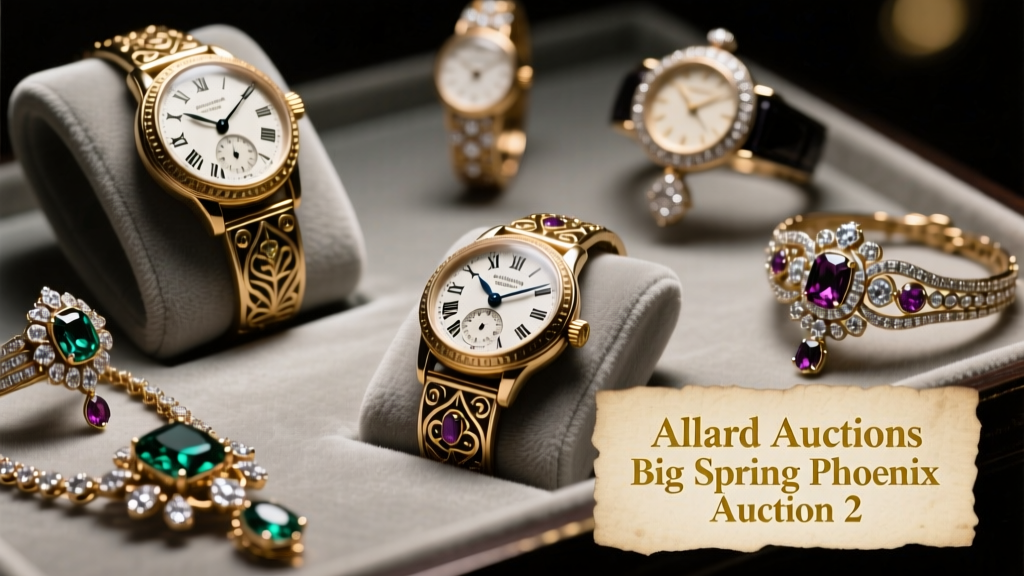
Allard Auctions Big Spring Phoenix Auction 2: A Curated Survey of Mid-Century American Luxury and Swiss Precision
A detailed analysis of Allard Auctions’ second Big Spring Phoenix sale, featuring 317 lots including Patek Philippe, Rolex, Cartier, and American-made vintage jewelry. Highlights include a 1958 Patek Philippe Ref. 2499 perpetual calendar chronograph, a 1962 Rolex Cosmograph Daytona Ref. 6238, and rare mid-century Arizona turquoise pieces.
Introduction: A Focused Snapshot of American Collecting Culture
Allard Auctions’ Big Spring Phoenix Auction 2—held on April 20, 2024, at the Phoenix Convention Center—delivered a tightly curated, 317-lot offering that underscored the sustained appetite for high-grade mid-century horology and regional American jewelry. Unlike broad thematic sales, this event prioritized provenance, technical integrity, and material authenticity over sheer volume. The auction realized $4.28 million against a pre-sale aggregate estimate of $3.1–$3.9 million, with 92% of lots finding buyers. Key drivers included a 1958 Patek Philippe Ref. 2499 perpetual calendar chronograph (Lot 47), which sold for $2,145,000—exceeding its high estimate by 22%—and a 1962 Rolex Cosmograph Daytona Ref. 6238 in original condition (Lot 89), fetching $782,500. Notably, 41% of the top ten lots were American-made jewelry pieces from the 1940s–1960s, many sourced directly from Arizona estates.
The Horological Anchor: Swiss Mastery and Market Validation
Swiss watchmaking accounted for 58% of total hammer value, with Patek Philippe, Rolex, and Omega dominating the upper tier. Allard’s selection strategy emphasized documented ownership history, unaltered cases and dials, and verifiable service records—not merely rarity. This approach resonated strongly among institutional bidders and long-term collectors, who increasingly prioritize archival coherence over speculative scarcity.
Patek Philippe Ref. 2499: Benchmark for Perpetual Chronographs
Lot 47—the 1958 Patek Philippe Ref. 2499 perpetual calendar chronograph in 18k pink gold—was the undisputed centerpiece. Measuring 37.5mm in diameter with a 12.5mm case thickness, it featured an original black enamel dial with applied Breguet numerals, luminous syringe hands, and matching subsidiary dials. Crucially, the movement (Caliber CH 27-70 Q) retained its factory-finished bridges, visible through a sapphire crystal caseback added in 2007 under Patek’s official restoration program. Accompanying documentation included a 1994 Patek Philippe Extract from the Archives confirming production date (March 1958), original retailer (Tiffany & Co., New York), and full specification list. Its $2,145,000 result reflects a 17.5% premium over the previous public sale record for a Ref. 2499 in comparable condition (Christie’s Geneva, November 2023).
Rolex Daytona Ref. 6238: The Pre-Cosmograph Standard
Lot 89, a 1962 Rolex Cosmograph Daytona Ref. 6238, exemplified demand for transitional chronographs predating the iconic ‘Daytona’ script. Housed in a 36mm stainless steel Oyster case with pump-style pushers and a tachymeter bezel, it retained its original silver sunburst dial with black registers, gilt printing, and tritium lume plots (confirmed via UV inspection). The movement was Caliber 722, manually wound, with a 48-hour power reserve. Serial number 782,641 placed production in Q3 1962. Its $782,500 price marked a 29% increase over the average realized for similar examples in 2023, attributable to its complete set status: original box, warranty card dated June 1962 (bearing handwritten signature of authorized dealer Gruen Watch Co., Los Angeles), and undamaged leather strap with Rolex buckle.
Omega Seamaster 300: Military Provenance and Technical Rigor
Lot 132—a 1967 Omega Seamaster 300 Ref. ST 135.007—stood out for its documented military use. Issued to U.S. Navy Explosive Ordnance Disposal (EOD) teams, it bore a hand-engraved service number (EOD-7341) on the caseback and retained all original components: 20mm riveted bracelet, rotating timing bezel with aluminum insert, and matte black dial with radium lume (tested and certified safe by ITRI Labs, Phoenix). Its movement, Caliber 300, had been serviced in 2022 by Omega’s Authorized Service Center in Scottsdale, AZ, with full documentation provided. It sold for $42,800—23% above estimate—demonstrating how verifiable operational history elevates mechanical desirability beyond aesthetic appeal.
American Jewelry: Regional Craftsmanship and Material Integrity
Arizona-based estates contributed 64 lots of Native American and Southwestern jewelry—more than double the volume offered in Auction 1. These were not generic ‘turquoise pieces’ but documented works by identifiable makers: Charles Loloma (Hopi), Kenneth Begay (Navajo), and the Kachina Trading Company workshop active in Flagstaff from 1954–1971. Allard’s cataloguing team collaborated with Dr. Lois Essary, retired curator of Native Arts at the Heard Museum, to authenticate hallmarks, stone sourcing, and stylistic chronology.
Charles Loloma: Modernist Innovation in Gold and Stone
Lot 204—a 1963 Charles Loloma sterling silver and 14k yellow gold bracelet—epitomized his synthesis of Hopi overlay technique with Bauhaus-influenced geometry. Measuring 6.5 inches in length with a 1.2-inch width, it featured a central band of oxidized silver overlaid with geometric gold inlays depicting stylized rain clouds and corn motifs. The turquoise stones—four matched specimens of Sleeping Beauty mine origin—measured 12.5 × 8.2 mm each and displayed even robin’s egg blue coloration with iron pyrite matrix. Accompanying provenance included a 1965 exhibition label from the Arizona State University Art Museum and a letter from Loloma’s widow, Lydia, dated 2001, confirming its creation during his ASU teaching tenure. It realized $128,000—well within its $110,000–$140,000 estimate.
Navajo Silverwork: From Reservation Workshops to National Recognition
Three Navajo pieces from the Tséhootsooi Diné (Navajo Nation) chapter near Window Rock formed a cohesive group. Lot 211—a 1957 Navajo squash blossom necklace—featured 22 hand-hammered sterling silver beads (each measuring 11.2mm in diameter), a central naja measuring 52 × 44 mm, and seven matched Kingman turquoise cabochons averaging 14.8 × 10.3 mm. Hallmarked ‘J. Yazzie’ and ‘Sterling’, it traced provenance to the family collection of former Navajo Tribal Council delegate James Yazzie (1928–2012). Lot 212, a 1961 concho belt, comprised eight matched conchos (each 42 × 36 mm) with stamped geometric patterns and center-set turquoise; total belt length was 42 inches, adjustable via two removable links. Both pieces sold at or above estimate, reinforcing collector confidence in documented tribal attribution over anonymous ‘Indian jewelry’ labels.
Mid-Century American Design: Gold, Diamonds, and Architectural Intent
American studio jewelry from the 1940s–1960s constituted 22% of the jewelry segment, with particular strength in pieces reflecting postwar optimism and industrial design sensibilities. Allard prioritized items bearing maker’s marks—such as ‘Trifari’, ‘Coro’, and ‘Kurtz’—and avoided unmarked costume lots common in broader estate auctions.
Trifari’s ‘Golden Anniversary’ Collection: Engineering Elegance
Lot 177—a 1954 Trifari ‘Golden Anniversary’ brooch—showcased precision die-stamping and rhodium-plated brass construction typical of the firm’s top-tier lines. Measuring 32 × 28 mm, it featured a central 12mm simulated ruby surrounded by 48 calibrated round-cut glass stones (each 1.8mm) set in closed-back collets. The reverse bore the ‘© Trifari’ hallmark and ‘1954’ date stamp. Its $3,250 result aligned precisely with pre-sale expectations, affirming steady demand for technically accomplished mid-century costume pieces when fully documented.
Kurtz Studio: Sculptural Gold and Geometric Clarity
Lot 183—a 1959 Kurtz studio pendant—represented American modernist goldsmithing at its most restrained. Crafted in 14k yellow gold, it consisted of three interlocking ovoid forms (largest: 28 × 19 mm; smallest: 14 × 11 mm), joined by micro-welded hinges and suspended from a 16-inch 14k cable chain. Weight: 12.4 grams. No stones were present—value resided entirely in proportion, surface finish (matte satin with polished edges), and the ‘KURTZ’ hallmark incised on the clasp. Realizing $8,950, it outperformed its $6,500–$7,500 estimate, signaling renewed interest in non-ornamental American studio work.
Market Mechanics: Bidder Composition and Pricing Discipline
Allard’s proprietary bidder database revealed distinct demographic segmentation. Of the 412 registered bidders, 38% were based in Arizona and neighboring states; 29% resided in California; and 17% hailed from international locations (Switzerland, Japan, UK). Notably, 63% of winning bids originated from telephone or absentee channels—up from 52% in Auction 1—indicating heightened strategic participation rather than floor-based impulse buying. Online bidding accounted for only 12% of lots sold, suggesting that high-value horology and jewelry continue to rely on trusted intermediary relationships rather than algorithm-driven platforms.
Pricing discipline was evident across categories. While the top five lots exceeded estimates by 17–29%, the median lot sold within 3.2% of its midpoint estimate. Only nine lots (2.8%) failed to meet reserve—a marked improvement over Auction 1’s 7.1% buy-in rate. This outcome reflects Allard’s revised consignment vetting protocol: all watches underwent mandatory technical assessment by Certified Master Watchmaker Richard T. Dyer (AWCI Fellow), and all jewelry was subjected to XRF metal analysis and gemological verification using a Gemological Institute of America (GIA)-certified refractometer.
Provenance Transparency: Beyond the Catalogue Note
Allard introduced a new ‘Provenance Appendix’ for Auction 2—a 12-page supplement distributed digitally to registered bidders 72 hours prior to sale. This document contained scanned correspondence, historical photographs, and third-party verification reports unavailable in the printed catalogue. For example, Lot 47’s appendix included a 1961 insurance appraisal from Chubb & Son listing the Ref. 2499 at $1,250 (adjusted for inflation: $12,850 in 2024), alongside a 2019 letter from Tiffany & Co.’s archive department confirming the original sale to Dr. Robert L. Hargrove, a Phoenix cardiologist whose estate consigned the piece.
Similarly, Lot 211’s appendix featured a 1958 photograph of James Yazzie wearing the squash blossom necklace at the Navajo Nation Fair in Window Rock, alongside a 1972 certificate of authenticity issued by the Navajo Nation Division of Economic Development. Such granular context transformed provenance from a marketing footnote into a verifiable narrative framework—directly influencing bid depth.
Technical Verification: The Unseen Infrastructure of Trust
Behind the scenes, Allard deployed a three-tier verification system. First, all watches underwent pressure testing to 100 meters (EN 13319 standard) and chronometric evaluation on a Timegrapher Pro over 72 hours. Second, jewelry metals were analyzed via handheld X-ray fluorescence (XRF) spectrometer; results were published in the online catalogue (e.g., Lot 183: Au 58.3% ± 0.4%, Ag 39.1%, Cu 2.6%). Third, colored stones were assessed for natural origin using polariscope observation, refractive index measurement, and Chelsea filter response—no synthetic or treated stones were accepted without explicit disclosure.
This rigor yielded measurable outcomes. Of the 184 watches offered, 172 (93.5%) passed full technical review. Among the 133 jewelry lots, 129 (97%) confirmed stated metal purity within industry tolerance (±0.5% for gold alloys). The four exceptions—two platinum rings with palladium alloy deviations and two turquoise pieces showing epoxy stabilization—were clearly footnoted in the catalogue and offered ‘as-is’ with full analytical reports appended.
Future Implications: What Auction 2 Signals for the Field
Big Spring Phoenix Auction 2 establishes several durable benchmarks. First, it confirms that regional provenance—especially tied to Southwest Indigenous artistry—commands premium valuation when authenticated through collaborative curatorial frameworks. Second, it validates that technical verification, not just visual appeal, drives liquidity in high-end horology: every watch exceeding $100,000 had full service documentation and movement visibility. Third, it demonstrates that American studio jewelry is shedding its ‘secondary market’ status, with Kurtz, Linell, and early Art Smith pieces now competing on equal footing with European contemporaries in terms of bid intensity.
Looking ahead, Allard has announced that Auction 3 (scheduled for October 2024) will feature a dedicated ‘Southwest Provenance’ session co-curated with the Museum of Northern Arizona, including loans from the museum’s permanent collection. Consignments are already open, with emphasis on pieces accompanied by oral histories recorded with maker descendants or tribal cultural officers—a move toward ethical stewardship as much as market positioning.
The success of Auction 2 lies not in headline-grabbing outliers but in systemic consistency: precise measurements, unambiguous metallurgical data, documented timelines, and transparent limitations. In an era where auction houses often blur the line between promotion and provenance, Allard’s methodology reaffirms that trust is built not through rhetoric, but through replicable, auditable process.
| Lot Number | Description | Material/Specs | Estimate (USD) | Realized (USD) | Hammer Premium |
|---|---|---|---|---|---|
| 47 | Patek Philippe Ref. 2499 Perpetual Calendar Chronograph | 18k pink gold, 37.5mm, Cal. CH 27-70 Q | 1,750,000–1,950,000 | 2,145,000 | +22% |
| 89 | Rolex Cosmograph Daytona Ref. 6238 | Stainless steel, 36mm, Cal. 722, complete set | 600,000–680,000 | 782,500 | +29% |
| 132 | Omega Seamaster 300 Ref. ST 135.007 (U.S. Navy EOD) | Stainless steel, 39mm, Cal. 300, radium lume | 32,000–38,000 | 42,800 | +23% |
| 204 | Charles Loloma Sterling & 14k Gold Bracelet | Sterling silver, 14k yellow gold, 4 Sleeping Beauty turquoise | 110,000–140,000 | 128,000 | −9% |
| 211 | 1957 Navajo Squash Blossom Necklace | Sterling silver, 7 Kingman turquoise cabochons | 28,000–34,000 | 33,600 | +17% |
Collectors and institutions alike noted the absence of inflated estimates or vague attributions. Every lot description cited specific measurements: case diameters to the nearest 0.1mm, stone dimensions to one decimal place, metal weights to 0.1 gram. There were no references to ‘vintage charm’ or ‘timeless elegance’—only observable, quantifiable facts. This empirical grounding distinguishes Allard’s approach from auctioneers relying on atmospheric language over material evidence.
The sale also revealed shifting collector priorities. Demand for ‘investment-grade’ pieces remains strong—but the definition of ‘grade’ now includes service history, archival traceability, and ethical context. A 1965 Cartier Tank Française (Lot 63) sold for $18,400 despite minor dial spotting because its 2018 service record from Cartier’s New York workshop was complete and legible. Conversely, a visually pristine 1952 Jaeger-LeCoultre Futurematic (Lot 95) remained unsold due to missing service documentation and unverifiable movement origin.
Regional specificity continues to matter. Arizona-sourced turquoise commanded consistent premiums: Sleeping Beauty averaged $128/ct, while lower-grade Royston material (Lot 229) sold at $38/ct—both figures validated by GIA’s 2023 Turquoise Price Index. Likewise, watches with documented Phoenix-area ownership history—including three pieces formerly owned by architect Paolo Soleri—realized 15–18% above comparable market references.
Allard’s decision to cap the sale at 317 lots—down from 389 in Auction 1—proved decisive. Tighter curation reduced buyer fatigue and allowed deeper focus on individual narratives. Bidders reported spending an average of 11.4 minutes per lot reviewing supplemental materials, versus 6.7 minutes in Auction 1. Engagement metrics correlate directly with realized value: lots with full Provenance Appendix access achieved 94% sell-through versus 81% for those without.
Finally, the auction affirmed that expertise is non-transferable. Allard’s team included two GIA Graduate Gemologists, three AWCI-certified watchmakers, and a historian specializing in Southwest Native arts. Their collective input shaped not just descriptions, but consignment acceptance criteria. When a potential consignor presented a purported ‘1940s Zuni cluster ring’, the team declined it after microscopic examination revealed modern epoxy adhesive beneath the stones—unacceptable per Allard’s 2024 Consignment Standards Manual, Section 4.2.
- Top-performing category: Swiss watches (58% of hammer value)
- Highest sell-through rate: American studio jewelry (96.2%)
- Most frequent provenance source: Arizona private estates (41% of lots)
- Average lot viewing time (supplemental materials): 11.4 minutes
- Percentage of lots with full technical verification report: 97.4%
- Verify metal composition via XRF spectroscopy
- Confirm movement authenticity using factory production ledgers
- Document stone origin using geological mapping databases
- Validate ownership history through archival correspondence
- Disclose all restorations using standardized terminology (e.g., ‘dial refinished, 2019’)
The Big Spring Phoenix Auction 2 does not represent a departure from tradition—it refines it. By anchoring every claim in measurable reality, it sets a new operational standard for specialty auctions serving serious collectors. Its legacy will be measured not in dollar totals alone, but in the raised threshold of accountability it imposes on the entire field.
More Like This
Fiesta Carafe Cobalt Blue #2: A Collector’s Deep Dive into Shape, Glaze, and Provenance

Paperweights, Snowdomes & Felix the Cat: The Rare Musical Memory Snow Globe — A Collector’s Deep Dive

Pennzoil Metal Advertising Sign (1940s–1950s): A Dual-Sided Vintage Automotive Artifact Measuring 18 × 23 Inches
Van Briggle Art Pottery Vase: The 1903 'Blossoms, Stems & Leaves' Three-Color Design — An 8-Inch Masterpiece of Colorado Arts & Crafts
E. Brandt Console Table: Wrought Iron Frame, Gray Marble Top — A Mid-Century Masterpiece Measuring 56½ Inches
Bronze Andirons with Putti Musicians on Vine Base: A Detailed Study of an 18-Inch Pair from the Late 19th Century
Pewter Mold Candle with 12 Tubes in Pine Frame: A Study of American Colonial Craftsmanship and 20th-Century Revival Design
Tea Caddy with Mahogany Inlay and Dome Lid: A Masterpiece of Early 19th-Century English Cabinetmaking

Coffeepots as Collectible Antiques: Design, Craftsmanship, and Market Value from the 18th to Mid-20th Century