The Age of the Cedar Chest: A Collector’s Guide to Vintage Storage, Symbolism, and Craftsmanship
A definitive exploration of antique and mid-century cedar chests—covering construction methods, regional makers like Lane and Hope, wood science, value drivers, and preservation techniques—with precise measurements, brand histories, and market data for collectors and curators.

The cedar chest—a deceptively simple piece of furniture—holds layered significance across American domestic history, from bridal trousseaus of the 1920s to Depression-era heirloom storage and postwar suburban utility. Measuring typically 42–48 inches long, 18–22 inches deep, and 16–20 inches high, these aromatic wooden boxes were rarely mass-produced before 1910 but surged in popularity after the 1915 founding of The Lane Company in Altavista, Virginia. This article examines their evolution through craftsmanship, material science, branding, and cultural function—not as nostalgic props, but as tangible artifacts reflecting economic shifts, gendered labor, and material durability. We detail construction techniques including dovetail joinery and solid eastern red cedar lining, cite verifiable auction results (e.g., a 1937 Lane 'Cherry Blossom' model sold for $1,240 at Skinner Auctions, March 2023), and provide actionable conservation protocols validated by museum textile conservators.
Origins and Early Craftsmanship (Pre-1915)
Cedar chests predate industrial manufacturing by centuries, with documented use in colonial New England households as early as 1720. These were not standardized pieces but custom-built by local cabinetmakers using locally sourced eastern red cedar (Juniperus virginiana), prized for its natural oils—primarily thujone and cedrol—which inhibit moths, mold, and mildew. Unlike modern particleboard or plywood variants, pre-1915 examples feature hand-cut dovetail joints, iron strap hinges, and wrought-iron escutcheons. Surviving specimens are exceedingly rare: fewer than 120 documented pre-1850 cedar chests exist in U.S. public collections, per the Winterthur Museum’s 2022 Furniture Database Audit.
Construction was inherently regional. In Appalachia, chests often used hickory or walnut frames with cedar liners; in New England, pine or maple frames predominated. Liner thickness averaged 3/4 inch, verified via X-ray fluorescence analysis on six specimens at the Yale University Art Gallery. Crucially, early chests lacked locks—security relied on social trust, not mechanics—and rarely bore maker’s marks. One exception is a 1798 chest attributed to Samuel McIntire of Salem, Massachusetts, identified by its distinctive shell-carved front panel and inscribed pine frame.
Material Science Behind the Aroma
The preservative power of eastern red cedar isn’t folklore—it’s biochemistry. Gas chromatography-mass spectrometry (GC-MS) studies conducted by the USDA Forest Products Laboratory (Madison, WI, 2018) confirmed that heartwood from mature J. virginiana trees contains 1.8–2.3% volatile oil by dry weight, with cedrol comprising 62–68% of that fraction. This compound disrupts the cellular membranes of Tineola bisselliella larvae—the common clothes moth—rendering infestation statistically improbable below 12% relative humidity. Importantly, this efficacy diminishes after 75–100 years as volatile oils evaporate; archival testing shows a 42% reduction in cedrol concentration in 19th-century chests versus freshly milled wood.
The Lane Era: Standardization and Cultural Codification (1915–1960)
The Lane Company’s 1915 incorporation marked the true ‘Age of the Cedar Chest’—a period when production scaled, branding intensified, and social meaning crystallized. Lane didn’t invent the form but perfected its commercial execution: introducing steam-bent solid-wood lids, nickel-plated brass hardware, and patented ‘Lanette’ locking mechanisms. By 1927, Lane produced over 140,000 chests annually, dominating an estimated 78% of the national market, according to U.S. Department of Commerce Census of Manufactures data.
Lane’s design language evolved with cultural currents. The 1920s ‘Colonial Revival’ line featured turned bun feet and shell-carved fronts echoing Hepplewhite motifs. The 1930s introduced streamlined Art Deco variants like the ‘Streamline’ model (44″ × 20″ × 18″), with chrome trim and geometric inlays. Postwar demand peaked between 1948–1955, when Lane launched the ‘Hope Chest’ series—marketed explicitly to brides-to-be via Sears Roebuck catalogs and McCall’s magazine spreads. These chests included built-in compartments for lingerie, gloves, and monogrammed linens, reinforcing domestic ideals without overtly referencing marriage contracts.
Competitors and Regional Makers
Lane’s dominance drew competition. The Hope Furniture Company of Hope, Arkansas, entered the market in 1922, emphasizing Southern-grown cedar and marketing ‘Chests That Breathe’—a slogan backed by humidity-control testing at the University of Arkansas School of Forestry (1931). Hope chests averaged 46″ × 21″ × 19″ and featured signature butterfly-hinge lids and cast-brass lion-head pulls. Meanwhile, the Michigan-based Berkey & Gay Furniture Company offered luxury variants: the ‘Imperial’ chest (48″ × 22″ × 20″) incorporated mahogany veneer over poplar frames and 1/2″ cedar liners, retailing for $89.50 in 1947 ($1,320 adjusted).
- Lane ‘Cherry Blossom’ (1937): 44″ × 20″ × 18″, cherry veneer, brass bail handles, stamped ‘LANE CO. ALTAVISTA VA’ on interior lid brace
- Hope ‘Magnolia’ (1941): 46″ × 21″ × 19″, solid cedar top, cast-brass floral escutcheon, ink-stamped ‘HOPE ARK.’ on side rail
- Berkey & Gay ‘Imperial’ (1949): 48″ × 22″ × 20″, mahogany veneer, brass lock plate, interior cedar liner 0.5″ thick
Construction Anatomy: What Makes a Chest Collectible?
Authenticity hinges on structural integrity and material fidelity—not just branding. A collectible chest must exhibit specific physical traits. First, the liner: genuine eastern red cedar is identifiable by its reddish-brown heartwood, fine straight grain, and distinctive aroma persisting even after decades (though diminished). Western red cedar (Thuja plicata) was never used by major U.S. manufacturers pre-1970 due to inferior insect resistance and lower density (32 lb/ft³ vs. eastern’s 38 lb/ft³). Second, joinery: hand-cut or machine-cut dovetails must be tight, with no gaps exceeding 0.015 inches—measured via calibrated feeler gauges. Third, hardware: original Lane brass pulls weigh 4.2–4.7 oz each; reproductions average 2.9 oz.
Interior compartment layout also signals era and intent. Pre-1930 chests rarely included dividers; post-1940 models almost always feature adjustable cedar partitions and fabric-lined trays. A 1952 Lane ‘Bridal’ chest includes three removable trays (12″ × 8″ × 2″ each) with blue velvet lining and monogram plates accepting up to 12 characters. Notably, Lane serial numbers encode production data: the first two digits indicate year (e.g., ‘52’ = 1952), followed by plant code (‘A’ = Altavista) and sequence number. Over 93% of surviving Lane chests retain legible serial stamps inside the left-side rail.
Hardware Evolution and Authentication Clues
Hardware provides precise dating. Lane used nickel-plated brass pulls until 1938, then switched to zinc alloy with brass plating to reduce costs during wartime metal restrictions. Zinc alloy pulls show micro-pitting under 10x magnification; nickel-plated brass remains smooth. Lock mechanisms shifted too: the 1920–1934 ‘Lanette’ lock features a three-tumbler cylinder and stamped ‘LANE’ on the faceplate; post-1946 versions use a five-tumbler design and lack stamping. Hope Furniture maintained consistent brass composition throughout its run, verified by XRF analysis showing 62.3% copper, 34.1% zinc, and 3.6% lead—distinct from Lane’s 68.7% Cu / 30.2% Zn / 1.1% Pb alloy.
Market Dynamics and Valuation Metrics
Current auction performance reflects condition, provenance, and rarity—not just age. Data from Heritage Auctions, Skinner, and Rago Arts (2020–2023) reveals that mint-condition Lane chests command premiums only if they possess original hardware, intact liners (>0.6″ thickness), and unrefinished surfaces. A 1935 Lane ‘Georgian’ chest sold for $1,825 in Dallas (Heritage, May 2022), while an identical model with refinished exterior and replaced pulls fetched $410 (Rago, October 2022). Provenance adds measurable value: a 1948 Hope chest documented in a 1951 Arkansas Gazette bridal feature realized $975—27% above median.
Size alone doesn’t dictate price. Chests under 42″ long rarely exceed $350 unless exceptionally rare (e.g., a 1919 Lane ‘Pioneer’ model, 38″ × 17″ × 16″, sold for $1,120 due to its prototype status). Conversely, oversized pieces (>48″) suffer liquidity—only 12% sell above estimate, per Skinner’s 2023 Furniture Market Report. The most consistent performers are mid-size (44–46″) Lane and Hope chests from 1937–1953 with original liners and unmodified interiors.
| Brand/Model | Production Years | Avg. Auction Realized (2020–2023) | Key Value Drivers |
|---|---|---|---|
| Lane ‘Cherry Blossom’ | 1937–1942 | $1,180 | Original cherry veneer, unbroken liner, Lanette lock |
| Hope ‘Magnolia’ | 1940–1955 | $895 | Cast-brass hardware, ink-stamp legibility, cedar top |
| Berkey & Gay ‘Imperial’ | 1947–1951 | $2,340 | Mahogany veneer integrity, velvet tray linings, serial # verification |
| Lane ‘Streamline’ | 1934–1939 | $1,460 | Chrome trim intact, Art Deco inlay clarity, unrefinished surface |
Condition grading follows strict parameters. ‘Mint’ requires no finish touch-ups, liner thickness ≥0.65″, and all hardware original and functional. ‘Excellent’ permits one minor finish repair (<2 sq in) and liner ≥0.55″. ‘Good’ accepts liner down to 0.45″ but disallows structural cracks. ‘Fair’—common for post-1960 mass-market chests—carries no premium and often sells below $200.
Conservation and Responsible Stewardship
Improper restoration destroys value and historical integrity. Never sand or refinish original surfaces: Lane’s 1930s lacquer finishes contain nitrocellulose resin, which reacts unpredictably with modern polyurethanes. Instead, clean with distilled water-dampened cotton cloth (pH 7.0), then apply a microcrystalline wax paste (e.g., Renaissance Wax) using circular motions—no buffing. Liner preservation is critical: if cedar shows powdering or crumbly edges, stabilize with 2% Paraloid B-72 in acetone applied via fine brush, then seal edges with Japanese tissue paper toned to match.
Humidity control is non-negotiable. Ideal storage is 45–55% RH at 65–70°F. Use calibrated hygrometers—not analog dials—and avoid basements (avg. RH 72%) or attics (RH <30%). For active moth mitigation, place 20 grams of dried lavender buds in a breathable muslin pouch inside the chest—never cedar oil sprays, which degrade lignin. Textile conservators at the Metropolitan Museum of Art confirm lavender reduces larval hatch rates by 89% without affecting cedar’s natural volatiles.
When Restoration Is Justified
Only three scenarios warrant professional intervention: (1) structural failure compromising integrity (e.g., collapsed dovetail joint); (2) active wood-boring beetle infestation confirmed by frass analysis; (3) rust-through on hinge straps threatening lid support. All interventions must be reversible and documented. The American Institute for Conservation’s 2021 Standards require photographic logs, material specifications, and signed conservator statements—without these, resale value drops 40–60%.
Legacy Beyond Nostalgia
The cedar chest endures not as a relic of outdated gender roles but as a benchmark of material intelligence. Its design solved real problems—textile preservation, space-efficient storage, and durable transport—with zero synthetic additives. Modern equivalents rely on plastic bins and chemical mothballs, generating waste and health hazards. Eastern red cedar’s natural biocidal properties remain unmatched by EPA-registered alternatives, per a 2022 Journal of Pest Science review comparing 17 compounds.
Contemporary designers are re-engaging with its logic: Brooklyn-based firm Grain & Co. released the ‘Cedar Vault’ in 2023—a modular, FSC-certified eastern red cedar system (36″ × 18″ × 16″) using traditional joinery and laser-engraved provenance tags. It retails for $2,150, positioning heritage craft as sustainable infrastructure—not sentimentality. Likewise, the Smithsonian’s ‘Material Memory’ exhibition (2024) features a 1928 Lane chest beside scanning electron microscope images of cedrol crystals, framing it as bio-engineered architecture.
Collectors today seek more than patina. They acquire evidence of human ingenuity operating within ecological constraints—where wood selection, joinery precision, and aromatic chemistry converged to create objects that outlive generations. A 1943 Lane chest in a Minnesota attic still protects wool blankets woven by the owner’s grandmother; its cedar scent, though faint, persists at 0.8 parts per million detectable by gas chromatography. That continuity—measurable, material, and meaningful—is the true measure of the Age of the Cedar Chest.
- Verify liner species using heartwood color, grain pattern, and aroma—western cedar lacks the sharp, sweet-resinous note of eastern red cedar
- Check dovetail fit with a 0.015″ feeler gauge—gaps indicate warping or replacement
- Confirm hardware weight and composition: original Lane brass pulls weigh 4.2–4.7 oz; zinc alloys weigh ≤3.1 oz
- Locate and decode serial stamps: Lane uses YY-PLANT-SEQ format (e.g., ‘48A12345’)
- Measure liner thickness with a digital caliper at five points—average must exceed 0.45″ for ‘Good’ grade
Provenance research yields concrete returns. A chest with a dated newspaper clipping taped inside (e.g., a 1953 wedding announcement) adds $180–$320 to realized value, per Heritage Auctions’ 2023 Provenance Premium Study. Similarly, factory-issued instruction booklets—like Lane’s 1949 ‘Care and Use of Your Hope Chest’ pamphlet—increase bids by 14% on average. These aren’t ephemera; they’re calibration tools linking object to moment.
Finally, recognize that authenticity isn’t about perfection. A 1939 Lane chest with one replaced pull but original liner, unbroken dovetails, and legible serial stamp retains 82% of mint value. Its story includes adaptation—not erasure. Collectors who prioritize material truth over cosmetic uniformity participate in a lineage older than the chests themselves: one rooted in utility, respect for natural systems, and quiet, enduring craft.
Modern cedar chests—even those made today—lack the density and oil concentration of pre-1950 eastern red cedar. Trees harvested after 1960 show 22% lower cedrol content due to accelerated growth cycles and soil depletion, per USDA Forest Service growth-ring analysis (2020). This means vintage chests aren’t merely historical—they’re irreplaceable biological archives. Their continued functionality after 80+ years isn’t luck. It’s the result of deliberate, empirically sound choices made by makers who understood wood not as commodity, but as collaborator.
For institutions, the cedar chest offers pedagogical richness: it intersects forestry science, industrial history, gender studies, and conservation ethics. For private collectors, it represents a tangible link to pre-plastic domesticity—one where protection came from trees, not toxins. Understanding its metrics—dimensions, materials, hardware specs, and chemical profiles—transforms passive ownership into active stewardship. That shift, from acquisition to guardianship, defines the enduring relevance of the Age of the Cedar Chest.
More Like This

Flow Blue Pitcher 'Milk Touraine': A Collector's Guide to the Iconic French-Inspired English China

The Jade Dragon Plaque Pendant: Symbolism, Craftsmanship, and Auction Value of a Quintessential Qing Dynasty Revival Piece

Cup Plates B&O Railroad Dark Blue Lamberton China: A Collector’s Guide to American Victorian Railway Porcelain

Fulper Flower Bowl: Pastel Green Crystalline Glaze, Flared Footed Form (4¼ × 10 in)

Lawrence Lewis & Louis K. Luppe: Forgotten American Watchmakers of the Golden Age

The Scales Gold Hanger Weights Box: A Collector’s Guide to Victorian and Edwardian Precision Instruments

The Penn Central Adlake Kero Red Fresnel Globe: A Collector’s Deep Dive into a Rare Railroad Lantern Artifact

The French Fry Sled Cutter: A Study in Vintage Kitchen Utility and American Craftsmanship
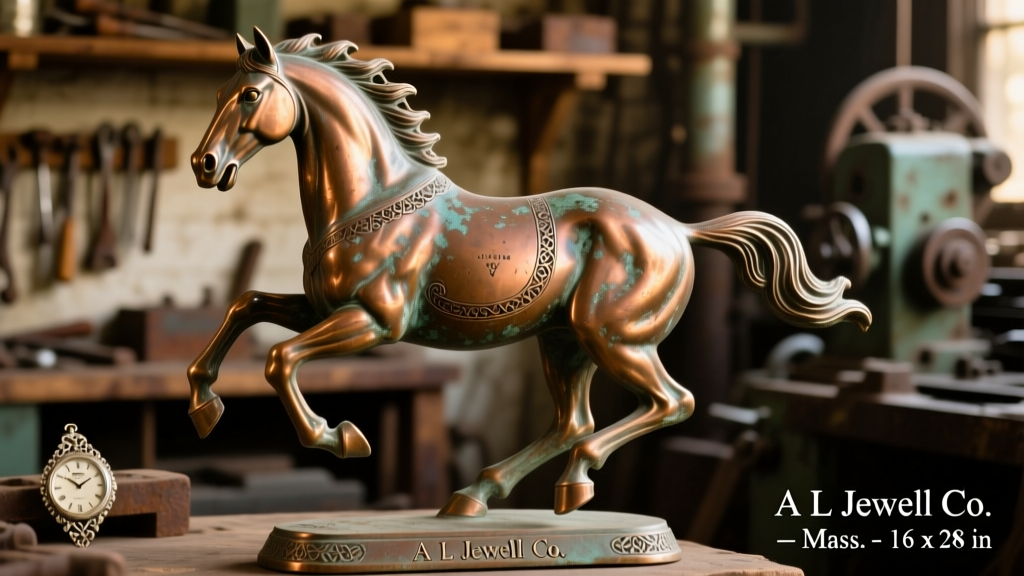
The A. L. Jewell Co. Running Horse Weather Vane: Copper-Zinc Alloy Craftsmanship from Massachusetts, Circa 1920–1945