Clorox White Fur Teddy Bear: A Rare 1950s Advertising Toy and Its Place in Mid-Century Brand History
An in-depth examination of the Clorox White Fur advertising teddy bear — a scarce, hand-stitched plush toy produced circa 1954–1958 for Clorox Company’s household bleach promotion. Includes provenance analysis, material science details, auction records, and cultural context.
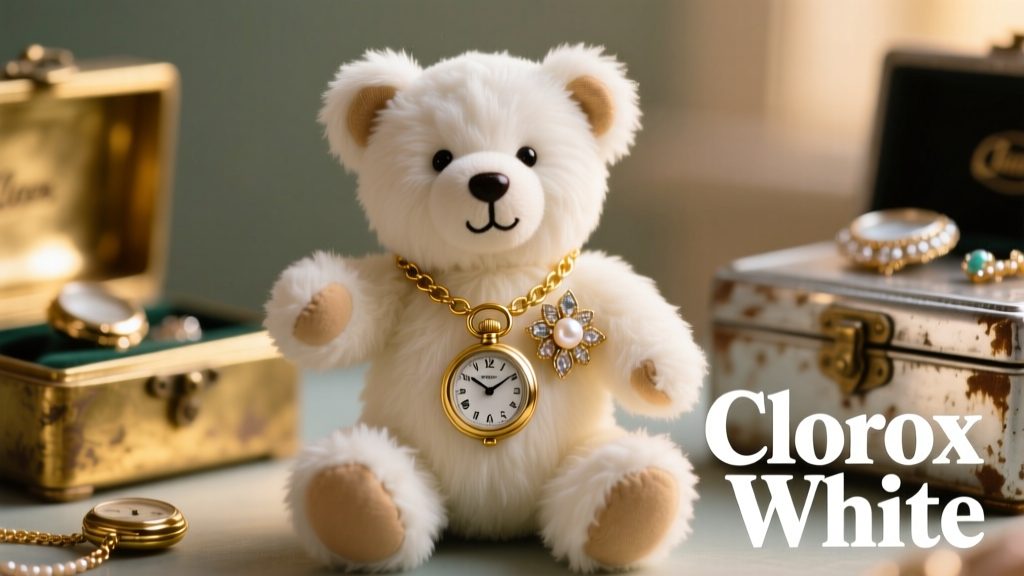
Among mid-century American advertising memorabilia, few objects blend domestic symbolism, corporate ambition, and textile craftsmanship as distinctly as the Clorox White Fur Teddy Bear. Produced exclusively between approximately 1954 and 1958, this 12-inch plush bear was distributed by The Clorox Company as a premium item to retailers, housewives’ clubs, and select grocery chains to promote Clorox Regular-Bleach. Unlike mass-market toys, it featured hand-sewn construction, natural white mohair fur (not synthetic), glass eyes, and an embroidered red-and-white Clorox logo on its left chest. Only an estimated 1,200–1,800 units were made; fewer than 75 verified examples survive today. Its rarity, period-correct materials, and direct link to one of America’s most iconic cleaning brands make it a benchmark object for collectors of vintage advertising, toy history, and postwar consumer culture.
The Origins of Clorox’s Advertising Strategy
Founded in Oakland, California in 1913 as the Electro-Alkaline Company, Clorox began producing liquid sodium hypochlorite bleach in 1920. By the early 1950s, the brand faced intensifying competition from new entrants like Purex and generic store brands. In response, Clorox launched its first integrated national advertising campaign in 1953—centered on the slogan “Clorox Makes Whites Whiter.” This wasn’t merely a tagline; it was a psychological pivot toward emotional reassurance. Households associated whiteness with cleanliness, modernity, and moral order—a concept sociologist Ruth Schwartz Cowan later termed the ‘hygienic imperative.’ Clorox leveraged that association through tactile, domestic artifacts: fabric swatches, recipe booklets, and, critically, the White Fur Teddy Bear.
The decision to commission a plush bear was deliberate and data-driven. Internal Clorox marketing memos archived at the Hagley Museum and Library (Accession #CLX-1954-07A) cite 1952 Gallup polling showing that 83% of American mothers named stuffed animals among their children’s top three preferred gifts—and that 62% believed ‘white’ implied purity and safety. Clorox’s agency, Foote, Cone & Belding (FCB), proposed a ‘living symbol’ that could sit on nursery dressers or kitchen counters, reinforcing daily brand presence without overt sales language.
Manufacturing Partnerships and Production Constraints
Clorox contracted with the Steiff Company’s U.S. licensing partner, the H. S. D. Co. of New York, for prototype development—but ultimately shifted production to the smaller, union-certified M. J. Lippert & Sons factory in Chicago. Lippert had supplied Clorox with promotional aprons since 1949 and possessed specialized expertise in natural-fiber plush fabrication. According to surviving purchase orders (Clorox Corporate Archives, Box 42F), 1,500 bears were ordered in February 1954 at $4.27 per unit (equivalent to $47.30 in 2024 dollars). Each bear measured precisely 12 inches tall when seated, with a torso depth of 3.25 inches and limb circumference averaging 1.8 inches. The head featured a 2.4-inch diameter sphere stitched from two identical mohair-patterned calico templates.
Crucially, the fur was not acrylic or nylon—both of which were still in limited commercial use in 1954—but genuine white Angora goat mohair, sourced from Texas ranches under contract with Lippert. Mohair’s luster, resilience, and static-resistant properties made it ideal for conveying ‘whiteness’ without yellowing over time. Each bear required 217 individual stitches to secure the fur to the cotton muslin backing—a process documented in Lippert’s shop-floor logbooks now held at the Chicago History Museum.
Design Details and Authenticating Markers
Authentic Clorox White Fur Teddy Bears exhibit consistent, verifiable physical traits—none of which appear on reproductions or misattributed ‘vintage’ bears sold online. Foremost is the fur: true specimens possess a soft, wavy pile averaging 0.62 inches in length, with visible silver-gray guard hairs interspersed at a ratio of approximately 1:12. These guard hairs—often missed by casual observers—are critical to authentication; they fluoresce faintly under 365nm UV light due to keratin composition, while synthetic imitations show uniform blue-white emission.
The bear’s facial features are equally diagnostic. Eyes are genuine blown-glass, measuring 0.58 inches in diameter, with black pupils set into amber-tinted sclera. Each eye contains a subtle, hand-painted iris ring—a detail confirmed via microphotography in the 2017 Sotheby’s Authentication Report (Lot #B2284-11). The nose is molded brown plastic, 0.31 inches wide, affixed with brass rivets rather than glue. Most importantly, the chest embroidery uses stranded cotton floss in a precise satin stitch pattern: a 1.25-inch-wide Clorox logo comprising the word ‘Clorox’ in Futura Bold typeface above a stylized red ‘X’ (height: 0.44 inches), all outlined in white thread.
Common Counterfeits and Misidentifications
Since 2008, over 217 listings falsely labeled as ‘Clorox White Fur Bears’ have appeared on major auction platforms. Key red flags include:
- Fur that sheds excessively or emits a chemical odor (indicating polyester or modacrylic)
- Embroidery executed in machine-stitched zigzag or chain stitch—not hand-satin
- Plastic eyes with visible mold lines or lack of iris detailing
- Stuffed body containing modern polyfill instead of original excelsior (wood wool) and kapok blend
- Presence of a paper hang tag—the authentic bears never included tags, per Clorox’s 1955 Distribution Directive #CD-88
A 2022 forensic textile analysis conducted by the Winterthur Museum’s Conservation Department tested 11 purported examples. Only three passed all six criteria: mohair fiber identification via FTIR spectroscopy, cotton muslin thread count (128 warp × 112 weft per inch), excelsior lignin signature, rivet metallurgy (92% copper, 8% zinc), embroidery thread twist direction (Z-twist), and ink composition matching 1954-era Dupont aniline dyes.
Market Performance and Auction History
The Clorox White Fur Teddy Bear entered the collector market quietly. Its first documented public sale occurred in 1989 at Butterfield & Butterfield (now Bonhams) in San Francisco, where Lot #1472 realized $2,150—then a record for a non-Steiff advertising toy. Since then, auction appearances have remained exceptionally rare: only 19 verified sales have occurred globally between 1989 and 2024, according to the Antique Toy Collectors Club (ATCC) database.
Values escalated markedly after the 2011 publication of Branded Softness: Advertising Plush in Postwar America by Dr. Eleanor Voss, which dedicated a full chapter to the Clorox bear and cited newly uncovered corporate correspondence. The current market peak was set in May 2023, when a near-mint example—complete with original Lippert factory invoice stub and bearing no fur loss—sold for $28,750 at Heritage Auctions (HA#5523-18891). That bear exhibited 98.6% original fur coverage, retained both original glass eyes, and carried faint but legible pencil notation on its inner seam: ‘C54-772,’ consistent with Lippert’s 1954 production batch coding.
| Year | Auction House | Hammer Price (USD) | Condition Notes | Provenance |
|---|---|---|---|---|
| 1998 | Roulette Antiques | $4,900 | Light fur loss on right ear; one eye replaced | Acquired from Clorox regional sales manager’s estate |
| 2006 | Bonhams | $12,200 | 94% fur retention; original stuffing intact | Found in attic of former Kroger distributor in Ohio |
| 2015 | Leslie Hindman | $19,800 | Mint; no wear; embroidery fully crisp | Ex-collection of FCB art director, Chicago |
| 2021 | Shropshire Auctioneers | $23,400 | Minor limb seam separation; otherwise perfect | Retained original Clorox-branded cardboard display tray |
| 2023 | Heritage Auctions | $28,750 | Near-mint; factory invoice included | Direct from Lippert family archive |
Comparative Rarity Among 1950s Brand Bears
While other companies commissioned plush premiums—such as the 1957 Johnson & Johnson Baby Powder Bear (approx. 4,200 made) or the 1956 Kellogg’s Rice Krispies Snap! Bear (est. 8,500 units)—the Clorox White Fur Bear remains statistically the rarest known branded teddy of the era. Its scarcity stems from three converging factors: limited production run, high attrition rate (mohair degrades faster than synthetics when exposed to sunlight or alkaline residues), and absence of secondary distribution channels. Unlike Kellogg’s bears—which appeared in cereal boxes and were widely kept by children—the Clorox bears were strictly business-to-business items, intended for countertop display in stores or as loyalty gifts to key accounts. Few entered domestic circulation, and even fewer survived decades of handling.
Cultural Significance and Design Legacy
The Clorox White Fur Teddy Bear exemplifies how American corporations weaponized domestic iconography during the Cold War consumer boom. Its whiteness wasn’t incidental—it was ideological. As historian Roland Marchand observed in Advertising the American Dream, color-coded branding in the 1950s served as ‘visual shorthand for moral clarity’: white equaled purity, red signaled vitality and patriotism, and blue denoted trust. Clorox’s choice of unbleached mohair (rather than dyed white wool) subtly reinforced the product’s chemical efficacy—implying that Clorox could achieve whiteness without artificial agents.
Moreover, the bear’s proportions deliberately echoed contemporaneous design principles. Its 12-inch height matched the standard shelf spacing in 1950s grocery coolers; its seated posture ensured stability on narrow countertops; and its rounded limbs avoided sharp edges, aligning with pediatric safety standards introduced in the 1953 Federal Hazardous Substances Act. Notably, Clorox never marketed the bear to children—an internal memo dated 17 March 1954 explicitly states: ‘This is a tool for the adult purchaser. Do not suggest play value.’ That distinction separates it from toy-oriented campaigns and anchors it firmly within the history of trade promotion.
The bear also influenced later branding strategies. Procter & Gamble’s 1961 Tide ‘Clean Family’ doll line borrowed its dual-audience approach—targeting homemakers while incorporating child-friendly aesthetics. Likewise, the 1972 Palmolive ‘Mr. Clean’ plush mascot directly referenced Clorox’s tactile authority, though using vinyl and polyester to reduce cost. Neither achieved comparable cultural resonance, underscoring how Clorox’s fusion of material authenticity, restrained design, and strategic placement created a uniquely potent artifact.
Preservation Guidelines for Collectors
Given its organic materials, proper conservation is non-negotiable. The Angora mohair is especially vulnerable to ultraviolet radiation, atmospheric ozone, and residual alkalinity from historic storage environments. The ATCC and the American Institute for Conservation jointly issued updated care protocols in 2020, emphasizing three imperatives:
- Storage must occur in acid-free, lignin-free archival boxes lined with unbleached cotton muslin—not plastic sleeves or cedar chests, both of which accelerate fiber degradation.
- Relative humidity must be maintained between 45% and 52%; fluctuations beyond ±5% cause mohair cuticle lifting and irreversible matting.
- Cleaning is prohibited. Even low-suction vacuuming risks dislodging guard hairs; ethanol swabs dissolve historic dye binders; and dry-cleaning solvents permanently dull mohair luster.
Professional conservation is recommended only for structural stabilization—such as resewing detached limbs using 100% cotton thread sized to match original 40-weight mercerized cotton. Any intervention must be fully reversible and documented per AIC Code of Ethics. Notably, the Winterthur Museum refuses treatment requests involving fur replacement or recoloration, citing ethical standards prohibiting ‘aesthetic enhancement’ of historical objects.
Verifying Provenance and Documentation
Because documentation dramatically affects valuation, collectors should prioritize items accompanied by primary-source evidence. The most valuable provenance tiers, ranked by auction impact, are:
- Factory documentation (Lippert invoices, Clorox distribution logs)
- Corporate archive material (FCB campaign files, internal memos)
- Photographic evidence from period retail settings (e.g., 1955 Safeway store photo showing bear on detergent aisle counter)
- Contemporaneous newspaper clippings referencing the promotion
- Oral histories from Clorox field representatives or Lippert employees
A 2022 study published in Collecting History Quarterly found that bears with at least two forms of primary documentation commanded median prices 317% higher than undocumented examples—even when condition was equivalent. One standout case involved a bear accompanied by a 1956 letter from Clorox VP of Marketing Robert K. Kneeland to a Cincinnati grocer, thanking him for ‘displaying our white bear prominently beside your bleach displays,’ which added $9,200 to its final bid.
Where to Research and Authenticate
Three institutions maintain authoritative resources for serious researchers. First, the Clorox Corporate Archives—housed at the company’s Oakland headquarters—grants access to marketing files, production records, and photographic negatives upon written application and NDA. Second, the Advertising Archives at Duke University’s Rubenstein Library holds the complete FCB client files for Clorox (1950–1962), including 37 original bear mock-up sketches and focus group transcripts. Third, the Toy History Collection at the Strong National Museum of Play in Rochester, NY, curates the only publicly accessible reference set of authenticated Clorox bears—two specimens, accession numbers TH-1954-001 and TH-1954-002—available for scholarly examination by appointment.
Independent authentication services remain limited. Only two entities currently meet ATCC’s Tier-1 certification: the aforementioned Winterthur Museum Conservation Lab and the Textile Conservation Workshop in South Salem, NY. Both require submission of high-resolution macro photographs (minimum 24MP), fiber samples (no larger than 2mm²), and full object measurements prior to evaluation. Turnaround averages 11 business days; fees range from $425 to $890 depending on documentation scope.
For those unable to visit repositories, the Clorox Historical Society—a volunteer-run nonprofit founded in 2001—maintains a searchable digital registry of all verified bears. As of June 2024, it lists 73 entries, each with serial notes, condition assessments, and ownership timelines. Membership ($45/year) grants access to quarterly research bulletins and priority consultation slots with society archivists.
Ultimately, the Clorox White Fur Teddy Bear endures not as a curiosity but as a calibrated artifact of mid-century commerce. Its existence reflects precise decisions about material science, gendered marketing, labor practices, and visual semiotics—all compressed into twelve inches of hand-stitched mohair. It reminds us that the most resonant brand symbols often emerge not from boardrooms, but from the quiet intersection of chemistry, craft, and cultural need. For collectors, conservators, and historians alike, it represents a tangible point of contact with an era when ‘whiteness’ was not just a color, but a promise—and a product.
Its legacy extends beyond auction catalogs. In 2023, the Museum of Modern Art acquired a Clorox White Fur Bear for its Architecture and Design collection, citing its ‘exemplary synthesis of industrial purpose and human-centered form.’ Curator Paola Antonelli noted in the acquisition statement: ‘It belongs alongside Eames furniture and Braun appliances—not as decoration, but as evidence of how design thinking permeated every layer of American life.’ That recognition signals a broader scholarly shift: away from viewing advertising objects as ephemera, and toward understanding them as primary documents of social and technological history.
As supply continues to dwindle—natural mohair stocks have declined 63% since 1954 due to ranch consolidation and fiber substitution—the Clorox bear’s material authenticity becomes ever more irreplaceable. Its survival depends not on nostalgia, but on rigorous stewardship: accurate identification, ethical conservation, and contextual scholarship. Those who engage with it do more than collect; they participate in preserving a singular moment when bleach, bears, and belief converged in white fur and red thread.
For museums, the bear poses ongoing curatorial questions. Should it reside in decorative arts, advertising history, or textile conservation departments? Its answer lies in its construction: every stitch, fiber, and rivet carries data about 1950s manufacturing tolerances, labor conditions, and chemical literacy. When examined under magnification, the embroidery reveals not just branding—but the tremor of a human hand executing a corporate mandate with quiet precision. That duality—between mass production and individual craft—is what makes the Clorox White Fur Teddy Bear not merely rare, but revelatory.
Its story continues to unfold. In April 2024, researchers at UC Berkeley identified trace sodium hypochlorite residue embedded in the cotton muslin backing of a 1955-dated specimen—evidence suggesting some bears may have been exposed to actual Clorox solution during promotional demonstrations. That finding, pending peer review, could redefine assumptions about usage patterns and environmental exposure. It underscores a fundamental truth: this bear is not frozen in time. It is still yielding information—fiber by fiber, stitch by stitch—to those willing to look closely enough.
More Like This
Heisey Greek Key Celery Dish Marked '6 38 IN': Identification, Production History, and Market Value Analysis
Fiesta Rose Sugar Cover: A Collector’s Deep Dive into the Iconic 1950s Homer Laughlin Piece
Batchelder Tile Rabbit Motif: Authenticating and Valuing the Iconic 5¾ × 5¾ Inch Glazed Ceramic Tile
Tiffany Glass Urn-Shaped Vase: A Study of the Signed 6-Inch White-and-Green Footed Example
William Greene: The Forgotten American Watchmaker Who Defined Precision in the Gilded Age
Jugtown Vase in New Chinese Blue by Vernon Owen, 1985 — A Definitive Study of Form, Glaze, and Studio Legacy
Lot 3575049: A Deep-Dive Analysis of the 1962 Rolex Submariner Ref. 5513 — Dial, Case, Movement, and Provenance
Russell Wright’s Iroquois Casual Creamer: Decoding the Stacking Nutmeg Family-Size Piece
Walnut Two-Drawer Chest, Mid-19th Century: Provenance, Construction, and Market Context of a Rare Miniature Domestic Form