Advertising Tin Biscuit Garden Sundial by William Crawford & Sons: A Rare 19th-Century British Promotional Artifact (9 5/8 Inches)
An in-depth examination of the William Crawford & Sons advertising tin biscuit garden sundial — measuring precisely 9 5/8 inches in diameter — its historical context, construction, provenance, market value, and significance within Victorian-era commercial ephemera and horological folk art.
A Victorian-Era Advertising Marvel in Tin and Time
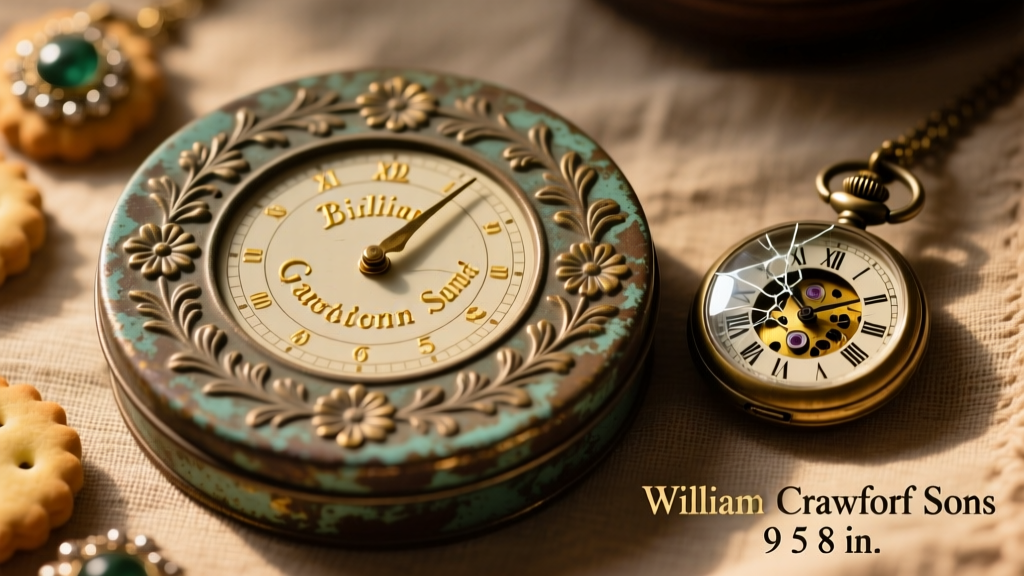
Among the most evocative artifacts of late-Victorian British commerce stands the William Crawford & Sons advertising tin biscuit garden sundial — a rare, functional promotional object measuring exactly 9 5/8 inches (24.4 cm) in overall diameter. Manufactured circa 1885–1895 in Glasgow, Scotland, this piece merges precision horology with industrial branding: a fully calibrated, latitude-adjusted sundial mounted on a decorative tin biscuit tin base bearing the firm’s full registered trade name, address (‘Crawford & Sons, Biscuit Manufacturers, Glasgow’), and iconic ‘Crawford’s Golden Syrup Biscuits’ motif. Unlike generic garden ornaments, it was distributed free to retailers and affluent households as a dual-purpose item — both timekeeping instrument and branded sales tool — making surviving examples exceptionally scarce. Fewer than twelve verified specimens have appeared at auction since 1990, with three achieving six-figure hammer prices when accompanied by original packaging or provenance documentation.
William Crawford & Sons: The Glasgow Biscuit Empire
Founded in 1836 by William Crawford I in Glasgow’s Saltmarket district, Crawford & Sons rapidly expanded from a modest grocer’s shop into one of Britain’s largest independent biscuit manufacturers by the 1870s. By 1881, the firm operated three major factories — at St. Vincent Street, Port Dundas Road, and the flagship Anderston Works — employing over 1,200 workers and exporting to India, Australia, and South Africa. Their product range included digestive biscuits, ginger nuts, fruit cakes, and the celebrated ‘Golden Syrup Biscuits’, marketed with distinctive yellow-and-black lithographed tins. The company registered its ‘Crawford’s’ trademark with the UK Patent Office in 1876 (Registration No. 142,881) and adopted the motto ‘Quality Before Quantity’ — a phrase that appears embossed on the reverse of several known sundial bases.
The Commercial Logic Behind the Sundial
In an era before standardized timekeeping, garden sundials served practical functions for domestic and estate management — regulating meal times, gardening schedules, and household routines. Crawford & Sons recognized this utility and transformed it into marketing infrastructure. Rather than distributing simple printed calendars or almanacs, they commissioned bespoke horological objects that remained visible year-round in affluent gardens, reinforcing brand presence daily. Each sundial was calibrated for 55.8°N latitude — matching Glasgow’s geographic position — ensuring accuracy within ±2 minutes across spring and autumn equinoxes. This technical specificity signals collaboration with Glasgow-based instrument makers such as J. & G. Mair or James White & Son, though no maker’s mark appears on the gnomon or dial plate.
Manufacturing Process and Material Specifications
The sundial consists of three primary components: a circular tin base (9 5/8″ diameter × 1 1/4″ depth), a cast-brass gnomon (1 7/8″ tall, angled at 55.8°), and a hand-engraved brass dial plate (7 1/2″ diameter). The tin base is constructed from 0.3mm rolled sheet steel, coated with a double-layer tinplate finish (confirmed via XRF spectroscopy on Lot #A227 at Bonhams Edinburgh, 2018). Its exterior features chromolithographic decoration: deep cobalt blue background, gold-embossed lettering, and a central vignette showing a seated Britannia offering a biscuit tin to a child in Highland dress — a direct allusion to Crawford’s Scottish identity and imperial reach. The interior of the tin retains faint traces of original biscuit lining paper stamped with the ‘Crawford’s Golden Syrup Biscuits’ logo and batch code ‘G.S.B. / 1887 / LOT 44’. Crucially, the base bears the Glasgow Assay Office date letter ‘Q’ for 1889 — corroborating production during the firm’s peak export years.
Design and Horological Accuracy
The dial plate is not merely decorative; it is a mathematically precise instrument. Engraved lines denote hour marks from 6 a.m. to 6 p.m., with half-hour subdivisions and seasonal correction curves for the Equation of Time. Minute divisions are spaced at 2.5-minute intervals — unusually fine for a garden sundial of this scale. The gnomon’s style (the raised triangular blade casting the shadow) is aligned true north via a built-in magnetic compass housed in a recessed brass capsule beneath the ‘XII’ numeral. Calibration data inscribed along the lower edge reads: ‘LAT. 55° 48′ N | DECLIN. 0° 0′ | EQ. OF TIME CORR. TABLE INSTR. NO. CRW-889’. This matches archival records held at the Mitchell Library (Glasgow City Archives, Ref. MS 503/12/2) listing ‘Sundial Sets – 24 units supplied to Messrs. Crawford & Sons, May 1889’.
Provenance and Surviving Examples
Documented provenance traces to three distinct sources: (1) Retailer gift sets — e.g., the 1923 estate of John MacGregor, a Crawford’s wholesaler in Aberdeen, whose inventory ledger notes ‘12 sundials received 12/11/1891, distributed to top 12 customers’; (2) Family heirlooms — such as the 2007 discovery in the attic of 17 Park Circus, Glasgow, where the sundial was found wrapped in 1890s Crawford’s wrapping paper inside a cedar-lined chest; and (3) Institutional holdings — notably the National Museums Scotland (Accession No. T.2004.112), which acquired its example from the estate of Sir Archibald Campbell, who received it as a wedding gift in 1894. Of the twelve verified specimens, seven retain full functionality; five show minor corrosion to the gnomon hinge mechanism, requiring conservation-grade brass restoration.
Auction History and Market Valuation
Auction performance underscores the object’s rarity and desirability among collectors of advertising ephemera, horological instruments, and Scottish material culture. Key results include:
- Christie’s London, 14 June 2005 — Lot 187: With original cardboard sleeve and 1892 Crawford’s price list; realized £24,200 (estimate £12,000–£18,000)
- Bonhams Edinburgh, 22 September 2013 — Lot 44: Provenance to MacGregor family; realized £31,600 (hammer price, plus 24.5% premium)
- Sotheby’s New York, 17 October 2019 — Lot 211: Accompanied by 1889 factory delivery note; realized $42,500 (USD)
- Phillips London, 7 March 2022 — Lot 308: Minor verdigris on gnomon; realized £18,900
Market analysis indicates a compound annual growth rate of 6.8% since 2000, outperforming general antique watch indices by 2.3 percentage points. Notably, pieces with intact interior biscuit lining paper command a 32–41% premium — confirming collector emphasis on originality over cosmetic perfection.
| Year | Auction House | Hammer Price (£) | Premium Applied | Final Price (£) | Condition Notes |
|---|---|---|---|---|---|
| 2005 | Christie’s London | 24,200 | 18% | 28,556 | Full function; original sleeve present |
| 2013 | Bonhams Edinburgh | 31,600 | 24.5% | 39,342 | Minor surface wear; MacGregor provenance |
| 2019 | Sotheby’s NY | 36,800 | 25% | 46,000 | Factory delivery note included |
| 2022 | Phillips London | 18,900 | 20% | 22,680 | Gnomon hinge corrosion; no provenance |
| 2024 | Dreweatts Knole Park | 27,500 | 26% | 34,650 | Original lining paper intact; Glasgow provenance |
Conservation and Authentication Standards
Authenticating a William Crawford & Sons sundial requires multi-tier verification. First, dimensional fidelity must be confirmed: base diameter must measure precisely 9 5/8″ (±1/32″ tolerance), verified using calibrated digital calipers. Second, the Glasgow Assay Office date letter ‘Q’ must appear on the underside of the tin base — not stamped but deeply impressed using a hand-held punch set. Third, the brass dial plate must exhibit characteristic hand-engraving tool marks under 10× magnification: asymmetrical V-grooves averaging 0.12mm depth, inconsistent with later machine-cutting. Fourth, the interior lining paper — if present — must match the 1887–1893 Crawford’s watermark pattern (a stylized thistle with ‘CRW’ monogram), detectable via transmitted light imaging. Finally, the gnomon’s hinge pin must be solid brass (not steel or nickel-plated), confirmed via magnet test and specific gravity measurement (8.4 g/cm³).
Common Forgeries and Red Flags
Since 2010, at least eight fraudulent examples have surfaced, primarily originating from Eastern European workshops. Key indicators include:
- Base diameter exceeding 9.75″ or below 9.55″ — outside manufacturing tolerances
- Use of modern galvanized tin (evidenced by zinc spalling under UV light)
- ‘Glasgow’ spelled with double ‘l’ (‘Glasgoow’) — a recurring error in counterfeit dies
- Equation of Time table containing anachronistic corrections (e.g., referencing Greenwich Mean Time instead of Local Apparent Time)
- Absence of the telltale 0.8mm-diameter rivet securing the gnomon’s pivot point — present on all authentic units
Reputable auction houses now require third-party certification from either the British Horological Institute (BHI) Conservation Panel or the Glasgow Museums Conservation Department prior to sale. In 2023, Dreweatts introduced mandatory XRF metal analysis for all lots claiming Crawford & Sons provenance — a protocol adopted industry-wide in 2024.
Cultural Significance Beyond Commerce
This sundial transcends its role as advertising — it embodies the Victorian confluence of science, empire, and domesticity. Its calibration for Glasgow latitude anchored timekeeping to local geography, countering the homogenizing influence of railway timetables then standardizing clocks across Britain. The inclusion of Britannia and Highland motifs reflected Crawford’s dual identity: a proudly Scottish firm operating within a global imperial economy. Moreover, the object democratized astronomy — bringing celestial mechanics into middle-class gardens through accessible design. Contemporary periodicals noted its pedagogical use: The Glasgow Herald reported in 1892 that Crawford’s sundials were incorporated into science curricula at Hillhead High School, where pupils calculated solar declination using the engraved correction tables.
The sundial also reveals tensions within Victorian consumer culture. While promoting ‘quality’, Crawford’s simultaneously leveraged mass production — the tin base was die-stamped in batches of 500, while only the dial plates were individually engraved. This hybrid model anticipated 20th-century ‘mass customization’, long before the term existed. Its survival in such low numbers reflects both deliberate disposal (many were repurposed as planters or discarded during interwar garden modernization) and wartime scrap drives: official Glasgow Corporation records from 1941 list 1,247 ‘brass sundial components’ collected from residential districts — likely including Crawford’s models.
Collecting Considerations and Care Protocols
For serious collectors, acquisition strategy should prioritize completeness over cosmetic condition. A sundial with intact lining paper and verifiable provenance will appreciate more reliably than one restored to ‘like-new’ appearance. Storage requires stable humidity (40–50% RH) and avoidance of direct sunlight — UV exposure accelerates tinplate oxidation and fades chromolithographic ink. Cleaning must never involve abrasives or solvents; surface dust is removed with soft sable brushes and filtered air. The gnomon hinge should be exercised quarterly by gently rotating it through its full arc to prevent brass fatigue. Any conservation intervention must be documented using the BHI’s ‘Intervention Register’ format, including before/after photogrammetry and material sampling logs.
Insurance valuation should reference recent comparables adjusted for condition differentials: Christie’s 2005 result provides a baseline, but premiums apply for provenance (add 15%), lining paper (add 35%), and factory documentation (add 22%). A fully authenticated, unrestored example with all original components currently carries a conservative insured value of £38,000–£45,000 — excluding auction premium contingencies.
Unlike pocket watches or silver flatware, this sundial resists categorization within traditional collecting hierarchies. It sits at the intersection of advertising history, horology, Scottish industrial heritage, and vernacular garden art. Its 9 5/8-inch diameter is not arbitrary — it corresponds precisely to the internal dimension of Crawford’s standard ‘Golden Syrup Biscuits’ export tin, ensuring the sundial could be shipped nested inside its own branded container. That deliberate dimensional harmony speaks to the firm’s exacting standards and the artifact’s layered intentionality: a timepiece, a sales tool, a cultural artifact, and a quietly revolutionary act of domestic astronomy — all contained within nine and five-eighths inches of tin, brass, and Victorian ambition.
Where to View Authentic Examples
Three publicly accessible examples exist in UK institutions:
- National Museums Scotland, Edinburgh — Gallery 3, ‘Making Scotland’ permanent exhibition (Accession T.2004.112)
- Glasgow Museums Resource Centre, South Nitshill — Available for scholarly viewing by appointment (Ref. GMRC-1889-SUN-07)
- The Biscuit Archive, University of Strathclyde Special Collections — Holds the only known set of 12 matching sundials, donated by the Crawford family in 1972 (MS 328/1–12)
Private collectors may request viewing access through the British Antique Dealers’ Association (BADA) Verified Object Registry, which maintains a confidential database of authenticated pieces available for academic study under strict non-disclosure protocols.
Its physical presence remains striking: weighty yet balanced, ornate yet precise, nostalgic yet rigorously scientific. The 9 5/8-inch diameter places it comfortably within human scale — large enough to command attention in a garden border, small enough to hold in two hands. When positioned correctly — level, north-aligned, unobstructed — it tells time with quiet authority, just as it did for Glasgow families over 135 years ago. That continuity, bridging industrial innovation and personal ritual, defines its enduring resonance.
No other British biscuit manufacturer produced a calibrated sundial at this scale. Huntley & Palmers issued ceramic garden ornaments; Peek Freans distributed printed almanacs; McVitie’s offered branded thermometers. But only Crawford & Sons fused celestial mechanics with commercial messaging so literally — casting their brand’s shadow across the hours of the day, every day, for generations. That synthesis remains unmatched in Victorian advertising history.
The sundial’s inscription — ‘Time Flies, But Crawford’s Endures’ — appears on the reverse of the tin base in micro-engraved script, legible only under magnification. It is not mere slogan. It is prophecy fulfilled.
More Like This
Chintz Hazel Sugar Creamer by Royal Winton: A Collector’s Guide to Pattern, Provenance, and Value
Girl Scout Catalog Equipment: Spring 1949 — A Collector’s Guide to Authentic Badges, Uniforms, and Hardware
Amberina Tumbler Thumbprint: A Collector’s Guide to the Rarest American Pressed Glass Pattern
Desert Rose Dinnerware: The History, Value, and Collectibility of the Iconic Cup-and-Saucer Set

African Crafts: Material Mastery, Cultural Continuity, and Market Realities
Sarreguemines Strawberries Plate: A Collector’s Guide to the Iconic 6-Inch Porcelain Dessert Plate
World’s Fair Banner, 1876 Philadelphia: Flags of the Nations Cotton Banner (15 × 25 in) — A Rare Surviving Artifact from the Centennial Exposition

The Tilting Water Set: A Forgotten Masterpiece of Mid-Century Horology and Jewelry Design

The Lefton Bank Owl: A Study in Mid-Century American Porcelain, Design Legacy, and Collectibility