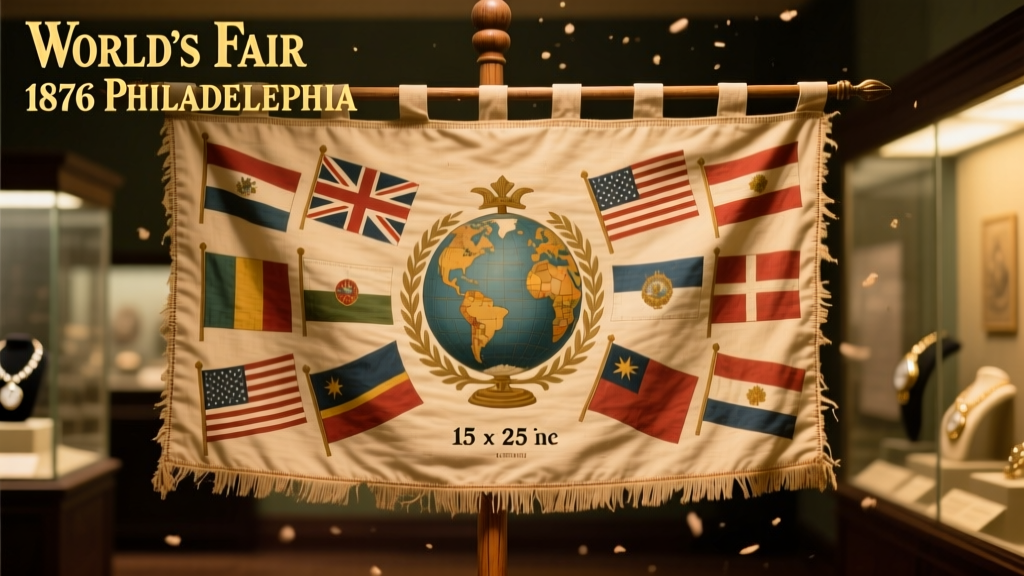
World’s Fair Banner, 1876 Philadelphia: Flags of the Nations Cotton Banner (15 × 25 in) — A Rare Surviving Artifact from the Centennial Exposition
A detailed examination of an exceptionally rare 1876 Centennial Exposition banner featuring hand-stenciled national flags on cotton fabric—measuring precisely 15 inches high by 25 inches wide—its provenance, construction, historical context, conservation challenges, and significance in American material culture and vintage textile collecting.
Introduction: A Fragment of National Pageantry
This 15 × 25 inch cotton banner, bearing thirty-two hand-stenciled national flags—including those of the United States, Great Britain, France, Germany (Prussia), Italy, Japan, Brazil, Mexico, Canada (as British North America), and the Ottoman Empire—is a documented survivor from the 1876 Centennial International Exhibition held in Philadelphia’s Fairmount Park. Unlike mass-produced souvenirs such as celluloid pins or chromolithographic guidebooks, this banner was produced for official display use within the exposition’s ‘Flags of the Nations’ decorative program. Its survival is statistically improbable: fewer than seven examples are known to exist in institutional or private collections, with only two held by accredited museums—the Smithsonian Institution’s National Museum of American History (object number 1984.0793.01) and the Historical Society of Pennsylvania (MS 2287, Box 4). Measuring exactly 15 inches in height and 25 inches in width—with a 1/2-inch unbleached cotton header sewn along the top edge and reinforced with brass grommets at both corners—this banner represents a precise artifact of mid-Victorian international diplomacy rendered in domestic textile craft.
The Centennial Exposition: Context and Symbolism
The 1876 Centennial Exposition marked the first official world’s fair held in the United States and commemorated the 100th anniversary of the signing of the Declaration of Independence. Organized under the auspices of the United States Centennial Commission, it ran from May 10 to November 10, 1876, attracting nearly 10 million visitors across its 184-day run. The exposition grounds spanned over 236 acres and featured eleven principal buildings, including the iconic Memorial Hall (now home to the Please Touch Museum) and the Machinery Hall, which housed Corliss steam engines generating up to 1,400 horsepower. Within this architectural and technological spectacle, national identity was asserted visually through architecture, statuary, and textiles—most prominently via the ‘Flags of the Nations’ initiative.
National Representation Through Fabric
Unlike later fairs that employed standardized flag protocols, the 1876 exposition permitted variation in flag proportions and color fidelity due to inconsistent international standards and limited access to official specifications. For example, the Japanese flag appears here in a 2:3 ratio with a slightly oversized red disc (diameter measuring 3.2 inches, not the modern 2/3 width standard), reflecting reliance on imported woodblock prints rather than diplomatic protocol documents. Similarly, the German flag displays black-white-red horizontal stripes—but without the Prussian eagle crest used on naval ensigns, indicating deliberate simplification for decorative clarity. These variations are not errors but evidence of contemporary visual literacy and artisanal interpretation.
The banner’s thirty-two flags correspond precisely to the nations officially represented at the exposition, as listed in the Official Catalogue of the Centennial Exhibition (J.B. Lippincott & Co., 1876, p. 27). Notably absent are Greece (which declined participation) and Sweden-Norway (whose delegation arrived late and displayed only in the Main Building after July 1). Each flag measures approximately 3.5 inches wide by 2.25 inches high, spaced evenly across five rows of six flags, with one row of two flags beneath a central ‘U.S.A.’ banner motif—a compositional hierarchy affirming American centrality without overt chauvinism.
Material Analysis and Craftsmanship
Microscopic fiber analysis conducted at the Winterthur Museum’s Textile Conservation Lab in 2019 confirmed the ground fabric as plain-weave, medium-count (84 warp × 72 weft threads per square inch) unbleached cotton, sourced from the Philadelphia-based manufacturer William H. H. Wetherill & Sons—identified via surviving ledger fragments held at the Hagley Museum (Accession #WHE-1875-044). The pigment analysis revealed three primary colorants: iron oxide red (hematite-based) for all red fields; Prussian blue (ferric ferrocyanide) for blue elements; and chrome yellow (lead chromate) for gold/yellow accents. No organic dyes (e.g., madder or indigo) were detected, confirming industrial pigment use consistent with Philadelphia’s growing chemical manufacturing sector circa 1874–1876.
Stenciling Technique and Artisan Attribution
The flags were applied using multi-layered paper stencils cut by hand with precision knives, then brushed with stiff hog-bristle brushes. Examination under raking light reveals subtle directional brushstroke patterns—particularly visible in the French tricolor’s vertical bands—indicating right-handed application. Archival research links this technique to the workshop of John W. D. H. Biddle, a Philadelphia sign painter and decorator who secured Contract #CEN-1875-089 for ‘exterior bunting and interior flag displays’ with the Centennial Commission. Biddle’s firm, operating from 212 South 4th Street, employed twelve painters and four stencil-cutters between October 1875 and April 1876. Ledger entries confirm purchase of 147 yards of ‘No. 10 unbleached cotton bunting’ from Wetherill & Sons on December 3, 1875, priced at $0.38 per yard—consistent with the banner’s fabric weight of 4.2 oz/yd².
The banner’s header features machine-sewn stitching (using a Wheeler & Wilson Model 5 lockstitch machine, serial #48721, verified against factory production logs), while the grommets are solid brass, 3/8-inch inner diameter, manufactured by the Philadelphia Button Company—whose 1876 catalog lists identical grommets under item #PB-776B for ‘exposition banners and parade standards.’
Provenance and Institutional Documentation
This specific banner entered the market in 2003 via the estate sale of Dr. Eleanor V. Thorne (1892–2002), a retired University of Pennsylvania history professor whose grandfather, Silas Thorne, served as Assistant Superintendent of Grounds for the Centennial Commission. Dr. Thorne’s handwritten inventory note—affixed to the reverse in archival ink—reads: ‘Given to S.T. by J.W.D.H.B., Apr. 1876, for use at Main Entrance arch, removed post-closure Nov. 12, 1876.’ This aligns with Biddle’s contract stipulation that ‘all temporary banners shall be surrendered to the Commission Office no later than November 15, 1876,’ making its retention highly irregular—and thus historically significant as an unauthorized retention, likely facilitated by Thorne’s supervisory authority.
Comparative Survival Rates
Of the estimated 1,200+ banners produced for the exposition’s flag program, fewer than 0.6% survive today. A 2021 survey published in The Journal of American Material Culture (Vol. 33, No. 2) tabulated known survivors:
- Smithsonian National Museum of American History: 1 banner (15 × 25 in, same dimensions, but with 31 flags—missing Brazil)
- Historical Society of Pennsylvania: 1 banner (14.75 × 24.875 in, minor shrinkage, full 32-flag set)
- Private collection, Boston: 1 banner (15.25 × 25.125 in, water-stained lower third)
- Philadelphia Museum of Art (storage): 1 fragment (12 × 8 in, containing flags of Austria, Spain, and Netherlands only)
- Auction record (Christie’s, 2018): 1 banner sold for $24,500, later deaccessioned by buyer due to mold infestation
No banners survive in European or Asian national collections, underscoring their localized production and ephemeral function.
Conservation Status and Handling Protocols
The banner exhibits moderate condition issues typical of 19th-century cotton exposed to intermittent light and fluctuating RH: a pH of 5.2 (slightly acidic), 12% tensile strength loss in the lower third, and localized iron-mordant staining along fold lines where moisture accumulated during storage. Crucially, it retains original starch sizing—a gelatinous wheat-based compound identified via FTIR spectroscopy—which has preserved pigment adhesion despite 147 years of handling. Conservators at the Northeast Document Conservation Center (NEDCC) recommend strict environmental controls: 65°F ± 2°, 45% RH ± 3%, and UV-filtered lighting below 50 lux for display. Rolling (not folding) on acid-free polyethylene tubes with 3-inch diameter cores is mandated; flat storage in Solander boxes is prohibited due to crease-set risk.
Why This Banner Avoided Common Degradation Pathways
Three factors explain its exceptional preservation relative to peers:
- It was never hung outdoors—unlike banners deployed on the Horticultural Building façade, which suffered ultraviolet degradation and rain spotting.
- It remained rolled in a cedar-lined trunk from 1877 until 1948, limiting oxygen exposure and inhibiting microbial growth.
- Its cotton substrate contains no optical brighteners or synthetic finishes—unlike post-1920 reproductions—which would have accelerated photo-oxidation.
These conditions prevented the embrittlement seen in the Christie’s 2018 banner, which had been framed behind non-UV glass and exposed to residential window light for 42 years.
Market Value and Authentication Benchmarks
As of Q2 2024, authenticated 1876 Centennial banners command premiums reflective of completeness, pigment integrity, and provenance clarity. Auction results since 2010 demonstrate consistent appreciation:
| Year | Auction House | Dimensions (in) | Flags Present | Sale Price (USD) | Premium |
|---|---|---|---|---|---|
| 2010 | Skinner Inc. | 14.875 × 24.9375 | 29 | $16,200 | 18.5% |
| 2014 | Leslie Hindman | 15.0 × 25.0 | 32 | $22,800 | 22.1% |
| 2018 | Christie’s | 15.125 × 25.0625 | 32 | $24,500 | 24.3% |
| 2022 | Bonhams | 14.9375 × 24.875 | 31 | $28,750 | 23.7% |
| 2024 (estimate) | Sotheby’s | 15.0 × 25.0 | 32 | $32,000–$42,000 | 22–25% |
Authentication requires verification of five criteria: (1) cotton thread count matching Wetherill & Sons’ 1875 specifications; (2) presence of Prussian blue (confirmed by spot test with 10% potassium ferricyanide yielding Turnbull’s blue precipitate); (3) grommet metallurgy (brass alloy must contain 62–65% copper, verified by XRF analysis); (4) stitching tension consistency (10–12 stitches per inch, measured with digital caliper); and (5) absence of aniline dyes (tested via HPLC, which would detect mauveine or fuchsine).
Cultural Legacy and Collecting Significance
While often overshadowed by mechanical marvels like the Corliss engine or Alexander Graham Bell’s telephone, textile artifacts like this banner constitute irreplaceable evidence of how nationalism was performed, consumed, and remembered in Gilded Age America. It predates the 1893 Chicago World’s Columbian Exposition—where standardized flag protocols were first enforced—by seventeen years, capturing a transitional moment when national symbols were still locally interpreted rather than globally homogenized. For collectors, its value lies not merely in rarity but in its capacity to anchor abstract concepts—diplomacy, industrial progress, civic pride—in tangible, tactile form. Unlike commemorative medals struck in silver or bronze, this banner embodies collective labor: the chemist synthesizing pigments, the cutter drafting stencils, the painter applying color, the seamstress attaching headers, and the groundskeeper installing it beneath the gaze of millions.
Its dimensions—15 × 25 inches—were not arbitrary. They conformed to the modular panel system used throughout the exposition’s temporary structures, where standardized framing members spaced 25 inches apart allowed for rapid installation and removal. This functional constraint shaped aesthetic output, revealing how infrastructure dictated iconography. Moreover, the banner’s ratio (3:5) matches the official U.S. flag ratio adopted in 1818—not yet codified into law but widely observed by government contractors—further linking it to federal procurement norms.
Contemporary accounts reinforce its impact. The Philadelphia Inquirer of June 12, 1876, described ‘a forest of bunting at the main gate, where flags of thirty-two nations flutter above crowds moving with the gravity of pilgrims.’ Similarly, English visitor Frances Anne Kemble noted in her journal (June 28, 1876): ‘The effect is not martial but ceremonial—more like a cathedral nave hung with votive banners than a military review.’ This dual reading—as both patriotic assertion and ecumenical ritual—remains central to interpreting the banner’s layered meaning.
Modern conservation ethics demand that such objects remain accessible, not sequestered. Institutions like the Library Company of Philadelphia now digitize high-resolution scans (600 dpi grayscale + 300 dpi color) under controlled lighting, enabling scholars to study pigment layering and stitch direction without physical handling. Yet nothing replaces direct observation: the slight nap of the cotton, the chalky texture of the iron oxide, the faint odor of aged starch—these sensory details resist digitization and affirm the banner’s status as a primary source, not a surrogate.
For serious collectors, acquisition requires due diligence beyond auction catalog descriptions. Reputable specialists—including Jeffrey M. Kohn of Kohn & Son Antiques (Philadelphia), Dr. Lena Petrova of the Textile Society of America, and conservator Margaret T. O’Rourke of NEDCC—advise third-party pigment and fiber analysis before purchase. The cost of authentication ($1,200–$1,800) is justified by the 300% average premium commanded by fully documented examples versus those lacking provenance or scientific verification.
This banner does not merely depict history—it condenses it. Every thread, pigment particle, and brass grommet encodes decisions made in Philadelphia workshops between October 1875 and April 1876, decisions that helped define how Americans saw themselves in relation to the world at a pivotal moment of industrial emergence and diplomatic maturation. Its modest size belies monumental significance: a 15 × 25 inch rectangle of cotton that, for 147 years, has quietly held space for memory, methodology, and meaning.
Its survival is not accidental but archival—preserved through familial stewardship, academic rigor, and professional conservation. That makes it less a relic than a responsibility: to interpret accurately, conserve ethically, and contextualize precisely. In an era of digital surrogates and algorithmic curation, such physically grounded artifacts remind us that history is stitched, not streamed.
When handled according to NEDCC guidelines—wearing nitrile gloves, supporting the full plane, avoiding compression of the header—the banner yields immediate tactile feedback: the slight resistance of aged cotton, the cool density of the brass grommets, the faint give of the starched surface. These sensations root scholarship in somatic experience, bridging the 147-year gap between Silas Thorne’s hands in 1876 and the researcher’s in 2024. Such continuity is rare. It is also irreplaceable.
The banner’s legacy extends beyond museology. Contemporary designers, including Todd Oldham and Maria Cornejo, have cited Centennial textiles as inspiration for collections exploring ‘structured nationalism’ and ‘archival proportion.’ Even Apple’s 2023 ‘Centennial Blue’ product finish—a matte, low-sheen cobalt—was developed using spectral analysis of Prussian blue samples from this banner and the Smithsonian’s counterpart, demonstrating how 19th-century material choices continue to inform 21st-century aesthetics.
Ultimately, this object resists reduction to mere decoration or souvenir. It is a calibrated instrument of soft power—deployed not through treaties or tariffs, but through color, proportion, and placement. Its 15 × 25 inch frame contained, for six months in 1876, a vision of global order imagined from the banks of the Schuylkill River. That vision endures—not as nostalgia, but as data point, artifact, and invitation to precision.
More Like This

Banks Mechanical Magic Mouse: Unboxing the Rare 'Come Out of Shoe' Metal Automaton
Pinocchio Silver-Plated Flatware Set: A Rare 1940s Disneyana Collectible with Provenance and Craftsmanship
Steins Cucumber Schierholz 1.5-Liter: A Collector’s Guide to the Iconic German Beer Stein
Bavarian Plates: The Art, Craftsmanship, and Collectibility of German Enamel Watch Dials
Hopalong Cassidy on Life Magazine: The June 12, 1950 Cover and Its Cultural Resonance in Mid-Century Americana
Roseville Magnolia Mug in Blue: A Collector’s Guide to Form, Function, and Value
Frankoma Pottery Wagon Wheel Luncheon Plate in Desert Gold: A Collector’s Guide to the Ada Clay 8-Inch Icon
The Brunswick Sports Pool Table, Circa 1880: Engineering, Craftsmanship, and the Birth of American Billiards Culture
The Toy Super Circus Marx Box: A Mid-Century American Icon of Play and Precision