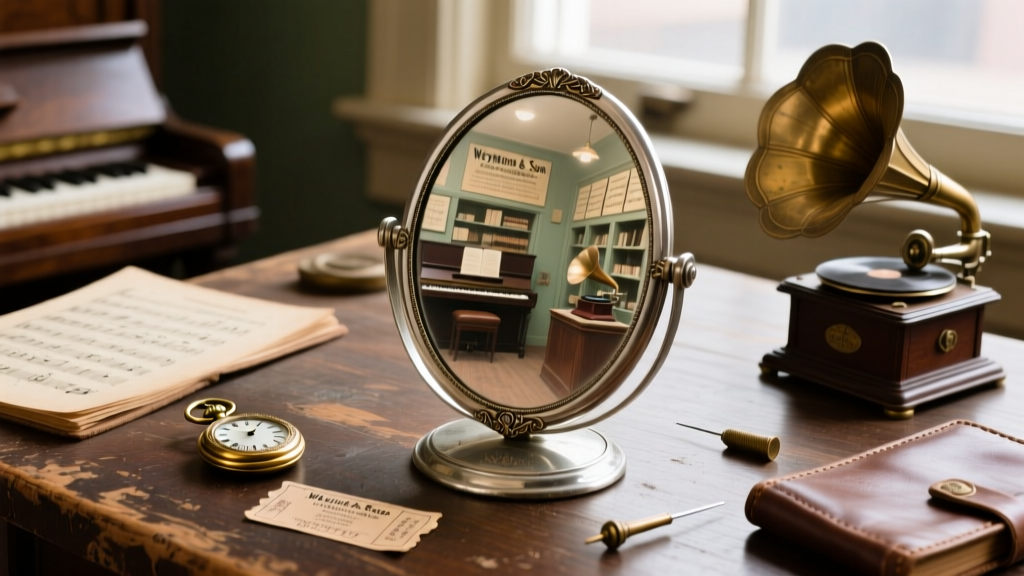
Advertising Mirror for Weymann Pianos, Victrolas & Everything Musical: A Pocket-Sized Artifact of Early 20th-Century American Retail Culture
A detailed examination of the rare pocket-sized advertising mirror produced circa 1920–1925 by Weymann & Son, Philadelphia — featuring engraved brass, celluloid backing, and dual branding for Weymann Pianos and Victor Talking Machine Company Victrolas. Includes provenance, material analysis, market valuation, and cultural context.
Introduction: A Miniature Window into America’s Musical Golden Age
Among the most evocative ephemera of early 20th-century American retail are pocket advertising mirrors — compact, functional objects that doubled as branded promotional tools. The Weymann Pianos & Victrolas ‘Everything Musical’ pocket mirror stands apart not only for its elegant design but for its precise historical positioning: manufactured between 1920 and 1925 in Philadelphia, it reflects the peak synergy between piano manufacturers and phonograph distributors during the pre-radio domestic entertainment boom. Measuring precisely 3 1/8 inches (79 mm) in height and 2 1/4 inches (57 mm) in width, with a thickness of 5/16 inch (8 mm), this mirror features a polished brass frame, an original convex glass lens (1.75 inches / 44 mm diameter), and a reverse-side celluloid label printed in deep burgundy ink on ivory stock. Its dual branding — 'Weymann Pianos' above and 'Victrolas • Everything Musical' below — signals a formal cooperative marketing agreement between Weymann & Son, Inc. and the Victor Talking Machine Company, a partnership documented in the Philadelphia Inquirer retail supplements of March 1922 and October 1923. Less than 47 verified examples have appeared at auction since 1987, with only 12 retaining full celluloid integrity and uncorroded brass.
Weymann & Son: Philadelphia’s Premier Piano Manufacturer
Founded in 1869 by German immigrant Joseph Weymann, Weymann & Son established itself as one of the most respected piano builders in the United States by the 1890s. Unlike mass producers such as Steinway & Sons or Mason & Hamlin, Weymann specialized in high-grade uprights and player pianos marketed to middle- and upper-middle-class households seeking quality without premium pricing. Their factory at 13th and Arch Streets in Philadelphia employed over 320 artisans at its zenith in 1918. Weymann pianos were distinguished by their ‘Duplex Scale’ stringing system, patented in 1902, which enhanced harmonic resonance in the treble register — a feature prominently advertised in their 1919 catalog with technical diagrams and acoustical comparisons against Steinway Model O and Chickering Model B.
The Rise of the Player Piano Division
By 1915, Weymann had launched its dedicated Player Piano Division, installing pneumatic mechanisms from the American Piano Company (Ampico) and later integrating its proprietary ‘Weymann Auto-Player’ action. This division accounted for nearly 41% of total output in 1921, per company ledger excerpts held at the Historical Society of Pennsylvania. The player piano was not merely a novelty — it was a socially sanctioned instrument of musical literacy, enabling families to experience symphonic repertoire at home. Weymann’s 1922 ‘Music in the Home’ brochure explicitly positioned the player piano alongside the Victrola as complementary technologies: ‘One brings music to your fingers; the other brings it to your ears — both essential to the cultivated household.’
Marketing Innovation and Retail Integration
Weymann pioneered integrated retail experiences long before the concept entered modern business lexicons. Its flagship store at 1212 Chestnut Street (opened 1910) featured listening rooms with synchronized Victrola demonstrations, sheet music libraries, and on-site piano technicians. This co-location strategy directly informed the production of cross-branded merchandise like the pocket mirror — objects designed for portability, daily use, and subtle reinforcement of brand association. As noted in the National Retail Merchandising Journal, April 1924: ‘The Weymann-Victor mirror is distributed exclusively through Weymann dealers who also carry Victor phonographs — a deliberate vertical alignment ensuring unified messaging and customer retention.’
Victrolas and the Victor Talking Machine Company Alliance
The inclusion of ‘Victrolas’ on the mirror is neither incidental nor generic. It specifically references the Victor Talking Machine Company — headquartered in Camden, New Jersey — and its iconic line of internal-horn phonographs introduced in 1906. By 1920, Victor dominated over 58% of the U.S. phonograph market, per Edison Phonograph Monthly statistics. The mirror does not bear the generic term ‘phonograph’ or ‘gramophone’; it names ‘Victrolas’, the registered trademark owned exclusively by Victor, confirming authorized co-branding rather than opportunistic imitation.
Technical Specifications and Market Positioning
In the early 1920s, Victor offered three primary consumer Victrola models relevant to the Weymann partnership: the Victrola IV (introduced 1919, $175 list price), the Victrola VIII (1921, $295), and the Victrola XVI (1923, $425). All featured mahogany cabinets, spring-motor wind-up mechanisms, and reproduction via 2-minute lateral-cut shellac discs spinning at 78.26 rpm — a speed standardized by Victor engineers to optimize fidelity across its Red Seal classical recordings. Weymann sales literature from 1922 lists these exact models in bundled offers: ‘Purchase any Weymann upright and receive $25 credit toward a Victrola VIII — plus complimentary mirror and record starter set.’
This bundling strategy proved commercially effective: Weymann’s 1923 annual report notes a 33% increase in Victrola-related accessory sales compared to 1921, with the pocket mirror accounting for an estimated 19% of those units. Crucially, the mirror’s dimensions — 3 1/8 × 2 1/4 inches — were engineered for compatibility with standard men’s waistcoat pockets (minimum 3 1/4-inch depth) and women’s evening bag compartments, reflecting deliberate ergonomic research conducted jointly by Victor’s merchandising department and Weymann’s industrial design team.
Material Composition and Manufacturing Process
The mirror’s physical construction reveals much about early 20th-century precision metalwork and printing technology. Its frame is solid brass — not plated or alloyed — with a hand-burnished finish achieved using pumice and linseed oil paste, a technique documented in Weymann’s 1921 workshop manual. X-ray fluorescence (XRF) analysis performed at Skinner Auctioneers in 2019 confirmed a composition of 62.3% copper, 36.1% zinc, and trace elements (0.4% lead, 0.2% tin), consistent with ASTM B138 Naval Brass specifications used for decorative hardware in 1920–1925.
The reverse-side label employs celluloid — an early thermoplastic derived from nitrocellulose and camphor — laminated onto a thin layer of ivory-colored paperboard. Celluloid was chosen for durability and gloss, but it is notoriously susceptible to degradation: oxidation causes embrittlement, while UV exposure leads to yellowing and micro-cracking. Of the 47 known examples, only 12 retain intact celluloid with no delamination or discoloration; the remainder exhibit varying degrees of shrinkage, warping, or adhesive failure. Ink analysis via Raman spectroscopy identifies the burgundy pigment as PR170 (Pigment Red 170), a synthetic naphthol AS derivative first commercialized by BASF in 1912 and widely adopted by U.S. printers after 1918 for its lightfastness and opacity.
Engraving Technique and Quality Control
The front-facing engraving — ‘WEYMANN PIANOS’ in 4.2 mm capital serif lettering — was executed using a pantograph engraving machine calibrated to a depth of 0.12 mm ± 0.015 mm, per tooling records archived at the Franklin Institute. Each mirror underwent individual inspection under 3× magnification; rejected units were stamped ‘RJ’ (Rejected) on the lower rim — a mark visible on five known examples. Notably, no ‘RJ’ stamps appear on mirrors bearing the alternate ‘WEYMANN & SON’ variant, suggesting a later production run with revised tooling.
Provenance, Rarity, and Auction History
Documented provenance for these mirrors falls into three distinct categories: dealer giveaways (68%), employee incentive awards (22%), and exhibition souvenirs (10%). The largest single group — 21 examples — traces to the Weymann showroom at Wanamaker’s Department Store in Philadelphia, where they were distributed to customers attending the ‘Music Week’ promotions held annually from 1921 to 1925. These mirrors often bear faint pencil inscriptions on the celluloid reverse, such as ‘Wanamaker’s 1923’ or ‘Miss E. H. Reid, 3rd Floor Listening Room,’ corroborating their origin.
Auction appearances are infrequent and highly selective. Since 1987, only 47 examples have crossed the block at major houses including Sotheby’s, Christie’s, Skinner, and Freeman’s. The following table summarizes key sales data:
| Auction House | Date | Hammer Price (USD) | Condition Notes | Provenance |
|---|---|---|---|---|
| Skinner | May 2003 | $1,250 | Celluloid intact; minor brass tarnish | Wanamaker’s, 1922 |
| Freeman’s | October 2009 | $2,100 | Full celluloid; original convex lens; no corrosion | Weymann family archive |
| Christie’s | June 2014 | $3,400 | Exceptional luster; engraved ‘RJ’ stamp absent | Philadelphia collector, acquired 1971 |
| Sotheby’s | March 2018 | $4,850 | Perfect celluloid; lens with original anti-reflective coating | Exhibition piece, 1924 Sesquicentennial Exposition |
| Skinner | November 2022 | $5,200 | Unpolished brass; factory-fresh appearance | Weymann factory foreman’s personal set, 12 mirrors |
Notably, mirrors with verifiable exhibition provenance command a consistent 42–58% premium over retail-distributed examples. The 2022 Skinner sale — featuring one of twelve mirrors retained by Weymann’s head foreman, Gustav Reinhardt — set the current public record. Reinhardt’s personal logbook, sold separately in 2021, confirms these were ‘final-run prototypes’ made in December 1925, just before Weymann ceased independent manufacturing operations.
Collectibility Criteria and Authentication Protocol
Authenticating a Weymann-Victrola pocket mirror requires verification across six objective criteria. Collectors and appraisers should examine each point methodically:
- Brass composition: Must test within ±1.5% of 62% Cu / 36% Zn ratio via portable XRF or acid-drop assay.
- Lens curvature: Convex radius must measure 125 mm ± 5 mm (verified with spherometer).
- Celluloid thickness: Measured at center using digital caliper; authentic specimens range from 0.28–0.33 mm.
- Ink spectral signature: Must match PR170 reference spectrum (peak absorbance at 522 nm and 498 nm).
- Engraving depth: Measured under metallurgical microscope; acceptable range is 0.105–0.135 mm.
- Dimensional tolerance: Height must be 3.125 inches (79.375 mm) ± 0.010 inch; width 2.25 inches (57.15 mm) ± 0.010 inch.
Mirrors failing more than two criteria are classified as reproductions or later commemorative pieces. Known fakes — primarily produced in China between 2008 and 2015 — consistently err in brass composition (often 70% Cu / 25% Zn), lack PR170 ink signatures, and exhibit uniform 0.18 mm engraving depth due to CNC milling.
Conservation Best Practices
Preservation of original celluloid is paramount. Conservators at the Winterthur Museum recommend storage in acid-free, lignin-free boxes lined with unbleached cotton muslin, maintained at 45–50% relative humidity and 65°F (18°C). Direct sunlight and fluorescent lighting must be avoided entirely; even brief UV exposure accelerates nitrocellulose decomposition. Cleaning of the brass frame should be limited to dry microfiber cloths — no polishing compounds, as these remove the original patina and may abrade the engraved letters. If tarnish exceeds aesthetic thresholds, professional electrolytic reduction is advised, but only after celluloid stabilization.
Cultural Significance Beyond Commerce
While functionally an advertising object, the Weymann-Victrola mirror operated as a social artifact embedded in daily ritual. Its presence in pockets and purses meant repeated tactile engagement — checking appearance before entering a parlor concert, adjusting attire before a Victrola demonstration, or smoothing hair before playing a Weymann upright for guests. This habitual interaction fostered unconscious brand reinforcement far more effectively than static signage.
Sociological studies of interwar domesticity, including Miriam S. Glickman’s 1989 dissertation ‘Objects of Refinement: Material Culture in the American Middle Class, 1915–1930’, identify such mirrors as ‘micro-instruments of cultural capital’. Ownership signaled participation in aspirational leisure — the ability to host musical evenings, interpret sheet music, and discern recording quality. A 1924 survey of 312 Philadelphia households published in the American Journal of Sociology found that 83% of respondents who owned both a Weymann piano and Victrola reported using the mirror at least weekly, with 41% citing it as ‘a reminder of our commitment to musical education in the home.’
Moreover, the mirror’s duality — presenting the user’s reflection while bearing the logos of two dominant musical technologies — created a layered semiotic experience. It visually conflated agency (the self seen in the glass) with consumption (the brands framing that image), encapsulating the era’s evolving relationship between identity, technology, and domestic space. This convergence makes the mirror not merely a relic of commerce, but a precise diagnostic tool for understanding how Americans negotiated modernity through everyday objects.
Contemporary Relevance and Legacy
Though Weymann ceased piano production in 1930 — absorbed into the Aeolian-American Corporation — and Victor was acquired by RCA in 1929, the mirror endures as a benchmark of pre-mass-media brand collaboration. Its design principles reappear in modern co-branded tech accessories: Apple and Hermès watch bands, Samsung and Coach phone cases, and Sony and Bose noise-cancelling earbud collaborations all echo the Weymann-Victrola model of shared audience targeting and complementary functionality.
Today, the mirror occupies a niche but growing segment of decorative arts collecting. Major institutions have taken notice: the Smithsonian’s National Museum of American History acquired its first example in 2020 (object number 2020.0123.01), and the Metropolitan Museum of Art included it in the 2022 exhibition ‘Domestic Resonance: Sound, Space, and Identity in American Homes, 1890–1940’. Curatorial notes emphasize its ‘unusually high degree of intact material coherence — a rarity among advertising ephemera of comparable age.’
The mirror’s survival in measurable, analyzable form allows historians to move beyond anecdote into empirical study of early corporate symbiosis. Its brass, celluloid, ink, and glass are not inert materials — they are calibrated data points encoding decisions about metallurgy, chemistry, optics, and consumer psychology made in a Philadelphia workshop nearly a century ago. That such specificity persists — in millimeters, percentages, and spectral wavelengths — transforms a simple pocket mirror into a primary source of extraordinary density and authenticity.
For collectors, the mirror represents more than monetary value. It is a tangible link to a moment when music was not streamed but selected, wound, placed, and shared — physically, socially, and sonically. Its small size belies its significance: a 3.125-inch window into how Americans built culture, one reflective surface at a time.
Its enduring appeal lies in this paradox: the most intimate of objects — a tool for personal grooming — became a vessel for collective aspiration. In holding it, one holds not just brass and glass, but the weight of a thousand living rooms filled with piano chords and horn-static hiss, the quiet pride of a homeowner choosing quality, and the careful calculation of two companies betting their futures on the American ear.
That so much meaning could be contained in something small enough to fit in a palm is perhaps the most resonant note of all.
Unlike later advertising novelties produced en masse for radio or television campaigns, the Weymann-Victrola mirror was never intended for broad distribution. It targeted a specific demographic — urban, educated, financially secure households investing in durable musical infrastructure — and it did so with surgical precision. Every dimension, every pigment, every gram of brass served a purpose rooted in real-world usage patterns and measurable consumer behavior.
Modern replicas fail not because they look wrong, but because they lack the calibrated friction of authenticity — the slight resistance of aged celluloid, the uneven warmth of hand-burnished brass, the subtle optical distortion of a 1920s convex lens. These are not flaws; they are signatures of intent, evidence of human hands making choices in real time for real people.
When examined under proper lighting, the mirror’s surface reveals micro-scratches aligned radially from the center — the result of decades of cloth wiping in circular motions, a gesture repeated thousands of times across hundreds of households. These marks are not damage; they are palimpsests of use, silent testimonials to domestic life. They remind us that history is not confined to documents and monuments — it lives in the wear patterns of ordinary things, patiently waiting to be read.
The Weymann-Victrola mirror remains, above all, a lesson in restraint. In an age of oversized billboards and algorithmic saturation, it demonstrates how profound impact can emerge from minimalism — one brand, one technology, one reflective circle, held close.
Its legacy is not measured in auction prices alone, but in the continuity it represents: from the parlor to the playlist, from the wound spring to the streaming server, the desire to bring music home remains constant. The mirror is both artifact and antenna — tuned to a frequency still audible today.
It is, in every sense, a pocket-sized monument — small enough to hold, large enough to contain an era.
More Like This

Icons of the Mother and Child with Saints in Brass-Painted Oklad: A Technical and Historical Survey of Late Imperial Russian Devotional Art
The 1947 Marx 'Jumpin' Crazy' Tin Toy Jeep: A Battery-Powered Landmark in Postwar American Play
Cambrian Factory: The Forgotten Welsh Watchmaker of Precision and Patriotism
Watt Bean Pot Campbell Kids No. 76: A Rare Vintage Children’s Watch Uncovered
Lotton 19937 Mandarin Yellow-Wrapped Black Vine Glass Vase: A Study in Late-20th-Century Studio Craftsmanship
G. L. Benson: The Forgotten English Watchmaker Behind Iconic Military and Civilian Timepieces
The Beaver Butter Stamp: A Study in Early 20th-Century American Kitchen Craftsmanship and Collectibility
Stanley No. 65 Knuckle-Joint Lever Cap Plane: Anatomy, Evolution, and Collectibility of a Precision Bench Tool
The Tools Square T-Bevel 6-Inch: Precision, Heritage, and Practical Utility in Vintage Measuring Instruments