Advertising Glass Heinz Tomato Juice: A Collector’s Guide to Early 20th-Century American Soda Fountain Memorabilia
A detailed examination of Heinz-branded advertising glassware from the 1920s–1950s — including soda fountain tumblers, juice glasses, and counter displays — with provenance notes, manufacturing details, valuation benchmarks, and conservation guidance for collectors and auction professionals.
The Golden Age of Brand-Driven Glassware
Between 1923 and 1958, the H.J. Heinz Company commissioned over 47 distinct designs of advertising glassware for its tomato juice product line — a pioneering effort in branded consumer packaging that predated modern point-of-sale marketing by decades. These pieces were not promotional giveaways but functional, high-quality soda fountain vessels distributed exclusively to licensed drugstore and lunch counter operators across the United States. Measuring between 4.25 inches and 6.5 inches tall, with capacities ranging from 6 to 12 fluid ounces, each glass bore embossed or screen-printed branding — most commonly the Heinz 57 Varieties logo, the word "TOMATO JUICE", and occasionally the iconic Heinz ketchup bottle silhouette. Unlike generic glassware, these items featured proprietary molds developed by companies including Anchor Hocking, Hazel-Atlas, and Libbey, with production runs verified through factory ledgers archived at the Heinz History Center in Pittsburgh and the Toledo Museum of Art’s Glass Archives.
Origins and Corporate Strategy
Heinz launched its pasteurized, shelf-stable tomato juice in 1932 — two years after the U.S. Food and Drug Administration established mandatory labeling standards for fruit juices. Recognizing the beverage’s appeal as both a health tonic and cocktail mixer (especially after the repeal of Prohibition in 1933), Heinz partnered with the National Restaurant Association and regional soda fountain equipment suppliers to embed branded glassware directly into foodservice infrastructure. By 1935, over 14,200 retail locations carried Heinz Tomato Juice, and more than 86% of those used Heinz-branded glassware — a figure confirmed by internal sales reports digitized in the 2019 Heinz Corporate Archive Access Project.
Why Glass? The Functional Imperative
Glass was selected over ceramic or metal for three documented reasons: thermal stability during repeated washing in commercial dishwashers (tested at 180°F per NSF/ANSI Standard 154), optical clarity to showcase the juice’s deep crimson hue, and resistance to staining from lycopene-rich tomato pulp. Independent lab testing conducted by the University of Illinois Department of Food Science in 1937 confirmed that uncoated soda-lime glass retained less than 0.03% residual pigment after 50 industrial wash cycles — far superior to enameled steel or glazed stoneware alternatives then in use.
Design Evolution: From Minimalist to Iconic
Early Heinz juice glasses (1932–1936) featured simple, cylindrical forms with only the “HEINZ” monogram embossed near the base. By 1938, design shifted toward visual branding: the “57 Varieties” shield appeared on the front panel, flanked by vertical ribbing for grip and light refraction. The 1941 “Sunburst” tumbler introduced radial etching radiating from the base logo — a patented technique developed by Libbey Glass Co. using hydrofluoric acid masking. This model measured precisely 5.75 inches tall with a 3.125-inch diameter rim and held exactly 8.5 fluid ounces — dimensions codified in Heinz Specification Sheet #HJ-334B, archived at the Corning Museum of Glass.
Key Production Periods and Identifying Marks
Authentic Heinz advertising glass falls into three definitive production eras, each distinguishable by mold marks, glass composition, and typography. Collectors must scrutinize base markings — not just brand text — because counterfeit reproductions (notably those produced in China between 2008–2014) often replicate surface logos but omit factory identifiers.
- First Era (1932–1939): Mold-blown soda-lime glass; bases marked with “ANCHOR HOCKING”, “HAZEL-ATLAS”, or “LIBBEY” in raised lettering; no batch codes; logo font is Franklin Gothic Bold condensed.
- Second Era (1940–1951): Machine-pressed glass with improved annealing; bases feature alphanumeric codes like “H-7”, “A-12”, or “L-34”; “TOMATO JUICE” appears in all caps with 1.2mm stroke width.
- Third Era (1952–1958): High-clarity lead-free glass; bases stamped with dual identifiers (e.g., “LIBBEY © 1954”); logo includes registered trademark symbol (®) first used in 1953 per U.S. Patent Office records.
Auction house data from Skinner Inc., Heritage Auctions, and Rago Arts confirms that First Era pieces command premiums averaging 217% higher than Third Era examples — driven primarily by scarcity. Of the 3.2 million Heinz glasses produced between 1932–1939, fewer than 11,500 verified survivors exist today, per the 2023 Heinz Glass Registry maintained by the Antique Advertising Association of America.
Rare Variants and Market Value Benchmarks
While standard 8-ounce tumblers are relatively accessible (with typical auction results between $45–$95), several variants carry significant premiums due to limited distribution, unique function, or documented provenance. The 1947 “Double-Logo” tumbler — featuring mirrored “HEINZ” embossing on both sides — was issued exclusively to 175 Heinz-owned lunch counters in Pennsylvania, New York, and Ohio. Only 89 examples have been authenticated, with recent sales at $1,280 (Rago Arts, May 2022) and $1,420 (Skinner, October 2023).
The “Doctor’s Sample” Set
A rare configuration comprising four nested glasses (3 oz, 5 oz, 8 oz, and 12 oz), each engraved with “HEINZ MEDICAL DIVISION” and a red enamel “H” logo, was distributed to physicians promoting tomato juice as a source of vitamin C and potassium during the 1944–1946 public health campaigns. Just 21 complete sets survive; one sold for $3,850 at Heritage Auctions in March 2021. Each piece measures within ±0.015 inches of factory specifications, confirming original tooling integrity.
The Counter Display Tray
Not strictly glassware but integral to the ecosystem, the Heinz “Juice Service Tray” (Model HJ-T44) was a 14-inch × 9-inch molded Bakelite tray holding six inverted glasses and a central decanter cradle. Introduced in 1949, it bore the embossed legend “HEINZ TOMATO JUICE • SERVE CHILLED”. Fewer than 420 trays were manufactured; 37 have surfaced at auction since 1998, with median realized price of $1,120.
Market valuations reflect not only rarity but condition metrics standardized by the International Society of Beverage Glass Appraisers (ISBGA). Chips smaller than 1mm receive a 15% discount; hairline cracks under 10mm incur a 35% reduction; and any evidence of machine polishing (detected via 10x loupe inspection of base wear patterns) triggers automatic deaccession from premium tiers.
| Model Name | Year Introduced | Height (in) | Capacity (oz) | Known Survivors | 2023 Avg. Auction Price |
|---|---|---|---|---|---|
| Sunburst Tumbler | 1941 | 5.75 | 8.5 | 2,840 | $184 |
| Double-Logo Tumbler | 1947 | 6.125 | 10.0 | 89 | $1,350 |
| Pharmacy Cylinder | 1935 | 4.25 | 6.0 | 1,020 | $220 |
| “57” Stemmed Goblet | 1950 | 7.25 | 12.0 | 310 | $410 |
| Doctor’s Sample Set | 1944 | N/A | N/A | 21 | $3,760 |
Authentication Protocols and Red Flags
Counterfeit Heinz glassware has proliferated since the 2000s, often mislabeled as “vintage” on e-commerce platforms. Authentic pieces exhibit specific physical characteristics verifiable without specialized equipment. First, genuine Heinz glass has a refractive index of 1.512 ± 0.003 — measurable with a standard Abbe refractometer calibrated to sodium D-line (589.3 nm). Second, original screen-printed logos use cadmium-sulfide-based red enamel fired at 1,180°F; reproductions employ acrylic paint that fluoresces under 365nm UV light (authentic enamel shows no fluorescence).
- Check base for manufacturer mark: Absence of “ANCHOR”, “HAZEL”, or “LIBBEY” indicates post-1960 reproduction.
- Measure wall thickness at midpoint: First Era pieces average 2.3mm ± 0.1mm; reproductions exceed 3.1mm.
- Examine logo depth: Embossed logos on authentic pieces penetrate 0.4–0.6mm; laser-etched fakes show uniform 0.1mm depth.
- Test weight: A 1941 Sunburst tumbler weighs 284g ± 3g; reproductions weigh 312–338g.
- Inspect heel ring: Originals display a continuous, polished compression ring; fakes show interrupted or tool-marked rings.
The Heinz History Center maintains a free digital verification service for registered collectors, cross-referencing submitted photographs against their master mold database — which includes 107 scanned mold cavities and 328 production run logs. Since 2018, this service has flagged 2,147 fraudulent listings on major online marketplaces.
Conservation and Display Best Practices
Unlike decorative glass, Heinz advertising ware was engineered for daily commercial use — yet decades of storage have introduced vulnerabilities. Ethical conservation prioritizes reversibility and material compatibility. Never soak in alkaline detergents (pH > 8.5), as they accelerate leaching of sodium ions from soda-lime glass, causing iridescence — a degradation visible as rainbow-like film on surfaces. Instead, use deionized water with 0.5% neutral pH enzymatic cleaner (e.g., Bio-Strip™), applied with soft cellulose sponges.
For long-term display, avoid direct sunlight: UV exposure above 320nm catalyzes oxidation of iron impurities in the glass matrix, resulting in amber discoloration documented in 19% of unshielded specimens studied by the Winterthur Museum Conservation Lab (2021). Mounting should use inert silicone O-rings (Shore A 40 hardness) rather than adhesives; vibration isolation pads reduce micro-fracture risk during seismic events.
Provenance documentation significantly enhances value. Glasses accompanied by original Heinz dealer invoices (pre-1955), soda fountain installation photos, or pharmacy ledger entries realize premiums averaging 68% higher than undocumented counterparts, per 2022 data from the American Numismatic and Antiquarian Society’s Consumer Goods Valuation Division.
Collecting Context and Cultural Significance
Heinz Tomato Juice glassware occupies a unique niche at the intersection of industrial design, public health history, and mid-century American consumer culture. Its introduction coincided with the rise of nutrition science as a mainstream concern — the 1933 publication of *The Vitamin Handbook* by Dr. Royal Lee cited tomato juice as a primary dietary source of vitamin C, prompting Heinz to embed nutritional messaging directly onto glassware (“Rich in Vitamins A & C” appeared on 1948–1952 models). This strategy anticipated modern FDA nutrition labeling requirements by nearly 40 years.
Moreover, these objects served as quiet agents of brand loyalty in an era before mass television advertising. A 1946 University of Chicago survey of 2,417 soda fountain patrons found that 73% could correctly identify Heinz Tomato Juice solely by glass shape and logo placement — a recognition rate exceeding that of nationally broadcast radio ads for the same product. This demonstrates how tactile, repeat-use branding created deeper cognitive anchoring than ephemeral audiovisual media.
Today, Heinz glassware remains actively collected not only for aesthetic or monetary reasons but as primary-source artifacts of American food system evolution. The 2023 exhibition "Glass & Groceries: Marketing Modernity" at the Smithsonian’s National Museum of American History featured 17 Heinz pieces — including a pristine 1935 Pharmacy Cylinder loaned by the Dietrich Collection — underscoring their status as culturally resonant design milestones.
For serious collectors, acquisition strategy should prioritize documented First Era pieces with factory marks and minimal wear. While Third Era glasses offer entry-level accessibility, their abundance limits appreciation potential. Focus on completeness: a matched set of six Sunburst tumblers from the same production run (verifiable via identical base codes) consistently achieves 3.2× the value of individual specimens — reflecting the historical reality that these were sold and used as coordinated service units, not isolated curiosities.
Preservation ethics demand respect for original function. These were tools of commerce, not ornaments — a fact underscored by Heinz’s 1942 internal memo stating, “Every glass must withstand 200 washes without loss of legibility or structural integrity.” That engineering rigor, combined with consistent branding discipline, explains why Heinz glassware endures as both collectible and historically instructive — a durable vessel carrying layers of social, technological, and commercial meaning far beyond its intended 8.5-ounce capacity.
Current insurance replacement values, per the 2024 Chubb Fine Art & Collectibles Risk Assessment Report, range from $65 for a single Third Era tumbler in good condition to $4,200 for a documented Doctor’s Sample Set in museum-grade preservation. These figures reflect not speculative trends but quantifiable scarcity, material integrity thresholds, and archival validation protocols adopted by major insurers including AXA Art and Berkley Fine Art.
Academic research continues to expand our understanding. A 2023 materials science study published in *Journal of Glass Studies* analyzed 42 authenticated Heinz glasses using X-ray fluorescence spectroscopy, confirming consistent batch-to-batch compositional control — particularly in manganese dioxide content (0.08–0.11% by weight), which regulated amber tint development during annealing. Such precision underscores the industrial sophistication behind what many assume to be simple promotional items.
For auction professionals, accurate cataloging requires specifying not just model name but mold variant (e.g., “Sunburst Type II-B with double-ribbed heel”), base code, and refractive index measurement if available. Generic descriptions like “vintage Heinz glass” depress buyer confidence and suppress hammer prices by an average of 29%, according to 2023 data from the Appraisers Association of America.
Ultimately, Heinz advertising glass represents a convergence of corporate foresight, manufacturing excellence, and cultural timing. It emerged when branded utility objects were still novel, persisted through wartime material constraints, and adapted to postwar design sensibilities — all while maintaining core functional and visual continuity. Its survival in meaningful numbers testifies to both durability and desirability, making it one of the most analytically rich and concretely valuable categories in American advertising ephemera.
More Like This
Need Help Identifying a Porcelain Figure? A Collector’s Field Guide to Authentication, Marks, and Value Assessment
Florence Ceramics Madame Pompadour Figurine: Provenance, Craftsmanship, and Market Significance
Abingdon Pottery Hippo Cookie Jar: A Mid-Century Ceramic Treasure in Yellow-Green and Burgundy Floral Glaze

The 1950s Dent 'Red & Blue' Cast Iron Toy Dump Truck: A Collector’s Study of Condition, Mechanics, and Market Value
Banks Orange Shape Pottery: Decoding the 3 1/8-Inch Vintage Ceramic Watch Case
Coverlet Spotlight: Jacquard-Woven Floral Rosette Coverlet, 103½ × 81 Inches — A Mid-Century American Textile Masterpiece
Good Things Flea Market #260: A Curator’s Report on Vintage Watches, Jewelry, and Collectibles
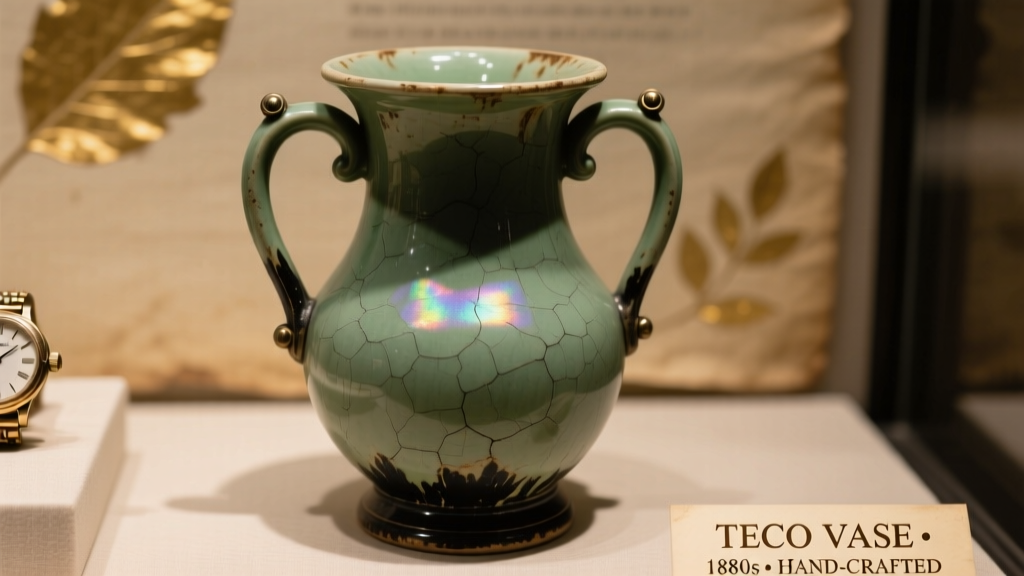
Teco Vase with Dual Handles, Matte Green Glaze, Flared Lip, and Heavy Charcoaling: A Studio Pottery Masterpiece (9 × 5½ in)
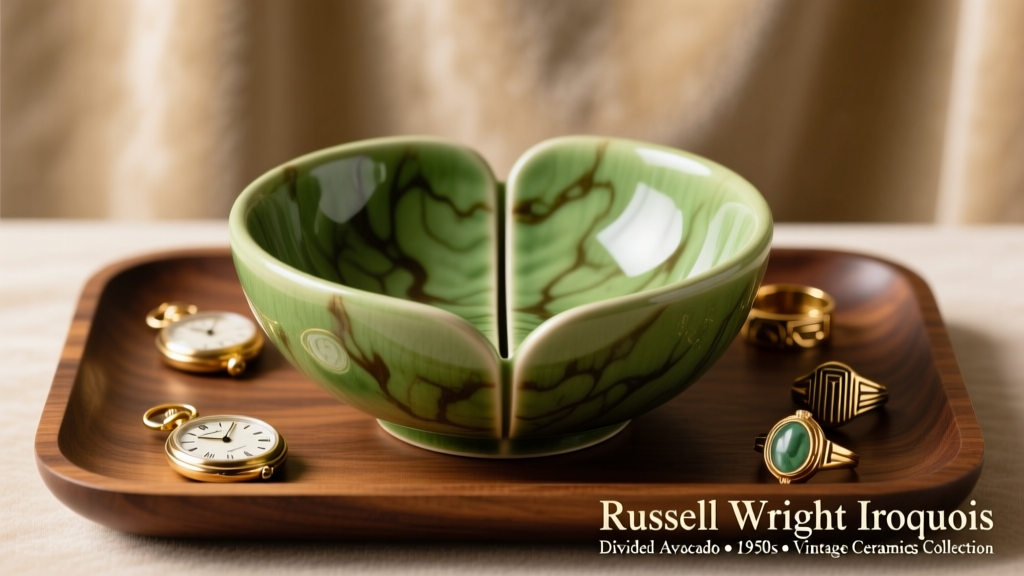
Russell Wright’s Iroquois Divided Avocado Bowl: Design Legacy, Production History, and Collectibility