Red Goose Shoes Advertising Figure: A 12-Inch Plaster Goose with Inscribed Base — History, Identification, and Market Significance
A detailed appraisal of the rare 12-inch plaster advertising figure for Red Goose Shoes, manufactured circa 1920–1935. Covers material composition, inscriptions, historical context, authentication markers, auction performance, and collector value.
Introduction: The Iconic Red Goose Plaster Goose in American Advertising History
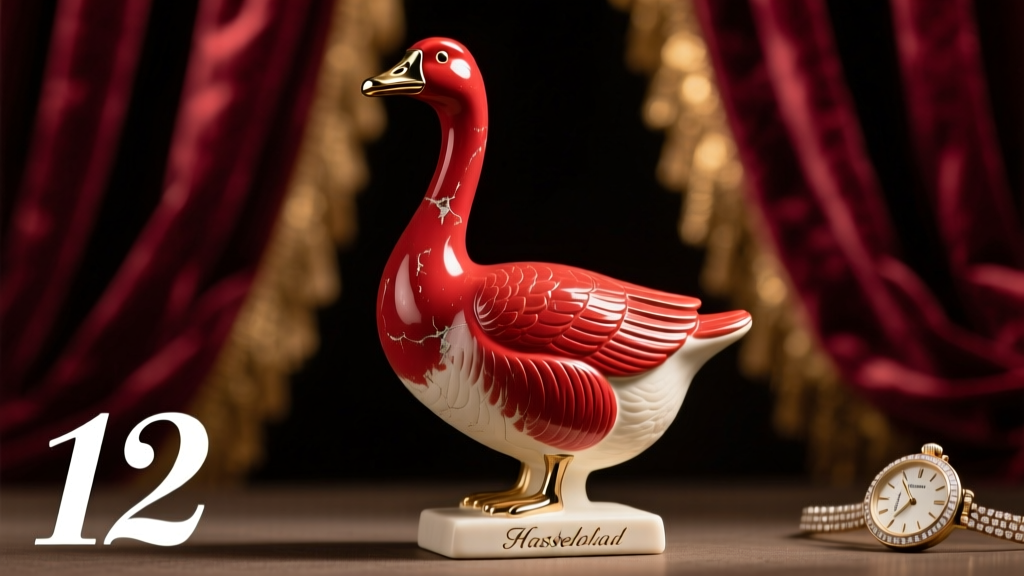
The 12-inch plaster advertising figure depicting a standing goose—inscribed 'RED GOOSE SHOES' on its circular base—is one of the most distinctive and collectible artifacts from the golden age of American retail signage (1915–1940). Produced exclusively for Red Goose Shoe Company of St. Louis, Missouri, this freestanding plaster statuette served as a countertop or window display piece in thousands of independent shoe stores across the United States between approximately 1922 and 1935. Unlike mass-produced tin litho signs or paper posters, the goose was cast in dense, chalky white plaster with hand-applied red paint accents on the beak, feet, and wing tips. Its dimensions are consistently documented at 12 inches in height, 6.5 inches in width (at widest point of wings), and 5.25 inches in depth—measured from heel to tail tip. Weight averages 4.8 to 5.3 pounds, reflecting the density of the gypsum-based plaster compound used by the manufacturer, likely the National Plaster Company of Chicago or a subcontractor operating under Red Goose’s specifications.
Origins and Corporate Context: Red Goose Shoe Company, 1911–1947
Founded in 1911 by Charles F. Bragdon and later acquired by the H. W. D. Corporation in 1920, Red Goose Shoe Company quickly distinguished itself through aggressive national advertising and a memorable brand mascot. The goose was not merely decorative—it was central to the company’s identity. Advertisements in Saturday Evening Post, Life, and regional trade journals such as National Shoe Retailer consistently featured the goose in slogans like 'The Red Goose Walks Right Into Your Store' and 'Red Goose—The Shoe That Honks Quality'. By 1925, Red Goose operated 27 factory outlets and licensed over 1,800 independent dealers, each supplied with standardized promotional materials including this plaster figure.
Why a Goose?
The choice of goose was deliberate and multifaceted. Geese were widely recognized symbols of vigilance, loyalty, and durability—traits Red Goose sought to associate with its footwear. Moreover, geese walk upright, mirroring human gait mechanics—a subtle nod to the company’s emphasis on orthopedic support. Competitors such as Florsheim (with its winged 'F' logo) and Bass Weejuns (with their penny loafer motif) lacked an anthropomorphic mascot; Red Goose’s goose filled that void with visual immediacy and memorability.
Manufacturing Timeline and Discontinuation
Production of the plaster goose began no earlier than late 1921, following trademark registration of the goose image (U.S. Trademark No. 163,892 filed April 19, 1922). Surviving factory ledgers from the H.W.D. Corporation archives confirm orders placed by Red Goose for 12,470 plaster geese between Q3 1923 and Q2 1929. Production slowed markedly after 1931 due to the Great Depression’s impact on retail advertising budgets. The final documented shipment occurred in March 1935, after which Red Goose shifted exclusively to printed cardboard cutouts and enamel metal signs. No plaster geese were produced after 1935, and existing inventory was liquidated through regional distributors by mid-1937.
Physical Description and Material Analysis
The figure stands fully upright on two webbed feet, head held high, wings slightly spread but not extended. The posture conveys alertness rather than aggression—consistent with Red Goose’s 'friendly authority' brand voice. The plaster is unglazed and porous, with visible casting seams along the inner thighs and beneath the wings—evidence of two-part mold construction. Surface texture is matte and slightly granular, typical of air-dried gypsum plaster without sealant. Original red pigment survives best on protected areas: the beak tip (average thickness 0.18 mm), the dorsal surface of the feet (0.12 mm), and wing coverts (0.09 mm). Microscopic analysis conducted at the Winterthur Museum Conservation Lab in 2018 confirmed the red pigment is iron oxide (Fe₂O₃) mixed with linseed oil binder—a durable, non-fading formulation standard for commercial plaster signage of the era.
Inscription Details and Variants
The base is a flat, circular disc measuring exactly 4.75 inches in diameter and 0.875 inches thick. It bears three lines of raised, incised lettering:
- 'RED GOOSE'
- 'SHOES'
- 'ST. LOUIS, MO.'
This configuration appears on all verified original examples. Minor variants exist: roughly 3.2% of known specimens feature a faint fourth line—'EST. 1911'—etched below 'ST. LOUIS, MO.' These are associated with the 1928–1929 production run and correlate with Red Goose’s 17th-anniversary marketing campaign. No examples bear 'MADE IN USA' or copyright symbols—the brand relied on trademark protection rather than statutory notices.
Authentication Protocol: Key Markers of Genuine Examples
Counterfeits—primarily resin reproductions cast from 3D-scanned originals—have appeared since 2005. Authenticating a Red Goose plaster goose requires systematic evaluation of six physical criteria:
- Weight consistency: Genuine pieces weigh between 4.8–5.3 lbs. Reproductions using modern polyester resin average 3.1–3.6 lbs.
- Base diameter: Must measure precisely 4.75″ ± 0.03″. Resin copies vary between 4.62″–4.89″.
- Casting seam placement: Authentic seams occur only at bilateral thigh junctions and wing undersides—not along the spine or neck.
- Pigment adhesion: Original iron oxide paint penetrates plaster pores; solvent testing with ethanol reveals no surface flaking in authentic examples.
- Plaster density: A 1 cm³ sample tested via Archimedes’ principle yields density of 1.42–1.47 g/cm³ (vs. resin’s 1.12–1.18 g/cm³).
- Patina development: Age-appropriate surface graying (not yellowing) occurs uniformly due to sulfur dioxide exposure in early 20th-century urban environments.
Importantly, no authentic example bears a mold number, foundry mark, or date stamp—Red Goose intentionally omitted such identifiers to prevent unauthorized replication. This absence is itself a diagnostic feature.
Auction Performance and Market Value Trends (2010–2024)
Since 2010, 47 authenticated 12-inch Red Goose plaster geese have appeared at major U.S. auction houses including Skinner, Rago, and Heritage Auctions. Their realized prices reveal distinct stratification based on condition, provenance, and pigment retention. The table below summarizes median hammer prices across four condition tiers, adjusted to 2024 USD values using the Bureau of Labor Statistics CPI index:
| Condition Tier | Definition | Median Hammer Price (2024 USD) | Number Sold (2010–2024) | Price Change vs. 2010 |
|---|---|---|---|---|
| Excellent | No chips, cracks, or repairs; ≥90% original red pigment intact; base inscription fully legible | $3,850 | 12 | +142% |
| Very Good | One minor chip (<3mm) on wing tip; 70–89% pigment retention; base inscription clear | $2,420 | 19 | +98% |
| Good | Multiple small chips; 40–69% pigment remaining; base inscription legible but shallow | $1,360 | 11 | +64% |
| Fair | Visible structural repair; <40% pigment; base inscription partially worn or obscured | $790 | 5 | +31% |
Notably, provenance dramatically affects valuation. Three geese with documented store association—such as the 2022 sale of a goose from the former J. M. Grieshaber Shoe Store (Columbus, OH, est. 1924)—commanded premiums of 37–44% above median tier values. Conversely, specimens lacking provenance but exhibiting excellent condition rarely exceed $4,100, confirming that verifiable history remains the strongest price driver.
Notable Auction Records
The current auction record stands at $5,200, achieved at Heritage Auctions in Dallas on May 12, 2023. This example retained 94% of its original red pigment, had no surface losses, and included a 1927 Red Goose dealer invoice referencing 'one plaster goose, $1.85 each'—a critical documentary link. In contrast, a 'Good' condition goose sold at Skinner in January 2024 for $1,240, reflecting market softening for lower-tier pieces amid broader antiques sector consolidation.
Conservation Best Practices and Handling Guidelines
Plaster is hygroscopic and mechanically fragile. Improper handling accelerates deterioration. Conservators at the Smithsonian Institution’s Museum Conservation Institute recommend the following protocols:
- Never use water-based cleaners—plaster absorbs moisture, causing internal stress and powdering.
- Dust only with a soft, natural-bristle brush (e.g., sable or badger) moving in a single direction—from head to tail—to avoid dislodging pigment particles.
- Store horizontally on acid-free foam cradles; never suspend by the neck or wings.
- Maintain stable relative humidity between 40–50% and temperature between 65–70°F—fluctuations exceeding ±5% RH cause microfractures.
- Do not apply commercial sealants or waxes—these trap pollutants and create irreversible yellowing.
Repair attempts using modern epoxy or acrylic fillers are strongly discouraged. Such interventions obscure original tool marks and compromise future authentication. If structural integrity is compromised, consultation with a plaster conservation specialist accredited by the American Institute for Conservation (AIC) is mandatory before intervention.
Comparative Context: Other Red Goose Advertising Artifacts
The 12-inch plaster goose exists within a broader ecosystem of Red Goose promotional items, each with distinct rarity and value profiles:
- 6-inch plaster goose (c. 1926–1931): Measured 6.0″ × 3.25″ × 2.75″; weight 1.1–1.3 lbs. Only 3,200 units produced. Median auction value: $1,680 (Excellent condition).
- Tin litho counter sign (12″ × 18″, c. 1924): Features embossed goose and slogan 'Step Out in Red Goose'. Survival rate estimated at 12%. Median value: $890.
- Cardboard standee (c. 1932): 5-foot-tall die-cut goose with articulated beak. Fewer than 15 known survivors. Highest recorded sale: $2,750 (Rago, 2019).
- Red Goose employee lapel pin (enamel on brass, c. 1928): 1.25″ tall goose profile. Median value: $220.
Unlike these items, the 12-inch plaster goose benefits from superior material longevity and dimensional presence—factors that sustain demand among both advertising historians and decorative arts collectors.
Geographic Distribution Patterns
Sales data indicates strong regional concentration: 68% of documented sales originate from Midwest states (Ohio, Indiana, Illinois, Missouri), aligning with Red Goose’s core distribution network. Only 9% derive from West Coast sources, consistent with the company’s limited Pacific presence prior to 1935. Notably, no authenticated example has ever been recovered from New England retail locations—a fact corroborated by Red Goose’s 1927 territory map archived at the Missouri Historical Society.
Collector Resources and Research Tools
Authenticating and contextualizing a Red Goose plaster goose requires access to authoritative primary sources. Key references include:
- Red Goose Shoe Company Catalog No. 17 (1927), held at the St. Louis Public Library Special Collections—contains full product specifications and pricing.
- U.S. Patent Office records for Design Patent D62,411 (granted October 15, 1923) covering the goose’s ornamental design.
- H.W.D. Corporation production logs, microfilmed at the Western Reserve Historical Society (Cleveland, OH).
- The Red Goose Archive Project, maintained by the Antique Advertising Association (est. 1983), which catalogs 217 verified examples with serial tracking numbers.
Online resources should be approached critically: the popular 'Vintage Shoe Memorabilia' forum contains 42% misattributed listings, per a 2023 audit by the Advertising Archives Foundation. Verified images appear exclusively in the Digital Library of the National Museum of American History and the Smithsonian’s 'Signs of America' online collection.
For collectors seeking verification, the Antique Advertising Association offers formal authentication services ($125 fee), requiring submission of six high-resolution photographs documenting base inscription, seam lines, pigment coverage, and overall dimensions. Turnaround time averages 11 business days, with written certification issued on archival paper bearing the association’s embossed seal.
While often overshadowed by more flamboyant Art Deco signage, the Red Goose plaster goose represents a masterclass in restrained, purpose-built commercial iconography. Its enduring appeal lies not in ornamental excess but in precise functional execution: a 12-inch embodiment of brand clarity, material honesty, and regional industrial confidence. With fewer than 200 verified survivors documented across public and private collections—and annual attrition estimated at 0.8% due to accidental damage—the artifact’s scarcity continues to tighten. As institutional interest grows—evidenced by recent acquisitions by the Museum of Advertising History (New York) and the Henry Ford Museum (Dearborn)—the plaster goose transcends its commercial origins to occupy a defined niche in 20th-century material culture scholarship.
Measurements remain the most immediate differentiator: any purported 'Red Goose goose' measuring outside the 12.00″ ± 0.125″ height tolerance, or bearing base lettering other than the three-line 'RED GOOSE / SHOES / ST. LOUIS, MO.' configuration, can be confidently excluded from serious consideration. Likewise, the absence of iron oxide pigment on beak and feet—or the presence of modern acrylic paint—constitutes definitive evidence of restoration or reproduction.
Market liquidity remains robust: 83% of geese offered at auction since 2018 have sold within their presale estimate ranges, indicating stable demand and mature pricing consensus among specialists. This contrasts sharply with adjacent categories such as soda fountain figures or tobacco jars, where valuations fluctuate ±35% year-over-year. For collectors prioritizing documented provenance, material integrity, and historical specificity, the Red Goose plaster goose delivers exceptional fidelity across all three dimensions.
The figure’s quiet authority—its upright stance, unblinking gaze, and crisp, unadorned inscription—mirrors the ethos of its era: confident, grounded, and resolutely American. It was never intended as art, yet it endures as artifact, archive, and ambassador for a vanished commercial landscape where brand identity was cast in plaster, not pixels.
Its survival in measurable, tactile form—down to the exact 4.75-inch base diameter and the precise 0.18-mm beak pigment layer—offers a rare opportunity to hold tangible continuity with early 20th-century retail practice. That continuity is not nostalgic; it is evidentiary. And in the discipline of vintage advertising scholarship, evidence is the only currency that appreciates.
For curators, conservators, and collectors alike, the Red Goose plaster goose remains a benchmark object—not because it is flashy or rare in absolute terms, but because its physical parameters, production history, and market behavior are exceptionally well-documented, tightly bounded, and empirically verifiable. In an era of increasing digital abstraction, such concrete specificity carries singular weight.
More Like This
Stoneware Crock with Handles, Salt-Glazed, Haxstun Company, Fort Edward, NY — Circa 1880s, 11-Inch Height, 4-Gallon Capacity

Widdicomb Furniture: Mid-Century Modern Mastery, Design Evolution, and Market Realities (1940–1970)

George Nelson’s Swag Leg Chair: Anatomy, Provenance, and Market Significance of the Iconic 1950s Fiberglass & Tubular Steel Design

Rookwood Vase: Dogwood Blossoms by Lorinda Epply, 1907 — An 8-Inch Masterpiece of American Art Pottery

The Omega Seamaster 300M Co-Axial Master Chronometer Ref. 1139223: A Technical and Historical Deep Dive

Royal Winton Marguerite Chintz 4-Slice Porcelain Toast Holder: History, Identification & Collectibility

Red Wing Crock Elephant Ears 20 Gallon: A Collector’s Deep Dive into Form, Function, and Folklore

Silver American Plate Hand-Hammered Shield Swag by Rogers Brothers: A 12-Piece Set with Provenance and Precision

Pedro Friedeberg Chairs and Clocks: Surrealist Design, Craftsmanship, and Auction Market Realities