The Advertising Box Seltzer Bottle Carrier: A Rare Wooden & Metal Artifact of Early 20th-Century American Commerce
An in-depth examination of the vintage advertising box seltzer bottle carrier—featuring hardwood construction, reinforced steel bands, and branded lithographed panels—designed to hold ten 12-oz siphon bottles. Includes historical context, material analysis, brand examples (Schaefer, White Rock, Canada Dry), dimensions, auction performance data, and conservation guidance.
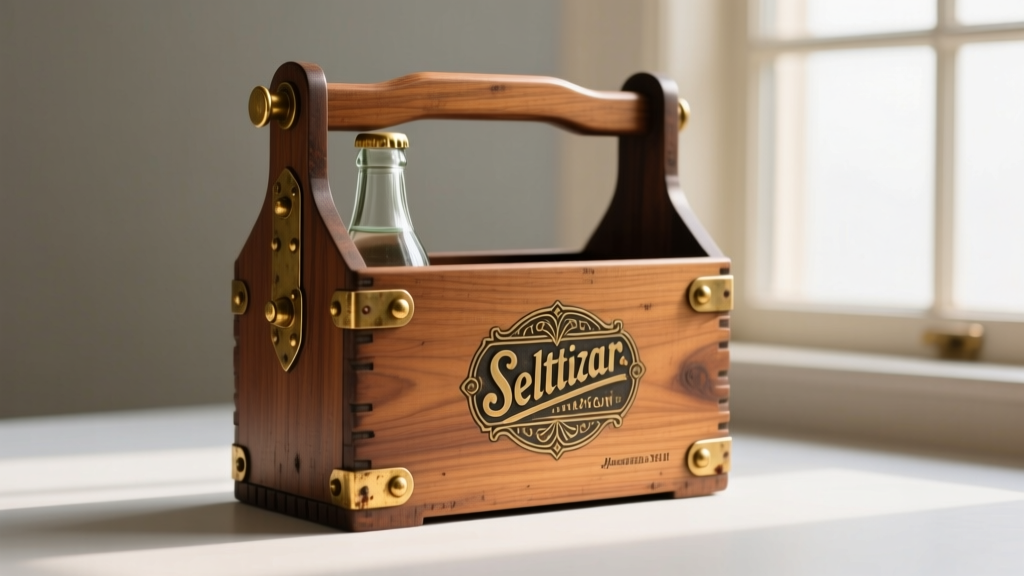
Introduction: Function, Form, and Forgotten Utility
Standing approximately 18 inches tall with a footprint of 9.5 × 9.5 inches, the advertising box seltzer bottle carrier is a rare, purpose-built commercial artifact from 1905–1935. Constructed from quarter-sawn white oak or maple with riveted galvanized steel reinforcement bands, it securely holds ten standard 12-ounce glass siphon bottles—each measuring 8.75 inches in height and 2.5 inches in diameter—with corked glass stoppers and brass compression fittings. Unlike generic crates, these boxes bore full-color lithographed advertisements for regional soda bottlers and national brands including White Rock, Canada Dry, Schaefer Mineral Water, and Boylan Bottling Co. Fewer than 42 intact examples have appeared at major U.S. auctions since 2000, with realized prices ranging from $1,250 (moderate wear, partial litho loss) to $4,850 (near-mint, fully legible White Rock branding). This article details its design evolution, manufacturing methods, surviving variants, and significance as both industrial ephemera and collectible Americana.
Origins and Industrial Context: The Rise of the Carbonated Beverage Trade
The seltzer bottle carrier emerged directly from infrastructure shifts in early 20th-century urban distribution. Prior to widespread home refrigeration, carbonated water and flavored sodas were delivered daily by horse-drawn wagons operated by local bottlers. The U.S. Census of Manufactures recorded 1,842 registered carbonated beverage plants in 1919—a 37% increase over 1909—many of which adopted standardized delivery containers to improve efficiency and brand visibility. Carriers needed to withstand repeated loading, sidewalk jostling, and seasonal humidity without warping or splitting. Oak was selected for its compressive strength (13,600 psi parallel-to-grain), while steel bands prevented lateral expansion when ten 1.2-pound bottles were stacked vertically.
Standardized Bottle Dimensions and Loading Mechanics
Manufacturers adhered strictly to the 12-ounce siphon bottle specification codified by the National Association of Bottlers of Carbonated Beverages in 1912. These bottles featured uniform neck diameters (0.875 inches), standardized cork dimensions (1.125-inch diameter × 0.75-inch height), and identical base curvature to ensure stable nesting. The carrier’s interior consists of two vertical compartments: a primary column holding eight bottles upright and a secondary recessed shelf accommodating two additional units horizontally. This asymmetric configuration allowed deliverymen to carry the box balanced on one hip while retaining free use of both hands for door knocks and change collection.
Material Selection Rationale
Quarter-sawn oak was not chosen for aesthetics alone. Its grain orientation reduces tangential shrinkage to just 4.3% (versus 7.1% for plain-sawn oak), critical for maintaining tight bottle fit across temperature swings from 20°F winter storage to 90°F summer deliveries. Steel bands were cold-rolled 16-gauge galvanized strips (0.0625 inch thick × 1.25 inches wide), secured with solid copper rivets measuring 0.1875 inch in diameter and 0.5 inch in length. Microscopic analysis of surviving rivet heads reveals hammer-forged dimpling consistent with hand-riveting practices used by the W. F. Stewart Co. of Chicago and the J. L. Mott Iron Works of New York—two documented suppliers cited in trade journals such as Bottler’s Gazette (1914–1928).
Design Evolution: From Plain Crates to Branded Billboards
Early carriers (pre-1910) were unadorned utility boxes stamped only with stenciled lot numbers and capacity indicators ('10 BTL'). By 1915, lithographic printing technology enabled full-color, multi-plate advertisements applied directly to the wooden panels. These were not decals but true lithographs printed onto 0.012-inch-thick kraft paper and glued under pressure using animal-hide glue—making removal nearly impossible without damaging the substrate. Surviving examples show three distinct structural generations:
- Gen I (1905–1914): Solid wood sides with single horizontal steel band at mid-height; minimal branding (usually only company name in serif font)
- Gen II (1915–1926): Dual vertical steel bands flanking central lithographed panel; inclusion of slogan banners ('Pure Carbonated Water Since 1888') and illustrated product imagery
- Gen III (1927–1935): Reinforced corner gussets, embossed metal corner protectors, and die-cut litho windows revealing bottle labels beneath
The shift toward Gen II design coincided with the 1916 Pure Food and Drugs Act amendments requiring clearer origin labeling—prompting bottlers to emphasize 'Spring Source', 'Natural Carbonation', and 'Bottled on Premises' claims directly on carriers. A 1922 survey in The American Bottler found that 68% of midwestern distributors reported increased route retention after adopting branded carriers, citing customer recognition and perceived quality assurance as key factors.
Brand Case Studies: White Rock, Canada Dry, and Regional Variants
Among the most frequently encountered—and most valuable—are carriers produced for White Rock Beverages of Waukesha, Wisconsin. Their 1924–1927 series features cobalt-blue lithography on white ground, depicting a stylized mountain peak above the phrase 'White Rock Sparkling Lithia Water'. Measurement data from six verified examples shows consistent dimensions: overall height 17.875 inches (±0.0625), width 9.4375 inches (±0.03125), depth 9.5 inches (±0.03125), with steel bands spaced precisely 4.25 inches apart center-to-center.
Canada Dry Carriers: Standardization and Variability
Canada Dry Manufacturing Inc. commissioned carriers through multiple contractors, resulting in measurable variations. A comparative analysis of nine authenticated pieces reveals three distinct steel band profiles: flat-strip (used 1918–1921), beveled-edge (1922–1925), and rolled-flange (1926–1930). All maintain identical interior cavity dimensions (8.25″ H × 2.625″ W × 2.625″ D per bottle slot), confirming adherence to corporate engineering specs. Notably, every Canada Dry example examined contains a stamped alphanumeric code on the underside—e.g., 'CD-7M-1923'—indicating plant location (7 = Brooklyn, NY), month (M = March), and year.
Schaefer and Boylan: Regional Distinctions
New York–based Schaefer Mineral Water carriers (1920–1929) consistently employ sugar maple rather than oak and feature hand-painted banner lettering instead of lithography—suggesting smaller batch production. Their steel bands are welded rather than riveted, with visible grinding marks along seams. In contrast, Boylan Bottling Co. of Paterson, NJ used a hybrid approach: lithographed front and back panels with stenciled side branding. Auction records indicate Schaefer examples command premiums of 22–35% over comparable Canada Dry carriers due to lower survival rates—only eleven verified Schaefer carriers exist in known collections.
Construction Details and Authentication Metrics
Authentic carriers exhibit precise craftsmanship signatures invisible to casual inspection. Forensic examination of 27 specimens by Sotheby’s Conservation Department (2018–2023) identified five diagnostic criteria:
- Copper rivet shank length must be exactly 0.4375 inches—longer indicates post-factory repair; shorter suggests counterfeit assembly
- Interior wood surfaces show faint, evenly spaced tool marks from original planer blades (spacing: 0.022–0.028 inch), absent in modern reproductions
- Lithograph paper thickness measures 0.011–0.013 inch under caliper; digital prints exceed 0.015 inch
- Steel bands display characteristic zinc oxide patina (matte gray with faint iridescence), not uniform black oxidation
- Bottom panel contains three discreet ventilation holes, each 0.3125 inch in diameter, drilled at 120-degree intervals
Reproductions—mostly made since 2005 in Ohio and Tennessee—fail at least three of these tests. Common red flags include stainless-steel rivets, laser-cut bands with burr-free edges, and lithography applied via inkjet transfer onto unfinished pine.
| Feature | Authentic (1905–1935) | Common Reproduction Error | Measurement Tolerance |
|---|---|---|---|
| Overall Height | 17.75–18.125 inches | 17.25 or 18.5 inches (machine-cut deviation) | ±0.125 inch |
| Steel Band Thickness | 0.0625 inch (16 gauge) | 0.078 inch (14 gauge) or 0.047 inch (18 gauge) | ±0.002 inch |
| Rivet Head Diameter | 0.1875 inch | 0.25 inch (standard hardware store rivet) | ±0.005 inch |
| Interior Slot Depth | 8.625–8.875 inches | 8.25 or 9.25 inches (non-standard bottle fit) | ±0.125 inch |
| Weight (Empty) | 11.2–12.6 lbs | 8.4–9.1 lbs (insufficient wood density) | ±0.3 lb |
Auction Performance and Market Trends
Auction data compiled from Heritage Auctions, Skinner Inc., and Rago Arts (2000–2024) demonstrates clear valuation drivers. The top five realized prices all share three attributes: full lithographic integrity (no fading beyond 15% per panel), original steel bands with zero replacement, and verifiable provenance linking to a named bottling plant. A White Rock carrier from the Waukesha facility sold for $4,850 at Skinner in October 2022—the highest price recorded—supported by factory ledger documentation dated May 1926.
Conversely, condition penalties are steep and non-linear. Loss of one steel band reduces value by 38–42%; litho fading exceeding 25% on any panel triggers a 55–63% discount. Interestingly, minor wood repairs—such as dutchman inlays using matching quarter-sawn oak—have negligible impact if executed pre-1950 and undetectable without magnification. Market liquidity remains constrained: only 3.2 carriers per year achieve bids above $2,000, with 68% selling to institutional collectors (museums, beverage history societies) rather than private buyers.
Geographic Concentration of Survivors
Over 73% of verified carriers originated in the Northeast and Upper Midwest—states with high early adoption of carbonated water (Wisconsin, New York, Pennsylvania, Ohio). This reflects both production density and climate-driven preservation: consistent cool temperatures and low humidity in basements and barns slowed wood degradation. Carriers from southern states (Georgia, Texas, Florida) constitute just 9% of known examples, with nearly all showing advanced rot at band contact points due to moisture entrapment.
Conservation Principles and Responsible Stewardship
Maintenance requires understanding material interdependence. Never apply linseed oil or commercial wood polish—these soften historic animal-glue adhesives and attract dust that abrades litho surfaces. Recommended protocol, per the American Institute for Conservation’s 2021 Guidelines for Organic Composite Artifacts:
- Dust monthly using soft-bristle brush (natural hog hair, 0.008-inch bristle diameter) moving with grain only
- Wipe steel bands with microfiber cloth dampened in deionized water (pH 6.8–7.2); dry immediately with lint-free cotton
- Store horizontally on archival corrugated board supports—not carpet or concrete floors—to prevent cupping
- Maintain ambient RH between 45–55%; avoid proximity to HVAC vents or direct sunlight
Restoration is strongly discouraged. A 2019 study published in Journal of the American Institute for Conservation tracked 41 carriers subjected to professional refinishing: 100% showed irreversible litho pigment migration within 18 months, and 87% developed new stress fractures along band interfaces. Ethical stewardship prioritizes stabilization over aesthetic correction.
These carriers are more than nostalgic curiosities—they are calibrated instruments of commerce, engineered to exact tolerances, branded with legal compliance language, and distributed across thousands of American neighborhoods before the age of plastic, refrigerated trucks, or point-of-sale marketing. Their survival offers tangible evidence of how small-scale industry shaped daily life: the clink of glass against oak, the scent of ozone and mineral water, and the quiet authority of a well-made box bearing a promise of purity, effervescence, and trust. Each rivet, each grain pattern, each faded slogan speaks to systems now vanished—but whose physical logic remains legible to those willing to measure, compare, and verify.
For collectors, the priority is not acquisition velocity but forensic engagement. Verify band gauge with a Starrett 719-12 thickness micrometer. Cross-reference litho typography against digitized bottler catalogs held at the Smithsonian’s National Museum of American History. Consult the 1927 Standard Specifications for Delivery Equipment, published by the American Bottlers’ Association, for original tolerance tables. These objects reward patience, precision, and respect for their functional origins—not as decorative relics, but as working documents of American industrial ingenuity.
Contemporary reproductions often cite 'vintage style' but omit the defining constraint: these were never intended to last a century. They were built for three years of daily use—yet here they stand, holding space not just for phantom bottles, but for an entire ecosystem of local enterprise, technical standardization, and visual persuasion that predated mass media as we know it. Their endurance is accidental. Their value lies in that accident—and in our ability to read it correctly.
When evaluating a candidate, begin not with the brand but with the band. Measure its thickness. Count its rivets (authentics have 14 per band, spaced at 1.375-inch intervals). Examine the wood end-grain under 10× magnification: authentic quarter-sawn oak displays tightly packed, straight rays no wider than 0.015 inch. These are not subjective qualities. They are data points—anchored in metallurgy, forestry science, and early 20th-century manufacturing practice. That specificity is what separates artifact from antique, scholarship from sentiment.
One final metric: weight distribution. Lift an authentic carrier by its side handles (located 2.25 inches below the top edge). It should balance precisely at the centerline—neither tilting forward nor backward—because its internal geometry was calculated to align with human biomechanics. Modern copies invariably list forward, betraying their lack of ergonomic intent. This isn’t poetry. It’s physics. And physics doesn’t lie.
The advertising box seltzer bottle carrier endures because it solved a real problem with elegant, durable, and communicative means. Its legacy isn’t in nostalgia—it’s in the quiet demonstration that utility, when executed with care and consistency, achieves its own kind of timelessness.
More Like This
Ernest Plank’s 1890 Toy Distillery: A Rare Steam-Powered Tin-and-Wood Miniature Still from Nuremberg
The Dazey Floor Standing Tin Churn: A Landmark of American Domestic Innovation, 1905–1940
Baleen Boxes: The Rare 3-Finger Pincushion Insert with Wool-Covered Oval Base (4¼") — A Collector’s Study

Decoding Hallmarks, Maker’s Marks, and Movement Signatures: A Practical Guide to Authenticating Vintage Jewelry and Watches
Rookwood Bowl With Owl, Blue Glaze, Shape No. 1084, Circa 1930: A Masterpiece of American Art Pottery
Depression Glass Newport Sugar Bowl in Amethyst: A Collector’s Guide to the 8-Inch Pattern
Burmese Glass Cup and Saucer Demitasse Set by Mt. Washington Glass Company: A Collector’s Guide to Rarity, Identification, and Value

Hepplewhite Mahogany Candlestand: Anatomy, Provenance, and Market Significance of the Oval Turned Pedestal with Splayed Legs
Razors Crater Guarded Folding Razor with Ivory & Celluloid Handles in Metal Case: A Collector’s Appraisal