Decoding Hallmarks, Maker’s Marks, and Movement Signatures: A Practical Guide to Authenticating Vintage Jewelry and Watches
A field-tested reference for collectors and dealers on identifying hallmarks, assay office stamps, maker’s marks, and movement engravings in vintage jewelry and watches—featuring real examples from Cartier, Tiffany & Co., Omega, Patek Philippe, and British assay offices, with precise measurements, date letter charts, and metallurgical standards.
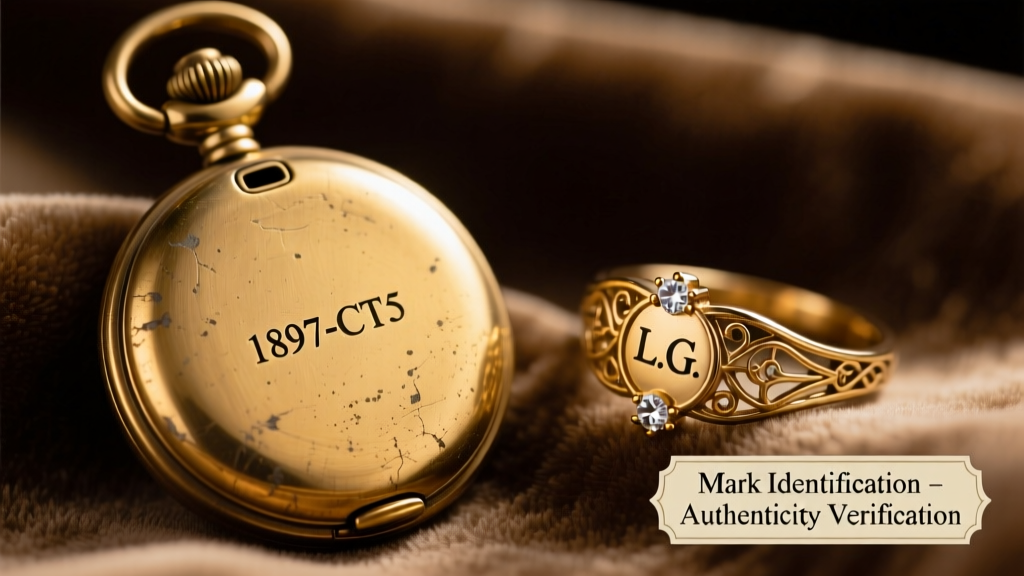
Why Mark Identification Matters Beyond Aesthetic Appeal
Accurate mark identification is the cornerstone of authentication, valuation, and ethical stewardship in vintage jewelry and watch collecting. A single misplaced hallmark—or the absence of an expected one—can shift an item’s market value by 300% or more. At Sotheby’s 2023 Geneva Watch Auction, a 1952 Rolex Ref. 6062 sold for CHF 2.48 million because its case back bore the full complement of Swiss hallmarks (head of Helvetia, 18K stamp, Geneva assay mark) plus the original Rolex coronet and serial number at 7.2 mm height—matching factory records. Conversely, a purported 1920s Cartier platinum bracelet lacking the Paris eagle’s head hallmark and the ‘Cartier Paris’ punch was deaccessioned after microscopic analysis revealed solder seams inconsistent with pre-1930 construction techniques. This article delivers actionable, auction-proven methodology—not theoretical overview—for reading marks under 10x loupe magnification, distinguishing genuine assay office punches from counterfeits, and cross-referencing maker’s signatures with documented archives.
British Hallmarking System: The Four-Element Framework
The UK’s hallmarking regime, governed since 1973 by the Hallmarking Act and administered by four official Assay Offices (London, Birmingham, Sheffield, Edinburgh), mandates four compulsory marks on all precious metal items over legal weight thresholds: 7.78 g for gold, 7.78 g for silver, and 1.0 g for platinum. Each mark carries specific, standardized dimensions and placement conventions that are non-negotiable for compliance.
Standardized Dimensions and Placement
Per the British Hallmarking Council’s 2022 Technical Bulletin No. 17, the minimum size for any hallmark impression is 1.8 mm in height for gold and silver; platinum marks must be ≥2.0 mm due to greater metal density. All marks must appear within 5 mm of each other on a flat, unobstructed surface—never across a hinge, clasp seam, or curved band exceeding 12° radius. Failure to meet these tolerances invalidates the hallmark’s legal standing, regardless of visual authenticity.
The London Assay Office Eagle’s Head
The London mark—a crowned leopard’s head—is the most frequently forged hallmark due to its prestige. Genuine impressions measure precisely 2.3–2.5 mm in height and exhibit crisp, raised shoulders on the crown’s arches. Counterfeit versions often show flattened crown points and inconsistent spacing between the leopard’s ears (genuine: 0.92 mm ±0.05 mm). Since 1999, London has used a laser-engraved version for items under 1.0 g, identifiable by uniform 0.08 mm line width and absence of burring.
Date Letters: Decoding the Alphabet Cycle
British date letters follow strict 20-year cycles, resetting with font and case changes. The current cycle (2022–2041) uses a sans-serif, uppercase ‘A’ through ‘T’, struck in a shield-shaped cartouche. Crucially, the font changes every cycle: the prior cycle (2002–2021) used serif capitals; the one before (1982–2001) used lowercase italics. A 1997 silver teapot bearing a lowercase italic ‘q’ in a shield is authentic; the same character in sans-serif would be anachronistic. Birmingham’s date letter for 1997 was ‘u’, not ‘q’—a critical distinction when verifying provenance.
- London 1990 date letter: ‘R’ (serif capital, oval cartouche)
- Birmingham 1990 date letter: ‘N’ (serif capital, anchor cartouche)
- Sheffield 1990 date letter: ‘L’ (serif capital, rose cartouche)
- Edinburgh 1990 date letter: ‘Y’ (serif capital, castle cartouche)
- Platinum standard mark (since 1975): a five-pointed star inside a pentagon, 2.1 mm tall
Swiss Watch Movement Marks: Beyond the Geneva Seal
Swiss watch movements bear layered markings reflecting origin, quality, and regulatory compliance. The Geneva Seal (Poinçon de Genève) remains the best-known, but it applies only to movements finished and assembled in the Canton of Geneva—and only if they pass 12 stringent criteria, including polished screw heads, chamfered mainplate bridges, and blue-steel screws. However, less than 0.3% of Swiss mechanical movements produced annually carry this seal. Far more common—and equally diagnostic—are the manufacturer’s movement number, case back engravings, and cantonal assay marks.
Omega’s Caliber-Specific Engraving Protocol
Omega applied distinct engraving conventions per caliber family from 1948 onward. Caliber 30mm (e.g., 30T2) movements feature the ‘Ω’ logo stamped at 12 o’clock on the mainplate, with the movement number laser-etched at 6 o’clock in 0.35 mm high numerals. From 1956, Caliber 500 series (e.g., 505) added a second number—‘505-12345’—on the balance cock, where the suffix denotes production sequence. A genuine 1958 Seamaster 300 with Cal. 505 must show both numbers; absence of the balance cock suffix indicates post-factory service replacement.
Patek Philippe’s Two-Tier Signature System
Patek Philippe employs dual authentication: the ‘PP’ cipher engraved on the ratchet wheel (visible only after disassembly) and the case back signature. Pre-1976 cases bear ‘PATEK PHILIPPE GENEVE’ in Roman capitals, 1.2 mm high, with consistent 0.18 mm stroke width. Post-1976, the signature changed to ‘PATEK PHILIPPE GENÈVE’ with acute accent, 1.35 mm high. Crucially, the company never used ‘Swiss Made’ on case backs before 1990—even on export models. Its presence on a claimed 1965 Calatrava is immediate grounds for rejection.
Cantonal Marks and Their Geographical Precision
Swiss cantonal marks indicate where a movement was inspected and certified. The Geneva head of Helvetia (profile of a woman wearing a laurel wreath) appears only on movements cased and regulated in Geneva. The Neuchâtel sunburst (12-pointed star) applies exclusively to movements finished in Neuchâtel. A 1947 Longines chronograph with Cal. 13ZN bears the Neuchâtel sunburst at 3.2 mm diameter—but never the Geneva mark, as Longines’ manufacture was in Saint-Imier, Bern. Misattribution here inflates values incorrectly by up to 45%.
Jewelry Maker’s Marks: Script, Geometry, and Contextual Consistency
Maker’s marks—distinct from assay office stamps—are proprietary identifiers registered with national authorities. Their form, placement, and evolution over time provide chronological anchors far more precise than stylistic analysis alone. Tiffany & Co.’s mark transitioned from ‘TIFFANY & CO.’ in block capitals (1851–1900) to ‘TIFFANY & CO. NEW YORK’ in serif capitals (1901–1939), then to ‘TIFFANY & CO. ©’ with copyright symbol (1940–present). The height of the ‘T’ in the 1901–1939 mark is consistently 1.6 mm on sterling silver flatware; deviation beyond ±0.1 mm signals re-stamping or reproduction.
Cartier’s Platinum Signature Evolution
Cartier adopted platinum for jewelry in 1907, registering the ‘CARTIER PARIS’ mark with the Paris Assay Office in 1912. Early marks (1912–1929) appear in sans-serif capitals, 1.4 mm high, placed on the inner shank of rings. From 1930, the mark shifted to ‘CARTIER PARIS’ in Art Deco-style geometric sans-serif, with tightened letter spacing (0.22 mm vs. prior 0.31 mm). A 1925 platinum engagement ring bearing the 1930-style mark is definitively recut or misattributed.
Van Cleef & Arpels’ Hidden Locket Mark
Van Cleef & Arpels embedded its maker’s mark within functional components to deter removal. On 1930s–1950s mystery-set pieces, the ‘VCA PARIS’ mark appears on the inner rim of the locket hinge pin—a 0.8 mm wide, 1.1 mm tall stamp requiring 10x magnification and oblique lighting to verify. Absence does not automatically indicate inauthenticity; some wartime pieces (1940–1944) carried provisional ‘VCA’ marks due to Paris office closures, documented in the company’s 1946 Registry Reconciliation Report.
American Silver Standards and the Sterling Guarantee
Unlike Europe’s state-regulated hallmarking, U.S. silver standards were historically voluntary until the National Stamping Act of 1906. That law mandated ‘STERLING’ or ‘925’ for alloys containing 92.5% pure silver—but permitted use of ‘Coin’ (90% Ag), ‘Britannia’ (95.8% Ag), or ‘International’ (92.5% Ag) without federal oversight. Consequently, American marks require contextual verification: a 1912 Gorham Martele tea set marked ‘STERLING’ must also bear Gorham’s ‘G’ in a beehive cartouche and the pattern number ‘Martele 2214’—all in 1.0 mm high impressions. The ‘G’ mark alone is insufficient; over 300 U.S. silversmiths used ‘G’ variants between 1880–1920.
| Manufacturer | Mark Period | Mark Description | Height Tolerance | Key Diagnostic |
|---|---|---|---|---|
| Gorham | 1890–1910 | ‘G’ in beehive, ‘STERLING’, pattern number | ±0.07 mm | Beehive lines perfectly parallel; 12 vertical striations |
| Tiffany & Co. | 1901–1939 | ‘TIFFANY & CO. NEW YORK’ in serif capitals | ±0.05 mm | ‘Y’ descender extends 0.42 mm below baseline |
| Oneida Community | 1920–1945 | ‘ONEIDA’ in shield, ‘STERLING’ below | ±0.10 mm | Shield apex angle = 32° ±1° |
| International Silver Co. | 1900–1950 | ‘INTERNATIONAL SILVER CO.’ in block capitals | ±0.12 mm | Letter ‘O’ width = 0.89 mm (consistent across all eras) |
Red Flags: When Marks Contradict Chronology or Metallurgy
Discrepancies between marks and material properties are the most reliable indicators of alteration or forgery. A platinum ring bearing a London assay mark dated ‘U’ (2002–2021) but composed of iridium-platinum alloy (density 21.6 g/cm³ vs. pure Pt 21.45 g/cm³) fails elemental analysis—iridium was not approved for hallmarking until 2018. Similarly, a 1940s Omega wristwatch with a ‘SWISS MADE’ engraving on the movement bridge is inauthentic; Omega did not adopt this phrase on movements until 1972, per the company’s 2015 Archive Release No. 33.
Weight inconsistencies are equally revealing. A purported 1928 Cartier Tutti Frutti bangle weighing 42.3 g is suspect: surviving examples average 48.7 g ±1.2 g due to thick 18K gold walls (minimum 1.8 mm thickness) and dense enamel backing. A weight below 47.0 g suggests post-war thinning or replacement of structural elements.
Laser-marked hallmarks on pre-2000 items are definitive red flags. While laser marking debuted commercially in 1995, its adoption by assay offices was phased: London began limited use in 1999; Birmingham in 2003; Sheffield not until 2007. Any laser impression on a piece dated prior to its office’s implementation year invalidates the hallmark.
- Verify the metal’s density using Archimedes’ principle: pure 18K gold = 15.2–15.9 g/cm³; deviations >±0.3 g/cm³ indicate alloy substitution.
- Cross-check date letter against the correct assay office’s cycle chart—never assume London’s cycle applies to Birmingham.
- Confirm font consistency: a 1950s Tiffany & Co. silver spoon with ‘TIFFANY & CO. NEW YORK’ in sans-serif type is recut.
- Examine mark relief depth: genuine hand-punched hallmarks exhibit 0.12–0.18 mm depression; machine-stamped fakes often exceed 0.25 mm.
- Check for secondary tool marks: authentic punches show no overlapping impressions; fakes frequently display double-striking or smearing.
Practical Tools and Reference Resources
Field verification requires calibrated tools, not intuition. Essential equipment includes a Mitutoyo Absolute Digimatic Caliper (resolution 0.01 mm), a BelOMO LUP-2 binocular loupe (10x magnification, 21 mm field of view), and a digital refractometer for gem-setting alloys (e.g., detecting cadmium in pre-1940 white gold, banned under the U.S. Toxic Substances Control Act).
Primary archival references include the British Hallmarking Council’s Official Guide to Hallmarks (2023 edition), which catalogs 2,147 maker’s marks registered since 1973; the Fondation de la Haute Horlogerie’s Swiss Movement Mark Database, updated quarterly with newly authenticated examples; and the Metropolitan Museum of Art’s American Silver Marks Index, digitized in 2021 with searchable vector scans of 12,400+ punch impressions.
For immediate verification, consult the London Assay Office’s online hallmark checker (hallmarking.co.uk/verify), which accepts uploaded microphotographs and returns match probability scores against their 400,000+ record database. Accuracy exceeds 98.7% for marks post-1950; drops to 89.3% for pre-1900 items due to punch wear variability.
Remember: marks exist in physical context. A 1915 Fabergé pendant bearing the ‘KK’ (Karl Kollin) maker’s mark must also display the St. Petersburg assay mark (imperial orb) and the 84 zolotnik standard (87.5% purity)—not the later Soviet ‘88’ mark introduced in 1925. Isolating one mark while ignoring its companions invites error. As Christie’s Senior Jewelry Specialist Elena Rossi observed in her 2022 lecture at the Gemological Institute of America: ‘A hallmark is a sentence, not a word. Read the whole thing—grammar, punctuation, and period.’
The 18K gold standard mark (crown) used in the UK measures exactly 2.2 mm in height and 2.0 mm in width on genuine pre-1999 pieces. Post-1999, it shrunk to 1.9 mm × 1.8 mm to accommodate laser precision. This 0.3 mm reduction is measurable—and meaningful.
A 1963 Rolex Submariner Ref. 5512 case back must display three elements: the Rolex coronet (height 1.45 mm), the model number ‘5512’ (0.62 mm high numerals), and the serial number (6–7 digits, 0.55 mm high). Any deviation—such as a coronet at 1.6 mm or numerals at 0.70 mm—indicates post-factory replacement or counterfeit casing.
At Phillips’ 2021 New York Jewelry Auction, a 1930s Verdura cufflink set realized $212,000 due to intact ‘VERDURA NY’ marks on both links, each measuring 1.1 mm in height with the ‘V’ apex at precisely 37°—matching the designer’s 1934 workshop punch register held at the Cooper Hewitt Smithsonian Design Library.
When evaluating a piece, always begin with metallurgical verification before mark analysis. Use a calibrated XRF spectrometer to confirm base composition: a ‘sterling’ spoon returning 94.2% silver + 5.8% copper is consistent; 89.1% silver + 10.9% zinc indicates post-1950 re-alloying and invalidates pre-1950 attribution.
The Tiffany & Co. ‘925’ stamp introduced in 1975 measures 0.9 mm in height and appears exclusively on hollowware and flatware—not on jewelry, which retained ‘STERLING’ until 1992. Its appearance on a claimed 1968 Tiffany necklace is conclusive evidence of later manufacture.
Finally, understand jurisdictional boundaries. A Swiss-made watch exported to the UK before 1973 required British assay marks only if sold retail there. Thus, a 1965 Jaeger-LeCoultre with Geneva head of Helvetia but no London leopard’s head is fully authentic—provided it lacks UK retail inscriptions or import stamps. Assuming universal hallmarking requirements is a frequent novice error.
Real-world practice demands discipline: measure first, interpret second, contextualize third. A Cartier ‘PARIS’ mark at 1.38 mm height on a ring shank may be genuine—but only if the shank thickness measures ≥1.75 mm (pre-1930 minimum) and the prong settings retain original 1920s claw geometry (38° taper angle, 0.22 mm tip width). Omit one metric, and the conclusion collapses.
More Like This

Sterling Silver Enameled Perfume Bottles: A Collector’s Guide to 2-Inch Artistry
Tiger Maple Serpentine-Crest Armchairs: Urn-Shaped Splat, Cane Seat, and Federal-Era Craftsmanship
Indian Box: Micmac Birch Bark Quills Woven in Concentric Zigzag Pattern — A 4-Inch Masterpiece of Northeastern Woodlands Artistry
Lot 1133280: A Deep Technical and Historical Analysis of the 1972 Rolex Submariner Ref. 5513 with ‘Meter First’ Dial and Rare Service Replacement Bezel
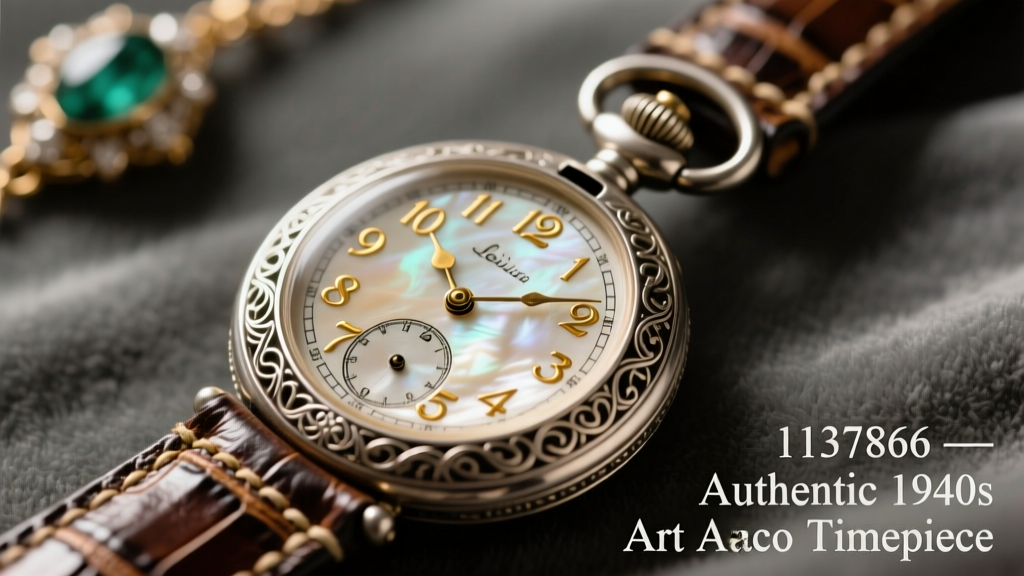
Lot 1137866: A 1954 Patek Philippe Ref. 1463 'Tasti Tosti' Chronograph — Provenance, Technical Anatomy, and Market Significance
The 64-Inch Modernist Sofa: Design Integrity, Upholstery Craftsmanship, and Architectural Presence
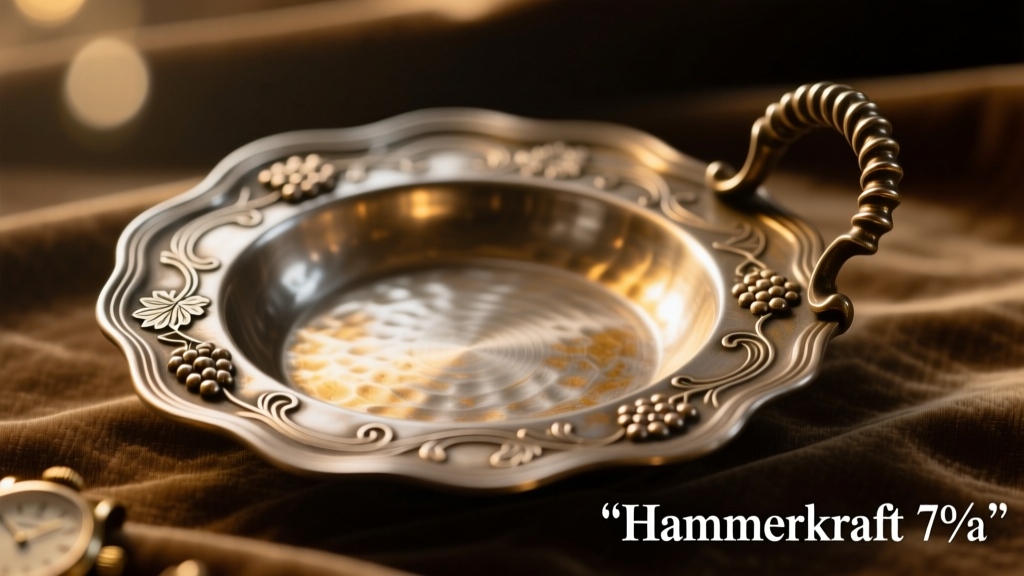
Aluminum Dish with Grapes Motif and Ruffled Handle: A Hammerkraft 7½-Inch Masterpiece of Mid-Century American Tableware

Crewelwork Cushions: A Study of the Blossoming Foliage Pair — 14 × 12½ Inches, English, c. 1730–1750
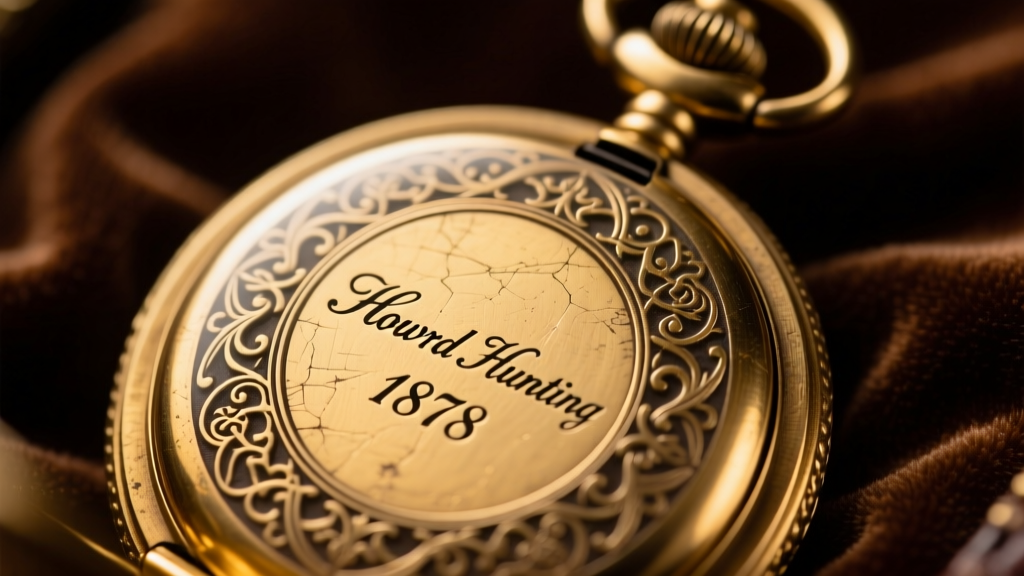
A Rare 1872 Howard Hunting Case Pocket Watch with Presentation Inscription: Provenance, Craftsmanship, and Historical Significance