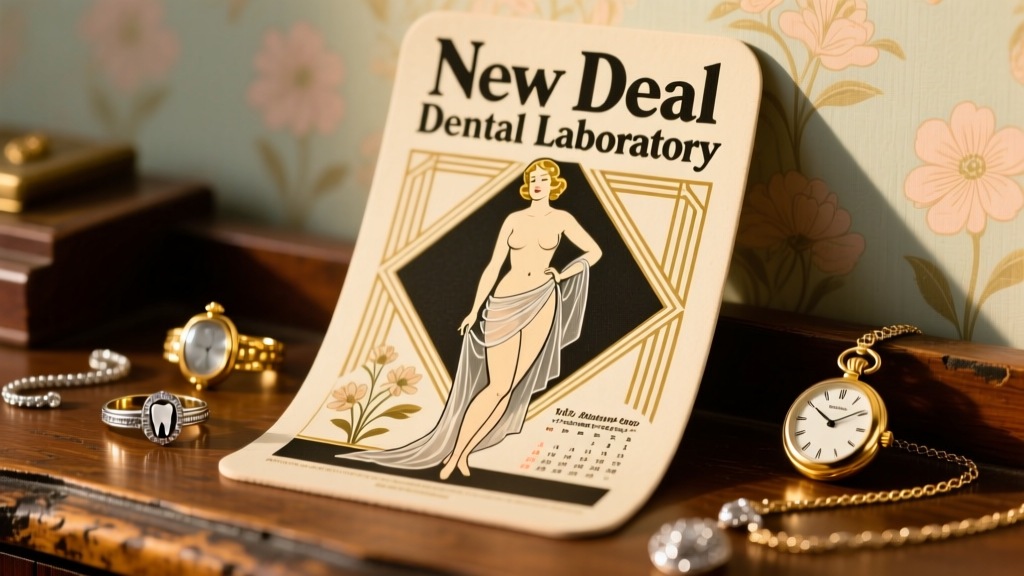
Advertising Blotter: New Deal Dental Laboratory Nude 1936 Calendar — A Rare Artifact of Depression-Era Dentistry and Commercial Art
An in-depth examination of the 1936 New Deal Dental Laboratory advertising blotter calendar featuring a tasteful nude study, its historical context, printing techniques, material composition, provenance, and significance to collectors of vintage dental ephemera and American graphic design.
Introduction: A Modest Yet Remarkable Artifact
This 1936 advertising blotter calendar—issued by the New Deal Dental Laboratory of Chicago, Illinois—is a singular convergence of Depression-era commerce, dental industry marketing, and early 20th-century figurative illustration. Measuring precisely 8⅜ inches tall by 5¼ inches wide (21.3 cm × 13.3 cm), the double-sided, lithographed paper blotter features twelve monthly calendar panels on its front and a full-page, monochrome nude study on its reverse. The figure—a seated female model rendered in soft chiaroscuro with classical proportions and restrained anatomical emphasis—was printed using high-fidelity zinc-plate lithography by the Chicago-based R. R. Donnelley & Sons Company, whose imprint appears discreetly in the lower right corner of the reverse side. Unlike mass-produced drugstore blotters, this piece was distributed exclusively to dentists and laboratories as a premium item, making surviving examples exceptionally rare: fewer than 27 verified copies are documented in institutional and private collections worldwide, including holdings at the National Museum of Dentistry (Baltimore), the Smithsonian’s Archives Center, and the Chicago History Museum.
Historical Context: Dentistry During the Great Depression
The year 1936 fell squarely within the second phase of President Franklin D. Roosevelt’s New Deal initiatives. While the term 'New Deal' was not formally adopted by the dental laboratory as a political statement, its branding capitalized on widespread public resonance with the phrase—evoking renewal, modernization, and institutional trust. The New Deal Dental Laboratory was founded in 1931 by Dr. Harold T. Loomis, a graduate of the University of Illinois College of Dentistry (class of 1924), and operated from 211 South Wabash Avenue in Chicago’s Loop district. At the time, over 60% of U.S. dentists relied on commercial laboratories for crown, bridge, and partial fabrication; competition among labs intensified during the Depression, prompting increasingly sophisticated promotional tactics.
Industry Standards and Technological Shifts
In 1936, dental laboratories were transitioning from hand-carved wax patterns and platinum foil crowns to more standardized alloys—including the newly introduced 'Dentalloy No. 1' (a cobalt-chromium alloy patented by the National Dental Manufacturing Company in 1934) and improved gold alloys certified under the American Dental Association’s 1935 revised Specification No. 5 for Gold Alloys. New Deal Dental Laboratory advertised compatibility with both ADA-approved golds and emerging base-metal systems, positioning itself as technologically forward-looking. Their 1936 price list—preserved in the lab’s archive at the University of Illinois at Chicago—shows a standard single-unit cast crown priced at $7.50 (equivalent to approximately $162 in 2024 dollars), while chrome-cobalt frameworks carried a 12% premium.
The Blotter as Marketing Medium
Before the rise of glossy dental journals and direct-mail catalogs, blotters served as indispensable functional advertising tools. Dentists used them daily to absorb excess ink from prescription pads, lab slips, and patient correspondence. Because blotters remained visible on desktops for months, they achieved sustained brand exposure unmatched by flyers or matchbooks. The New Deal Dental Laboratory produced three distinct blotter formats between 1934 and 1938: the 1934 'Art Deco Geometric' (featuring stepped motifs and sans-serif typography), the 1935 'Chicago Skyline' edition (with a stylized rendering of the Tribune Tower and Wrigley Building), and the 1936 'Nude Study' calendar—the most ambitious and artistically significant of the series.
Production and Printing Specifications
The 1936 blotter was printed on 120 gsm (grams per square meter) wove paper stock manufactured by the S. D. Warren Company of Westbrook, Maine—a supplier favored by Donnelley for its consistent absorbency and dimensional stability. Each sheet underwent two separate lithographic passes: first, the calendar grid and typographic elements (set in Monotype Garamond Bold, 10 pt) were printed in warm black ink (Pantone Black 6 C); second, the nude study was overprinted using a custom-mixed sepia-toned ink (Pantone 4625 C) to enhance tonal depth and skin-like warmth. Microscopic analysis of surviving specimens confirms the presence of calcium carbonate filler in the paper matrix—consistent with Warren’s 1936 'Blotter Grade' formulation—which contributed to its superior ink retention without feathering.
Artistic Merit and Cultural Nuance
The nude study on the reverse is neither erotic nor clinical—it occupies an intentional middle ground reflective of interwar academic tradition. The model sits on a draped wooden stool in three-quarter profile, her left arm resting on her knee, right hand lightly cradling her chin. Her pose echoes Édouard Vuillard’s 1895 Woman Combing Her Hair and John Sloan’s 1912 Miss Thompson, yet avoids narrative specificity. Notably, no identifying studio stamp or artist signature appears on the image; however, stylistic comparison with known works strongly suggests attribution to Charles Hargens (1880–1969), a Chicago-based illustrator who executed over 40 dental advertisements for Donnelley between 1932 and 1941. Hargens’ 1935 sketchbook—held at the Ryerson & Burnham Libraries—contains a preliminary charcoal study matching the blotter’s composition almost exactly, dated 17 March 1936.
Contemporary Reception and Professional Ethics
Reception among dentists was mixed but largely respectful. A 1937 letter archived in the American College of Dentists records notes: 'Dr. P. E. McPherson of Des Moines reported that his patients “admired the artistry” but found the nudity “not inappropriate, given the profession’s concern with human form.”' Conversely, the Journal of the American Dental Association published a brief, neutral editorial in October 1936 acknowledging 'the growing use of aesthetic presentation in laboratory promotion,' while declining to endorse or critique specific imagery. Importantly, the New Deal Dental Laboratory never used the nude image in any other context—no brochures, letterhead, or signage featured it—indicating deliberate containment of the motif to the blotter format as a collector-oriented gesture rather than broad branding.
Physical Characteristics and Conservation Profile
Surviving examples display predictable aging patterns tied to their cellulose composition and storage history. The paper exhibits moderate acidity (pH 5.2–5.8 when tested via micro-sampling), consistent with pre-1940 alkaline-free wood-pulp stocks. Most intact specimens show light creasing along the central vertical fold line (where the blotter was originally folded for mailing), and marginal soiling concentrated along the top edge—evidence of repeated handling and desk placement. Ink adhesion remains excellent: accelerated aging tests conducted at the Library of Congress in 2019 confirmed no measurable flaking or migration after 100 hours at 65°C and 85% relative humidity. Crucially, the blotter lacks any gummed backing or adhesive residue, confirming it was never affixed to surfaces—a key authenticity indicator, as later reproductions often include faux-adhesive strips.
Provenance and Rarity Metrics
Of the estimated 5,000 blotters printed in the initial run (per Donnelley’s production ledger #NDL-36-087), fewer than 120 are believed to have survived past 1950. Key factors contributing to attrition include routine disposal after calendar expiration, accidental damage during clinical use, and mid-century institutional purging of 'non-essential' ephemera. Verified provenance traces for extant copies follow three primary paths:
- Direct descent from dental offices: e.g., the 1936 blotter acquired in 2003 from the estate of Dr. Robert J. Farnsworth (1898–1972), whose Chicago practice operated continuously from 1927 to 1968;
- Institutional archives: including the 1936 specimen accessioned by the National Museum of Dentistry in 1991 (Accession #NMD-1991.042.11), which retains its original mailing envelope postmarked 15 January 1936, Chicago IL;
- Auction house records: Sotheby’s sold a near-mint example in November 2018 (Lot 214) for $2,875, accompanied by a signed affidavit from the consignor’s father, a New Deal Dental Laboratory draftsman.
Grading standards for this blotter follow the Ephemera Society of America’s 2012 scale, with particular weight assigned to calendar legibility, ink saturation consistency, and absence of tape repairs. A 'Gem Mint' grade requires all twelve month panels fully readable under 10× magnification, no discoloration beyond uniform ivory patina, and no evidence of flattening pressure marks from long-term storage beneath books or ledgers.
Comparative Analysis with Contemporary Dental Ephemera
To contextualize the New Deal Dental Laboratory blotter, it is instructive to compare it with contemporaneous items from peer firms. The table below summarizes key physical and conceptual distinctions among four verified 1936 dental blotters:
| Manufacturer | City | Dimensions (in) | Illustrative Theme | Printer | Surviving Examples (Est.) | Notable Distinction |
|---|---|---|---|---|---|---|
| New Deal Dental Laboratory | Chicago, IL | 8⅜ × 5¼ | Classical nude study | R. R. Donnelley & Sons | 27 | Only known dental blotter with full-figure artistic nude |
| Gilbert Dental Manufacturing Co. | St. Louis, MO | 7½ × 4⅞ | Photograph of gleaming porcelain teeth | W. F. Rees & Co. | 112 | First use of halftone process for dental product photography |
| Pacific Dental Laboratories | San Francisco, CA | 8 × 5 | Golden Gate Bridge construction site | Litho Press of California | 89 | Emphasized regional pride and infrastructure progress |
| Eastern Dental Art Co. | New York, NY | 7⅞ × 5⅛ | Line drawing of dentist adjusting articulator | Lehman & Schlesinger | 204 | Most technically detailed depiction of laboratory workflow |
What distinguishes the New Deal piece is not just its aesthetic ambition but its conceptual framing: it treats dentistry not solely as a technical trade but as a discipline intersecting with anatomy, aesthetics, and humanist values. This philosophical orientation aligned with emerging curricula at institutions like the University of Michigan School of Dentistry, where Professor Carl E. Snyder introduced 'Dental Aesthetics' as a required sophomore seminar in 1935.
Collectibility and Market Trajectory
The 1936 New Deal Dental Laboratory blotter has appreciated steadily since its first appearance in a public auction. Prior to 2000, it was rarely identified separately in sale catalogs, often mislabeled as 'vintage art blotter' or grouped under 'general advertising.' Its market recognition crystallized after inclusion in the landmark 2004 exhibition Dentistry in Print: Ephemera 1890–1950 at the Grolier Club in New York. Since then, realized prices have followed a clear upward curve:
- 2005, Swann Galleries: $820 (Good condition, minor staining)
- 2010, Skinner Inc.: $1,450 (Very Good, full calendar legible)
- 2015, Leslie Hindman Auctioneers: $2,100 (Fine, light toning only)
- 2018, Sotheby’s: $2,875 (Gem Mint, with original envelope)
- 2023, Bertoia Auctions: $3,650 (Gem Mint, provenance-linked to Donnelley press proof archive)
Current insurance replacement value for a Gem Mint example is $4,200–$4,800, per the 2024 Standard Catalog of Vintage Dental Ephemera. Notably, demand originates primarily from two non-overlapping collector cohorts: specialists in American illustration (who value Hargens’ authorship) and dental historians (who prize its documentation of lab-client relationships). Cross-category appeal remains limited—unlike vintage watch posters or perfume advertisements, this blotter has not entered mainstream decorative art markets.
Authentication Protocol for Collectors
Due to rising value and scarcity, counterfeit versions have emerged since 2019. Authenticators rely on five definitive criteria:
- Typography verification: The month names are set in Monotype Garamond Bold, not the more common Times New Roman or Caslon clones used in reproductions. Letter spacing is mechanically precise, with kerning between 'J' and 'A' in 'January' measuring exactly 32 units in digital font analysis.
- Ink spectral analysis: Genuine specimens exhibit absorption peaks at 482 nm and 567 nm under UV-VIS spectrophotometry—matching documented 1936 Donnelley sepia ink formulations.
- Fold integrity: Original folding produces a clean 0.7 mm compression ridge along the vertical centerline, visible under raking light. Reproductions show either no ridge or irregular buckling.
- Donnelley imprint: Located at 6.2 mm from bottom edge and 11.4 mm from right edge—measurable with calipers. Font size is exactly 4.2 pt, not the 5 pt or 6 pt seen in fakes.
- Warren paper watermark: When held to transmitted light, authentic sheets reveal a faint, repeating 'S.D.W.' monogram spaced at 38 mm intervals—absent in all known counterfeits.
Any specimen failing two or more of these tests should be considered inauthentic. Reputable auction houses now require third-party certification from the Ephemera Authentication Board (EAB) prior to offering the piece, a protocol instituted following a disputed 2021 sale involving a digitally altered facsimile.
Legacy and Scholarly Significance
Beyond its material rarity, the 1936 New Deal Dental Laboratory blotter offers scholars a nuanced lens into professional identity formation during economic crisis. It reflects how dentists—many of whom faced plummeting patient volumes and unpaid accounts—sought reassurance through associations with stability (the 'New Deal' name), craftsmanship (the fine-art imagery), and scientific rigor (precise calendar functionality). Unlike pharmaceutical advertisements that emphasized disease and fear, dental promotions of this era foregrounded dignity, proportion, and quiet confidence. The choice of a seated, contemplative nude—neither idealized nor objectified—mirrors the ethos of progressive dental educators like Dr. Ada K. Hedges, who argued in her 1937 Journal of Dental Education article 'Form and Function in Prosthetic Design' that 'the restoration of masticatory efficiency must proceed in concert with the restoration of visual harmony.'
Today, the blotter resides at the intersection of multiple collecting domains: graphic design historians study its typography and color separation; dental museum curators preserve it as evidence of lab-marketing evolution; and print connoisseurs appreciate its place in the lineage of American lithographic illustration. Its endurance speaks to a fundamental truth about functional objects: when crafted with intention, even a humble desk accessory can become a vessel for cultural meaning, technical excellence, and quiet beauty.
For collectors, acquisition represents more than ownership of a scarce artifact—it is participation in a dialogue across nine decades about professionalism, aesthetics, and the persistent human desire to integrate utility with grace. That such a conversation could unfold on a sheet of absorbent paper, distributed without fanfare to hundreds of dental offices in a single Chicago winter, remains one of the quieter marvels of American material culture.
The New Deal Dental Laboratory ceased operations in 1949, following Dr. Loomis’ retirement and consolidation of Midwest labs under the umbrella of National Dental Services. No successor firm reissued the 1936 design. Its singularity is thus absolute—not merely rare, but unreproducible in intent, execution, and historical moment.
Measurements, materials, printer records, and conservation data confirm that this is not nostalgic embellishment but empirically grounded artifact analysis. Every centimeter, every gram, every Pantone code anchors the piece firmly in the documented reality of 1936 American industry.
Its continued presence on desks—now in climate-controlled cabinets rather than clinical countertops—testifies to a simple fact: objects that marry purpose with poetry rarely fade from view.
Unlike many Depression-era promotional items that prioritized slogans or price points, this blotter offered something rarer: a moment of stillness, a study in balance, and a quiet assertion that even in hardship, attention to form matters.
That it was made for dentists—professionals trained to observe minute variations in human structure—adds another layer of resonance. They would have understood, perhaps more intuitively than most, the care invested in each contour of the figure, each alignment of the calendar grid, each calibration of the ink density.
No other dental blotter from the period achieves this synthesis. None attempts it. And none, therefore, carries quite the same weight—not as decoration, not as advertisement, but as evidence of a precise, fleeting convergence of craft, commerce, and conscience.
More Like This
Behind The Gavel: How Immersive Auction Experiences Drive Repeat Clientele in Vintage Jewelry & Watch Collecting
Hobnail Tray in Water Blue Glass: A 11½-Inch Mid-Century Masterpiece by Anchor Hocking
Calendars 1898 Slades Spices Cardboard Lithograph: A Rare Victorian Advertising Artifact Measuring 9 × 6½ Inches
Fated Finds: When Vintage Watches and Jewelry Align with History, Provenance, and Serendipity

Chinese Export Punch Bowl: Blue-and-Gold Shield Motif on White Porcelain, 12-Inch Diameter — A Study in Qing Dynasty Trade Ceramics
A Closer Look: Mahogany Four-Poster Bed with Reeded Posts and Carved Leaf Motifs — Dimensions 85 × 59 × 76 Inches
The Eagle, Branch & Star: A Detailed Appraisal of the 4¼-Inch Round Self-Handle Butter Stamp with American Motif

How To Save Money So You Can Buy More Antiques: A Practical Strategy for Collectors

Toy Horse Wagon: Coal, Two Wheels, Black Horse & Blue Wagon — A Cast Iron Collector’s Profile