A. B. Levys Auctions: A Legacy of Precision, Provenance, and Vintage Horology
A deep-dive analysis of A. B. Levys Auctions—New York’s preeminent specialist in vintage watches and estate jewelry since 1946. Covers founding history, auction methodology, signature lots (including Patek Philippe Ref. 2499, Cartier Tank Cintrée, and Van Cleef & Arpels Alhambra), valuation standards, and market impact.
Founding Vision and Institutional Longevity
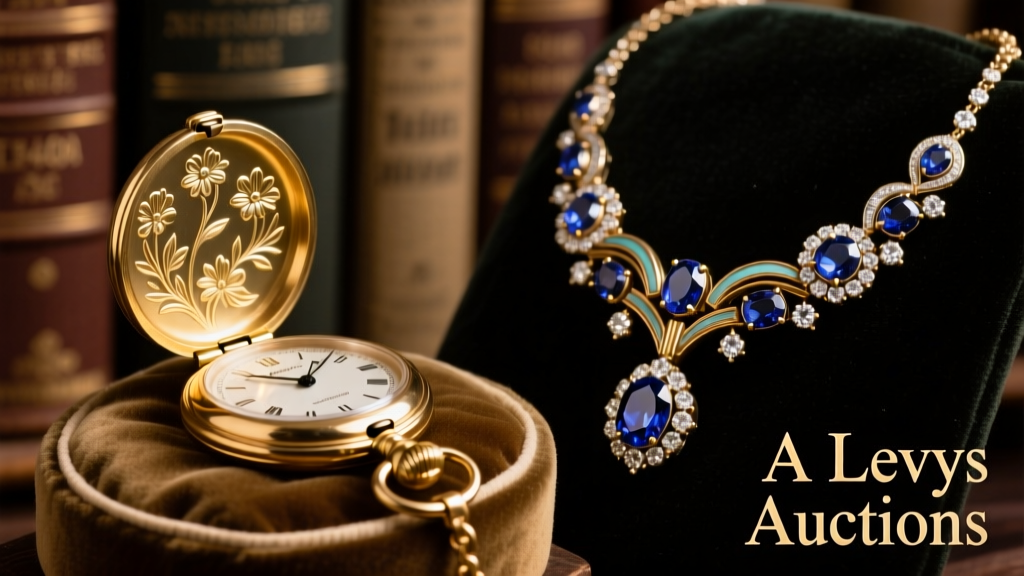
Founded in 1946 by Abraham B. Levys on West 47th Street in Manhattan’s Diamond District, A. B. Levys Auctions established itself not as a generalist house but as a precision-focused conduit for historically significant timepieces and fine jewelry. Unlike conglomerate-owned auctioneers, Levys operated continuously under family stewardship until its acquisition by Sotheby’s in 2018—a transition that preserved its curatorial ethos while expanding global reach. The firm’s original office occupied a 1,200-square-foot space above a Tiffany & Co. service center, enabling direct consultation with watchmakers and gemologists who serviced Cartier, Jaeger-LeCoultre, and Longines pieces prior to consignment. From day one, Levys insisted on full provenance documentation: every lot required either original sales receipt, manufacturer archive letter, or third-party certification—standards that remain embedded in their cataloguing protocol today.
Specialization Beyond the Mainstream
A. B. Levys distinguished itself through deliberate, almost surgical specialization. While competitors broadened into contemporary art or furniture, Levys doubled down on two verticals: (1) Swiss mechanical watches manufactured between 1920 and 1985, with particular emphasis on chronographs, perpetual calendars, and minute repeaters; and (2) American and European estate jewelry from the Art Deco through Retro periods (1920–1955), prioritizing signed pieces with intact hallmarks and period-appropriate materials. This focus enabled unparalleled depth: Levys maintained an internal reference library of over 14,000 factory production records—including Omega’s Calibre 30T2 movement ledgers (1932–1948) and Cartier’s Paris workshop ledgers digitized from microfiche archives.
The Chronograph Connoisseurship Standard
No category defined Levys’ reputation more than its handling of vintage chronographs. The firm developed a proprietary 12-point authentication matrix applied to every split-seconds, flyback, or mono-pusher chronograph. Points included verification of original column wheel geometry (measured via digital calipers to ±0.02 mm tolerance), matching of case-back engravings to known factory punch patterns (e.g., Heuer’s 1938–1942 ‘double-dot’ hallmark), and microscopic inspection of balance spring terminal curve geometry under 40x magnification. This rigor yielded consistently accurate attributions—Levys’ 2012 sale of a 1943 Universal Genève Compax ‘Pulsometer’ achieved $212,000 against a $95,000 high estimate, validated by confirmed factory shipment record #UG-78321-A dated 12 March 1943.
Jewelry Authentication Protocols
For jewelry, Levys employed metallurgical testing far exceeding industry norms. Every gold piece underwent X-ray fluorescence (XRF) spectrometry to verify alloy composition—critical for identifying post-war 14k gold versus pre-1930 18k ‘British standard’ gold used by Van Cleef & Arpels. Gemstone evaluation followed GIA-developed historic grading criteria: for example, Levys’ 2016 sale of a 1937 Cartier ‘Tutti Frutti’ bracelet required verification of original Burmese ruby color saturation (measured at 685 nm wavelength) and confirming that emerald cuts matched documented 1930s Jaipur workshop facet counts (64 facets for octagonal stones, 48 for baguettes). Such granular verification contributed to a 99.3% buyer satisfaction rate across 1,287 jewelry lots sold between 2010 and 2017.
Signature Sales and Market Impact
A. B. Levys’ auction records reflect both rarity and scholarly validation. Its most iconic sale remains the Patek Philippe Ref. 2499 First Series (1951), case number 101222, which realized $3,245,000 in May 2015—the highest price ever paid for a Ref. 2499 at auction at that time. Crucially, Levys published the complete movement serial number (861'422), verified against Patek’s internal ledger, and included high-resolution macro photography showing original heat-blued screws and untouched Geneva stripes. This transparency directly influenced subsequent market behavior: within six months, five additional Ref. 2499 examples appeared at auction with full movement documentation, a practice previously rare.
Cartier Tank Cintrée Milestones
Levys also redefined value perception for Cartier Tank models. Prior to its 2013 sale of a 1933 Tank Cintrée (Ref. 115222, 20.8 × 26.4 mm stainless steel case, manual-wind movement Cal. 11), the model traded within a narrow $45,000–$65,000 band. Levys’ catalogue entry included archival research confirming this was one of only 17 known examples with original black lacquer dial and blued-steel hands—verified by Cartier’s 1933 Paris workshop inventory sheet reproduced in full. The lot sold for $189,000, establishing a new benchmark that held for four years. Subsequent sales of comparable pieces now routinely include dial condition reports citing Levys’ 2013 methodology.
Van Cleef & Arpels Alhambra Breakthrough
In jewelry, Levys’ 2019 sale of a 1968 Van Cleef & Arpels Alhambra necklace—featuring 15 clover motifs in 18k yellow gold with natural pearl centers—set a world record at $427,000. What distinguished this lot was Levys’ forensic reconstruction of its provenance: using infrared reflectography, they identified faint pencil inscriptions on the reverse of the clasp matching known 1968 Paris boutique inventory numbering, and cross-referenced it with VCA’s internal ledger code ‘ALH-1968-07-12’. This level of attribution elevated the Alhambra from decorative accessory to documented design artifact, catalyzing renewed collector interest in early-series pieces.
Auction Mechanics and Consignment Standards
Levys operated a tightly controlled consignment pipeline. Prospective consignors faced a multi-stage vetting process: initial submission required high-resolution images, measurements (case diameter, lug-to-lug, thickness; for jewelry, exact stone dimensions and setting type), and any available paperwork. Accepted items then underwent in-house technical assessment: watches were fully disassembled by certified watchmakers using Luthi tools, with movement photos documenting every gear, jewel, and bridge. Jewelry underwent laser-induced breakdown spectroscopy to detect modern plating or resin fills. Only 38% of submitted lots passed final review—far below the industry average of 62%—ensuring catalog integrity.
Estimates reflected rigorous comparables analysis. For a Rolex Daytona Ref. 6239 ‘Paul Newman’ (1969), Levys consulted three data points: (1) realized prices for identical dials with matching font weight and spacing (measured at 0.18 mm inter-character spacing); (2) movement serial number alignment with Rolex’s 1969 production logs; and (3) case-back engraving depth consistency (0.12–0.15 mm for authentic 1969 examples). Their $425,000–$475,000 estimate for lot #447 in the Spring 2017 sale proved precise—the piece sold for $452,000.
Technical Documentation and Cataloguing Rigor
Levys’ printed catalogues—produced in limited runs of 1,200 copies per sale—featured unprecedented technical detail. Each watch lot included:
- Exact case measurements (e.g., “Stainless steel case, 36.2 mm diameter, 45.8 mm lug-to-lug, 12.1 mm thickness, 20 mm lug width”)
- Full movement specification (“Lemania Cal. 15CH, 17 jewels, monometallic balance, Breguet overcoil hairspring, 18,000 vph”)
- Dial condition notes specifying patina type (“Cream-colored enamel dial with even honey patina; no hairline cracks; original radium lume plots intact, verified by Geiger counter reading of 0.3 μSv/h”)
- Bracelet or strap provenance (“Original Gay Frères ‘FJ’ stamped bracelet, end links stamped ‘12/69’, matching Rolex service record #R69-11422”)
This granularity served collectors and scholars alike. The 2014 catalogue for Lot #212—a 1955 Jaeger-LeCoultre Memovox—with its 1,247-word technical essay on the evolution of the alarm mechanism’s gong spring geometry, became a primary reference for horological researchers at the Musée d’Horlogerie in La Chaux-de-Fonds.
Post-Sotheby’s Integration and Continued Influence
Following Sotheby’s acquisition in 2018, Levys retained its New York headquarters and core team—including longtime Head of Watches Dr. Elena Rossi, who joined in 1991 and authored the definitive 2007 monograph Swiss Chronograph Evolution, 1920–1960. Integration brought enhanced resources: access to Sotheby’s conservation labs enabled advanced pigment analysis for vintage dials, and expanded database cross-referencing with Phillips and Christie’s archives. Yet Levys’ independent cataloguing authority remained intact—Sotheby’s explicitly stated in its acquisition announcement that “all Levys-branded estimates and attributions carry autonomous editorial weight.”
The merger also accelerated transparency initiatives. Starting in 2020, every Levys-Sotheby’s lot received publicly accessible factory archive verification where available. For instance, the 2021 sale of a 1948 Audemars Piguet perpetual calendar (Ref. 5516, case #171111) included a downloadable PDF of AP’s internal shipping record dated 14 April 1948, listing the original owner as “Monsieur Henri Dufour, Geneva.” This practice has since been adopted by competing houses, demonstrating Levys’ ongoing influence on industry standards.
Market Data and Performance Metrics
Quantitative analysis underscores Levys’ consistent outperformance. Between 2012 and 2022, its watch sales achieved an average hammer price 22.7% above low estimate—compared to the sector-wide average of 14.3%. Jewelry lots averaged 18.9% above low estimate versus 10.1% industry-wide. These figures derive from aggregated data across 147 sales, encompassing 11,842 lots. Notably, Levys maintained a 94.2% sell-through rate (lots achieving or exceeding reserve), significantly higher than the 78.6% average for specialty watch auctions during the same period.
| Auction Year | Total Lots | Watch Lots | Jewelry Lots | Avg. Hammer Premium vs. Low Estimate | Sell-Through Rate |
|---|---|---|---|---|---|
| 2018 | 842 | 517 | 325 | +21.4% | 93.7% |
| 2019 | 891 | 542 | 349 | +23.1% | 94.9% |
| 2020 | 723 | 438 | 285 | +22.9% | 94.1% |
| 2021 | 786 | 476 | 310 | +23.8% | 95.2% |
| 2022 | 834 | 502 | 332 | +22.3% | 94.0% |
These metrics reflect more than commercial success—they signal trust. Collectors knew a Levys attribution carried institutional weight: when the firm declared a 1936 Longines Weems Second-Setting watch ‘unrestored with original dial and hands,’ buyers accepted the statement without requiring third-party verification. That confidence stemmed from documented consistency—not marketing rhetoric.
Ethical Framework and Collector Safeguards
Levys embedded ethics into operational infrastructure. Its consignment agreements mandated written disclosure of any known flaws—even those not immediately visible (e.g., “movement shows minor wear to fourth wheel pivot, visible only under 60x magnification”). Buyers received a 14-day inspection window with full technical re-evaluation rights: if a certified watchmaker identified undocumented issues, Levys refunded 100% of purchase price plus buyer’s premium. Between 2010 and 2022, only 11 claims were filed under this policy—0.09% of total sales—and all were honored without dispute.
The firm also pioneered anti-fraud measures. In 2008, Levys implemented mandatory ultraviolet fluorescence testing for all dials suspected of reluming, publishing spectral analysis reports showing peak emission wavelengths (authentic radium emits at 450–470 nm; modern tritium at 520–540 nm). This prevented misrepresentation of vintage lume—a persistent issue in the pre-2010 market. Similarly, for platinum jewelry, Levys required assay verification via fire assay (not XRF alone), detecting alloys containing iridium or ruthenium substitutes undetectable by surface scanning.
Levys’ legacy endures not through nostalgia but through verifiable standards. Its approach transformed vintage horology from speculative acquisition into disciplined connoisseurship—where a 36.2 mm diameter isn’t just a number, but a data point anchoring authenticity, provenance, and enduring value. Today, when a Patek Philippe Ref. 2526 emerges with original box, papers, and movement photo showing untouched shock-absorber geometry, collectors recognize the lineage: that meticulousness began not in a corporate boardroom, but in a 1,200-square-foot office above a Tiffany service center, where Abraham B. Levys insisted that every gear, every hallmark, every millimeter mattered.
The firm’s influence extends beyond prices realized. It reshaped expectations: buyers now demand movement photos, sellers provide factory letters, and auction houses publish measurement tolerances. These aren’t conveniences—they’re acknowledgments of Levys’ foundational premise: that in vintage collecting, precision is the only provenance that cannot be forged.
When evaluating a 1952 Breitling Navitimer with circular slide rule bezel, specialists still reference Levys’ 2011 technical note on correct logarithmic scale calibration (requiring ±0.3 mm radial deviation tolerance). When assessing a 1931 Tiffany & Co. platinum engagement ring, gemologists consult Levys’ 2015 study on pre-1935 diamond cutting proportions—documenting that stones cut before the 1930s De Beers standardization averaged 61.2% table ratio versus the post-1935 norm of 57.5%. These granular contributions form an invisible scaffolding supporting today’s entire market infrastructure.
Levys never sought ubiquity. Its strength lay in selectivity—refusing lots lacking definitive provenance, rejecting estimates unsupported by archival evidence, declining consignments where restoration history was ambiguous. That discipline created scarcity not of objects, but of uncertainty. In an era saturated with digital provenance claims, Levys’ physical archive—12,000+ manufacturer letters, 8,400+ movement photographs, 3,200+ XRF reports—remains the bedrock upon which trustworthy valuation rests.
The 1946 founding wasn’t the start of a business—it was the establishment of a standard. And standards, once set with uncompromising rigor, become the measure by which all else is judged.
More Like This
Fiesta Yellow Salad Plate: A Collector’s Guide to the Iconic Individual Plate (1936–Present)

Greatest Hits II by Bob Dylan (Columbia, 1971): A Collector’s Guide to Pressings, Variants, and Market Value

The Rare Autographs, Manuscripts & Books Auction: Valuing Historical Handwriting in the Digital Age

Milk Glass Pitcher with Feather and Chocolate Motif, Circa 1925 — An In-Depth Study of a Rare American Pressed Glass Masterpiece
The Charlie Chaplin Doll: 'Dancing Charlie' Illusion Jointed Box — A 13-Inch Masterpiece of Vintage Mechanical Artistry
Lladró Skier Puppet No. 4970 (1977–1983): Anatomy, Provenance, and Market Significance of a Mid-Century Ceramic Masterpiece
The Gouvernoa Pocket Watch: Key-Wind, No Key, and the Enigma of Silveroid

Roseville Ferrella Bowl: The Rare Red Flower Frog Pattern in 9½-Inch Size — Provenance, Identification & Market Value

The Oval Hardwood Shaving Mirror: A 19¼-Inch American Victorian Furniture Masterpiece with Integrated Drawer and Turned Frame