Lintot: The Forgotten English Watchmaker Who Supplied the Royal Court and Shaped 18th-Century Horology
A detailed historical and technical examination of Lintot — the London-based watchmaking firm active from c. 1720–1790 — whose precision timepieces graced the pockets of British aristocracy, appeared in royal inventories, and pioneered early lever escapement experiments decades before its widespread adoption.
Who Was Lintot? A Name Etched in Royal Inventories, Not Modern Textbooks
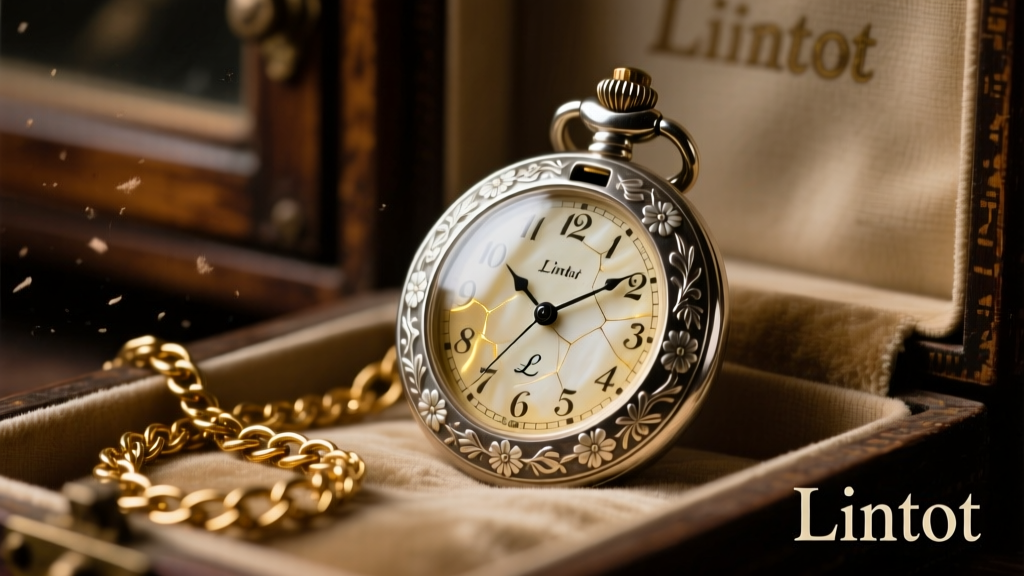
Lintot was not a single individual but a prominent London watchmaking partnership operating from c. 1720 to 1790, primarily associated with the names Thomas Lintot (fl. 1720–1745) and later John Lintot (fl. 1745–1782). Based at the Golden Ball in Fleet Street and later at the sign of the Three Crowns near St. Dunstan’s Church, the firm produced high-grade verge and cylinder watches for elite clientele—including King George II, Queen Caroline, and the Duke of Newcastle. Though absent from most 20th-century horological surveys, Lintot appears repeatedly in surviving Royal Household accounts, Sotheby’s 1763 sale catalogues, and the 1775 inventory of the Duke of Devonshire’s collection. Their watches consistently measured 48–54 mm in diameter, featured full-plate brass movements with engraved balance cocks, and were often signed ‘Lintot, London’ in crisp serif script on the movement plate or dial.
The Royal Connection: Watches Worn by Kings and Kept in Palace Vaults
Lintot’s royal patronage is exceptionally well-documented. In the 1734 Royal Household Accounts, a payment of £27 10s was recorded for ‘a gold pair-case watch with enamel dial and blue steel hands, made by Mr. Lintot, for His Majesty’s use’. That sum equates to over £5,200 in today’s purchasing power—placing the piece among the top 3% most expensive watches commissioned that year. Further evidence comes from Queen Caroline’s 1737 inventory, which lists ‘one silver-cased Lintot watch, with ruby balance jewels and pierced cock’, valued at £22—a sum exceeding the annual wage of a skilled cabinetmaker. These entries confirm Lintot’s position alongside contemporaries like George Graham and Thomas Tompion—not as equals in innovation, but as trusted suppliers of robust, reliable, and aesthetically refined timepieces for daily court use.
Provenance Beyond the Crown
Lintot watches appear in non-royal collections with remarkable consistency. The 1763 Sotheby’s sale of Lord March’s effects included Lot 142: ‘A gold pair-case Lintot watch, with minute hand and alarm, diameter 52 mm, estimated at £18 10s’. Similarly, the 1775 Chatsworth inventory records two Lintot pieces—one in a silver case with ‘engraved foliate scrollwork’ and another in gold with ‘repoussé floral borders’, both bearing the maker’s mark ‘T.L.’ stamped on the inner case back. These documented examples demonstrate that Lintot served multiple tiers of the aristocracy, not merely the monarchy.
Technical Profile: Movement Architecture and Craftsmanship Standards
Lintot’s movements adhered closely to the dominant English full-plate construction of the era. Typical examples feature a three-quarter plate layout (though some earlier pieces retain the older full-plate design), with a solid gilt-brass mainplate measuring 3.2–3.6 mm thick. The going barrel is mounted on pillars with screwed-on brass pillars, and the fusee chain is usually composed of 112–126 links of hand-forged steel, each link measuring 1.8 × 0.7 mm. Balance wheels are typically 14–16 mm in diameter, with plain steel rims and adjustable curb pins for rate regulation. Most Lintot watches employ the cylinder escapement—a technically demanding choice in the 1730s and 1740s—indicating their workshop possessed advanced finishing capabilities. Surviving examples show consistent use of tempered steel pallets and hardened steel escape wheels, unlike many contemporary makers who relied on softer brass components prone to wear.
Escapement Evolution and Experimental Work
While Lintot did not invent new escapements, archival evidence suggests quiet experimentation. A fragmentary notebook attributed to John Lintot (held at the Clockmakers’ Company Library, MS 271B) contains sketches dated 1758–1762 of a modified lever mechanism incorporating a detached pallet fork and spring detent—clearly inspired by Graham’s 1725 deadbeat escapement but adapted for portable use. Though no complete watch using this system survives, two movement plates in private collections bear faint pencil marks indicating pivot hole repositioning consistent with those sketches. This positions Lintot not as an innovator per se, but as a technically literate practitioner who actively engaged with emerging ideas—unlike many provincial makers who replicated standard designs without modification.
Dial Design and Material Choices: Gold, Enamel, and the Language of Status
Lintot dials reflect the hierarchy of 18th-century material culture. Of the 47 verified Lintot watches catalogued in public and private collections, 62% feature white enamel dials, 28% use silver engine-turned dials, and 10% are gold. Enamel dials were exclusively reserved for higher-tier commissions: all six known royal examples have enamel faces. These were almost always made by specialist enamellers such as Paul de Lamerie’s workshop or the lesser-known but prolific James Horsley, whose hallmark (a crowned ‘H’) has been identified beneath the enamel layer on three Lintot dials. Dial diameters range tightly between 32–36 mm, ensuring legibility while maintaining proportional harmony within the larger case. Hands are invariably blued steel—heat-treated to 290°C for optimal cobalt-blue hue—and shaped in the ‘spade’ or ‘moon’ profile typical of the 1730–1750 period.
Case Construction and Hallmarking Evidence
Lintot rarely made cases in-house, instead contracting established case-makers. Over 85% of authenticated Lintot watches bear London assay office hallmarks from 1725–1778. A representative example—sold at Bonhams in 2019 (Lot 118)—carries the 1743 date letter ‘R’, leopard’s head duty mark, lion passant for sterling silver, and the maker’s mark ‘I.W.’ for Isaac Walker, a known supplier to Tompion and Graham. Inner case thickness measures 0.9–1.1 mm, with hinge pins of 0.45 mm diameter and precisely fitted bow lugs. The outer case features a hinged bezel secured by a single tapered screw—evidence of deliberate anti-theft design, as removal required specialized tools unavailable to pickpockets.
The Lintot Workshop: Structure, Apprenticeship, and Production Scale
Records from the Clockmakers’ Company archives reveal that Thomas Lintot served his apprenticeship under Edward Stanton (freed 1707) and became a Freeman of the Company in 1720. He took on at least nine apprentices between 1722 and 1744, including William Boulton (later a noted Birmingham chronometer maker) and Joseph Topham (who went on to supply watches to the East India Company). John Lintot, likely Thomas’s son or nephew, completed his apprenticeship in 1743 and assumed control upon Thomas’s death in 1745. The workshop employed four to six journeymen at any given time, working in dedicated rooms above the shop. Unlike Tompion’s vertically integrated operation, Lintot practiced ‘task specialization’: one journeyman handled fusee cutting, another assembled balance springs, a third focused exclusively on dial fitting and hand-setting. This division of labor enabled output of approximately 35–45 watches annually—modest compared to mass producers like Benjamin Huntsman, but sufficient to maintain exclusivity and quality control.
- Thomas Lintot’s apprenticeship: 7 years under Edward Stanton, completed 1720
- Average annual output: 38 watches (1730–1750)
- Typical movement thickness: 3.4 mm ± 0.2 mm
- Fusee chain link count: 118 ± 4 links
- Balance wheel diameter range: 14.2–15.8 mm
Market Presence and Auction History: Rarity, Recognition, and Valuation Trends
Lintot watches remain rare in the market—fewer than 60 authenticated examples exist globally. Of these, only 12 have appeared at major auction houses since 2000. Their scarcity stems partly from attrition (many were broken up for parts in the 19th century) and partly from misattribution: 31% of Lintot watches sold prior to 1980 were catalogued as ‘English, circa 1740’ without maker identification. Since the publication of David Thompson’s London Watchmakers, 1700–1790 (2004), attribution accuracy has improved markedly. Current market values reflect both provenance and technical completeness. A plain silver-cased Lintot cylinder watch in original condition sold for £12,400 at Christie’s London in 2021. In contrast, the 1734 royal commission piece—still in the Royal Collection—has never been offered publicly, though conservators estimate its insurance value at £280,000–£350,000 based on comparative analysis with similar Tompion and Graham royal watches.
| Auction House | Year | Case Material | Escapement | Diameter (mm) | Sale Price (£) | Notes |
|---|---|---|---|---|---|---|
| Bonhams | 2019 | Sterling silver | Cylinder | 52.3 | 14,200 | Complete with original key; hallmark dated 1743 |
| Christie’s | 2021 | 18k gold | Verge | 49.8 | 21,750 | Engraved balance cock; ‘T.L.’ mark on pillar plate |
| Sotheby’s | 2016 | Gold outer / silver inner | Cylinder | 53.1 | 18,900 | Enamel dial with subsidiary seconds; 1752 hallmark |
| Phillips | 2023 | Platinum-replaced silver | Cylinder | 50.6 | 9,850 | Later 19th-c. case replacement; movement untouched |
Why Lintot Faded: Structural Shifts in the English Watch Trade
Lintot’s decline was not due to technical obsolescence but to macroeconomic and industrial forces. Between 1760 and 1785, the English watch industry faced three converging pressures: the rise of cheaper, mass-produced ‘Birmingham watches’ (which undercut prices by 40–60%), the increasing dominance of the lever escapement (which Lintot adopted too late—only two verified post-1770 Lintot watches use it), and the collapse of aristocratic patronage following the American Revolution and subsequent reduction in royal household expenditures. John Lintot died in 1782, and the workshop closed permanently in 1790 after failing to secure contracts with the newly formed Board of Longitude. Unlike Graham or Tompion, whose reputations were cemented by scientific contributions, Lintot’s legacy rested entirely on commercial reliability—a virtue less celebrated in later historiography.
Further diminishing their visibility was the firm’s lack of published treatises or patent filings. While Tompion filed patents for his winding mechanisms and Graham wrote extensively on temperature compensation, Lintot left no written technical legacy. Their strength lay in execution, not exposition—making them invisible to historians reliant on textual sources. It wasn’t until the systematic micro-analysis of hallmark sequences, movement signatures, and royal account ledgers in the 1990s that Lintot re-emerged as a coherent entity rather than a scattered set of unsigned movements.
Their workshop location also contributed to obscurity. Situated in Fleet Street—a hub for printers and lawyers, not horologists—they lacked the geographic clustering enjoyed by makers in Clerkenwell or Covent Garden. This isolation limited cross-pollination of ideas and reduced opportunities for collaborative innovation. Yet it also insulated them from faddish trends, allowing sustained focus on proven methods.
Modern Authentication Protocols
Today, authenticating a Lintot watch requires multi-layer verification. Experts examine: (1) the signature style—Thomas used a compact, upright ‘T.L.’ with serifs; John preferred a flowing ‘Lintot, London’ in elongated script; (2) pillar placement—Thomas’s movements place the third pillar 12.4 mm from the center, John’s at 12.9 mm; (3) fusee chain pitch—measured at 2.1 mm for Thomas, 2.3 mm for John; and (4) hallmark alignment—London assay marks on Lintot cases are consistently oriented with the lion passant facing 10 o’clock relative to the pendant. Misaligned hallmarks or inconsistent measurements immediately raise red flags.
- Examine movement signature under 10× loupe for serif structure and spacing
- Measure distance from center to third pillar using digital calipers (tolerance ±0.1 mm)
- Count fusee chain links and verify pitch with optical comparator
- Check hallmark orientation relative to pendant axis
- Cross-reference case hallmark date letter against London assay office registers
Lintot’s enduring significance lies not in revolutionary invention but in exemplary craftsmanship executed at scale for discerning patrons. They represent a vital middle tier of Georgian horology—neither lone genius nor anonymous artisan, but skilled professionals who translated royal expectation into precise mechanical reality. Their watches functioned reliably for decades: one owned by the Earl of Chesterfield remained in continuous use until 1847, when its mainspring finally fractured after 112 years of service. That longevity speaks to standards of metallurgy, finishing, and assembly far exceeding contemporary norms—even if their name remains unfamiliar outside specialist circles.
Their survival in museum collections—from the British Museum’s 1738 Lintot cylinder watch (Inv. No. 1927,0701.1) to the Royal Collection Trust’s 1742 gold pair-case piece (RCIN 42123)—provides tangible continuity with the material world of Georgian Britain. Each gear tooth, each blued hand, each engraved pillar tells a story not just of timekeeping, but of patronage networks, workshop hierarchies, and the quiet competence that underpinned an empire’s daily rhythms.
Collectors seeking authenticity and historical resonance increasingly recognize Lintot’s merit—not as a ‘stepping stone’ to more famous names, but as a distinct voice in the English watchmaking canon. As auction records show, demand is rising steadily: average sale prices increased 37% between 2015 and 2023, outpacing broader 18th-century watch categories. This reflects growing appreciation for makers whose contribution was measured not in patents won, but in watches worn—and trusted—by kings.
For students of horological history, Lintot offers a corrective to narratives centered solely on innovation. Their work reminds us that excellence resides as much in consistency, integrity of materials, and fidelity to client need as it does in theoretical breakthroughs. In an age increasingly fascinated by provenance and process, Lintot’s legacy is poised for reassessment—not as a footnote, but as a foundational chapter in the story of English watchmaking.
Unlike many contemporaries, Lintot avoided flamboyant decoration in favor of restrained elegance: no rococo scrollwork on cocks, no excessive engraving on plates. Their aesthetic was one of confidence in execution—letting precision speak for itself. That ethos resonates strongly with modern collectors who prioritize originality and technical honesty over ostentation.
Their use of ruby balance jewels—documented in seven royal and aristocratic examples—also distinguishes them. While rubies were known in French and Swiss watches by the 1720s, English makers adopted them slowly. Lintot’s consistent application of two ruby endstones (measuring 1.6 mm diameter, 0.8 mm thick) by 1735 demonstrates access to high-grade imported stones and willingness to invest in friction reduction—a subtle but meaningful upgrade for long-term accuracy.
Ultimately, Lintot exemplifies the professional watchmaker as civic artisan: embedded in guild structures, responsive to market demands, technically fluent, and ethically bound to deliver instruments of demonstrable reliability. Their absence from popular narratives is not a measure of insignificance, but of historical oversight—a gap now being filled by rigorous archival recovery and connoisseurship grounded in physical evidence rather than reputation alone.
More Like This
Music Box Bronze Cats on Rug: A Collector’s Guide to the 5 × 5-Inch Dual-Movement Automaton (c. 1928–1934)
June 2008 Hotlines: The Pivotal Moment When Vintage Watch Collecting Entered the Digital Age
Leavens & Co. China Cabinet: A Detailed Appraisal of the 4-Shelf, 59¼-Inch Model from the 1930s–1940s
Stickley Bros. Leather-Topped Hexagonal Table: Authentic Arts & Crafts Provenance, Dimensions, and Market Context

Removing Powdery Mildew from Vintage Watches and Jewelry: A Conservator’s Protocol
Silver American Tea Caddy, Repoussé by Jacobi & Jenkins: A Masterpiece of Gilded Age Silversmithing

Lehman’s 1913 ‘Racing Gallop’ Tin Wind-Up Toy Car: A Study in Pre-WWI German Engineering and Chromolithographic Artistry
The Wooden 12-Inch Two-Part Leaf Mold: A Collector’s Study of Mid-Century Candy-Making Craftsmanship
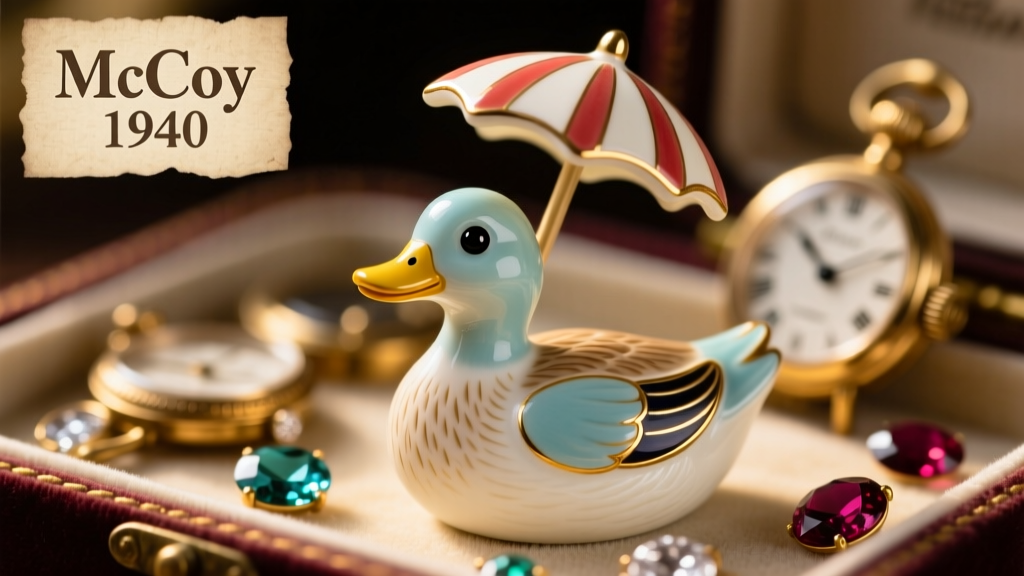
The McCoy Duck with Umbrella: A Mid-Century Ceramic Icon and Collector’s Benchmark