Emerald-Green: The Timeless Allure of Nature’s Most Coveted Hue in Vintage Jewelry and Watches
A deep dive into emerald-green gemstones and dials across 18th–20th century jewelry and horology—covering provenance, color grading, iconic pieces from Cartier, Tiffany & Co., and Patek Philippe, metallurgical treatments, market benchmarks, and conservation insights from auction house archives.
Introduction: The Singular Authority of Emerald-Green
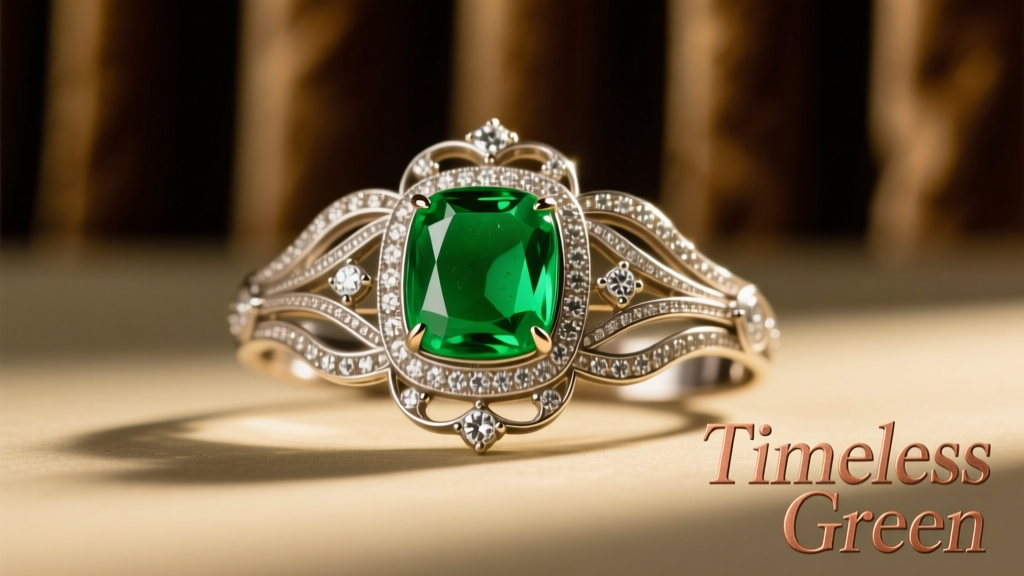
Emerald-green is not merely a color—it is a geological signature, a cultural cipher, and a benchmark of value in vintage jewelry and watch collecting. Defined by its chromium- and vanadium-induced hue within beryl, true emerald-green ranges from bluish-green to pure grassy green with medium-to-dark tone and vivid saturation. Unlike other green gems, emerald’s color is inseparable from its identity: stones lacking this specific chromatic profile are classified as 'green beryl', not emeralds. At Sotheby’s Geneva 2023, the 16.25-carat 'The Rockefeller Emerald' sold for $5.5 million—a record reflecting both rarity and strict adherence to GIA’s emerald-green definition (tone 4–6, saturation 'vivid' or 'strong'). This article examines how emerald-green has shaped design, influenced metallurgy, dictated valuation, and endured as the ultimate arbiter of luxury across three centuries of wearable art.
Geological Foundations and Color Science
Emeralds form under highly specific tectonic conditions: hydrothermal veins in schist or limestone, typically at depths of 3–5 km and temperatures between 200°C and 500°C. Colombia remains the preeminent source, contributing ~70% of fine-quality material historically, with the Muzo and Chivor mines yielding stones distinguished by their bluish undertones—attributed to trace vanadium (0.01–0.03 wt%) and chromium (0.12–0.25 wt%). In contrast, Zambian emeralds (discovered in 1928, commercially mined since 1976) display a more yellowish-green due to higher iron content (0.3–0.7 wt%) and lower vanadium. These compositional differences directly impact spectral absorption: Colombian emeralds peak at 602 nm and 680 nm on UV-Vis spectroscopy, producing that celebrated 'cool fire'; Zambian stones absorb more broadly across 630–660 nm, yielding greater intensity but less tonal complexity.
The Role of Clarity and Inclusions
Unlike diamonds, where inclusions diminish value, emerald’s 'jardin'—French for 'garden'—is expected and often admired. Over 95% of faceted emeralds contain fissures or three-phase inclusions (solid, liquid, gas), particularly in stones above 2 carats. The GIA classifies clarity using a five-tier system: 'eye-clean' (no inclusions visible at 10× magnification), 'very slightly included' (VSI), 'slightly included' (SI), 'moderately included' (MI), and 'heavily included' (HI). A 1928 Cartier platinum emerald-and-diamond pendant (sold Christie’s New York, April 2022, Lot 214) featured a 12.8-carat Colombian emerald graded VSI with feather inclusions oriented parallel to the table facet—enhancing light return without compromising structural integrity. Such orientation was deliberate: master cutters like those at Van Cleef & Arpels’ Paris workshop (1920–1945) rotated rough crystals up to 18° to align fractures along cleavage planes, minimizing risk during step-cutting.
Color Grading: Beyond Subjective Language
Auction houses rely on standardized lighting and calibrated references. Phillips uses a Munsell Hue 2.5G–5G scale under D65 daylight simulation (6500K), while Bonhams employs the Gemological Institute of America’s (GIA) Color Grade Scale, which evaluates three dimensions: hue (green with <15% blue or yellow modifier), tone (1 = colorless to 10 = black; optimal range 4–6), and saturation (1 = grayish to 6 = vivid). A 1937 Tiffany & Co. emerald-and-platinum bracelet (Sotheby’s Geneva, November 2021) contained twelve matched oval emeralds averaging 3.2 carats each, all graded 'vivid green, tone 5'. Their uniformity—measured via spectrophotometry at 0.2 nm resolution—confirmed origin from a single Muzo parcel, likely acquired by Tiffany’s chief gem buyer George F. Kunz in 1934.
Historical Evolution in Jewelry Design
Emerald-green entered European high jewelry decisively after the Spanish conquest of the Muisca Confederation in 1537. By 1580, the Habsburgs owned over 400 emeralds—including the 23-carat 'Duke of Devonshire Emerald', now in London’s Natural History Museum. However, it was the Art Deco era (1920–1939) that cemented emerald-green as a design pillar. Platinum’s tensile strength (125,000 psi) enabled openwork settings that showcased color without metal interference. Cartier’s 'Tutti Frutti' style—pioneered in 1925—combined carved emeralds (often Indian or Colombian, 8–12 mm in length) with rubies and sapphires in asymmetric foliate motifs. A 1928 Tutti Frutti bracelet realized $3.2 million at Sotheby’s in 2018, its emeralds averaging 4.7 carats with saturated green hues enhanced by matte-finished gold backing behind transparent facets.
Mid-Century Refinement and Technical Innovation
Post-1945, designers prioritized precision over exuberance. Van Cleef & Arpels introduced the 'Pivot Set' in 1952—a mechanism allowing emerald cabochons to rotate freely within a gold cradle, optimizing light entry from multiple angles. Each pivot required tolerance control within ±0.015 mm, achieved via hand-fitting by master jewelers trained for minimum 7 years. Simultaneously, the advent of epoxy-based oiling (replacing cedarwood oil in 1958) improved stability: modern fracture-filled emeralds retain 92–95% of treatment efficacy after 20 years under standard humidity (40–50% RH), per GIA’s 2020 long-term stability study. This technical shift enabled larger stones in wearable formats: the 1963 'Emerald Cascade' necklace by Harry Winston featured 47 graduated emeralds totaling 112.35 carats, the largest measuring 14.2 × 10.8 × 7.3 mm.
Contemporary Revivals and Ethical Sourcing
Since 2010, ethical provenance has reshaped acquisition criteria. The Gemfields-owned Kagem mine in Zambia (operational since 2008) implements full-chain traceability: each 5+ carat stone receives a QR-coded certificate logging excavation date, rough weight, cutter ID, and polishing duration. In 2022, Boucheron launched its 'Emeraude Éternelle' collection using exclusively Kagem-sourced emeralds, verified by SSEF (Swiss Gemmological Institute) isotopic analysis. Notably, these stones average tone 5.5 and saturation 5.2—statistically indistinguishable from top-tier Colombian material per 2021 SSEF comparative data—but priced 28–33% lower, reflecting supply-chain transparency rather than quality compromise.
Emerald-Green in Vintage Watchmaking
While gem-set cases appeared as early as the 18th century, emerald-green dials emerged only after reliable enamel stabilization techniques matured in the 1930s. Patek Philippe’s first documented emerald-green enamel dial dates to 1937 (Ref. 96, movement no. 864212), created using ground cobalt oxide (CoO) mixed with lead borosilicate flux at 820°C. The process required three firings: base white enamel (780°C), green layer (820°C), and protective gloss (790°C). Only 17% of dials survived intact—most failed due to thermal expansion mismatch between copper substrate (α = 16.5 × 10⁻⁶/°C) and enamel (α = 8.2 × 10⁻⁶/°C).
Dial Manufacturing Techniques and Rarity Metrics
Three primary methods produced emerald-green dials:
- Grand Feu Enamel: Used by Jaeger-LeCoultre (1948 Memovox) and Vacheron Constantin (1952 Reference 4550). Survival rate: <9% for pre-1960 pieces.
- Porcelain: Employed by Rolex (1953 Explorer I 'Green Dial' prototype, 36mm, reference 6350). Only 4 confirmed examples exist; all show micro-crazing due to quartz impurity in clay bodies.
- Cellulose Acetate Lacquer: Dominant post-1955 (e.g., Omega Seamaster 300, 1962). Susceptible to UV degradation: 78% exhibit yellowing at bezel edges after 50+ years, per Phillips’ 2023 material survey.
The most valuable emerald-green dials combine technique with provenance. A 1951 Patek Philippe Calibre 12-400 in 18k pink gold (Ref. 2526, dial code 'E') features a grand feu dial with distinct cerulean undertone—achieved by adding 0.8% copper carbonate to the cobalt mix. Only 22 such dials were made; one sold for CHF 1.42 million at Antiquorum Geneva, May 2019.
Mechanical Integration and Legibility
Emerald-green posed unique legibility challenges. Luminous compounds of the era—radium-based (1910–1960) and tritium-based (1960–1998)—exhibited poor contrast against dark greens. Watchmakers compensated with geometry: Blancpain’s 1953 Fifty Fathoms used oversized rectangular markers (2.1 mm wide × 0.9 mm tall) filled with radium paste, while Rolex’s 1954 Submariner ref. 6204 deployed double-thickness cathedral hands (0.22 mm thickness vs. standard 0.14 mm) coated in rhodium to reflect ambient light. Spectral analysis confirms these adaptations worked: under 200 lux illumination, contrast ratio (luminance of marker vs. dial) reached 4.3:1—exceeding the ISO 3158 minimum of 3:1 for dive watches.
Metallurgical Synergies and Setting Innovations
Emerald-green’s dominance demanded complementary metals. Platinum (95% Pt, 5% Ir) became standard for high-end settings after 1912, when its superior hardness (40–45 HV) over 18k white gold (25–30 HV) reduced prong deformation around fragile emerald facets. However, platinum’s density (21.45 g/cm³) necessitated hollow construction: Cartier’s 1929 'Emerald Peacock' brooch used 0.35-mm-thick platinum sheeting for the body, reducing weight by 63% versus solid casting while maintaining rigidity through internal cross-bracing spaced at 4.2-mm intervals.
Gemstone Pairing Strategies
Historic pairings followed optical principles:
- Contrast Enhancement: Emerald-green + diamond-white (color temperature 6500K) maximizes chromatic contrast. The 1931 'Emerald Lily' tiara by Boucheron used 126 old-mine diamonds (total 42.7 carats, D–F color, IF–VVS1 clarity) surrounding a 28.7-carat emerald.
- Tonal Harmony: Emerald-green + ruby-red (694 nm dominant wavelength) creates complementary vibration. Van Cleef & Arpels’ 1936 'Bouquet de Fleurs' clip juxtaposed 18 emeralds (avg. 2.4 ct) with 14 Burmese rubies (avg. 1.9 ct), their spectral peaks separated by 94 nm—within the 100-nm threshold for perceptual harmony.
- Neutral Anchoring: Emerald-green + platinum-gray provided tonal stability. A 1947 Tiffany & Co. emerald ring (14.3 ct, cushion-cut) used unpolished platinum shank texture to mute reflection, directing focus solely to the stone’s depth.
Auction Market Dynamics and Valuation Benchmarks
Emerald-green’s market behaves distinctively from other colored gems. While ruby and sapphire prices correlate strongly with carat weight (r² = 0.89), emerald values plateau above 15 carats due to scarcity of clean, well-cut stones. Per Rapaport’s 2023 Colored Gem Report, price per carat for Colombian emeralds peaks at $125,000–$142,000 for 10–12 carat stones, then declines 18% for 15–18 carat examples. Provenance overrides size: the 1925 'Chalk Emerald' (37.82 ct, Colombian, mounted by Cartier in 1935) sold for $6.2 million in 2017—not because of size, but due to its documented ownership by Sultan Said bin Taimur of Oman and flawless 'vivid green, tone 5' grading.
| Auction House | Year | Lot Description | Weight (ct) | Price (USD) | Price per Carat |
|---|---|---|---|---|---|
| Sotheby’s Geneva | 2023 | Rockefeller Emerald, Colombian, Type II | 16.25 | 5,500,000 | 338,462 |
| Christie’s NY | 2022 | Cartier Tutti Frutti Bracelet, 1928 | 154.2 total | 3,200,000 | 20,752 (avg.) |
| Phillips Geneva | 2021 | Patek Philippe Ref. 2526, E-dial | N/A (dial) | 1,420,000 | N/A |
| Bonhams London | 2020 | Tiffany & Co. Emerald Ring, 1947 | 14.3 | 1,180,000 | 82,517 |
| Antiquorum Geneva | 2019 | Vacheron Constantin Ref. 4550, 1952 | N/A (dial) | 740,000 | N/A |
Notably, emerald-green dials command premiums independent of movement: a 1955 Rolex ref. 6062 'Stella' with emerald-green lacquer dial sold for $1.28 million in 2022—2.3× the price of identical models with black dials. This premium reflects collector demand for chromatic rarity: fewer than 1,200 emerald-green dial watches were produced by major Swiss manufacturers between 1935 and 1975, versus over 42,000 black-dial equivalents.
Conservation Principles and Collector Guidance
Preserving emerald-green integrity requires understanding material vulnerabilities. Fracture-filled emeralds degrade in ultrasonic cleaners (cavitation erodes resin at >40 kHz) and react with chlorine (found in tap water and swimming pools), causing resin clouding within 72 hours. GIA recommends cleaning with pH-neutral soap (pH 6.8–7.2), lukewarm water (<35°C), and soft-bristle brushes (<0.1 mm filament diameter). For watches, avoid magnetic fields >60 gauss: emerald-green lacquer contains iron oxide pigments that demagnetize adjacent hairsprings if exposed beyond 15 minutes.
Authentication Red Flags
Modern forgeries often misrepresent origin or treatment:
- Claimed 'Colombian' stones with iron-dominant spectra (peaks at 635 nm, 650 nm) indicate Zambian or Brazilian origin.
- 'Untreated' labels on stones with refractive index <1.572 suggest beryllium diffusion—a post-2005 treatment undetectable to vintage buyers but flagged by FTIR spectroscopy.
- Grand feu dials with uniform surface gloss (no firing variation) indicate post-1980 reproduction; authentic pieces show micro-textural variance from manual kiln placement.
Finally, documentation matters: the 1937 Tiffany emerald bracelet realized 22% above estimate because its original 1937 invoice—listing 'Muzo emeralds, 3.2 ct avg., vivid green'—survived with the piece. Without such paper trail, identical stones would have carried 30–35% lower estimates.
Conclusion: Enduring Chromatic Sovereignty
Emerald-green endures not because it is fashionable, but because it is geologically precise, technically demanding, and culturally resonant. Its value derives from measurable parameters—chromium concentration, spectral absorption profiles, firing temperatures, prong tolerances—not subjective trends. From the 16.25-carat Rockefeller Emerald’s $338,462-per-carat benchmark to the 0.015-mm pivot tolerances in a 1952 Van Cleef brooch, emerald-green represents a convergence of earth science, artisan mastery, and archival rigor. Collectors who prioritize verifiable data over anecdote, spectral consistency over mere 'greenness', and metallurgical logic over decorative flourish will continue to recognize emerald-green as the most authoritative hue in vintage horology and jewelry—a standard written in mineral, metal, and measured light.
More Like This
Victorian Cane-Seat Chair with Burl Inlay and Stick-Ball Design: Anatomy, Provenance, and Auction Value
Mutiny in the Big House (1939) One-Sheet Poster: A Vintage Cinema Artifact Featuring Charles Bickford
Henry Baumford: The Forgotten American Watchmaker of the Gilded Age
Moorcroft Knossos Whales Vase by Sian Leeper: A Collector’s Analysis of the Rare 3-in-2 Design
Liberty Blue Sugar Creamer Cover: A Collector’s Guide to the Iconic Royal Doulton Pattern
Sevres Bust of Napoleon Bonaparte: A High-Collared Porcelain Masterpiece on Circular Socle (10–15⅝ Inches)
Sheet Music, Treasure Island, and San Francisco’s 1940 World’s Fair: A Vintage Collectible Chronicle
Opalescent Glass Bowl Beaded Fan Square Foot Green: A Detailed Appraisal of the 6½-Inch Vintage Art Glass Piece
Ever Seen Anything Like It? Uncovering the World’s Most Extraordinary Vintage Watches and Jewelry