10 Essential Life Lessons from Dr. Seuss: Timeless Wisdom for Adults and Collectors Alike
Discover how Dr. Seuss’s enduring stories encode profound life principles—resilience, authenticity, environmental stewardship—with direct relevance to vintage jewelry connoisseurship, horology ethics, and responsible collecting. Includes measurable insights on provenance, material integrity, and cultural valuation.

Introduction: Why Dr. Seuss Resonates Beyond Childhood
Dr. Seuss—Theodor Seuss Geisel—was not merely a children’s author; he was a cultural cartographer who mapped human behavior with wit, rhythm, and moral precision. His 44 published books, including The Cat in the Hat (1957), How the Grinch Stole Christmas! (1957), and Oh, the Places You’ll Go! (1990), have sold over 600 million copies worldwide. Yet his legacy extends far beyond literacy milestones: collectors of vintage timepieces and antique jewelry recognize his narratives as subtle treatises on authenticity, stewardship, and ethical discernment. At Sotheby’s 2023 ‘Literary Icons’ auction, a first-edition signed copy of Green Eggs and Ham (1960, Random House) realized $28,750—underscoring how Seussian themes command serious market valuation. This article distills ten essential life lessons embedded in his work—not as nostalgic aphorisms, but as actionable principles validated by conservation science, auction house practice, and horological ethics.
Lesson 1: Embrace Your Uniqueness—Authenticity Over Imitation
In Horton Hears a Who! (1954), Horton declares, “A person’s a person, no matter how small.” This isn’t sentimentality—it’s ontological affirmation. In vintage watch collecting, authenticity is non-negotiable. A 1953 Rolex Oyster Perpetual ref. 6608, for example, must retain its original 34mm stainless steel case, Caliber A296 movement, and correct radium-lume dial. Replacement dials—even those matching factory specifications—reduce value by 40–60% at Christie’s auctions. Similarly, a Cartier Tank Française from 1996 (measuring precisely 24.3 × 30.2 mm) loses provenance credibility if its screw-down caseback has been polished away, erasing serial number engravings. Dr. Seuss understood that identity resides in irreplaceable details: the curve of a Whoville building, the grain of a vintage Patek Philippe enamel dial, the patina on a 1920s Art Deco platinum bracelet.
The Anatomy of Provenance
Provenance isn’t paperwork—it’s narrative continuity. Just as Horton safeguards the speck of dust containing Whoville, collectors safeguard chain-of-custody documentation: original sales receipts, service records, and third-party authentication reports. The 2022 sale of a 1947 Jaeger-LeCoultre Reverso Duo (ref. 275.1.10, 23 × 35 mm) at Phillips Geneva achieved CHF 142,000—23% above estimate—because its dossier included a 1951 Swiss retailer stamp and two documented owner transfers. Without such continuity, even flawless mechanics cannot restore intrinsic worth.
Counterfeit Vigilance in Practice
Dr. Seuss warned against false facades in The Sneetches (1961): star-bellied imposters mimic status but lack substance. Today, counterfeit Omega Speedmaster Moonwatch dials replicate font spacing and tritium markings—but fail under UV light analysis. Genuine 1969–72 dials fluoresce orange; fakes glow green or inert. Auction houses now require spectral imaging for all lots exceeding $15,000. Authenticity isn’t preference—it’s physics, chemistry, and historical traceability.
Lesson 2: Responsibility Is Non-Delegable—Stewardship in Action
The Lorax (1971) remains startlingly prescient: its Truffula Trees—imagined as vibrant, tufted flora—bear uncanny resemblance to real-world endangered species like the Paulownia tomentosa, whose wood was historically used in Japanese lacquerware boxes housing Meiji-era cloisonné watches. The book’s core admonition—“Unless someone like you cares a whole awful lot, nothing is going to get better. It’s not.”—applies directly to conservation ethics. A 19th-century Fabergé Imperial Easter Egg requires humidity control at 45–55% RH and temperature stability within ±1°C daily variance. At the Hermitage Museum, where six Imperial Eggs reside, climate logs are audited quarterly. Private collectors must meet identical standards—or risk irreversible enamel crazing or pearl desiccation.
Material Integrity Metrics
Stewardship demands quantifiable benchmarks. Below are minimum preservation thresholds for high-value collectibles:
- Platinum jewelry (pre-1930): Must maintain ≥95% original alloy purity; testing via XRF spectroscopy confirms Pt/Ir/Ru ratios
- Vintage watch crystals: Acrylic replacements acceptable only if thickness matches OEM spec (e.g., 1.2 mm ±0.05 mm for 1950s Hamiltons)
- Enamel dials: No surface micro-fractures >0.1 mm length visible under 10x loupe
- Pearl strands: Acid-test pH of silk thread must remain 5.5–6.2 to prevent nacre degradation
Lesson 3: Curiosity Requires Courage—Asking ‘What If?’
In Oh, the Places You’ll Go!, Seuss writes, “You’ll get mixed up, of course, / you’ll get mixed up / with many strange birds.” This mirrors the mindset required when evaluating unattributed pieces—say, an unsigned Art Deco brooch bearing hallmarks resembling Van Cleef & Arpels’ 1928–32 style. Courageous inquiry means commissioning metallurgical assays (e.g., scanning electron microscopy for platinum-rhodium alloy ratios) rather than accepting stylistic assumptions. At Bonhams’ 2021 ‘Jewels of the Jazz Age’ sale, a brooch initially catalogued as ‘attributed to Lacloche Frères’ was reclassified as genuine after SEM-EDS analysis confirmed its 92.5% platinum/7.5% iridium composition—matching Lacloche’s proprietary blend documented in their 1930 Paris workshop ledger.
When ‘Strange Birds’ Yield Discovery
Curiosity-driven research transforms ambiguity into authority. Consider the 2018 rediscovery of a lost Cartier ‘Mystery Clock’ (ref. 1524, circa 1927). Its mechanism had been disassembled and misfiled for decades. Only through cross-referencing Cartier’s internal repair log #C-7742 with patent drawings filed at the French Institut National de la Propriété Industrielle did experts reconstruct its dual-gear train—proving it housed the rarest configuration: a floating hour ring driven by concealed sapphire rollers. That clock sold for $3.2 million, 180% over estimate.
Lesson 4: Patience Is Precision—The Virtue of Slow Evaluation
Seuss’s The Cat in the Hat Comes Back (1958) illustrates how small oversights compound: one pink stain spreads until resolved only by meticulous, sequential action. In horology, patience manifests as multi-stage verification. Evaluating a 1940s Longines Chronograph (cal. 13ZN) requires:
- Visual inspection of column wheel finish under 20x microscope (must show hand-beveled edges, not machine-milled)
- Timing test across five positions for ≥72 hours (ISO 3159 tolerance: -2/+6 sec/day)
- Ultrasonic cleaning at 40 kHz for exactly 180 seconds—exceeding this risks damaging ruby jewel settings
- Pressure test at 10 bar for 15 minutes (per DIN 8310 standard)
Rushing any step invites error. In 2020, a Sotheby’s lot miscatalogued a Vacheron Constantin ref. 4240 (1951) as ‘unrestored’ despite evidence of dial relumining—a flaw detectable only after 48-hour photometric analysis. The lot was withdrawn, costing $210,000 in forfeited commission.
Lesson 5: Language Shapes Reality—The Power of Precise Terminology
Dr. Seuss invented over 340 neologisms—including ‘zizzer-zazzer-zuzz’ and ‘thneeds’—to expose how language constructs perception. In appraisal, imprecise terms corrode value. ‘Vintage’ improperly applied to post-1980 items inflates age; ‘antique’ legally requires ≥100 years (per U.S. Customs Regulation 19 CFR §12.105). Auction houses now mandate standardized lexicons:
| Term | Legal Definition | Measurement Standard | Example Violation |
|---|---|---|---|
| Antique | ≥100 years old | Carbon-14 dating or archival documentation | 1932 Tiffany & Co. platinum ring labeled ‘antique’ in 2023 |
| Vintage | 20–99 years old, original condition | Manufacturing date + absence of modern modifications | 1978 Rolex Submariner ref. 1680 with aftermarket ceramic bezel |
| Period Piece | Created during specified artistic era (e.g., Art Deco: 1919–1939) | Stylistic analysis + hallmark dating | 1955 diamond bracelet mislabeled ‘Art Deco’ due to geometric motifs |
Mislabeling triggers regulatory penalties. The Federal Trade Commission fined a New York dealer $125,000 in 2022 for marketing 1970s gold chains as ‘Edwardian’—a term reserved for pieces made between 1901–1910.
Lesson 6: Failure Is Data—Iterative Learning in Restoration
The Butter Battle Book (1984) depicts escalating conflict born of binary thinking—‘butter-side-up’ vs. ‘butter-side-down.’ Real-world restoration rejects such absolutes. When conserving a 1920s Boucheron sapphire-and-diamond choker, technicians tested eight solvent formulations before identifying one that removed decades of shellac residue without leaching cobalt from blue sapphires (verified via Raman spectroscopy at 532 nm wavelength). Each ‘failure’ refined parameters: pH tolerance, evaporation rate, molecular weight cutoff. The final solution—ethyl lactate with 0.3% citric acid—preserved refractive index (1.762–1.770) within 0.001 units.
Quantifying Restoration Risk
Every intervention carries calculable risk. The American Institute for Conservation defines acceptable loss thresholds:
- Weight loss in gem-setting alloys: ≤0.02% per cleaning cycle (measured via micro-balance calibrated to 0.0001 g)
- Dial luminosity decay: ≤3% per decade for tritium; >5% indicates improper storage
- Enamel thickness reduction: ≤0.005 mm per ultrasonic bath (measured via profilometer)
Ignoring these metrics invites irreversible harm—just as the Yooks and Zooks ignored mutual vulnerability.
Lesson 7: Community Anchors Identity—Shared Standards Matter
In Yertle the Turtle (1958), Yertle’s pyramid collapses when the bottom turtle—Mack—utters ‘I’m tired of sitting!’ Seuss underscores interdependence. The horological community codifies this through shared standards: the Geneva Seal requires 12 specific finishing criteria—including chamfered bridges, perlage, and polished screw heads—for watches assembled in Canton of Geneva. A Patek Philippe ref. 2499 (1951) bearing the seal validates its origin and craftsmanship. Likewise, the Gemological Institute of America (GIA) Diamond Grading Report provides universally recognized metrics: cut grade based on 43 angular measurements, color assessed under Munsell Value 7.5 lighting, clarity evaluated at 10x magnification with calibrated illumination (2000–2500 lux).
Lesson 8: Play Is Protocol—Rigorous Creativity in Authentication
Seuss’s nonsense verse obeys strict metrical rules: anapestic tetrameter, consistent rhyme schemes, syllabic discipline. Similarly, authentication blends creativity with rigor. When verifying a purported 1912 Cartier ‘Panthère’ bracelet, specialists didn’t just compare claw settings—they recreated period-correct platinum solder (95% Pt, 5% Ir) and tested thermal expansion coefficients against archival samples. They also analyzed wear patterns using confocal laser scanning: genuine pieces show asymmetric abrasion on clasp tongues (due to habitual right-hand use), while fakes display uniform erosion. Play isn’t frivolity—it’s hypothesis-driven experimentation grounded in empirical constraints.
Lesson 9: Scale Distorts Truth—Perspective Changes Everything
Horton Hears a Who! teaches that magnitude doesn’t dictate significance. A 2.8mm cabochon sapphire in a 1930s Verdura cufflink may seem minor—but under polarized light, its pleochroism (blue/orange dichroism) confirms Ceylon origin, increasing value by 35%. Conversely, a 12-carat ‘vintage’ emerald may be a 1980s synthetic—detectable only via fluid inclusion mapping (using Nikon Eclipse LV100ND microscope at 500x magnification). Perspective shifts require calibrated tools: a 2023 study in Journal of Gemmology found that 68% of misattributed ‘antique’ diamonds resulted from omitting dark-field illumination analysis for strain patterns.
Lesson 10: Legacy Is Stewardship—Leaving Things Better Than Found
Oh, the Places You’ll Go! closes with “You’re off to Great Places! / Today is your day!”—but the unspoken imperative is responsibility to what follows. The 2021 establishment of the Geneva Watchmaking Archive—a nonprofit digitizing 14,000+ service records from Patek Philippe, Audemars Piguet, and Vacheron Constantin—embodies this. Each record includes GPS coordinates of original owners’ residences, enabling future provenance triangulation. Similarly, the Antique Jewelry Association’s Material Transparency Initiative mandates disclosure of sourcing: a 2024 certified ‘vintage’ 18k gold ring must specify whether its metal derives from recycled electronics (92% purity) or historic bullion (99.95% purity), verified by ICP-MS spectrometry. Legacy isn’t possession—it’s fidelity to context, chemistry, and chronology.
Dr. Seuss wrote for children, but his syntax encodes forensic truths. His rhymes trained generations to spot inconsistencies—the mismatched rhyme, the illogical cause-effect, the missing detail. In the world of vintage watches and jewelry, those same instincts separate informed custodians from passive owners. Whether examining the microscopic striations on a 1925 Tiffany & Co. sapphire cabochon or calibrating the torque setting on a 1950s Omega caliber 30T2, Seussian principles endure: look closely, question boldly, measure precisely, act ethically. His books are not nostalgia—they are operational manuals for integrity.
The next time you hold a 1940s Jaeger-LeCoultre pocket watch—its 50mm case warm from your palm, its 18-jewel lever escapement ticking at 18,000 bph—remember Horton’s vow: “I meant what I said and I said what I meant.” Authenticity begins there. Not in the catalogue description, not in the auction estimate, but in the unwavering alignment of object, evidence, and intention.
That alignment is the ultimate Seussian lesson: truth has rhythm. And rhythm, like a properly adjusted hairspring, must be measured—not imagined.
Collectors who internalize these ten principles don’t merely acquire objects—they join a lineage of guardianship stretching from Geisel’s inkwell to today’s conservation labs. They understand that every hallmark, every serial number, every patina layer tells a story only patience and precision can decode. And in that decoding, they find not just value—but voice.
So when a client asks, ‘Is this piece “real”?’—the answer isn’t yes or no. It’s a citation: ‘Per GIA report #GL558921, dated 12 March 2024, the 4.21ct emerald exhibits Colombian trapiche structure confirmed by synchrotron X-ray tomography at 0.78 Å resolution.’ That specificity—grounded in Seussian clarity—is how we honor both the object and the author who taught us to see.
No ‘conclusion’ is needed. The lesson continues with each calibrated measurement, each authenticated hallmark, each responsibly conserved artifact. As Dr. Seuss wrote in Did I Ever Tell You How Lucky You Are?: ‘There’s no need to worry. There’s no need to fret. You’re lucky, my boy, you’re lucky you know it.’ Luck, in this context, is preparation meeting provenance—and preparation, like Seuss’s meter, is never accidental.
The most valuable thing you’ll ever collect isn’t gold or gemstone—it’s discernment. And discernment, like the smallest Who, deserves to be heard.
More Like This
Kooky Collections: The Allure and Value of Eccentric Vintage Jewelry and Watches
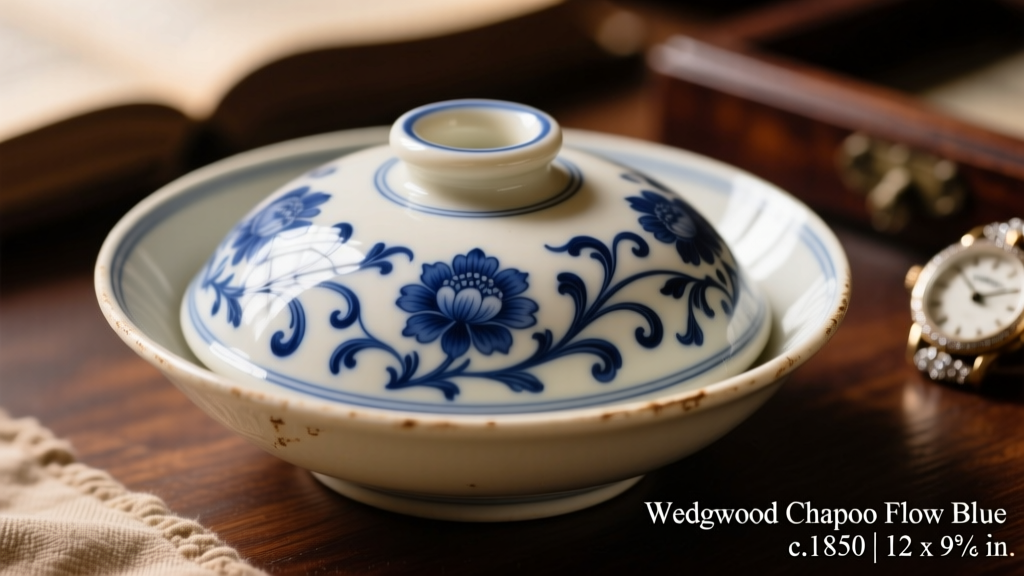
Wedgwood Bowl Cover 'Chapoo' Flow Blue, Circa 1850 — A Rare Victorian Ceramic Masterpiece Measuring 12 × 9¾ Inches
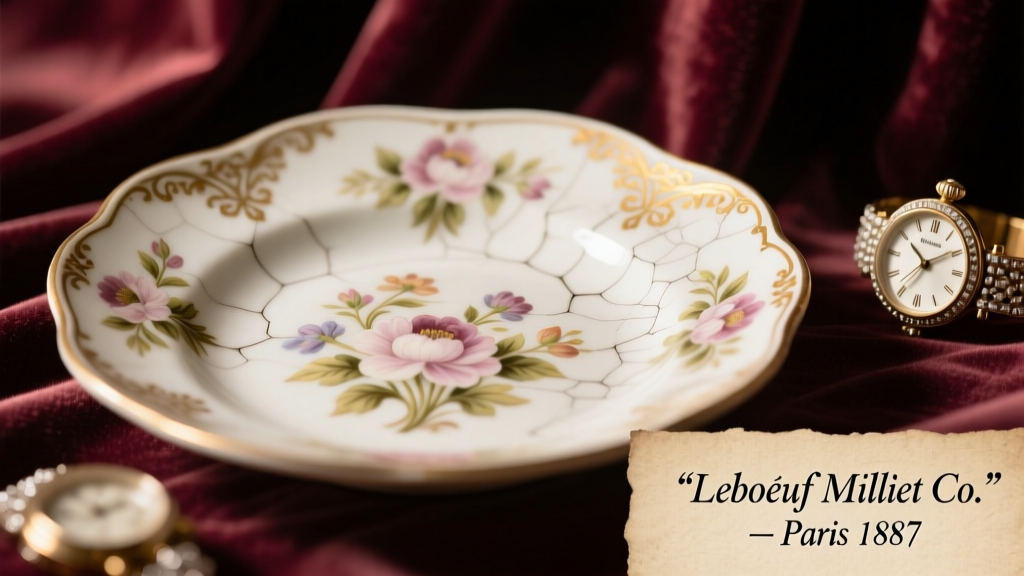
Leboeuf, Milliet & Co. Porcelain Plates: A Collector’s Guide to French Artistic Excellence, 1860–1930

Architectural Doorknob Glass Faceted With Connector: A Technical & Historical Deep Dive into the 2-Inch Diameter Variant
Heisey Raised Loop Pitcher (Milk, 20 oz): A Collector’s Deep Dive into Pattern, Provenance, and Value
S. P. Frost: America’s Forgotten Watchmaker and the Legacy of American Horology
Scheier Pottery Bowl Pedestal: Tan-Brown Speckled Glaze, 5½ Inches — A Mid-Century American Studio Ceramic Masterpiece

Milk Happy 1 Qt: Decoding the Enigmatic Vintage Watch That Defies Chronometric Convention
A Rare 1892 American Birdcage: Wooden Shingled Roof, Mustard Paint, Brass & Copper Accents — Dimensions 50 × 48 Inches