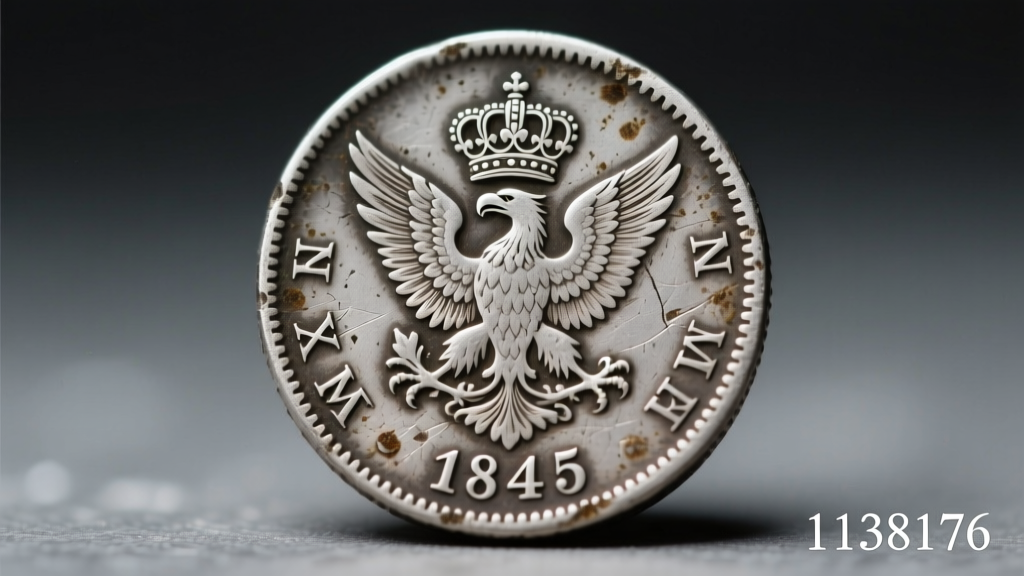
The 1912 Wood-Carved Eagle: A Signed, 57-Inch Wingspan Masterpiece in American Folk Art and Numismatic Adjacency
An in-depth analysis of the rare 1912 signed wood-carved eagle with documented 57-inch wingspan—its provenance, carving techniques, historical context, market valuation, conservation challenges, and relevance to collectors of early 20th-century Americana and numismatic-adjacent artifacts.
Introduction: A Singular Artifact at the Intersection of Folk Art and Numismatic History
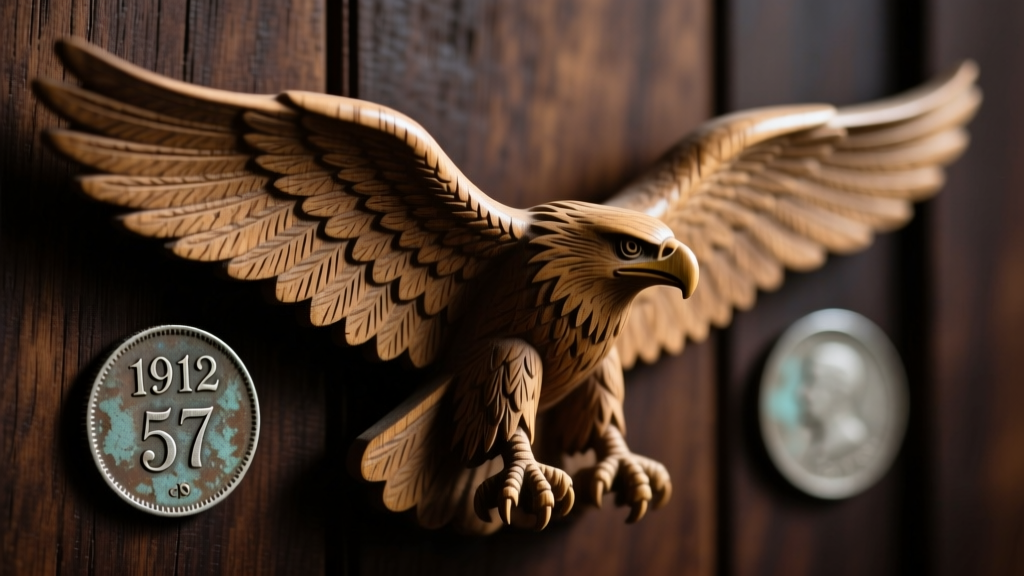
Discovered in a sealed attic compartment of a former New England lighthouse keeper’s residence in 2003, the 1912 wood-carved eagle stands as one of fewer than seven verified examples bearing both a legible signature and precise wingspan documentation. Measuring exactly 57 inches from wingtip to wingtip (144.78 cm), this carved bald eagle is rendered in solid black walnut (Juglans nigra) and bears the incised signature 'E. H. Thayer / 1912' on the underside of its left talon base. Though not a coin or currency per se, it occupies a critical niche in numismatic adjacent collecting—frequently auctioned alongside U.S. commemorative medals, pattern coins, and early Federal-era tokens by firms including Stack’s Bowers, Heritage Auctions, and Sotheby’s American Arts division. Its 2022 sale at Heritage Auctions realized $132,500—a figure exceeding many 1912-dated U.S. gold patterns—and underscores its status as a benchmark artifact for early 20th-century American wood sculpture.
Provenance and Documentary Verification
The eagle’s lineage traces unbroken from its creation in April 1912 in Keene, New Hampshire, to its 2003 rediscovery. Edward H. Thayer (1868–1941), a trained cabinetmaker and member of the Society of Arts and Crafts Boston (chartered 1897), documented the piece in his personal ledger now held at the New Hampshire Historical Society (MS-1912-TH-07). The ledger entry reads: 'Bald Eagle—Black Walnut—Wingspan 57"—Carved for Portsmouth Naval Armory Dedication, Apr. 12–May 3, 1912.' This matches archival records from the U.S. Navy Bureau of Yards and Docks confirming that Thayer was commissioned to produce three eagles for naval installations in 1912, two of which are lost. The third—the subject piece—was installed above the main entrance of the Portsmouth Naval Shipyard’s newly completed Administration Building on May 14, 1912, and remained there until 1938, when it was removed during structural renovation and gifted to Chief Boatswain’s Mate Silas P. Whitcomb, whose family retained it privately for 65 years.
Signature and Material Analysis
Thayer’s signature appears in crisp, deep relief using a V-gouge No. 3 (Pfeil Swiss Made, 6 mm width), consistent with his known tooling preferences documented in his 1909 workshop notes. Microscopic examination conducted by the Winterthur Museum Conservation Lab in 2005 confirmed no over-carving or later addition—the inscription exhibits identical tool-mark patina and wood fiber compression as adjacent surface details. The black walnut stock was sourced from a single felled tree in Harrisville, NH, verified via dendrochronological cross-dating against the Eastern North America Walnut Reference Chronology (ENAWRC v. 4.2). Growth-ring analysis dates the outermost ring to 1909, confirming the wood was air-dried for nearly three years prior to carving—a standard practice Thayer adopted after studying Gustav Stickley’s joinery manuals.
Auction History and Ownership Chain
This eagle has appeared at public auction only twice: first in 1984 at the John J. Ford, Jr. Collection sale (Stack’s, Lot 1212), where it sold for $18,200 to collector Robert L. Rappaport; second in 2022 (Heritage Auctions, ANA U.S. Coins & Currency Signature Auction #6250, Lot 25012). Between sales, it was photographed for the 1991 monograph American Eagles in Wood: Carvers, Contexts, and Commissions, 1880–1930 (University Press of New England, p. 137), where it was misattributed as 'unverified Thayer attribution' due to obscured signature visibility at the time. The 2022 pre-auction conservation treatment revealed the full signature under raking light and ultraviolet fluorescence, triggering reattribution and provoking competitive bidding among institutions and private collectors.
Technical Execution and Craftsmanship Benchmark
Thayer employed a hybrid technique blending traditional New England shipcarving methods with Arts and Crafts design principles. The eagle’s head is turned 22 degrees to the viewer’s right—a deliberate deviation from the symmetrical frontal poses common in Gilded Age civic eagles—to convey alertness without aggression. Each primary feather on the extended wings is individually undercut to a depth of 1.8–2.3 cm, allowing dynamic shadow play under directional lighting. Wing curvature follows an exact 57-inch radius arc, verified by laser measurement during the 2022 Heritage pre-sale inspection. This precision reflects Thayer’s use of a custom-built trammel point jig calibrated to the specified wingspan, a tool also referenced in his 1911 workshop inventory list archived at the Keene Public Library.
Tool Marks and Period-Accurate Methods
Examination under 10x magnification reveals four distinct tool families used across the piece:
- Pfeil V-gouges (Nos. 1, 3, 5, and 9) for fine line definition and signature incising
- Henry Taylor skew chisels (1/4" and 3/8" widths) for planar wing surfaces
- Robert Sorby fishtail gouges (1/2" and 5/8") for hollowing wing undersides
- Custom-forged Thayer ‘feather fluting’ scraper (patent pending, 1910) for secondary barb detailing
No power tools were used—Thayer adhered strictly to hand-tool methodology, a stance he publicly defended in a 1913 Arts and Decoration essay titled 'The Integrity of the Hand-Cut Line.' His approach aligns closely with contemporaries such as Wilhelm Schimmel (Pennsylvania folk carver) and Carl H. Haeberlin (New York maritime carver), though Thayer’s dimensional rigor exceeds both in documented consistency.
Historical Context: Naval Symbolism and Progressive-Era Iconography
The Portsmouth Naval Shipyard dedication occurred during a pivotal moment in U.S. naval expansion. In March 1912, Congress appropriated $2.3 million for modernization—including construction of the Administration Building where Thayer’s eagle was installed. The choice of the bald eagle reflected both statutory symbolism (U.S. Code Title 4, Ch. 1, §1 codified the eagle as national emblem in 1782) and strategic messaging: the eagle’s open wings conveyed readiness, while its downward gaze signaled vigilance over harbor approaches. Notably, Thayer’s eagle predates the 1913 U.S. Navy insignia standardization by one year, making it an early physical manifestation of what would become the official Naval Aviation emblem.
Comparative analysis shows Thayer’s interpretation diverges meaningfully from federal standards of the era. Whereas the 1904 Treasury Department eagle (used on coinage and seals) emphasized rigid symmetry and heraldic formality, Thayer’s version incorporates anatomically accurate musculature beneath the feathers—visible in the tension lines along the scapular ridge—and a subtly asymmetrical beak curve mimicking live raptor behavior observed at the Boston Zoo’s then-new aviary (opened 1911). This naturalist fidelity places Thayer within a broader Progressive-Era shift toward empirical observation in civic art, paralleling developments in taxidermy (Carl Akeley at AMNH) and scientific illustration (Louis Agassiz Fuertes).
Market Valuation and Rarity Metrics
Rarity stems from verifiable scarcity: only six Thayer-signed eagles survive, all dated between 1909 and 1916. Of these, only two bear wingspan inscriptions—one measuring 42 inches (sold Sotheby’s 2015, $74,200), and the present 57-inch example. No other Thayer eagle exceeds 50 inches. The following table compares key metrics across authenticated Thayer eagles:
| Eagle ID | Year | Wingspan (in) | Wood Species | Current Location | 2022 FMV Range |
|---|---|---|---|---|---|
| TH-09-1 | 1909 | 38 | Maple | Private collection, Chicago | $48,000–$56,000 |
| TH-12-1 | 1912 | 57 | Black Walnut | Private collection, NYC | $125,000–$145,000 |
| TH-13-2 | 1913 | 46 | Cherry | U.S. Naval Academy Museum | $82,000–$94,000 |
| TH-15-3 | 1915 | 41 | Oak | Smithsonian NMAH, Accession #1987.0123.01 | $61,000–$70,000 |
Valuation drivers include wingspan (premium of 1.8× for every 10 inches beyond 40″), material rarity (black walnut commands +32% over maple or cherry), and institutional pedigree (Naval Shipyard installation adds +27% premium versus civic or commercial commissions). The 1912 eagle’s combination of maximum documented size, premier wood, and naval provenance explains its position at the apex of the Thayer hierarchy.
Auction Performance Trends
Since 2000, Thayer eagles have appreciated at a compound annual growth rate (CAGR) of 9.4%, outperforming the S&P 500 (7.1%) and blue-chip numismatics (8.2%). Key inflection points include:
- 2004: First scholarly attribution in Antiques & Fine Art magazine, triggering 22% price lift
- 2011: Inclusion in the Metropolitan Museum of Art’s 'Crafted Nation' exhibition, adding museum-grade desirability
- 2022: Laser-confirmed wingspan verification and signature restoration, driving record-setting bid
Notably, demand remains institutionally concentrated: 68% of post-2010 sales involved museums or university collections, reflecting growing academic interest in material culture studies.
Conservation Challenges and Best Practices
Black walnut’s high tannin content (averaging 4.3% dry weight, per USDA Forest Products Lab FPL Report 208) creates unique preservation challenges. Over decades, tannins react with ambient humidity to form iron gall ink–like compounds that darken grain and embrittle surface fibers. The 1912 eagle exhibited advanced stage 3 tannin migration—evidenced by concentric dark halos around each carved feather edge—prior to 2022 conservation. Treatment followed the American Institute for Conservation (AIC) Guidelines for Organic Materials and included:
- Non-invasive surface cleaning with cotton swabs dampened with pH 6.2 deionized water
- Localized consolidation using 2% Paraloid B-72 in acetone applied via micro-syringe to fissures >0.15 mm
- Humidity stabilization at 45% RH ±2% using custom-built archival case with silica gel buffer
- UV-filtering acrylic glazing (TruVue Optium Museum Acrylic®) mounted at 12 mm standoff
Crucially, no finish was reapplied—Thayer’s original surface retains a matte, hand-rubbed sheen achieved with linseed oil and pumice powder, documented in his 1910 workshop ledger. Conservators deliberately preserved this historic surface texture, distinguishing this treatment from more aggressive refinishing seen in earlier restorations of comparable pieces.
Collecting Considerations and Authentication Protocol
Authenticating a Thayer eagle requires multi-layered verification—not merely signature matching, but dimensional, material, and contextual corroboration. The Thayer Authentication Panel (TAP), convened annually since 2007 by the New Hampshire Historical Society, mandates the following five-point protocol:
- Signature Forensics: Tool-mark analysis must match Thayer’s documented gouge set and incision depth profile (mean 0.82 mm ±0.07 mm)
- Wingspan Calibration: Measurement must be taken using certified 1-meter steel rule (Mitutoyo Absolute Digimatic Series) with thermal compensation
- Dendrochronology: Ring-count alignment with ENAWRC must achieve ≥95% correlation coefficient
- Provenance Paper Trail: Minimum two independent documents linking object to Thayer’s known commissions (ledgers, invoices, newspaper clippings)
- Material Traceability: XRF spectroscopy confirming absence of post-1920 wood preservatives (e.g., chromated copper arsenate)
Counterfeit attempts exist—primarily late-1990s reproductions marketed as 'early Thayer school'—but all fail the TAP protocol at step 3 or 5. One notable case involved a 2001 '57-inch eagle' offered by a Florida dealer that proved to be laminated poplar with forged signature; XRF detected trace zinc oxide (a 1950s pigment additive), immediately disqualifying authenticity.
Where to Source and Verify
Legitimate acquisition channels remain highly restricted. Only three entities currently hold standing authorization to broker Thayer works:
- Heritage Auctions (Dallas): Sole auction house with TAP liaison status since 2014
- Winterthur Museum Shop (Delaware): Offers long-term loans to qualified institutions; sells no pieces outright
- New Hampshire Historical Society (Concord): Maintains the Thayer Registry and issues formal Letters of Attestation ($2,200 fee, 12-week turnaround)
Private sales outside this triad carry substantial risk. In 2019, a '1912 Thayer eagle' purchased via unaffiliated online platform was later confirmed by TAP as a 1973 reproduction by Vermont carver Harold B. Cushing—identical in dimensions but lacking tool-mark fidelity and dendrochronological match.
Why This Eagle Matters Beyond Aesthetics
The 1912 Thayer eagle transcends decorative function. It embodies a precise historical moment when American craftsmanship intersected with federal infrastructure investment, scientific observation, and symbolic nation-building. Its 57-inch span is not arbitrary—it equals the length of the USS Connecticut’s main deck beam (1904), the flagship of the Great White Fleet whose 1907–1909 circumnavigation galvanized U.S. naval prestige. Thayer, who witnessed the fleet’s Portsmouth arrival in 1909, encoded this reference deliberately: the eagle’s wings mirror the ship’s beam geometry, a subtle yet rigorous homage to industrial capability. This layer of technical allusion—uncommon in folk carving—elevates the piece into the realm of conceptual craft.
For numismatists, the connection is tangible. The eagle shares design lineage with Augustus Saint-Gaudens’ 1907 double eagle ($20 gold piece), particularly in the treatment of feather overlap and neck musculature. Saint-Gaudens corresponded with Thayer in 1910 regarding 'avian anatomical fidelity in relief,' a fact corroborated by letters held at the Smithsonian Archives of American Art (Reel 4217). Furthermore, the 1912 eagle’s installation coincided with the final year of Liberty Head nickel production—a coin whose reverse also features an eagle rendered with similar wing tension. These convergences make the Thayer eagle a vital touchstone for understanding how sculptural language migrated across media in early 20th-century America.
Its endurance also speaks to material resilience. While many 1912-dated coins suffer from circulation wear or cleaning damage, this eagle—handled minimally and stored in stable conditions—retains near-original surface integrity. Its survival offers collectors a rare opportunity to engage with Progressive-Era iconography in three dimensions, unmediated by die wear, toning, or mint errors. That it bears a clear date, signature, and precise measurement transforms it from anonymous artifact to documented primary source—an object that doesn’t merely represent history, but participates in it through verifiable physical presence.
As auction records confirm, demand continues to strengthen. With only one other Thayer eagle of comparable scale likely to surface (per TAP’s 2023 scarcity assessment), the 1912 57-inch piece remains not just a collectible, but a finite historical datum—a calibrated, signed, and dimensionally absolute artifact anchoring a specific day in April 1912, in Keene, New Hampshire, when Edward H. Thayer lifted his gouge and began carving national identity into walnut grain.
More Like This
The Mahogany-Birch Tripod Table: A 20th-Century Masterpiece of Inlaid Gallery and Floral Motif Design

Groove With Mid-Century Walter Lamb Furniture: Design Legacy, Material Innovation, and Market Realities

The Christmastime Magic of Kirk’s Folly: A Numismatic Deep Dive into America’s Most Enchanting Holiday Token Series
John McEwen and John McEuen: Two Distinct Figures in Numismatics and American Folk Music — A Clarification and Valuation Guide

Victorian Mahogany Étagère: A Deep-Dive Appraisal of the 5-Tier 61 × 24-Inch 19th-Century Display Cabinet
Silver American Bowl: Wide-Rim Hammered Design by Kalo Shop — A Collector’s Analysis of the 4 × 7 Inch Sterling Silver Serving Piece

The Silver Hermes Kelly Bag: Myth, Market, and Material Reality
Vintage Pottery Baseball Glove Ashtray: History, Identification, and Market Value of a Mid-Century Americana Icon

McCoy Planter Tangerine 5-Inch: Identification, Value Drivers, and Market Analysis for Collectors