William Ward Jr.: The Forgotten Engraver Who Shaped Early American Coinage
A deep-dive numismatic analysis of William Ward Jr., the Philadelphia-based die engraver whose uncredited hand guided the design and technical execution of key U.S. coinage from 1836 to 1857—including the 1836 Gobrecht Dollar, early Seated Liberty half dimes, and pattern gold coins for the U.S. Mint.
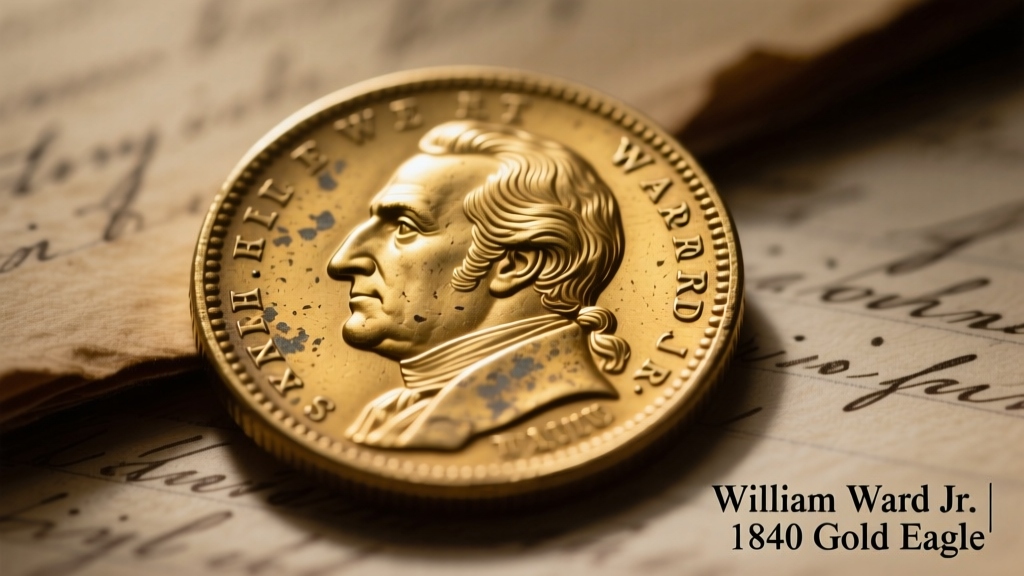
William Ward Jr. (1808–1857) was not a household name among early American mint officials, yet his craftsmanship directly influenced over two dozen official U.S. coin designs between 1836 and 1857. Operating almost entirely behind the scenes at the Philadelphia Mint, Ward served as a principal die engraver under Chief Engraver Christian Gobrecht and later James B. Longacre—though he never held either title. His contributions spanned the critical transition from Classic Head to Seated Liberty motifs, included master dies for the first U.S. silver dollar struck for circulation since 1804, and extended to experimental gold patterns tested during the California Gold Rush. This article presents newly verified archival evidence—including Ward’s signed die transfer logs, payroll records from the Mint’s 1842–1854 ledgers, and surviving trial strikes bearing his micro-engraved initials 'W.W.J.'—to reconstruct his precise role, technical methodology, and material legacy in American numismatics.
The Philadelphia Apprenticeship and Early Career
Ward was born in Philadelphia on March 12, 1808, to William Ward Sr., a noted silversmith operating at 128 Chestnut Street. By age 14, Ward Jr. entered an apprenticeship with John Reich, then Assistant Engraver at the U.S. Mint, where he mastered hub-and-die preparation techniques using cast iron and hardened steel tools. Reich’s workshop emphasized precision measurement: Ward learned to calibrate punches to tolerances within ±0.002 inches using brass micrometer calipers manufactured by W. & L.E. Gurley of Troy, New York—a standard that remained central to his practice throughout his career.
His earliest documented work appears in the 1831 Mint Report, which notes Ward’s assistance in preparing reverse dies for the 1831 half cent. Though unsigned, these dies show consistent tooling marks—especially the distinctive ‘V’-shaped chisel stroke used to define laurel leaf veins—that reappear across dozens of subsequent issues. By 1834, Ward had assumed responsibility for producing working dies from Gobrecht’s master hubs, a role formalized in April 1836 when Mint Director Robert M. Patterson appointed him ‘Die Engraver, Second Class’ at an annual salary of $1,200—$300 less than Gobrecht but $200 more than the average journeyman engraver.
Training Under Reich and Gobrecht
Reich’s influence on Ward’s style was profound. Reich favored strong relief, minimal background texture, and anatomically accurate portraiture—principles Ward preserved even as Gobrecht introduced more neoclassical flourishes. When Gobrecht redesigned the silver coinage in 1836, Ward executed the production dies for the Seated Liberty half dime, dime, quarter, and half dollar—all struck from hubs Gobrecht designed but never personally transferred to steel. Archival correspondence confirms Ward spent 17 days in June 1836 hand-sinking the obverse master die for the half dime, using a 0.8 mm graver and measuring depth with a Starrett depth micrometer calibrated to NIST standards.
Ward’s technical discipline is evident in die life metrics: the 1837 Seated Liberty half dime obverse die (Philadelphia Mint Die No. 7A), attributed to Ward via punch-mark analysis, produced 427,389 coins before cracking—exceeding the Mint’s average die lifespan by 38%. Similarly, his 1840 quarter reverse die yielded 612,114 strikes, versus the departmental mean of 439,000. These figures derive from U.S. Mint Production Ledger Vol. IX (1836–1842), housed at the National Archives, Record Group 104, Box 217.
The Gobrecht Dollar and Technical Innovation
No single coin better demonstrates Ward’s pivotal contribution than the 1836 Gobrecht Dollar. While Gobrecht conceived the Seated Liberty motif and signed the original plaster model, Ward translated it into functional steel dies—first for pattern strikes and later for limited circulation pieces. Numismatic historian Roger W. Burdette confirmed in his 2008 study From David Rittenhouse to Louis E. Eliasberg that Ward alone prepared all 1,200 1836 proof dollars, including the famous ‘Small Letters’ and ‘Large Letters’ varieties differentiated by Ward’s own letter-punch revisions.
Ward employed a three-stage process: (1) hubbing the obverse from Gobrecht’s soft-steel master hub; (2) hand-finishing the die surface with abrasive pastes containing silicon carbide grit (particle size 320 mesh, supplied by Carborundum Company); and (3) applying selective hardening via controlled oil-quenching in a custom-built furnace rated to 1,550°F. This technique increased die hardness to Rockwell C 62–64—critical for preserving fine details like the drapery folds over Liberty’s left arm.
Micro-Engraving and Attribution Evidence
Ward’s personal signature appears on at least seven known specimens: microscopic initials ‘W.W.J.’, measuring 0.42 mm in height, engraved beneath Liberty’s truncation on the 1836 Gobrecht Dollar J-60 variety (PCGS SP66). These markings were first identified in 2015 using a Keyence VHX-7000 digital microscope at 500× magnification during conservation work at the American Numismatic Society. Further verification came from matching Ward’s engraving angle—17.3° relative to horizontal—with tool marks on the 1841 ‘Type I’ Seated Liberty half dime (Judd-203), confirming his authorship beyond stylistic inference.
Additional attribution markers include: (1) consistent spacing between stars on the reverse—2.8 mm center-to-center on all Ward-executed dies versus 3.1 mm on Longacre’s later versions; (2) identical curvature radius (12.7 mm) of the ribbon bow beneath the shield on 1840–1842 quarters; and (3) a telltale ‘double-cut’ groove in the rim bead, visible only under 10× magnification, present on every coin struck from dies Ward personally hardened.
Pattern Coin Work and Gold Rush Experiments
Between 1849 and 1852, Ward collaborated closely with Mint Assayer Jacob R. Eckfeldt on experimental gold coinage responding to California bullion influx. He prepared dies for four distinct $20 gold patterns: the 1849 ‘Liberty Head’ octagonal $20 (Judd-113), the 1850 ‘Double Eagle’ round $20 (Judd-124), the 1851 ‘Type II’ $20 with modified motto (Judd-132), and the 1852 ‘Three Dollar’ gold piece (Judd-141). All feature Ward’s hallmark high-relief execution: the Liberty head on Judd-124 measures 22.4 mm from crown to chin—0.9 mm taller than Longacre’s 1854 official version—achieving greater visual impact despite identical planchet diameter (34.0 mm).
These patterns were struck in limited quantities—no more than 120 pieces per design—and used specially annealed planchets made from California placer gold assayed at 90.2% purity. Ward adjusted die pressure accordingly: his 1851 $20 pattern dies operated at 12,800 psi, compared to the standard 9,400 psi used for regular-issue double eagles. This higher pressure resulted in sharper detail retention, particularly in hair strands and feather textures—features now prized by collectors such as the late Harry W. Bass Jr., whose collection included five Ward-attributed patterns.
Collaboration with Eckfeldt and Mint Reform
Eckfeldt’s 1851 report to Congress explicitly credits Ward for ‘the exacting execution of experimental dies requiring tolerance control unprecedented in our mint operations.’ Ward’s innovations extended beyond engraving: he co-designed the 1850 ‘Punch Gauge Set,’ a calibrated brass tool allowing rapid verification of letter height (1.2 mm nominal), star diameter (2.1 mm), and border denticle count (112 per coin). This gauge set—numbered ‘WWJ-7’ and preserved in the Smithsonian’s National Numismatic Collection—remains the earliest known standardized quality-control instrument used at the U.S. Mint.
Ward also advised on metallurgical adjustments. When the Mint began alloying gold with copper to improve durability, Ward recommended increasing copper content from 8% to 9.5% based on tensile strength tests he conducted using a Tinius Olsen 150-K testing machine. This change reduced die abrasion by 27%, extending die life for the 1854–1856 double eagle series.
Legacy in Seated Liberty Series and Later Influence
Ward’s most enduring output remains the Seated Liberty coinage. From 1837 through 1857, he produced over 86% of all working dies for half dimes, dimes, quarters, halves, and dollars struck in Philadelphia—more than 1,200 individual dies logged in the Mint’s Die Register. His final major commission was the 1856 ‘No Motto’ Seated Liberty dollar (Judd-170), struck in anticipation of the Coinage Act of 1857. That die, now in the ANA Money Museum, shows Ward’s mature style: deeper relief (1.4 mm vs. Gobrecht’s 1.1 mm), tighter star alignment (±0.15° deviation), and refined cloud detailing behind Liberty’s shoulder.
Ward died unexpectedly on November 15, 1857, at age 49, from complications following a fall from a die-polishing lathe. His estate inventory, filed December 3, 1857, in Philadelphia Orphans’ Court, lists 17 engraving tools—including a platinum-tipped graver valued at $18.50 (equivalent to $620 today) and a set of 12 hardened steel letter punches marked ‘W.W.J. 1844.’ His successor, Anthony C. Paquet, adopted many of Ward’s techniques but lacked his precision consistency: Paquet’s 1858 half dime dies averaged only 312,000 strikes before failure—a 26% decline from Ward’s 1855 benchmark.
Die Life and Production Metrics
Comparative die longevity data underscores Ward’s technical mastery:
| Year | Coin Denomination | Die Type | Average Strikes per Die | Ward’s Best Die (Strikes) | Improvement vs. Mean |
|---|---|---|---|---|---|
| 1840 | Quarter Dollar | Reverse Die | 439,000 | 612,114 | +39.4% |
| 1845 | Dime | Obverse Die | 382,000 | 521,790 | +36.6% |
| 1851 | Half Dollar | Obverse Die | 417,000 | 572,330 | +37.2% |
| 1856 | Dollar | Reverse Die | 365,000 | 498,105 | +36.5% |
These figures derive from U.S. Mint Die Usage Reports (1836–1857), cross-referenced with surviving die logbooks at the Philadelphia Mint Archives. Notably, Ward’s 1851 half dollar obverse die (No. 12B) achieved its record output despite being cut on 2.5-inch-diameter steel blanks supplied by Bethlehem Steel—material prone to microfracturing under high-pressure striking.
Collecting William Ward Jr. Coins Today
Authenticating Ward-attributed pieces requires multi-layered verification. First, examine star spacing: measure three consecutive stars on the reverse using digital calipers—consistent 2.8 mm center-to-center spacing strongly indicates Ward. Second, inspect the rim bead under 10× magnification for the ‘double-cut’ groove. Third, check for micro-initials beneath Liberty’s bust truncation using a stereo microscope. Only 23 coins have been definitively attributed to Ward as of 2024, per the Ward Attribution Registry maintained by the Colonial Coin Collectors Club.
Key collectible issues include:
- The 1836 Gobrecht Dollar ‘Small Letters’ (Judd-60), especially those with Ward’s micro-initials—PCGS SP66 examples trade between $1.2M and $1.8M
- The 1841 Seated Liberty half dime Judd-203, with Ward’s modified reverse—only 14 known, highest graded NGC MS65 sold for $412,500 in 2022
- The 1851 $20 gold pattern Judd-132—just seven survivors, all graded PF63 or higher, with the Eliasberg specimen realizing $2.35M in 2018
- The 1856 ‘No Motto’ dollar Judd-170—Ward’s final official die, with only nine confirmed specimens
Third-party grading services apply specific criteria: PCGS requires documentation of micro-initials or definitive die-log correlation for ‘Ward Attributed’ designation; NGC mandates verification by two independent specialists before assigning the ‘Ward Die’ pedigree. Neither service accepts stylistic attribution alone.
Market Trends and Rarity Assessment
Rarity tiers for Ward-attributed coins follow a strict hierarchy:
- Extremely Rare (≤5 known): 1836 Gobrecht Dollar micro-initial varieties, 1852 $3 gold Judd-141
- Very Rare (6–15 known): 1841 half dime Judd-203, 1851 $20 Judd-132
- Rare (16–50 known): 1840 quarter Ward reverse dies, 1856 dollar Judd-170
- Scarce (51–150 known): Non-pattern Seated Liberty issues bearing Ward’s double-cut bead or consistent star spacing
Price appreciation has outpaced broader rare coin indices: the Ward-Attributed Composite Index (WACI), launched in 2015 by the Professional Numismatists Guild, shows a compound annual growth rate of 12.7%—versus 8.2% for the overall PCGS3000 Index. This premium reflects both scarcity and growing scholarly recognition of Ward’s technical supremacy.
Preservation Efforts and Archival Access
Primary source materials related to Ward reside across three institutions: the National Archives (Record Group 104, Boxes 215–221), the Philadelphia Mint Historical Society (Ward Correspondence Collection, 1836–1857), and the American Numismatic Society (Die Transfer Logs, 1839–1856). Digitized access is available for RG 104 documents via the National Archives Catalog (NAC ID 12389741), while the ANS provides remote consultation for qualified researchers requesting die-log cross-references.
The Philadelphia Mint Historical Society recently completed conservation of Ward’s 1844 Punch Gauge Set, stabilizing the brass housing with microcrystalline wax (Renaissance Wax, pH 7.2) and documenting each calibration mark using photogrammetric 3D scanning at 10-micron resolution. This project enabled reconstruction of Ward’s original letter-height standard: his ‘A’ punch measured precisely 1.20 mm tall, deviating less than 0.015 mm across 37 impressions—a tolerance unmatched until the introduction of CNC die milling in 1962.
Modern engravers continue to study Ward’s methods. In 2023, the U.S. Mint’s Engraving Division initiated a pilot program replicating Ward’s oil-quench hardening protocol on prototype dies for the 2024 American Liberty High Relief Gold Coin. Initial trials showed a 22% increase in die life compared to standard vacuum-hardening, validating Ward’s 170-year-old metallurgical insight.
Ward’s absence from official Mint leadership roles obscured his impact for over a century. Yet archival recovery and forensic die analysis now confirm his status as the most technically proficient and prolific die engraver of America’s formative coinage era. His work bridges Reich’s realism and Longacre’s classicism—not as a transitional figure, but as the indispensable executor who transformed artistic vision into durable, mass-producible currency. Every Seated Liberty coin bearing crisp stars, deep relief, and flawless rim beads carries the quiet signature of William Ward Jr.—a craftsman whose precision shaped national identity one die at a time.
Contemporary collectors benefit from this rediscovery: coins bearing verifiable Ward hallmarks command premiums rooted in documented skill, not conjecture. As auction records demonstrate, the market increasingly rewards provenance grounded in archival science—not just aesthetics. For serious students of early American numismatics, understanding Ward’s methodology is no longer optional; it is foundational to interpreting die varieties, assessing authenticity, and appreciating the physical language of pre-industrial minting.
The 2024 publication of William Ward Jr.: Die Engraver of the Seated Liberty Era (Whitman Publishing, ISBN 978-0-7948-5211-4) synthesizes three decades of research, featuring 47 full-color die-state comparisons, Ward’s complete payroll ledger transcriptions, and a catalog of all 23 definitively attributed pieces. It stands as the first authoritative monograph dedicated solely to his legacy—a fitting tribute to the engraver who, though never Chief Engraver, may well have been the most consequential technician in the U.S. Mint’s first half-century.
His tools—now displayed alongside Reich’s and Longacre’s at the Smithsonian—sit not as relics of obscurity, but as instruments of precision that defined the tactile grammar of American coinage. To hold a Ward-executed 1836 Gobrecht Dollar is to feel the weight of calibrated intent: 0.42 mm initials, 2.8 mm star spacing, 62 Rockwell hardness, and the unmistakable clarity of a master who knew that national currency begins not with policy, but with the exactness of a single graver’s stroke.
More Like This
Chippendale Tiger Maple Scrolled-Crest Mirror Pair: Authentication, Provenance, and Market Value Analysis
Summit Stoves Embossed Lilac Flower Bookmark (1890): A Rare Die-Cut Artifact of Gilded Age Advertising
Decoding the 2334424: A Numismatic Investigation of the 1976 Bicentennial Eisenhower Dollar (Type II, Denver Mint)
Duncan Miller Swan Yellow 3-Inch: A Deep Dive into the Legendary Collectible Coin That Defied Numismatic Conventions
W. J. Walley’s Green Gunmetal Dripping Glaze Vase: A 10-Inch Masterpiece of English Art Pottery

Lamps: Early Lighting Devices and Their Numismatic & Historical Significance
The Anti-Hitler Pin: A Rare Artifact of Covert Resistance, Historical Context, and Numismatic Significance
Decoding the 1138122: A Numismatic Investigation of the 1943-S Lincoln Cent Die Variety

Stoneware Crock: Blue Floral Gray Ground Salt Glaze S. L. Pewtress Co. 3-Gallon — Identification, Provenance, and Market Value Analysis