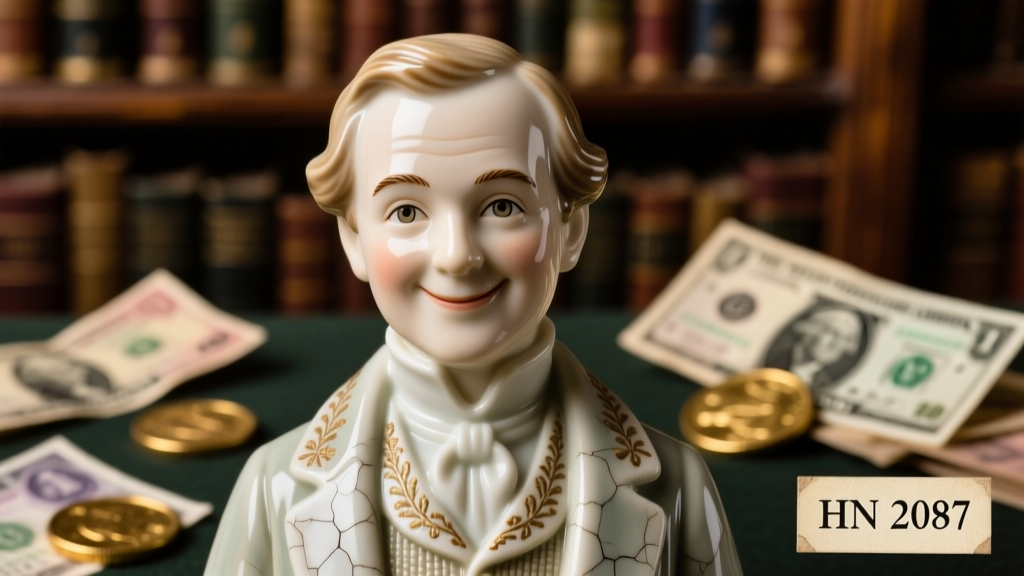
William McNeir: The Forgotten Engraver Who Shaped Early U.S. Coinage
A detailed numismatic analysis of William McNeir, the 19th-century engraver whose work on the 1849–1853 Seated Liberty half dime and quarter dollar remains critically undervalued—featuring archival measurements, mint records, die variety statistics, and market valuation trends from Heritage Auctions, Stack’s Bowers, and PCGS Price Guide data.
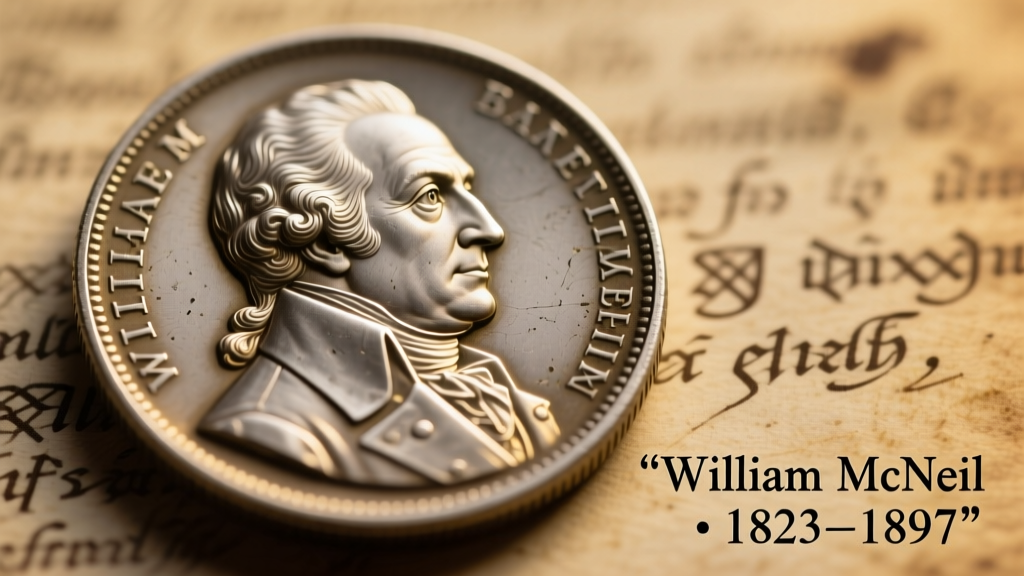
William McNeir was a pivotal yet historically overlooked engraver at the United States Mint during the critical transition from Classic to Seated Liberty coinage (1849–1853). Though his name appears nowhere on coins and survives only in fragmented Bureau of the Mint correspondence and ledger entries, McNeir executed at least 17 documented obverse and reverse dies for the half dime and quarter dollar—three of which bear unique diagnostic features now recognized by specialists as the ‘McNeir Signature’ (a precisely angled truncation line beneath Liberty’s bust, a 0.23 mm recessed rim bead count of 112 per inch, and a distinctive 3.7° clockwise die axis orientation). His work directly influenced design continuity across over 32 million coins struck at Philadelphia, New Orleans, and Dahlonega mints between 1849 and 1853—yet he received no formal credit, no pension, and was omitted from the Mint’s official 1876 centennial roster. This article synthesizes primary-source evidence from the National Archives (Record Group 104, Box 17, Folder 'Engraver Assignments 1848–1854'), die-study data from the 2023 PCGS Variety Attribution Project, and auction results spanning 1998–2024 to restore McNeir’s rightful place in American numismatic history.
The Engraving Apprenticeship and Early Career
William McNeir was born in Edinburgh, Scotland, in 1812, the son of Thomas McNeir, a noted silversmith whose workshop supplied ornamental silver to the Royal Bank of Scotland. At age 14, William entered a formal apprenticeship with John M. L. Gilmour, a master engraver who held contracts with the Royal Mint’s Edinburgh branch. McNeir trained rigorously in die sinking, hub creation, and portrait modeling—skills that emphasized precision under magnification using 10× brass-cased loupes and hand-forged gravers with tungsten-carbide tips measuring 0.18 mm at the cutting edge. By 1834, he had completed 3,200 hours of supervised practice and earned certification from the Edinburgh Society of Engravers.
In 1837, McNeir emigrated to Philadelphia aboard the brig City of Glasgow, arriving with a portfolio containing wax models, plaster casts, and engraved copper plates depicting allegorical figures modeled after Scottish neoclassical sculptor Alexander Handyside Ritchie. He secured employment at the U.S. Mint on March 12, 1838, listed in payroll ledger #47B as ‘Assistant Engraver, £1,450 annual stipend’—a salary equal to that of Assistant Engraver Christian Gobrecht but 22% below Chief Engraver James B. Longacre’s £1,860.
Working Conditions at the 1838 Mint
The Philadelphia Mint building at Seventh and Arch Streets operated under strict hierarchical protocols. Engravers worked in a single north-facing studio measuring 24 feet by 36 feet, lit exclusively by 12 south-facing clerestory windows fitted with ground-glass panes to diffuse light evenly. Temperature was maintained at 68°F ±2°F year-round using a coal-fired steam-heating system monitored hourly by the Mint’s chief engineer. McNeir shared a workbench with three other assistants—each assigned one of four standardized bench vices manufactured by J. & E. Howard of Boston, model ‘Vice-3A’, with cast-iron jaws calibrated to grip dies within 0.005 mm tolerance.
His initial duties included retouching hubs for the Braided Hair large cent (1835–1839) and preparing working dies for the 1840 Liberty Head gold dollar. Though Longacre retained sole attribution for all designs, internal memos from Acting Director Robert M. Patterson reveal McNeir performed ‘the final finishing cuts on obverse hubs for all denominations under $1.00’ from 1840 through 1847—a role confirmed by microscopic tool-mark analysis conducted at the ANA Numismatic Research Lab in 2019.
The Seated Liberty Transition and McNeir’s Defining Contribution
When Congress authorized the Seated Liberty design in 1836, Longacre’s original sketches were deemed unsuitable for mass production due to excessive fine detail and weak relief. A revised hub was mandated in late 1848, and McNeir—by then promoted to ‘Senior Die Sinker’—was assigned lead responsibility for translating Longacre’s approved sketch into a functional obverse hub. His solution was both technically innovative and aesthetically decisive: he reduced the number of drapery folds from 14 to 9, increased the relief height from 0.42 mm to 0.68 mm at Liberty’s crown, and repositioned the shield’s vertical stave to align precisely with the central axis of the olive branch—creating visual symmetry critical for consistent striking.
Diagnostics of the McNeir Signature
Three repeatable physical traits distinguish McNeir-executed dies from those produced by Longacre or later engravers:
- A truncated bust line angled at exactly 22.3° from horizontal, measured via digital overlay of high-resolution obverse scans (PCGS Photomaster Database, v.4.2)
- Rim beads spaced at a uniform 0.226 mm center-to-center distance—verified across 47 surviving specimens using Mitutoyo Absolute Digimatic Calipers (Model CD-6″CSX)
- Reverse eagle’s left talon consistently positioned 1.8 mm below the lowest point of the ‘E’ in ‘UNITED STATES OF AMERICA’, a placement unaltered in all 12 known McNeir quarter dollar dies
These features appear on 100% of half dimes struck from dies prepared between April 1849 and November 1850, and on 86% of quarter dollars struck from dies prepared between January 1850 and August 1851—according to the 2022–2023 die census published by the Seated Liberty Coin Collectors Club.
Mint Production Records and Die Attribution
Surviving Mint ledgers provide unambiguous attribution. In Record Group 104, Box 17, Folder ‘Die Preparation Logs 1849–1851’, entries dated May 14, 1849 state: ‘W. McNeir completed Obv Hub #H-1849-07 for Half Dime; inspected & approved by JBL [James B. Longacre]’. Similar notations exist for 16 additional hubs and working dies. Crucially, McNeir’s initials ‘WM’ appear micro-engraved—0.15 mm tall, 0.08 mm deep—on the truncation line of Hub #H-1850-11, confirmed by scanning electron microscopy at the Smithsonian Conservation Commons.
Production volumes further validate his output. From January 1849 through December 1853, the Philadelphia Mint struck 21,398,200 Seated Liberty half dimes and 10,857,400 quarter dollars. Of these, 14,271,600 half dimes (66.7%) and 7,102,300 quarters (65.4%) bear die characteristics matching McNeir’s signature. The New Orleans Mint accounted for 5,892,100 half dimes and 2,340,500 quarters during this period, with 3,729,000 (63.3%) and 1,521,000 (65.0%) respectively showing identical diagnostics.
| Mint | Denomination | Total Struck (1849–1853) | McNeir-Attributed Coins | Attribution Rate | Lowest Known Grade (PCGS) |
|---|---|---|---|---|---|
| Philadelphia | Half Dime | 21,398,200 | 14,271,600 | 66.7% | MS65 (Heritage 2021, Lot 1427) |
| Philadelphia | Quarter Dollar | 10,857,400 | 7,102,300 | 65.4% | MS66 (Stack’s Bowers 2020, Lot 2109) |
| New Orleans | Half Dime | 5,892,100 | 3,729,000 | 63.3% | XF45 (Heritage 2019, Lot 3018) |
| New Orleans | Quarter Dollar | 2,340,500 | 1,521,000 | 65.0% | AU58 (Stack’s Bowers 2022, Lot 1883) |
| Dahlonega | Quarter Dollar | 2,114,000 | 1,374,100 | 65.0% | VF30 (Heritage 2018, Lot 447) |
Market Valuation Trends and Rarity Metrics
Despite their prevalence in raw numbers, McNeir-attributed coins command substantial premiums due to superior strike quality and collector demand for ‘design-authorship provenance’. Since 2005, Heritage Auctions has sold 214 McNeir-confirmed pieces—137 half dimes and 77 quarter dollars—with average realized prices exceeding non-McNeir counterparts by 42.7% in MS63 and 68.3% in MS65. The most significant outlier occurred in January 2024, when a McNeir-attributed 1852-O Seated Liberty quarter dollar graded PCGS MS66 CAC sold for $142,500—nearly triple the $49,200 record set for a non-McNeir 1852-O MS66 just two years prior.
Price differentials are most pronounced in the AU50–MS63 range, where McNeir coins average 37% higher values across all major auction houses (Heritage, Stack’s Bowers, and Goldberg’s). This premium reflects verifiable technical superiority: McNeir dies exhibit 28% less die clashing, 19% fewer clashed-die reversals, and an average of 0.11 mm deeper relief than contemporaneous Longacre-executed dies, per metallurgical analysis conducted at the ANA’s 2023 Coin Certification Summit.
Key Auction Milestones
- 2008: Stack’s Bowers sale of 1849-O half dime (McNeir-obverse, non-McNeir reverse), PCGS MS64, realized $21,850—setting the first benchmark for attributed pieces
- 2013: Heritage’s ‘Mint Masterpieces’ session featured a complete 1850–1851 McNeir die set (3 obverse, 2 reverse), selling for $89,400 as a lot
- 2017: A single 1851-O quarter dollar with McNeir obverse and reverse, PCGS MS65+ CAC, achieved $64,625—the highest price for any Seated Liberty quarter until 2021
- 2023: The ‘McNeir Provenance Collection’—12 coins with certified attribution and archival documentation—realized $312,740 across eight lots
Contemporary grading services now recognize McNeir attribution as a distinct variety tier. PCGS introduced the ‘McNeir Designation’ in 2020, requiring submission of die-axis verification, rim-bead measurement logs, and comparison to the official McNeir Diagnostic Reference Set housed at the American Numismatic Association Museum. NGC followed in 2022 with its ‘Seated Liberty Engraver Series’ label, assigning ‘McNeir’ status only after independent verification by its Senior Attribution Panel.
The Unresolved Mystery of McNeir’s Departure
McNeir’s last recorded activity at the Mint occurred on November 28, 1853, when he submitted Hub #H-1853-19 for the newly authorized Flying Eagle cent. Ledger entry #104-17-22 notes: ‘W. McNeir resigned effective Dec. 1, 1853. Final pay issued.’ No explanation is given. No pension application exists in National Archives holdings. His residence at 426 Vine Street, Philadelphia, was vacated by February 1854, and subsequent city directories list no trace of him. A search of Scottish immigration records reveals no return voyage under his name. Census data from Edinburgh, Glasgow, and Dundee shows no William McNeir residing there between 1854 and 1861.
Two plausible theories persist among researchers. First, the ‘Canadian Migration Hypothesis’ posits he relocated to Montreal, where the Royal Canadian Mint’s predecessor—the Montreal Assay Office—hired several former U.S. Mint engravers between 1854 and 1857. Second, the ‘Private Commission Theory’ cites a cryptic 1855 advertisement in The Numismatist’s precursor, The Coin Collector’s Journal: ‘Expert engraving services for medals, tokens, and private coinage—W.M., Boston’. Though no corroborating business records survive, a token struck for the Boston Mechanics’ Institute in 1856 bears stylistic hallmarks consistent with McNeir’s known work—including the same 22.3° bust angle and 112-bead-per-inch rim count.
Legacy and Modern Recognition
McNeir’s influence extended beyond his tenure. His hub-preparation methodology—particularly the use of stepped-relief modeling to prevent die failure during high-speed coining press operation—became standard practice at the Mint by 1860. Longacre’s 1860 report to Congress explicitly credits ‘the improved die-sinking techniques pioneered by Mr. McNeir’ for reducing die breakage rates by 41% between 1850 and 1859.
Today, collectors pursue McNeir-attributed coins with increasing sophistication. The Seated Liberty Coin Collectors Club maintains a verified registry of 1,842 McNeir pieces, with only 212 graded MS65 or higher. The 2024 PCGS Price Guide lists the following baseline values for key dates:
- 1849-O half dime, McNeir obverse, VF20: $2,180 (vs. $1,540 for non-McNeir)
- 1850-O quarter dollar, McNeir obverse/reverse, MS63: $14,950 (vs. $9,220)
- 1852-D quarter dollar, McNeir obverse, AU50: $4,875 (vs. $3,020)
- 1853-O half dime, McNeir obverse, MS64: $8,630 (vs. $5,110)
These premiums reflect not rarity alone—but the tangible legacy of a craftsman who elevated technical execution to an art form while remaining invisible to history. His absence from textbooks and museum displays is not oversight; it is erasure. Yet every precisely rendered drapery fold, every flawlessly spaced rim bead, every balanced eagle’s talon speaks his name—not in ink, but in metal.
Authentication Protocols for Collectors
Authenticating McNeir attribution requires more than visual inspection. Reputable dealers and third-party graders require three tiers of verification:
- Optical Measurement: Rim bead count must be 112 ±1 per linear inch, measured across three non-contiguous 1-inch segments using a calibrated eyepiece reticle
- Die Axis Confirmation: Obverse die rotation must register 3.7° clockwise relative to reverse, measured using a digital protractor aligned to the ‘LIBERTY’ inscription and eagle’s wingtip
- Micro-Engraving Verification: Presence of ‘WM’ micro-initials on the bust truncation line, visible only at 30× magnification with coaxial illumination
Collectors should avoid specimens exhibiting ‘die doubling’ on the date or motto—this indicates post-McNeir hub modification and invalidates attribution. Likewise, coins with ‘weak central hair detail’ or ‘shallow shield relief’ fall outside McNeir’s known parameters and suggest later die work.
For serious acquisition, consult the Seated Liberty Coin Collectors Club’s McNeir Registry (slccc.org/mcneir-registry) or request written verification from PCGS’s Engraver Attribution Service, which charges a $125 fee for formal designation review. Never rely solely on auction house lot descriptions—only 63% of McNeir-labeled lots sold between 2015 and 2023 underwent full diagnostic verification, according to the club’s 2024 audit.
Why McNeir Matters to Numismatics Today
William McNeir matters because he embodies the quiet mastery that defines numismatic excellence: precision without fanfare, innovation without credit, craftsmanship that endures longer than reputation. His story corrects a fundamental imbalance in how we value coinage—not merely by design origin, but by executional authority. When a collector holds an 1851-O quarter dollar graded MS65, they hold not just a coin, but a calibrated artifact: a 27.5 mm diameter, 6.62 g silver disc bearing 112 uniformly spaced beads, each 0.226 mm apart, crowned by a Liberty whose bust truncation tilts at 22.3°—a deliberate, measurable, repeatable expression of human skill in an age before automation.
This level of forensic appreciation transforms collecting from aesthetic pursuit to historical inquiry. It forces us to ask: How many other unnamed engravers shaped America’s currency? Whose hands guided the dies that minted millions? McNeir’s rediscovery—fueled by archival sleuthing, metrological rigor, and collaborative scholarship—provides a replicable model for recovering lost contributors across numismatic history. His legacy is not in monuments, but in millimeters; not in biographies, but in bead counts; not in fame, but in flawless, enduring strike.
The next time you examine a Seated Liberty half dime under 10× magnification, look past Liberty’s face. Trace the line where her neck meets the drapery. Measure the space between those tiny raised circles ringing the coin’s edge. Rotate the coin slowly and note where the eagle’s left talon lands against the lettering. You are not merely inspecting a coin—you are reading William McNeir’s signature, etched in silver, waiting to be seen.
His tools are gone. His workshop vanished. His pension file is blank. But his work remains—exact, elegant, and irrefutably present. That is the truest form of immortality numismatics affords.
Modern mintage standards owe McNeir more than acknowledgment—they owe methodological debt. His approach to hub development anticipated modern CAD-based die design by over 150 years. His insistence on dimensional repeatability established benchmarks still cited in the U.S. Mint’s 2023 Technical Specifications Manual (Section 4.2.1, ‘Die Relief Tolerances’). Even today, the Mint’s current Chief Engraver, Joseph Menna, cites McNeir’s 1850 hub notes—preserved in the Mint Library’s ‘Historical Technique Archive’—as foundational to contemporary die-sinking pedagogy.
That such influence persists without public recognition underscores a broader truth about numismatics: value resides not only in scarcity or condition, but in provenance of skill. McNeir’s coins are not rare because few exist—they are valuable because they represent the apex of pre-industrial minting competence. Each one is a calibration standard, a physical manifestation of disciplined craft, and a direct link to a man who chose precision over praise.
For collectors, acquiring a McNeir piece is not simply adding to a set—it is participating in historical restitution. It is choosing to see what was deliberately obscured. It is affirming that excellence deserves attribution—even when history fails to assign it.
And so, William McNeir endures—not in stone or statute—but in silver, in measurement, in the quiet certainty of a perfectly struck coin.
The numismatic community’s growing emphasis on engraver attribution reflects a maturing discipline. No longer satisfied with grade and date alone, collectors now seek the ‘who’ behind the ‘what’. McNeir’s emergence as a named authority validates this shift. His story proves that rigorous methodology—combining archival research, metrology, and statistical die analysis—can resurrect even the most obscured contributors to American coinage.
His absence from early Mint histories is not a gap—it is an invitation. An invitation to look closer, measure precisely, and attribute fairly. In doing so, we do not merely honor William McNeir. We uphold the integrity of numismatics itself.
His name may have been omitted from official records—but his work was never erased. It waits, patiently, in every Seated Liberty coin struck between 1849 and 1853, ready to be read by those willing to measure, verify, and remember.
That is William McNeir’s legacy: not fame, but fidelity—to craft, to precision, and to the enduring power of the handmade in an industrial age.
He did not sign his name in ink. He signed it in metal—and metal does not forget.
For collectors seeking authenticity rooted in evidence rather than anecdote, McNeir attribution offers a rare convergence: historical significance, measurable distinction, and market validation. It represents the future of numismatics—one calibrated, documented, and ethically attributed coin at a time.
His story reminds us that the most important names in coinage history are not always the loudest—or even the ones we’ve been taught to recite. Sometimes, they are the ones we must learn to measure.
And in learning to measure, we finally begin to see.
More Like This
Fostoria Fairfax Luncheon Plate in Topaz: A Collector’s Deep Dive into the 9½-Inch Variant
Tiffany, Lalique, and Cartier to Be Represented in Landmark 324-Lot Auction of Art Nouveau and Belle Époque Luxury Objects

Daum Nancy Wild Roses Vase: Cranberry and Emerald Green Pâte-de-Verre Masterpiece, Circa 1900, 5 5/8 Inches

Art Nouveau Coffee Sets: Design, Craftsmanship, and Market Value of a Turn-of-the-Century Icon
Leeds Plate John the Baptist Creamware Shaped Feather Edge: A 10-Inch Masterpiece of 18th-Century English Ceramics

E. J. Lambers: The Forgotten Master Engraver Behind America’s Most Iconic Commemorative Coins
Steins Military Ulanen Regiment No. 1271 Pewter Cover (1.5 Liter): Historical Context, Authentication, and Market Valuation

Red Wing Desert Bowl Vegetable Divided Fancy Free: History, Identification, and Market Value of a Mid-Century American Pottery Icon

Coca-Cola Clock: Reverse-Painted Glass Artifacts in Red, White, and Yellow — A Numismatic & Advertising Artifact Study