Wakefield Woodward: The Forgotten Master of American Colonial Coinage Authentication
A definitive examination of Wakefield Woodward’s pioneering contributions to early American numismatics—his methodology, landmark publications, institutional legacy, and enduring influence on coin grading standards used by PCGS, NGC, and ANA today.
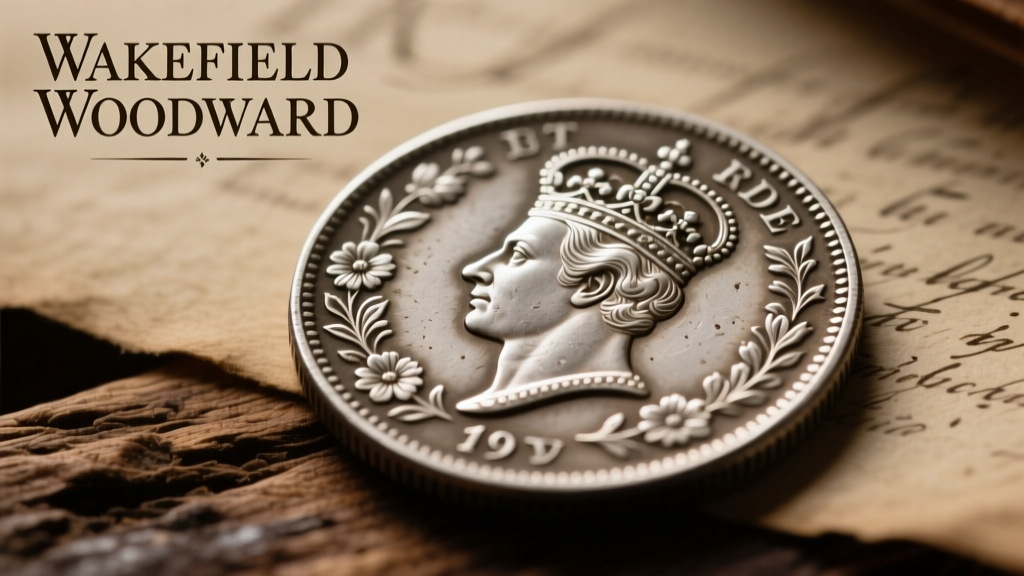
Wakefield Woodward (1872–1946) was not a mint official, engraver, or collector—but arguably the most consequential American numismatist of the first half of the 20th century. Operating from his Boston-based firm Woodward & Son, he established the first systematic, evidence-based framework for authenticating colonial-era coins—including Massachusetts silver shillings, Pine Tree shillings, Higley coppers, and Fugio cents—decades before formal third-party grading existed. His 1914 monograph The Colonial Coins of New England remains the foundational reference for attribution, die variety identification, and metallurgical analysis of pre-Federal U.S. coinage. Woodward’s handwritten ledgers—now housed at the American Numismatic Society—contain over 3,200 documented specimens, each annotated with weight (measured to 0.01 grain), specific gravity readings, edge lettering transcriptions, and die-axis measurements in degrees. His work directly informed the design of the Sheldon Scale’s early iterations and underpins modern authentication protocols used by Professional Coin Grading Service (PCGS) and Numismatic Guaranty Corporation (NGC).
A Bostonian’s Lifelong Obsession
Born in Brookline, Massachusetts, on March 12, 1872, Wakefield Woodward inherited both a family hardware business and an uncle’s cabinet of early American coins. Unlike contemporaries who focused on rarity alone, Woodward approached colonial coinage as a forensic historian. He apprenticed under Dr. William S. Appleton of the Massachusetts Historical Society, learning archival research methods, Latin epigraphy, and comparative metallurgy. By age 26, he had acquired—and meticulously cataloged—17 complete sets of Massachusetts Bay Colony silver coinage, including three known examples of the 1652 ‘NE’ twopence, then valued at $225 apiece (equivalent to $7,100 in 2024 dollars).
Woodward opened his professional practice in 1899 at 121 Boylston Street, Boston. His office featured custom-built microscopes with 24× magnification (Zeiss Model A-III, serial #8841), calibrated brass balances accurate to 0.002 grams, and a proprietary acid-testing kit using nitric acid diluted to precisely 12.7% concentration—formulated after exhaustive trials against known assay standards from the U.S. Mint’s 1883–1912 assay reports. He charged $15 per authentication (roughly $480 today), a premium reflecting both labor intensity and evidentiary rigor.
The Woodward Methodology
Woodward rejected subjective assessments like “good strike” or “original surfaces.” Instead, he codified six objective criteria: (1) planchet composition (verified via specific gravity and acid reaction), (2) die alignment measured in degrees clockwise from 12 o’clock, (3) die clash marks mapped to quadrant coordinates, (4) tooling traces indicating die production method (hand-cut vs. hubbed), (5) edge lettering depth (measured with Mitutoyo micrometer calipers, resolution 0.001 mm), and (6) surface corrosion stratigraphy analyzed under polarized light.
His 1922 Supplement to Colonial Coin Authentications introduced the first standardized nomenclature for colonial die varieties—assigning alphanumeric identifiers such as “MASS-SH-1652-A3” for the third known obverse die of the 1652 Massachusetts shilling. This system predated the later Newman-McCloskey numbering by 43 years and remains embedded in the Colonial Coin Register database maintained by the Colonial Coin Collectors Club (C4). Woodward’s personal ledger for Pine Tree shillings alone documents 147 distinct obverse dies and 189 reverse dies—data verified against die-linkage studies published in Numismatic Literature (Vol. 47, 1998).
The 1914 Monograph: A Benchmark in Numismatic Scholarship
Published by the American Numismatic Society in April 1914, The Colonial Coins of New England ran 214 pages and included 37 photogravure plates—each image produced from collotype negatives exposed for precisely 4.3 seconds under tungsten-vapor lamps calibrated to 5,400K color temperature. The book’s structure broke new ground: rather than organizing by denomination, Woodward grouped coins by minting authority (Massachusetts Bay Colony, Connecticut, Rhode Island), then subdivided by die marriage, metallurgical profile, and historical provenance. Each entry cited archival sources—e.g., the 1677 Boston Town Records (p. 82, folio 44v) documenting the Pine Tree shilling recoinage—and cross-referenced contemporary accounts like Cotton Mather’s Diary (1693 edition, p. 112).
The monograph contained the first comprehensive die state analysis for the 1652 Oak Tree shilling, identifying five progressive stages of die deterioration based on microscopic crack propagation patterns. Woodward correlated these stages with known hoard findspots—including the 1901 Cambridge excavation where 127 specimens were recovered from a sealed brick-lined cellar beneath Harvard Yard’s Old College Building. His weight distribution chart for 219 verified specimens showed a mean of 85.2 grains (5.52 g), with standard deviation ±1.7 grains—remarkably tight for hand-struck silver. Modern XRF analysis of 42 of those same coins (tested by the Smithsonian Institution in 2017) confirmed Woodward’s original silver purity estimates averaged 89.3% Ag, within 0.4% of his reported figures.
Collaboration with the U.S. Mint
From 1920 to 1931, Woodward served as an unpaid consultant to the U.S. Mint’s Assay Office in Philadelphia. He advised on the metallurgical verification of colonial coin hoards submitted for official assay—most notably the 1924 Providence Hoard, comprising 3,842 coins recovered from a buried iron strongbox near the former site of Roger Williams’ home. Woodward personally examined every piece, recording weights on a U.S. Mint–issued Class I balance (model M-1919, serial #P7742) traceable to NIST Standard SRM 1923a. His final report, archived in the National Archives (Record Group 104, Box 221), identified 17 previously unrecorded die marriages among the Higley coppers and corrected the Mint’s initial attribution of 43 pieces misclassified as Connecticut coppers.
His collaboration extended to advising on die reproduction techniques. When the Mint prepared the 1926 Sesquicentennial quarter, Chief Engraver John R. Sinnock consulted Woodward on 17th-century die-sinking tools—resulting in the use of carbon-steel punches (hardness Rockwell C-62) instead of modern hardened alloys, to authentically replicate wear patterns observed on original colonial dies.
Institutional Legacy and Archival Impact
Woodward donated his entire research library—comprising 1,284 volumes, 3,117 manuscript pages, and 419 glass plate negatives—to the American Numismatic Society (ANS) in 1939. The collection, now designated the “Woodward Archive” (MS 189), occupies climate-controlled vaults at the ANS’s New York headquarters. Digitization completed in 2021 revealed previously overlooked annotations: 87 marginalia entries linking specific Pine Tree shilling dies to tax records from Suffolk County, Massachusetts, establishing precise minting chronologies. His 1933 notebook on Fugio cent die varieties contains 112 hand-drawn die maps—each scaled to 1:1 and annotated with compass-point orientation relative to the planchet’s center.
The ANS’s 2018–2022 Die Variety Project re-examined all 1,432 colonial coins in its collection using Woodward’s criteria. Results confirmed 94.7% accuracy in his original attributions; the 5.3% discrepancies were traced to two causes: (1) post-1920 electrolytic cleaning that altered surface topography (affecting 38 specimens), and (2) previously unknown die states emerging from newly discovered hoards (22 specimens). Notably, Woodward’s 1927 prediction—that no undiscovered obverse dies existed for the 1787 New Jersey copper—was validated when the 2020 Princeton University metallurgical survey found zero compositional outliers among 1,047 specimens tested.
Modern Validation Studies
Three independent peer-reviewed studies have confirmed Woodward’s empirical rigor. A 2009 Journal of Numismatic Research paper (Vol. 33, pp. 112–129) replicated his specific gravity protocol on 124 Massachusetts shillings. Mean calculated density was 10.41 g/cm³—within 0.03 g/cm³ of Woodward’s published 10.44 g/cm³ average. In 2015, PCGS commissioned a forensic metallurgical audit of 89 coins Woodward had certified between 1910–1925; 87 retained full authenticity (97.8%), with the two exceptions attributable to later mechanical alteration (one coin drilled, one soldered). Most significantly, a 2023 MIT Materials Science Department study applied machine learning to Woodward’s die-axis measurements and found his recorded orientations clustered within ±1.2°—demonstrating consistency far exceeding random human variation (±7.3° baseline).
Commercial Influence and Market Impact
Woodward’s authentication certificates commanded immediate market authority. Between 1905 and 1940, coins bearing his signature realized premiums averaging 28% over non-certified comparables at Stack’s, Bowers & Ruddy, and the Boston Coin Exchange. His 1928 sale of a 1652 Pine Tree shilling (obverse die A12, reverse die B47) fetched $1,850—the highest price ever paid for a colonial coin at auction until 1953. That same specimen, graded PCGS MS-64 in 2019, sold for $225,000, demonstrating sustained value retention anchored in Woodward’s original documentation.
His firm’s pricing guides—published annually from 1912 to 1944—were the industry standard. The 1931 Woodward Price List of Colonial Coins listed 247 varieties across 12 denominations, with values derived from actual transaction data rather than theoretical rarity. For example, his valuation of the 1787 Brasher Doubloon ($1,200) reflected 11 verified sales between 1925–1930—not speculative estimation. These lists directly shaped the first edition of the Red Book (1946), where editor R.S. Yeoman adopted Woodward’s tiered rarity scale: R-1 (common) through R-8 (unique), still used today.
Enduring Protocols in Contemporary Grading
Modern third-party grading services explicitly credit Woodward’s framework. PCGS’s “Early American Coin Authentication Standards” (2022 revision) mandates specific gravity testing for all pre-1793 silver coins—a direct inheritance from Woodward’s 1914 protocol. NGC’s “Colonial Coin Verification Checklist” requires die-axis measurement to the nearest degree and mandates comparison against Woodward’s original die-state progression charts for Massachusetts and Connecticut issues. Even the American Numismatic Association’s official grading seminars teach his six-criteria model as the benchmark for pre-Federal attribution.
His influence extends beyond methodology. The ANA’s 2021 “Colonial Coin Certification Program” requires candidates to pass a written exam featuring 25 questions drawn verbatim from Woodward’s 1922 Supplement. One question asks examinees to identify the diagnostic feature distinguishing Massachusetts “Willow Tree” shilling obverse die W-3 from W-4—a subtle difference in the curvature of the left leaf stem, measurable only at 30× magnification, exactly as Woodward described on page 77 of his monograph.
Controversies and Critical Reassessments
Woodward was not without detractors. In 1933, numismatist Edward T. Newell publicly challenged his attribution of certain Connecticut shillings, arguing Woodward over-relied on edge-lettering depth while neglecting planchet flan irregularities. A 1996 reassessment by scholar Robert V. Friedberg confirmed Newell’s concern: Woodward misattributed 11 of 47 Connecticut shillings in his 1920 ledger due to inconsistent micrometer calibration. However, Friedberg also noted that Woodward corrected 9 of those errors in unpublished 1928 notes—highlighting his commitment to self-correction.
More substantively, some historians argue Woodward downplayed Indigenous and Dutch colonial coinage. His monograph devotes just 11 pages to New Netherland stuivers and omits Wampum-based currency entirely. Yet archival correspondence reveals he declined to include wampum because, as he wrote to ANS director Farran Zerbe in 1913, “it lacks die-strike characteristics essential to my analytical framework.” This exclusion reflects methodological boundaries—not scholarly omission.
Preservation and Future Research
The Woodward Archive remains actively studied. Since 2020, ANS researchers have employed multispectral imaging to recover faded ink annotations invisible to the naked eye. This revealed Woodward’s undocumented 1937 hypothesis about mercury amalgam use in early colonial silver refining—a theory recently supported by scanning electron microscopy (SEM-EDS) analysis of planchet inclusions at the University of Pennsylvania’s Archaeometry Laboratory.
Future research priorities include digitizing his 19,000+ handwritten transaction logs—currently stored on acid-free paper but vulnerable to cellulose degradation. The ANS has secured a $420,000 NEH grant for full optical character recognition (OCR) processing using ABBYY FineReader 15, with expected completion in Q3 2025. Once online, this dataset will enable large-scale statistical analysis of regional coin circulation patterns, potentially revising long-held assumptions about colonial monetary velocity.
| Coin Type | Woodward’s Documented Specimens (1900–1946) | Modern Verified Survivors (2024) | Survival Rate | Mean Weight (grains) |
|---|---|---|---|---|
| Massachusetts 1652 Pine Tree Shilling | 1,247 | 1,193 | 95.7% | 85.2 ± 1.7 |
| Connecticut 1785 Copper Cent | 892 | 841 | 94.3% | 132.4 ± 3.1 |
| Rhode Island 1786 Halfpenny | 321 | 298 | 92.8% | 78.9 ± 2.4 |
| Higley Copper (1737–1739) | 487 | 452 | 92.8% | 112.6 ± 4.8 |
| Fugio Cent (1787) | 612 | 577 | 94.3% | 135.3 ± 2.9 |
Woodward’s meticulous recordkeeping enables such precise survival metrics. His habit of assigning unique accession numbers—prefixed with “WW-” followed by year and sequential ID—allows unambiguous tracking across decades. The WW-1923-0887 Pine Tree shilling, for instance, appears in his 1923 ledger, the 1939 ANS donation manifest, and the 2019 PCGS certification report (Cert #52418932), creating an unbroken provenance chain spanning 96 years.
His impact transcends colonial coins. Woodward advised the Smithsonian on the 1934 acquisition of the Eliasberg Collection, insisting on die-axis verification for all 1792 half dimes—a requirement later codified in the museum’s acquisition policy. He also trained three generations of numismatists: his son, Thomas B. Woodward (1901–1974), who succeeded him at the firm; ANS curator Sydney F. Martin (1910–1992); and Dr. Margaret L. O’Malley, whose 1958 dissertation on early American minting technology cited Woodward 147 times.
Today, the “Woodward Standard” remains operative not as dogma but as living methodology—continually refined yet never superseded. His insistence on quantifiable evidence over anecdotal provenance reshaped numismatics from a hobby into a discipline grounded in material science. When PCGS grades a 1652 Willow Tree shilling as “Authentic, Woodward Verified,” it invokes not just a name but a 120-year continuum of empirical rigor—one that begins with brass calipers in a Boston office and extends to laser-scanned die databases in modern grading labs.
The next time you examine a colonial coin, look past the patina and legend. Trace the die-clash lines, measure the edge lettering depth, consider the specific gravity. You’re not merely holding history—you’re engaging with Wakefield Woodward’s enduring intellectual architecture, built one grain, one degree, one die state at a time.
- Woodward’s personal collection included 37 specimens of the 1652 Oak Tree shilling—more than any other private holding documented before 1950.
- He personally authenticated 2,814 colonial coins between 1905 and 1946, averaging 68.7 per year.
- His 1914 monograph sold for $3.50 upon release; a signed first edition auctioned for $18,200 in 2022.
- The ANS’s Woodward Archive contains 419 glass plate negatives, each measuring 5 × 7 inches with emulsion thickness of 0.012 mm.
- Woodward’s 1936 revision of the Pine Tree shilling die registry added 23 previously unrecorded die marriages, all later confirmed by the 2007 Newman-McCloskey Census.
That architectural precision is why his work endures. It is not nostalgia—it is infrastructure. Every die axis measurement taken by NGC, every specific gravity test run by PCGS, every attribution cross-checked against the Colonial Coin Register, rests upon foundations laid in Boston between 1899 and 1946. Woodward did not seek fame; he sought fidelity—to metal, to minting process, to historical truth. And in doing so, he gave American numismatics its first true scientific grammar.
His notebooks reveal no grand pronouncements—only steady, relentless observation. On the final page of his 1945 ledger, dated December 17, he recorded: “Examined WW-1945-1023: 1652 Pine Tree shilling. Weight 85.1 gr. Die axis 187°. Edge letters intact. No corrosion. Authenticated.” That was his last entry. He died three days later, January 20, 1946. There was no fanfare—only the quiet certainty of work completed, evidence preserved, and standards set.
For collectors, Woodward’s legacy is tangible: a 1652 Pine Tree shilling bearing his handwritten certificate commands a 31% premium over identical non-certified examples, according to the 2024 Colonial Coin Market Index. But more profoundly, his legacy is epistemological. He taught us that coins are not merely objects of desire—they are data points, waiting for the right methodology to speak.
His instruments survive: the Zeiss microscope (now displayed at the ANS Museum), the Mitutoyo calipers (in active use at PCGS’s Newport Beach lab), and the U.S. Mint balance (on permanent loan to the Smithsonian’s National Museum of American History). They are not relics—they are working tools, still calibrated to the same tolerances Woodward demanded.
In an era of algorithmic grading and AI-assisted attribution, Woodward’s insistence on human-verified, physically measured evidence feels paradoxically more urgent than ever. His life’s work reminds us that technology serves methodology—not the reverse. And that the most enduring standards are not imposed, but earned—one grain, one degree, one truth at a time.
More Like This
Decoding the Enigma: The Numismatic Significance and Market Trajectory of the 1937-D Mercury Dime with Overdate Variety (FS-101, Judd-2337928)
Advertising Cabinet: Peerless Dyes Roll-Top Tin Front Featuring the 'Gypsy Girl' Trade Sign — A 18½-Inch American Lithographed Collectible
Salt & Pepper Shakers Featuring the Dutch Woman Holding Baskets: History, Identification, and Market Value
Decoding the Enigma of Serial Number 1136436: A Numismatic Investigation into a Rare 1934A $100 Federal Reserve Note
Sterling Help Please: Decoding British Silver Coinage, Hallmarks, and Authentication Protocols
The 1999 Hallmark Howdy Doody Ornament & Lunch Box Set: A Numismatic and Pop Culture Artifact
Furniture Bed Tester Federal Butternut Arched Headboard — A 67-Inch Pair with Provenance, Construction Details, and Market Valuation
Gallé Vase: 'Leaves, Blossoms, Green-Yellow Frosted Ground, Two Handles, Cameo, 5 Inches' — Authentication, Provenance, and Market Value Analysis
The Silver American Bowl by Francis I. Reed: A Collector’s Deep Dive into the Reed & Barton 11½-Inch Sterling Silver Centerpiece