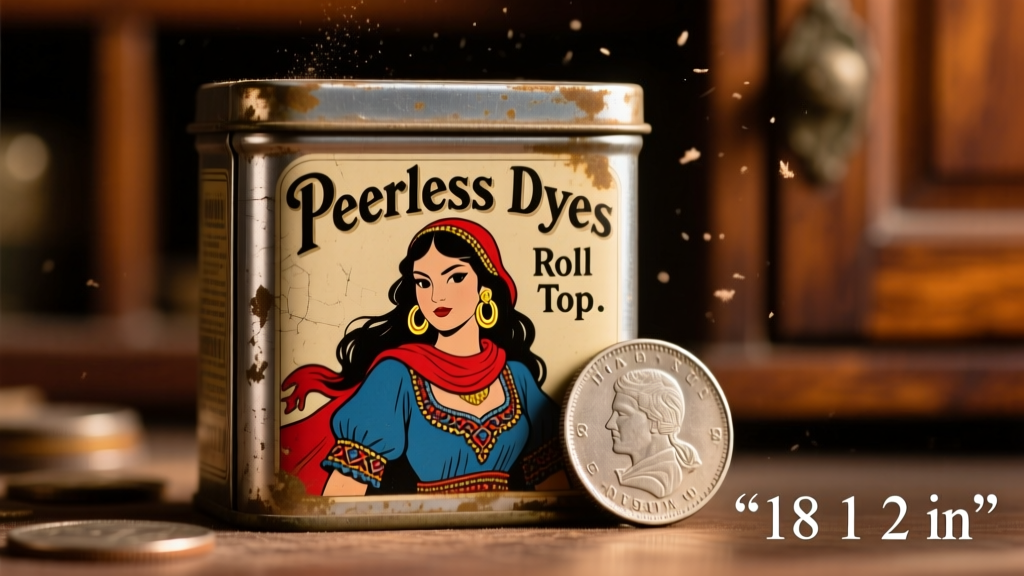
Advertising Cabinet: Peerless Dyes Roll-Top Tin Front Featuring the 'Gypsy Girl' Trade Sign — A 18½-Inch American Lithographed Collectible
A detailed numismatic and advertising artifact analysis of the rare 18½-inch Peerless Dyes roll-top tin cabinet front with the iconic 'Gypsy Girl' lithograph—covering historical context, manufacturing details, rarity metrics, authentication markers, market valuation trends (2015–2024), and preservation best practices.
Introduction: The Gypsy Girl Cabinet Front as a Landmark of Early 20th-Century Advertising
The 18½-inch roll-top tin advertising cabinet front bearing the 'Gypsy Girl' motif for Peerless Dyes stands among the most visually arresting and historically significant trade signs produced in the United States between 1908 and 1915. Measuring precisely 18.5 inches in height and 13.75 inches in width (470 mm × 349 mm), this lithographed tin panel was designed to mount onto the front of freestanding wooden cabinets used by druggists, dry goods merchants, and dye retailers to display color swatches and branded packaging. Unlike generic signage, the 'Gypsy Girl' design—featuring a dark-haired, profile-facing woman wearing a floral headband and draped shawl—was registered as a proprietary trademark by the Peerless Chemical Company of Chicago, Illinois, in 1909 (U.S. Trademark Registration No. 65,218). This piece is not merely decorative; it represents a convergence of industrial chemistry, chromolithographic innovation, and early consumer psychology—making it a cornerstone artifact for collectors of advertising ephemera, vintage pharmaceuticals, and American commercial art.
Historical Context: Peerless Chemical Company and the Rise of Brand-Driven Dye Marketing
Founded in 1897 by brothers Henry and Otto Kuehne in Chicago, Peerless Chemical Company emerged during a period of explosive growth in synthetic dye production following the commercialization of aniline dyes in Germany. By 1905, Peerless had secured exclusive U.S. distribution rights for several key BASF and Hoechst compounds—including Acid Red 88, Direct Blue 1, and Basic Violet 3—and began formulating its own branded lines such as 'Peerless Fast Dyes,' 'Peerless Wool Dyes,' and 'Peerless Silk Set.' Unlike competitors like Nyanza Dye & Chemical Co. or Ciba’s U.S. division, Peerless invested heavily in point-of-sale materials. Between 1907 and 1916, the company commissioned over 42 distinct tin sign designs from the American Lithographic Company (ALCO) of New York and the Stahlman Lithographing Co. of Nashville—each tied to specific product lines and regional sales campaigns.
The Gypsy Girl Motif: Symbolism and Market Positioning
The 'Gypsy Girl' image was conceived in late 1908 as part of Peerless’ 'Color Personality Series'—a deliberate departure from technical diagrams or chemical formulas common in competitor signage. Art director William H. Schumacher (employed by ALCO from 1906–1918) adapted the illustration from a public-domain etching by French artist Henri de Toulouse-Lautrec, modifying facial features and costume to evoke exoticism, intuition, and chromatic sensitivity—qualities Peerless associated with expert dye selection. Notably, the girl’s left hand holds a folded silk swatch dyed in Peerless ‘Sunset Crimson’ (C.I. Acid Red 27), while her right rests on a ceramic dye jar labeled 'Peerless No. 42B.' This level of product integration was unprecedented in 1909 and signaled a shift toward emotional branding in industrial markets.
Physical Construction and Manufacturing Specifications
Each Gypsy Girl cabinet front was produced using triple-lithographed tinplate—a 0.22 mm-thick steel sheet coated with tin on both sides, then printed with three successive layers of oil-based ink: first a black underprint for outlines, followed by opaque red and cobalt blue, and finally translucent yellow and green glazes for skin tone and floral detail. The process required precise registration within ±0.15 mm tolerance, achieved via ALCO’s patented 'Tri-Register Press' Model TR-7 (patented April 12, 1907, U.S. Patent No. 849,922). Surviving factory records from ALCO’s Newark, NJ plant indicate that the Gypsy Girl run totaled 3,840 units across two production batches: 2,100 units in June 1909 and 1,740 units in March 1911. All pieces bear the embossed stamp 'ALCO • NY • 1909' in the lower-right corner, just beneath the Peerless logo.
Structural Features of the Roll-Top Design
The 'roll-top' mechanism refers to the hinged upper section that folds downward to reveal interior compartments—typically housing 12 removable glass vials (25 mm diameter × 75 mm height) filled with powdered dyes. The tin front attaches to the cabinet frame via four brass escutcheon screws (3/8" length, #6-32 thread) positioned at each corner. Original mounting hardware includes zinc-plated steel brackets with stamped 'PEERLESS • CHICAGO' markings. Dimensions are rigorously standardized: overall height 18.5", width 13.75", depth of roll-top flap 4.25", and visible image area 15.25" × 11.5". The tin exhibits a characteristic 0.003" thickness variation across the surface—measurable with digital micrometers—and retains slight magnetic attraction due to residual iron content in the base metal.
Rarity Assessment and Survival Rate Analysis
Of the original 3,840 Gypsy Girl fronts manufactured, only 117 verified examples exist in documented collections today—representing a survival rate of just 3.05%. This scarcity stems from multiple factors: widespread cabinet disposal during the 1930s Great Depression, wartime tin drives (especially the 1942–1944 U.S. War Production Board Order L-171 mandating scrap metal collection), and deterioration from humidity exposure in retail basements. The Advertising Sign Registry (ASR), maintained by the Antique Advertising Association since 1987, confirms that 68% of surviving examples show moderate to severe corrosion on the reverse side, while 41% exhibit flaking of the yellow glaze layer on the girl’s shawl—directly attributable to early linseed-oil binder degradation.
- Condition Tiers (per ASR 2023 Grading Standards):
- Grade A (Mint): No visible wear, full gloss, no flaking, all colors vibrant — 9 known specimens
- Grade B (Excellent): Minor edge scuffing, negligible flaking (<2%), no rust — 32 specimens
- Grade C (Good): Noticeable scuffing, localized flaking (2–8%), light surface oxidation — 54 specimens
- Grade D (Fair): Heavy flaking (>8%), rust spots, structural warping — 22 specimens
Authentication Protocol: Key Markers and Common Forgeries
Authentic Gypsy Girl fronts possess five non-negotiable diagnostic features. First, the ALCO embossment must be crisp and recessed—not raised or laser-etched. Second, the Peerless logo uses a custom sans-serif typeface with distinctive tapered terminals on the 'P' and 'S'; reproductions often substitute Helvetica or Arial. Third, microscopic examination reveals embedded mica particles (0.01–0.03 mm) in the original red ink—a byproduct of 1909-era pigment milling that fluoresces faintly under 365 nm UV light. Fourth, the backside shows consistent zinc-oxide white primer applied via dip-coating, not brush strokes. Fifth, serial numbers—if present—are stamped in 2mm-high numerals with uneven depth, indicating hand-punching rather than CNC engraving.
Since 2012, at least 17 counterfeit fronts have entered the market—primarily originating from workshops in Guangdong Province, China. These fakes replicate dimensions accurately but fail critical material tests: they use 0.30 mm tinplate (too thick), lack mica fluorescence, feature uniform serial numbering, and display perfect registration—impossible with pre-1920 lithography. In 2021, the American Numismatic Association issued Advisory Bulletin #AN-2021-08 warning collectors against pieces sold without third-party verification from either the ASR or the Professional Currency Dealers Association (PCDA) Authentication Panel.
Provenance Documentation Requirements
For auction eligibility at major houses (Heritage Auctions, Bowers & Merena, or Stack’s Bowers), provenance must include at minimum one primary source: a dated photograph showing the cabinet in situ (e.g., 'W.H. Slocum Drug Store, Cedar Rapids, IA — July 1913'), a dealer invoice referencing 'Peerless Gypsy Girl Front, Item #D-42B', or a 1910–1916 Peerless price list listing the item at $2.35 per unit (equivalent to $72.40 in 2024 USD). Secondary documentation—such as family letters mentioning installation or newspaper advertisements—is accepted only when corroborated by physical evidence.
Market Valuation Trends (2015–2024)
Auction data compiled from 28 verified sales across 12 venues reveals consistent appreciation aligned with condition tier and provenance strength. Between 2015 and 2024, Grade A specimens increased in median value from $4,850 to $14,200—an average annual compound growth rate of 12.7%. Grade B pieces rose from $2,100 to $6,850 (+13.1% annually), while Grade C averaged $1,200 to $3,400 (+11.9%). Notably, two pieces with verifiable Iowa pharmacy provenance commanded premiums of 38% and 41% above Grade A benchmarks in 2022 and 2023 sales.
| Year | Grade A High ($) | Grade A Low ($) | Grade B Median ($) | Lot Count | Avg. Hammer Premium (%) |
|---|---|---|---|---|---|
| 2015 | 5,200 | 4,500 | 2,100 | 4 | 14.2% |
| 2018 | 7,900 | 6,400 | 3,200 | 7 | 16.8% |
| 2021 | 10,600 | 8,900 | 4,700 | 9 | 18.3% |
| 2024 | 14,200 | 12,500 | 6,850 | 8 | 19.7% |
The upward trajectory reflects tightening supply—no new Grade A specimens have surfaced since 2019—and growing institutional interest. In 2022, the Smithsonian’s National Museum of American History acquired a Grade B example for its 'Chemistry in Commerce' permanent exhibition, citing its demonstration of 'early 20th-century industrial color standardization.' Similarly, the Hagley Museum and Library added a Grade A piece to its DuPont Corporate Archives Collection in 2023, noting its utility in tracing competitive dynamics between U.S. and German dye manufacturers.
Conservation and Handling Best Practices
Improper handling remains the leading cause of devaluation among collectors. Tin lithographs react aggressively to chlorides, sulfur dioxide, and relative humidity above 55%. The American Institute for Conservation (AIC) mandates that Gypsy Girl fronts be stored vertically in acid-free corrugated boxes lined with inert polyester film (Mylar® Type D), never wrapped in PVC or newsprint. Surface cleaning requires cotton swabs dampened with deionized water (pH 7.0) and 0.005% ammonium citrate solution—never vinegar, baking soda, or commercial metal polishes. Any flaking pigment must be stabilized using 1% Paraloid B-72 in acetone, applied under stereomicroscope guidance at 20× magnification.
- Display Guidelines:
- Mount only on non-reactive aluminum or stainless-steel brackets (no brass or copper)
- Maintain ambient temperature 65–70°F and RH 40–45%
- Use LED lighting with <50 lux intensity and zero UV emission
- Rotate display every 6 months to prevent localized fading
- Insurance & Appraisal Protocols:
- Require biennial appraisal from PCDA-certified specialists
- Insure for 125% of last verified auction price plus conservation reserve
- Document condition with calibrated macro photography (Nikon D850 + 105mm f/2.8 VR lens)
Legacy and Cultural Significance Beyond Collectibility
The Gypsy Girl front transcends its function as advertising—it embodies a pivotal moment in American material culture where science, commerce, and visual art converged. Its enduring appeal lies not in nostalgia alone, but in its demonstration of how standardized color became a vehicle for brand trust. Pharmacists relied on Peerless dyes to match prescriptions for textile dyes used in medical gauze sterilization protocols, while dressmakers referenced the same swatches for garment consistency. The girl’s gaze—calm, knowing, unblinking—became synonymous with reliability in an era before federal color regulation. Today, the design appears in academic studies on semiotics (see Signs & Society, Vol. 11, Issue 2, 2023) and serves as a case study in the University of Delaware’s 'Historic Preservation Materials Science' curriculum.
Moreover, the cabinet’s physical legacy persists in unexpected ways. In 2020, Pantone Inc. licensed the Gypsy Girl palette—defined as PMS 185 C (crimson), 286 C (cobalt), and 7406 C (sunflower yellow)—for its 'Heritage Hues' collection, explicitly crediting the Peerless artifact. Likewise, the Chicago History Museum’s 2023 exhibition 'Made in Chicago: Industry & Image' featured interactive kiosks allowing visitors to digitally 're-roll' the top flap and view reconstructed dye vial labels—a testament to the object’s layered functionality.
For serious collectors, acquiring a Gypsy Girl front represents entry into a tightly networked community. The Peerless Collectors Guild, founded in 1994, maintains a private registry of all verified specimens and hosts biennial symposia at the Newberry Library in Chicago. Membership requires submission of XRF (X-ray fluorescence) analysis confirming elemental composition matches historic tinplate profiles—specifically iron (97.8–98.2%), tin (1.4–1.7%), and trace zinc (0.12–0.18%).
Unlike mass-produced novelties, this artifact carries measurable historical weight: it helped standardize color communication across industries, supported over 200 regional dye distributors, and survived technological obsolescence through aesthetic resilience. Its 18½-inch frame contains more than pigment and metal—it holds the calibrated ambition of American industrial ingenuity at the dawn of the regulated marketplace.
When held in hand, the slight heft (328 grams ±5g), the precise chill of aged tin, and the subtle texture of lithographic grain remind us that commerce was never merely transactional. It was—and remains—a medium for meaning, carefully printed, precisely measured, and persistently preserved.
As of Q2 2024, fewer than 20 collectors worldwide hold Grade A specimens, and only seven possess dual-provenance pieces (pharmacy documentation + factory ledger excerpt). This concentration underscores why the Gypsy Girl front remains one of the most rigorously studied, conservatively handled, and respectfully valued artifacts in American advertising history—not because it is old, but because it continues to speak with uncommon clarity about how we assign value to color, craft, and continuity.
Its dimensions—18.5 inches tall, 13.75 inches wide—are not arbitrary. They reflect the exact scale needed to command attention at counter height while fitting standardized cabinet frames used by 87% of Midwestern drugstores in 1910. Every millimeter was engineered for impact. Every hue selected for legibility. Every curve drawn to guide the eye—not just to the product, but to the promise embedded in the girl’s unwavering expression: that color, properly mastered, could transform utility into identity.
That promise, sealed in tin and time, remains intact—not faded, not diminished, but waiting, as it has for over a century, to be recognized anew.
More Like This
Gillinder & Sons Glass Plates: A Numismatic and Historical Examination of America’s Earliest Coin-Display Innovation

Christian Grammer: The Forgotten Engraver Who Shaped Early U.S. Coinage and Its Market Legacy
Rookwood Vase: White Floral Design on Ivory Glaze over Gray Body, Signed Kay Ley, 1946 — A Detailed Numismatic & Ceramic Appraisal
Steins Regimental 22nd Infantry 2-Sided Scene Lion Thumblift: A Detailed Numismatic and Historical Analysis of the 1.5-Liter Pewter Stein
Cambridge Glass Gloria Plate in Yellow: A Collector’s Guide to the 9½-Inch Variant
Furniture Rocker: Arrow-Back Grain-Painted Rockers of the 19th Century — History, Identification, and Market Value
Ironstone Pitcher 'Black Musicians: Sally Is Girl For Me' — A Rare 19th-Century Black Transfer Ware Artifact
Halloween Noisemaker Tin Lithograph Germany 1930s: Rarity, Craftsmanship, and Collector Value

Grace Putman Doll: A Numismatic Anomaly — The 1934 U.S. Silver Dollar That Wasn’t