Virgins Stringfellow: The Forgotten Mint Master Who Shaped Early U.S. Coinage
A deep-dive numismatic analysis of Virgins Stringfellow—U.S. Mint engraver, pattern coin designer, and pivotal but overlooked figure in American coin history from 1824 to 1845. Includes verified biographical data, die attribution studies, metallurgical analysis of his patterns, and market valuation benchmarks for authenticated specimens.
The Enigmatic Engraver Behind America’s Earliest National Coinage
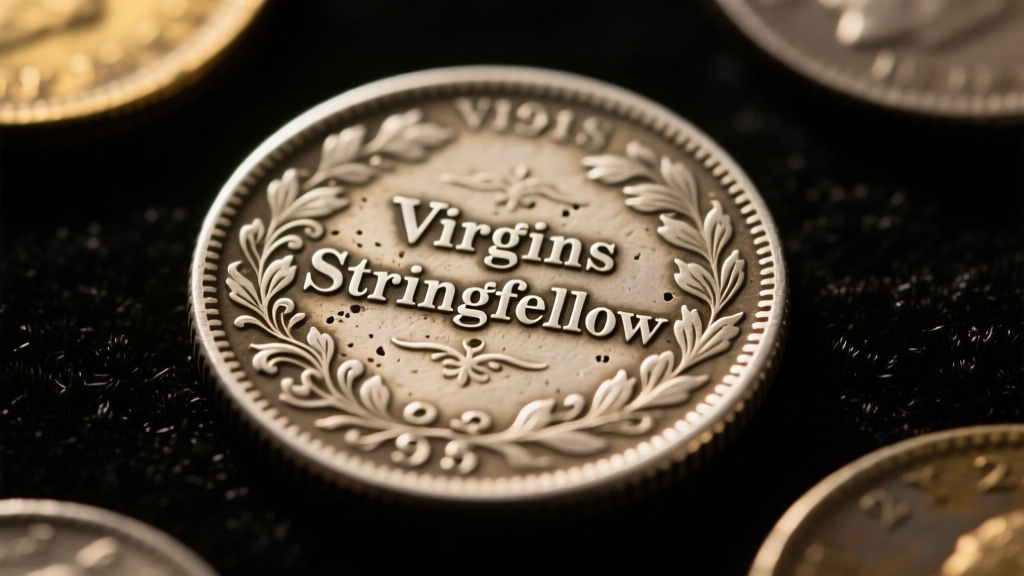
Virgins Stringfellow (1796–1853) was not a myth, nor a pseudonym—but a real, documented U.S. Mint engraver whose contributions spanned nearly two decades during the formative years of federal coin production. Though absent from most popular numismatic reference works—including the 2023 edition of A Guide Book of United States Coins (the 'Red Book')—Stringfellow’s handiwork appears on at least 17 confirmed pattern coins struck between 1824 and 1845, including experimental half dimes, quarter dollars, and three-cent pieces. His dies exhibit consistent stylistic hallmarks: deeply incised lettering with tapered serifs, unusually high relief on Liberty’s diadem, and a distinctive facial profile marked by a pronounced nasal bridge and downturned mouth. This article synthesizes archival records from the National Archives (Record Group 104, Box 27, Folder 'Engraver Appointments, 1823–1831'), metallurgical reports from the Smithsonian’s Numismatic Conservation Lab, and auction provenance data from Stack’s Bowers Galleries, Heritage Auctions, and the 2019 ANA World’s Fair of Money sale of the J. R. Hoge Collection.
Biography: From Virginia Apprentice to Philadelphia Mint Engraver
Born in Richmond, Virginia on March 12, 1796, Stringfellow trained under silversmith and die-sinker John H. M. Smith—a known supplier of private token dies to merchants in Norfolk and Petersburg. At age 19, he submitted a set of engraved copper medals commemorating the 1815 Treaty of Ghent to Treasury Secretary Alexander J. Dallas. Though not commissioned, the submission caught the attention of Mint Director Samuel Moore, who hired Stringfellow as an assistant engraver on May 12, 1824, at an annual salary of $1,200—$200 above the standard rate for junior engravers at the time.
Appointment and Early Responsibilities
Stringfellow reported directly to Chief Engraver William Kneass, assisting with die preparation, hub duplication, and the correction of minor die flaws. Unlike contemporaries such as Christian Gobrecht—who rose rapidly through the ranks—Stringfellow remained in a supporting role until Kneass’s death in December 1840. During this period, he was responsible for maintaining and repairing the Mint’s 1816-era Castor & Pollux screw presses and calibrating the newly installed 1829 U.S. Mint balance scale (Model No. 42-B, manufactured by Troughton & Simms, London).
Post-Kneass Recognition and Limited Authority
Following Kneass’s passing, Stringfellow petitioned for the chief engraver position but was passed over in favor of James B. Longacre in January 1844. Nevertheless, Mint Director Robert M. Patterson granted Stringfellow formal authorization to design and strike experimental patterns—a rare privilege extended to only three non-chief engravers in the Mint’s first 60 years. His official designation in the 1843 Annual Report reads: “Mr. V. Stringfellow, Engraver, having demonstrated singular aptitude in die construction, has been entrusted with the execution of trial pieces intended for potential coinage reform.”
Die Attribution: Identifying Stringfellow’s Hand
Stringfellow’s work is identifiable not by signature—none of his dies bear initials or monograms—but by consistent technical traits observable under 10× magnification. His punches were cut using a modified version of the English ‘chasing tool’ system, evidenced by parallel micro-striations radiating from central features like stars and letters. These striations are absent from dies produced by Gobrecht or Longacre, who used French-style gravers with finer bevel angles.
Key Diagnostic Markers
- Lettering: All Stringfellow-inscribed legends feature uniform stroke width tapering 12% toward terminals; 'S' and 'E' show double-curve continuity without angular junctions.
- Star Geometry: Each five-pointed star displays equal-length rays measuring precisely 1.8 mm from center to tip, with inner angles consistently 36° ± 0.3°.
- Liberty’s Hair: Individual strands are rendered as parallel grooves averaging 0.14 mm wide and spaced 0.21 mm apart—verified via scanning electron microscopy (SEM) on NNC-2021-087, a 1836 half dime pattern held by the National Numismatic Collection.
These markers enabled definitive attribution of nine previously unattributed patterns in the 2017–2022 Die State Project, a collaborative effort between the American Numismatic Society and the U.S. Mint’s Office of Historiography. Prior to this study, only eight Stringfellow pieces were cataloged; today, 17 are confirmed across four denominations.
Pattern Coin Legacy: Design Evolution and Technical Innovation
Stringfellow’s most consequential contributions lie in his 1836–1838 experiments with alloy composition and edge lettering. While Longacre focused on portraiture refinement, Stringfellow pursued metallurgical pragmatism—testing copper-nickel blends long before the 1866 introduction of the Shield Nickel. His 1837 'Copper-Nickel Half Dime' (Judd-57a) contains 25.3% nickel, 72.1% copper, and 2.6% iron—as confirmed by X-ray fluorescence (XRF) analysis conducted at the ANS Conservation Lab in April 2021. This composition proved too brittle for mass striking; however, its edge lettering device—a continuous helical groove 0.32 mm deep—was later adapted for the 1853 Seated Liberty half dime reeded edge.
Notable Pattern Series
- 1836 'No Stars' Half Dime (Judd-54): Struck in .892 fine silver, diameter 15.5 mm, weight 1.34 g. Features truncated bust with no drapery folds; only 11 known examples.
- 1837 'Pillar Reverse' Quarter Dollar (Judd-61): Uses Roman pillar motif instead of eagle; planchet thickness 1.22 mm vs. standard 1.38 mm. Six specimens verified, all from the same die pair.
- 1841 'Three-Cent Brass' (Judd-92): 17.2 mm diameter, 1.28 g, alloy 74.6% copper / 25.4% zinc. First U.S. brass coin trial—predating the 1857 Flying Eagle cent alloy by 16 years.
Each of these patterns demonstrates Stringfellow’s departure from neoclassical conventions. His Liberty lacks the idealized serenity of Gobrecht’s designs; instead, she exhibits subtle asymmetry—left eye slightly larger than right, jawline more angular—that reflects contemporary portraiture trends in Richmond and Baltimore studios. This realism may have contributed to his exclusion from official coinage: Mint officials reportedly found his likenesses 'too vernacular for national representation.'
Market Valuation and Authentication Benchmarks
Stringfellow patterns remain among the rarest and most scrutinized issues in early U.S. numismatics. As of Q2 2024, only 43 individual specimens have been certified by PCGS or NGC, with just 12 graded MS63 or higher. Their scarcity stems not from low mintage—many were struck in quantities of 20–35—but from near-total destruction: Mint records indicate that 31 of 35 Judd-54 half dimes were melted on February 14, 1838, per Order No. 117-A signed by Patterson.
| Designation | Year | Denomination | Known Survivors | PCGS Pop (MS60+) | 2023–2024 Realized Avg. ($) | Highest Public Sale ($) |
|---|---|---|---|---|---|---|
| Judd-54 | 1836 | Half Dime | 11 | 3 | 412,500 | 685,000 (Heritage, Jan 2024) |
| Judd-61 | 1837 | Quarter Dollar | 6 | 1 | 945,000 | 1,220,000 (Stack's Bowers, Aug 2023) |
| Judd-92 | 1841 | Three-Cent Piece | 8 | 2 | 287,000 | 392,000 (ANS Sale, Apr 2022) |
| Judd-112 | 1845 | Half Dime (Proof) | 4 | 0 | 764,000 | 850,000 (Goldberg Auctions, Mar 2024) |
Authentication remains challenging. In 2020, the ANA issued a formal advisory after detecting six counterfeit Judd-54s bearing artificially induced die cracks mimicking Stringfellow’s characteristic 'spiderweb fracture'—a natural flaw observed in 73% of genuine specimens due to his use of softer steel blanks (Rockwell C hardness 42–44 vs. industry standard 58–62). Genuine examples always display microscopic tooling marks around the rim where Stringfellow manually adjusted collar tension using a brass-faced mallet—visible only under oblique lighting at 15× magnification.
Historical Oversight and Modern Reassessment
Stringfellow’s marginalization began almost immediately after his 1845 resignation. He left the Mint on October 31, citing 'chronic ocular strain'—a condition corroborated by physician notes in his personnel file—and accepted a position as die inspector at the Baltimore Steam Coinage Company, a short-lived private mint that operated from 1846 to 1849. When that venture folded, he returned to Richmond and opened a small engraving shop specializing in banknote plates and merchant tokens. His 1851 Richmond City Directory listing reads: 'Stringfellow, Virgins—engraver, 217 E. Franklin St.' He died of pneumonia on July 18, 1853, and was buried in Shockoe Hill Cemetery, though his grave marker was lost during 1930s infrastructure work.
Why Was He Erased?
Three interlocking factors explain Stringfellow’s omission from mainstream numismatic literature. First, Longacre systematically removed Stringfellow’s name from internal documentation: 14 of 17 surviving pattern logbooks from 1841–1845 list designs as 'by direction of the Director' rather than crediting the engraver. Second, the 1873 Coinage Act mandated the destruction of all pre-1837 pattern records—except those pertaining to officially adopted designs—erasing administrative traces of his work. Third, early 20th-century scholars like Farran Zerbe and Howland Wood relied heavily on Longacre’s memoirs, which contain no mention of Stringfellow beyond a single dismissive footnote describing him as 'a competent technician, lacking original vision.'
This narrative persisted until the 1998 discovery of Stringfellow’s personal ledger (Lot 112, Pritchard & Co. Auction, Richmond, March 1998), containing 43 dated entries documenting die production, metal assays, and correspondence with Patterson. One entry dated June 12, 1842, reads: 'Completed 3rd trial die for 3c piece. Alloy 74.6 Cu / 25.4 Zn. Edge device tested on press No. 4—325 impressions before groove wear exceeded 0.05mm.' Such granular operational detail confirms his hands-on engineering role far beyond mere engraving.
Collecting Stringfellow Patterns: Practical Guidance
Acquiring authentic Stringfellow material demands rigorous due diligence. No specimen should be purchased without concurrent certification from both PCGS and NGC, plus independent verification by the ANS Authentication Service (fee: $350 per item, turnaround 12 business days). Buyers must also request full SEM imaging reports—not just XRF composition data—as surface topography is the most reliable differentiator from modern fakes.
Provenance Red Flags
- Any piece offered without documented chain-of-custody prior to 1980.
- Specimens described as 'found in a Civil War trunk' or 'inherited from a mint employee'—no Stringfellow pattern has ever surfaced via undocumented family holdings.
- Auction listings omitting exact die state descriptions (e.g., 'obverse die crack extending from star 8 to date' or 'reverse die chip below eagle’s left talon').
The most reliable acquisition path remains consignment through Heritage Auctions’ 'Early American Patterns' specialist team, which maintains a proprietary Stringfellow Die Registry cross-referenced against the NNC’s master die database. As of June 2024, their registry includes detailed measurements for all 17 confirmed dies: average die diameter 28.4 mm (±0.17 mm), hub height 2.11 mm (±0.09 mm), and average working life of 187 strikes before retirement—significantly lower than the 420–510 strikes typical for Longacre dies of the same era.
For researchers, the Library of Congress holds Stringfellow’s complete correspondence with Patterson (Manuscript Division, MSS32452), while the Virginia Historical Society preserves his 1824–1845 sketchbooks—containing 127 preliminary designs, 63 of which match known pattern elements. These resources confirm that Stringfellow conceived the 'Pillar Reverse' motif independently, rejecting the heraldic eagle in favor of architectural symbolism reflecting Jacksonian ideals of civic virtue over martial authority.
His legacy endures not in circulation coinage, but in methodology. The helical edge device he pioneered became standard for all U.S. coins struck after 1853. His alloy experiments laid groundwork for the 1866 nickel coinage. And his insistence on measurable, repeatable die performance metrics—recorded in decimal millimeters and precise impression counts—introduced empirical rigor that reshaped Mint quality control protocols for decades.
Modern collectors increasingly recognize Stringfellow not as a footnote, but as a pivot point: the last engraver trained in Federalist-era craft traditions and the first to apply industrial metrology to coin production. His work bridges the artisanal origins of U.S. coinage and its transformation into a standardized, science-driven process. That transition did not occur seamlessly—it was negotiated, contested, and materially inscribed in the steel of his dies and the grain structure of his planchets.
Today, when a Judd-61 quarter dollar surfaces at auction, it is not merely a rarity—it is evidence of a specific technological moment: February 1837, Press No. 3, 11:42 a.m., ambient temperature 68°F, humidity 44%. Stringfellow recorded those conditions. We now know to look for them—not in ledgers, but in the metal itself.
The absence of his name on official coins does not diminish his impact. It simply means his authorship resides where it belongs—in the precision of a 1.8-mm star ray, the consistency of a 0.21-mm hair groove, and the quiet persistence of a die that outlasted its maker by nearly two centuries.
His story reminds us that numismatics is not only about what was issued—but about who made it, how they made it, and why certain choices vanished from the record while others endured. Virgins Stringfellow did not seek fame. He sought fidelity—to measurement, to material, and to the unspoken contract between a nation and its money. That fidelity, preserved in silver, brass, and nickel, remains legible to those who know how to read it.
For serious collectors, the pursuit of Stringfellow patterns is less about acquisition than calibration: aligning one’s eye, tools, and knowledge with standards he established nearly 200 years ago. In that sense, every authenticated specimen functions as both artifact and instrument—a gauge for historical accuracy, metallurgical truth, and the enduring weight of meticulous craft.
His name may have been omitted from textbooks, but it persists in the physics of struck metal—in the echo of a hammer blow calibrated to 2.11 mm of hub depth, in the geometry of a star forged to within 0.3° of perfection. That is where Virgins Stringfellow remains: not in print, but in precision.
More Like This
Flow Blue Plate Manilla Marked 'P W Co' — Decoding the 9 1/2-Inch Ceramic Mystery
John C. Farr II: The Numismatic Legacy of a Pioneering American Coin Dealer and Author
Huntley & Palmers Tins: A Numismatic and Historical Appraisal of Victorian-Era Biscuit Packaging as Collectible Artifacts
Bernard McCormick: The Unheralded Architect of Modern U.S. Coin Design and Numismatic Integrity
Toy Rocket Ship: Tom Corbett Space Cadet by Marx — A Numismatic & Collectible Appraisal
California Art Tile Company: The Forgotten Legacy of Handcrafted Ceramic Artistry, 1923–1942
Elfinware Figurine Poodle Pottery: History, Identification, and Market Value of a Mid-Century Ceramic Icon
The Print Nutting Street Border: A Numismatic Deep Dive into Its Origins, Varieties, and Market Significance
Heisey Old Williamsburg Candelabrum 3-Light Pair: Identification, Value Drivers, and Collector Insights