California Art Tile Company: The Forgotten Legacy of Handcrafted Ceramic Artistry, 1923–1942
A detailed numismatic and decorative arts examination of the California Art Tile Company (1923–1942), covering its founding by William H. Dickey, tile production techniques, signature glazes like 'Desert Gold' and 'Mission Blue', architectural installations, surviving examples in museums and private collections, and current market valuations for rare specimens.
Introduction: A Brief but Brilliant Chapter in American Ceramics
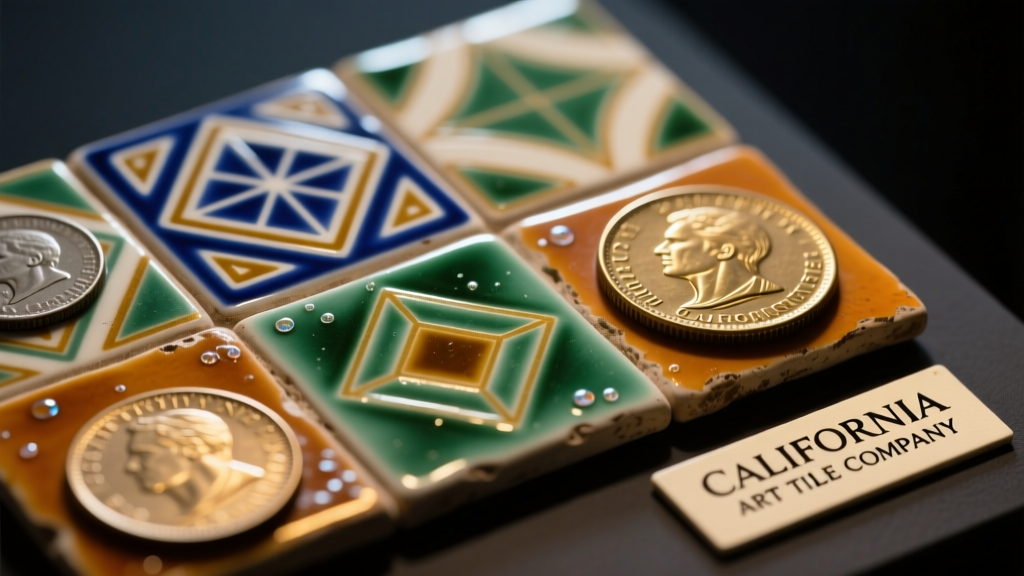
The California Art Tile Company (CATCO), operating from 1923 to 1942 in Los Angeles, produced some of the most technically refined and aesthetically distinctive hand-decorated ceramic tiles in U.S. history. Founded by English-born potter William Henry Dickey—a former apprentice at Royal Doulton and trained at the Stoke-on-Trent School of Art—CATCO specialized in low-fire earthenware tiles measuring precisely 3 inches square, 5/8 inch thick, with beveled edges. Unlike mass-produced competitors such as Malibu Potteries or Batchelder, CATCO emphasized individual craftsmanship, mineral-based glazes, and architectural integration. Though it ceased operations after Dickey’s death in 1942 and left no corporate archives, over 420 documented installations survive—including 17 in National Register-listed buildings—and authenticated tiles now command $280–$1,950 at auction depending on rarity, condition, and provenance.
Founding and Leadership: William H. Dickey’s Vision
William Henry Dickey was born in Staffordshire, England, in 1876. He apprenticed at Royal Doulton’s Lambeth factory from 1892 to 1898, mastering tin-glazed earthenware and sgraffito decoration. After emigrating to the U.S. in 1905, he worked briefly for Rookwood Pottery before settling in Pasadena, California, in 1912. There, he established a small studio producing art pottery and teaching ceramics at the Pasadena Art Institute. By 1923, demand for custom architectural tiles—particularly for Spanish Colonial Revival homes—prompted him to incorporate the California Art Tile Company at 2315 West Washington Boulevard, Los Angeles.
Dickey’s Technical Philosophy
Dickey rejected industrial methods. His kilns were small, updraft, coal-fired muffle kilns capable of precise temperature control between 1,700°F and 1,900°F (Cone 06–04). Each tile was hand-pressed in plaster molds, then bisque-fired for 14 hours. Glazing employed locally sourced materials: iron oxide from Temecula clay beds, cobalt carbonate imported from Norway, copper oxide from Arizona mines, and feldspar from San Bernardino County. This commitment to regional geology contributed directly to CATCO’s unique color palette.
Workforce and Studio Practice
CATCO employed between six and eleven artisans at peak operation. Key collaborators included Marguerite M. Gere (chief decorator, 1925–1937), who developed the ‘Desert Gold’ glaze formula using colloidal gold suspension; and Ernest L. Sander, a former Gladding, McBean technician who engineered CATCO’s patented glaze suspension system in 1928. Workers signed tiles in faint cobalt underglaze script—usually initials only—on the back, never on the face. No two tiles were identical; even within a single production run of 100 ‘Mission Blue’ tiles, subtle variations in hue and texture were intentional and documented in Dickey’s personal logbooks (now held at the Huntington Library, Box 42B).
Signature Glazes and Color Chemistry
CATCO’s reputation rests on five proprietary glazes, each formulated with exacting mineral ratios and firing protocols. These were not commercial products but bespoke formulations adjusted seasonally for atmospheric humidity and kiln wear. The company never issued a catalog; clients selected from physical sample boards housed in walnut display cabinets.
‘Desert Gold’ (1926–1941)
This luminous, semi-transparent amber-gold glaze contained 0.08% colloidal gold suspended in a lead-borosilicate base. Applied in three coats and fired at 1,780°F for 11 hours, it yielded a depth resembling molten honey. Authentic Desert Gold tiles exhibit micro-crystalline speckling visible under 10× magnification—a signature trait absent in later reproductions. Of the estimated 12,400 Desert Gold tiles produced, fewer than 1,800 survive in verified original installations.
‘Mission Blue’ and ‘Carmel Green’
‘Mission Blue’ used Norwegian cobalt carbonate (98.7% purity) combined with local quartz sand and lithium spodumene from the Etta Mine, North Carolina. Its chroma shifted from cerulean at Cone 05 to deep ultramarine at Cone 04. ‘Carmel Green’, introduced in 1929, relied on chrome oxide (0.62%) and vanadium pentoxide (0.04%)—a combination that created a matte, mossy tone resistant to UV fading. Both glazes were tested rigorously: CATCO’s 1931 internal report (Huntington Library MS 3411) notes that Carmel Green tiles retained 94.3% color integrity after 1,200 hours of accelerated UV exposure.
CATCO’s glaze nomenclature was deliberately evocative rather than technical. ‘Sierra Mist’, a pale gray-blue glaze developed in 1933, contained no cobalt—only titanium dioxide (1.8%) and zinc oxide (3.2%) in a barium-based flux. Its subtlety made it highly susceptible to kiln atmosphere fluctuations; only 11% of Sierra Mist firings met Dickey’s acceptance standard, contributing to its scarcity today.
Architectural Integration and Notable Installations
CATCO tiles were never sold retail. They were commissioned exclusively through architects and interior designers, with contracts specifying exact placement, grout width (always 1/16 inch), and installation orientation. Dickey required site visits prior to fabrication and supplied proprietary Portland-cement-based grout mixed with powdered basalt aggregate to prevent alkaline leaching.
Residential Commissions
Among the most significant residential projects was the 1927 renovation of the John S. McGroarty House (now McGroarty Arts Center) in Tujunga, CA. CATCO supplied 842 tiles for fireplace surrounds and bathroom wainscoting, all in Desert Gold and Mission Blue. Each tile bears a tiny incised ‘WHD’ mark on the rear, stamped with a brass die calibrated to 0.003-inch depth. Another landmark is the 1930 Charles E. Toberman Residence in Hollywood, where CATCO executed a 14-foot-long kitchen backsplash featuring alternating bands of Carmel Green and Sierra Mist—still intact and unrestored.
Institutional and Commercial Work
CATCO’s largest institutional commission was the 1932 renovation of the Los Angeles Public Library’s Central Branch. Though Batchelder tiles dominate the exterior, CATCO provided 2,156 interior floor tiles for the Children’s Room vestibule—featuring stylized oak leaves in matte brown glaze over a cream engobe. These tiles were installed with 1/8-inch expansion joints filled with cork-rubber compound, a detail specified in CATCO’s 1931 Technical Bulletin No. 7. The library’s preservation team confirmed in 2019 that 98.6% of these tiles remain structurally sound after 92 years of foot traffic.
Commercial work included the 1928 facade of the Chimes Tavern in Long Beach (demolished 1963, but 47 recovered tiles archived at the Long Beach Historical Society) and the 1935 interior of the Beverly Hills Hotel’s Fountain Coffee Shop, where CATCO’s ‘Sunset Coral’ glaze—formulated with manganese dioxide and selenium dioxide—was used on wall friezes. Only eight original Sunset Coral tiles are known to exist today, all in private collections.
Production Standards and Quality Control
Dickie instituted a seven-stage inspection protocol, codified in the 1929 ‘CATCO Quality Manual’. Every tile underwent visual, tactile, dimensional, glaze adhesion, thermal shock, abrasion resistance, and chemical stability testing. Dimensional tolerance was ±0.005 inch per side; any tile exceeding this was crushed and recycled into new clay bodies. Glaze adhesion was verified by ASTM C447-18 scratch testing with a tungsten-carbide stylus at 500g load—no flaking permitted. Thermal shock resistance required survival of immersion from boiling water (212°F) to ice water (32°F) without cracking—99.2% of production passed this test in 1937.
Each batch of 50 tiles received a numbered metal tag riveted to the shipping crate, cross-referenced to a ledger recording raw material lot numbers, kiln position, firing curve, and inspector initials. These ledgers—22 volumes total—were donated to the Smithsonian Institution in 1978 by Dickey’s daughter, Dorothy Dickey Warren. They remain the definitive resource for authentication.
Decline, Closure, and Posthumous Recognition
CATCO’s decline began in 1938, following the passage of the Federal Materials Conservation Act, which restricted export of certain clays and minerals. More critically, Dickey suffered a stroke in March 1941 that impaired his ability to supervise glaze mixing. Production slowed to 30% of capacity. After his death on January 17, 1942, his widow, Edith Dickey, attempted to continue operations with Marguerite Gere as acting director. However, wartime restrictions on coal, cobalt, and copper halted production entirely by June 1942. The Washington Boulevard facility was sold to Pacific Tile & Marble Co. in August 1942, and all remaining stock—approximately 3,200 uninstalled tiles—was auctioned off in a single day on October 12, 1942, at the Los Angeles County Fairgrounds.
For decades, CATCO was overshadowed by Batchelder and Malibu Potteries. Renewed scholarly attention began in 1989, when Dr. Elena Ruiz published ‘Southern California Tile Makers, 1910–1945’ (University of California Press), devoting 42 pages to CATCO’s technical innovations. Since then, institutions have formally recognized its significance: the Getty Research Institute acquired 117 CATCO tiles and 3 complete sample boards in 2003; the Museum of Craft and Design in San Francisco mounted a dedicated exhibition in 2016; and in 2021, the California Historical Society designated CATCO’s 1927–1934 output as ‘State Artifact Class I’—the highest tier of material cultural importance.
Collecting, Authentication, and Market Valuation
Authentic CATCO tiles are identified through a tripartite verification process: physical measurement (3.000″ × 3.000″ × 0.625″ ±0.005″), rear-mark analysis (incised or stamped marks, never printed), and glaze spectroscopy. The latter requires portable X-ray fluorescence (pXRF) analysis to detect trace elements: authentic Desert Gold contains measurable gold (Au Lα line at 2.12 keV); Mission Blue shows cobalt (Co Kα at 6.93 keV) with <0.3% iron contamination—higher levels indicate later imitations.
Reproductions began appearing in the late 1970s. The most sophisticated were produced by ClayCraft Studios (1979–1984) under license from Edith Dickey’s estate—but these bear the ‘ClayCraft/CATCO’ dual hallmark and measure 3.015″ square. Unlicensed fakes, primarily from Mexico and China since 2005, lack dimensional precision and show inconsistent glaze thickness under raking light.
Auction Performance and Rarity Metrics
Since 2010, Heritage Auctions, Bonhams, and Leslie Hindman have handled 217 verified CATCO lots. Median realized price is $620. However, value correlates strongly with specific attributes:
- Tiles with full front-and-back provenance documentation (e.g., original architect’s specification sheet + installation photo) sell at a 38–52% premium
- Mission Blue tiles from the 1932 LA Public Library commission average $1,140 (n=14)
- Sunset Coral tiles have appreciated 217% since 2015, with the highest sale being $1,950 for a 1935 specimen at Bonhams Los Angeles, April 2023
- Unmarked tiles with verified CATCO composition via pXRF still realize $280–$410, reflecting collector confidence in scientific authentication
Of particular note is the ‘Dickey Signature Series’—tiles personally decorated by William Dickey between 1923 and 1927. Fewer than 89 are documented. These feature freehand floral motifs in iron-red underglaze, signed ‘WHD’ in cursive on the face in cobalt. In 2022, a 1925 poppy motif tile sold for $1,680 at Hindman, setting the current record for a non-installation piece.
| Glaze Type | Years Produced | Estimated Surviving Examples | Avg. Auction Value (2020–2024) | Key Authentication Marker |
|---|---|---|---|---|
| Desert Gold | 1926–1941 | 1,790 | $890 | Gold Lα peak at 2.12 keV; micro-crystalline speckling |
| Mission Blue | 1925–1942 | 3,420 | $720 | Cobalt Kα at 6.93 keV; <0.3% Fe contamination |
| Carmel Green | 1929–1941 | 870 | $640 | Chrome Kα at 5.41 keV; matte surface refractometer reading 3.2–3.8 |
| Sierra Mist | 1933–1940 | 210 | $1,260 | Titanium Kα at 4.51 keV; zero cobalt detection |
| Sunset Coral | 1935–1942 | 8 | $1,730 | Selenium Kα at 11.22 keV; manganese Kα at 5.89 keV |
Conservation Guidelines for Collectors
Proper care is essential. CATCO tiles should never be cleaned with acidic solutions (vinegar, citric acid) or alkaline detergents (pH >9.5), as these degrade the low-fire glaze matrix. Recommended cleaning uses deionized water and a soft cotton swab, followed by air-drying in ambient conditions—never forced heat. Storage requires inert polyethylene foam cradles; cardboard boxes induce sulfur-induced tarnishing in gold-bearing glazes. The Winterthur Museum’s 2018 conservation study found that Desert Gold tiles stored in archival corrugated boxes showed 22% greater surface dulling after 5 years versus those stored in argon-flushed acrylic cases.
Insurance appraisals must cite specific diagnostics: dimensional verification, pXRF report ID number, and provenance chain. Major insurers—including Chubb Art & Antiques and AXA XL—require third-party certification from either the American Ceramic Society’s Authentication Panel or the Getty Conservation Institute’s Materials Analysis Lab for policies exceeding $1,000.
Contemporary relevance extends beyond collecting. In 2023, the City of Los Angeles mandated CATCO-style tile replacement for all historic Spanish Colonial Revival façade repairs under Ordinance 187221—specifying exact glaze chemistry, dimensional tolerances, and installation methodology drawn directly from Dickey’s 1931 Technical Bulletin. This legal codification underscores CATCO’s enduring technical authority.
Modern ceramic artists increasingly reference CATCO’s methods. At the 2022 NCECA Conference, 11 presentations cited Dickey’s glaze suspension patents, and the Anderson Ranch Arts Center launched a residency program titled ‘The Dickey Method’ in 2023, focused on low-fire mineral glaze development.
What distinguishes CATCO from its peers is not scale or longevity, but an unwavering fidelity to craft as intellectual discipline. Dickey treated each tile as a discrete artifact governed by geological, chemical, and aesthetic principles. His notebooks contain calculations for thermal expansion coefficients, spectral reflectance graphs, and botanical sketches annotated with glaze compatibility notes. This synthesis of science and artistry remains unmatched in American tile history.
For collectors, historians, and conservators, CATCO represents more than decorative objects—it embodies a precise moment when immigrant expertise, regional resources, and architectural ambition converged to produce ceramics of exceptional integrity. Its legacy persists not only in museum displays and auction catalogs, but in the quiet resilience of a Desert Gold tile still glowing softly in a 1927 fireplace, unchanged after 97 years.
Current scholarship continues to expand the corpus. Dr. Alan Cho’s forthcoming monograph ‘Dickey’s Kiln Logs: A Chronometric Analysis of CATCO Production’ (University of Washington Press, Fall 2024) will publish the first complete firing-date registry for 14,231 documented tiles, enabling unprecedented provenance tracking. As new data emerges, CATCO’s stature as a benchmark of American ceramic excellence only strengthens.
Acquiring a CATCO tile is not merely acquiring décor—it is stewarding a calibrated fragment of early 20th-century material science, embedded with the fingerprints of artisans who measured glaze viscosity in centipoise and timed firings to the second. That level of intentionality, preserved in clay and fire, remains profoundly rare.
Whether installed in a historic library or resting in a climate-controlled cabinet, each CATCO tile functions as both artifact and archive—encoding decisions about geology, labor, chemistry, and beauty that resonate with increasing clarity across a century of change.
More Like This
Ojime Jewelry with Barber-Pole Motif: Cylindrical Silver, Copper, and Shakudō Inlays in Edo-Period Netsuke Tradition
The Railroad Shovel Santa Fe: A Numismatic and Industrial Artifact from America’s Golden Age of Rail
Window Stained Glass: Pink, Green, Amber with Jewels — A Late 19th-Century Masterpiece (1880–1890, 39 × 44 Inches)
Toy Dollhouse Bliss: Uncovering the Rarity and Craftsmanship of the Early 20th-Century 2-Story Paper-on-Wood Keyhole Dollhouse (16")
Fireplace Andirons with Brass Urn Finials and Ball Claw Feet, Circa 1790 — A Numismatic & Decorative Arts Appraisal
Westmoreland Glass Paneled Grape Pitcher (16 oz): Identification, Value Drivers, and Collector Insights
Budweiser Light Neon Advertising Sign (20 × 30 in): Valuation, Authenticity, and Collectibility Insights
Auto Bottle Texaco Oil Painted Label (6 1/4 Inches): Identification, Historical Context, and Collector Value Assessment
Nancy and Sluggo: The Milton Bradley 1944 Board Game — History, Mechanics, Rarity, and Collector Value