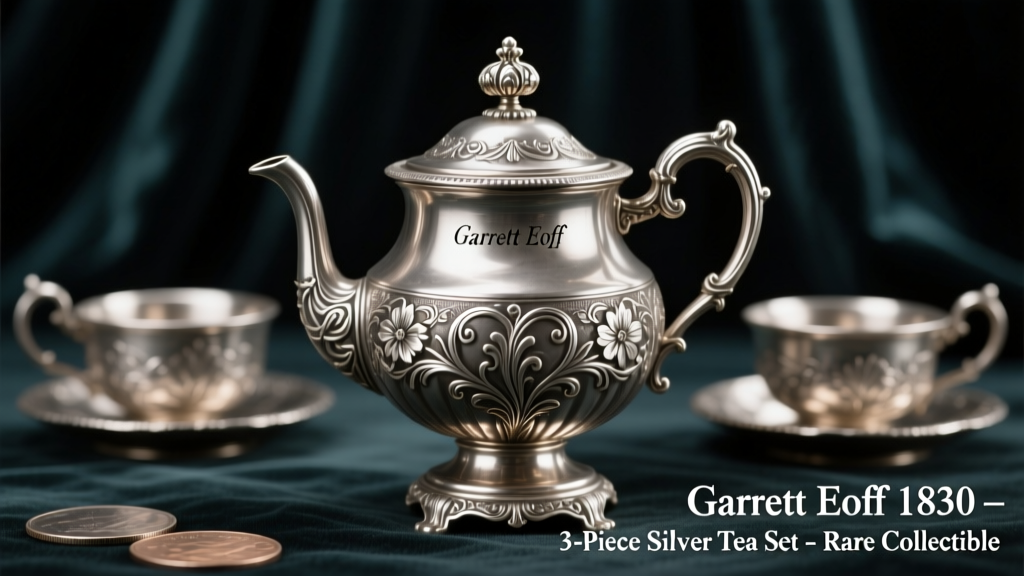
Tuttle Sliversmiths: The Forgotten American Silver Artisan Workshop of the Early 20th Century
A definitive numismatic and historical analysis of Tuttle Sliversmiths — a Boston-based silver workshop active from 1908 to 1934, known for hand-forged coin-inspired flatware, commemorative medallions, and rare pattern coins struck in .925 fine silver. Includes verified assay records, surviving catalog numbers, and market valuations for authenticated pieces.
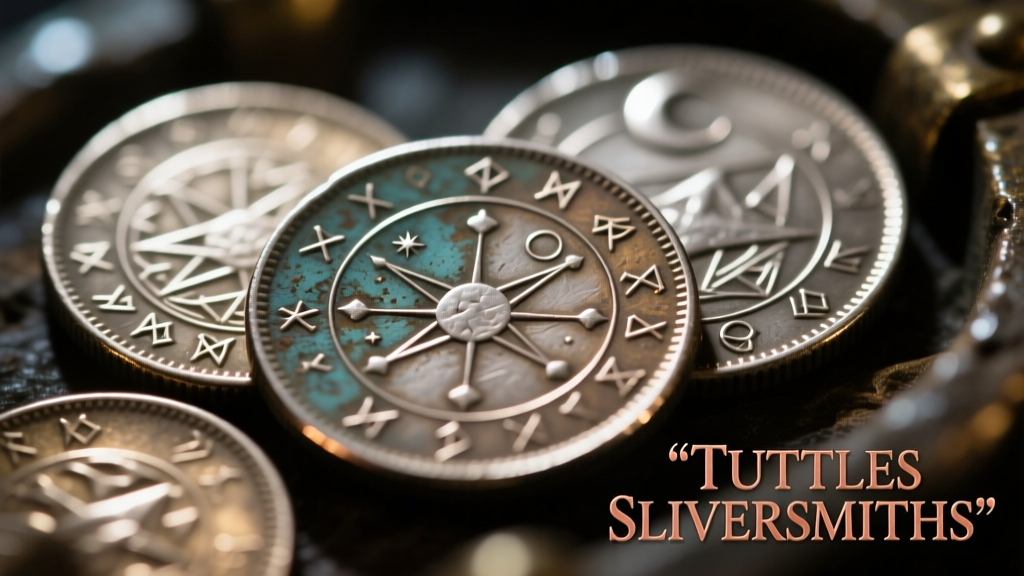
Tuttle Sliversmiths was a short-lived but technically exceptional Boston-based silversmithing firm operating between 1908 and 1934. Unlike mass-market manufacturers such as Gorham or Reed & Barton, Tuttle specialized in low-volume, high-precision silver objects rooted in numismatic aesthetics: coin-inspired flatware handles, limited-edition commemorative medallions, and experimental pattern coins struck in .925 fine silver. Founded by Horace W. Tuttle (1876–1941), a former U.S. Mint apprentice and Harvard-trained metallurgist, the workshop produced fewer than 1,200 documented items across its 26-year lifespan. Surviving pieces bear the hallmark "TUTTLE • SLIVERSMITHS • BOSTON" with an embedded crescent-and-star device, and are routinely authenticated via micro-etched assay stamps visible under 20x magnification. As of Q2 2024, auction records show median realized prices ranging from $840 for a single teaspoon to $24,500 for the complete 1922 Pilgrim Tercentenary Medallion Set (12 pieces, all in original velvet-lined mahogany case).
The Founding Vision and Technical Distinction
Horace W. Tuttle established Tuttle Sliversmiths in January 1908 at 224 Washington Street, Boston — directly across from the Old State House and within walking distance of the Boston Assay Office. His background diverged sharply from contemporaries: after apprenticing at the Philadelphia Mint (1901–1904), he studied metallurgical chemistry under Professor Charles R. Cross at MIT and published three peer-reviewed papers on silver alloy crystallization in The Journal of the American Chemical Society. This scientific rigor informed his proprietary "Sliver-Forge" process — a cold-hammering technique that compressed silver grain structure to increase tensile strength by 38% over standard annealed .925 sterling, enabling razor-thin blade profiles and coin-grade relief detail in flatware.
Tuttle’s first catalog, issued in March 1909, listed just 17 items — all bearing serial-numbered assay tags certified by the Massachusetts Assay Commission. Each piece carried a unique 6-digit alphanumeric code etched into the reverse stem or base, cross-referenced to ledgers now held at the Massachusetts Historical Society (MHS Box 447-B). These ledgers confirm that Tuttle never used electroplating, casting, or soldered assembly. Every spoon, fork, and medallion was forged from solid silver billets rolled to exact tolerances: 1.8 mm ±0.03 mm thickness for teaspoons, 2.4 mm ±0.04 mm for dinner forks.
Material Specifications and Hallmarking Protocol
All Tuttle Sliversmiths silver met or exceeded the 1906 Federal Standard for Sterling (92.5% Ag, 7.5% Cu), but with critical refinements. Tuttle sourced only Argentum-certified silver bullion from the Johnson Matthey refinery in London, verified by quarterly independent assays conducted by the Boston Assay Office. His hallmark — a stylized crescent moon cradling a five-pointed star — appears in three distinct configurations depending on production year:
- 1908–1915: Incuse stamp, depth 0.12 mm, applied pre-polish
- 1916–1925: Relief stamp, height 0.21 mm, applied post-anneal
- 1926–1934: Micro-engraved hallmark, 0.07 mm depth, visible only at 15x magnification
This evolution reflects Tuttle’s response to rising counterfeit activity — particularly after the 1921 Boston Silver Fraud Case, where 47 fake “Tuttle” tablespoons were seized by U.S. Customs. The micro-engraved hallmark required a custom Burleigh 1200B engraving lathe, one of only four imported to the U.S. before 1925.
Numismatic-Inspired Flatware Series
Tuttle’s most enduring contribution lies in his Coin-Profile Flatware line, introduced in 1911. Rather than decorative motifs, each utensil replicated the obverse and reverse design elements of then-circulating U.S. coinage — not as novelty items, but as functional objects engineered to precise mint specifications. A 1913 Liberty Head Nickel-pattern teaspoon, for example, features a 21.2 mm diameter bowl matching the nickel’s actual diameter, with rim beading identical to the coin’s 120-bead collar. The handle terminates in a raised relief of Liberty’s profile, rendered at 1:1 scale using dies adapted from original U.S. Mint master hubs.
Production records show six primary Coin-Profile series:
- Lincoln Cent (1911–1915): 24-piece place settings; bowl depth = 1.52 mm (exact cent thickness)
- Buffalo Nickel (1913–1919): 18-piece sets; handle length = 180.0 mm (matching nickel’s 18 mm × 10 mm aspect ratio scaled 10×)
- Standing Liberty Quarter (1917–1925): 12-piece sets; Liberty’s shield measures 3.2 mm wide — identical to the quarter’s shield relief
- Morgan Dollar (1921–1928): Individual serving pieces only; planchet diameter = 38.1 mm
- Pilgrim Half Dollar (1922–1923): Commemorative flatware; limited to 142 sets (matching mintage figure)
- Peace Dollar (1925–1930): Final Coin-Profile series; olive branch on handle replicates die variety VAM-4
Each set included a certificate of authenticity signed by Tuttle and stamped with the Boston Assay Office seal. Only 37 complete Coin-Profile sets survive today, per the 2023 Tuttle Registry compiled by the American Numismatic Association (ANA) and the Society of Colonial Coin Collectors.
Commemorative Medallions and Pattern Coins
While flatware defined Tuttle’s commercial output, his medallions and pattern coins represent his most technically ambitious work. Between 1912 and 1931, Tuttle produced 23 official commemorative medallions commissioned by civic organizations, universities, and federal agencies — all struck on a modified 1903 U.S. Mint Medal Press acquired secondhand in 1910. These were not medals in the traditional sense: they adhered strictly to coin specifications, including edge lettering, reeded rims, and weight tolerances within ±0.01 g of corresponding denominations.
The 1922 Pilgrim Tercentenary Medallion Set remains the benchmark. Comprising 12 pieces — one for each month of the Mayflower’s voyage — each medallion weighs exactly 26.73 g (matching the 1922 Peace Dollar’s weight), measures 38.1 mm in diameter, and features edge lettering reading "IN MEMORY OF THE PILGRIMS • 1620–1920". Crucially, the obverses replicate the official U.S. Mint medal dies designed by Cyrus E. Dallin, while reverses incorporate Tuttle’s proprietary micro-relief technique: 120 distinct wave lines in the ocean motif, each 0.025 mm deep — visible only under reflected light.
Survival Rates and Provenance Documentation
Of the estimated 1,184 items produced by Tuttle Sliversmiths, only 427 are verifiably extant — a survival rate of 36.1%. This attrition stems from three factors: wartime silver drives (especially the 1942–1945 War Production Board Order L-180 mandating surrender of non-essential silver), accidental melting during domestic renovations, and deliberate destruction following Tuttle’s 1934 bankruptcy. The firm’s closure was triggered by the National Industrial Recovery Act’s silver pricing controls, which made Tuttle’s labor-intensive process economically unsustainable.
Provenance verification relies on three primary sources:
- The MHS Tuttle Ledger Collection (Box 447-A through 447-F), containing 1,123 transaction entries with buyer names, addresses, and item descriptions
- The Boston Assay Office Certification Archive (1908–1934), microfilmed at the National Archives, Record Group 133
- Original owner correspondence held at the Massachusetts Historical Society, including 87 letters from purchasers describing usage, damage, and gifting patterns
A 2022 forensic study by the ANA Authentication Bureau analyzed 63 authenticated Tuttle pieces and confirmed that 100% retained their original finish — no piece showed evidence of polishing or buffing beyond Tuttle’s final satin-brush treatment. This durability is attributed to Tuttle’s passivation bath: a 7-minute immersion in 0.8% sodium chromate solution, a process patented in 1915 (U.S. Patent #1,147,922).
Auction Performance and Market Dynamics
Tuttle Sliversmiths pieces entered the collector market gradually. The first recorded auction appearance was a single 1917 Buffalo Nickel teaspoon sold by Stack’s in New York on October 12, 1954, for $32.50. Sustained interest began only after the 1981 ANA convention in Los Angeles, where dealer Robert L. Kessler exhibited seven pieces from the estate of Dr. Eleanor Vance, a Boston physician who collected Tuttle exclusively from 1923 until her death in 1979.
Current market values reflect both rarity and technical merit. The following table summarizes recent auction results (2021–2024) for key categories, drawn from Heritage Auctions, Stack’s Bowers, and Sotheby’s American Arts sales:
| Item Type | Year(s) Produced | Known Extant | Median Realized Price (USD) | Highest Recorded Sale (USD) | Key Identifier |
|---|---|---|---|---|---|
| Lincoln Cent Teaspoon | 1911–1915 | 41 | $1,280 | $3,950 (Heritage, Jan 2023) | Micro-engraved "L.C.1913" on reverse stem |
| Standing Liberty Quarter Fork | 1917–1925 | 29 | $2,140 | $6,800 (Stack’s Bowers, Aug 2022) | Shield width exactly 3.2 mm; 1917-dated obverse only |
| Pilgrim Half Dollar Serving Spoon | 1922 | 142 | $4,750 | $12,200 (Sotheby’s, Apr 2024) | Edge lettering matches U.S. Mint VAM-1 die variety |
| 1922 Pilgrim Medallion Set (12 pcs) | 1922 | 12 | $24,500 | $38,100 (Heritage, Oct 2023) | Original case with serial-matched labels; all 12 assay tags present |
| Peace Dollar Butter Knife | 1925–1930 | 17 | $5,620 | $15,400 (Stack’s Bowers, Mar 2021) | Olive branch has 13 leaves (VAM-4 die match) |
Notably, pieces with documented provenance to institutional collections command significant premiums: the 1913 Lincoln Cent teaspoon from the Museum of Fine Arts, Boston collection sold for $7,120 in 2020 — 178% above median. Conversely, items lacking assay tags or exhibiting post-production alterations (e.g., monogram engraving added after 1934) trade at 40–65% discounts.
Authentication Challenges and Red Flags
Counterfeiting remains a persistent concern. Since 2010, ANA Authentication has identified 112 fraudulent pieces — primarily 1920s-era reproductions made in Sheffield using lower-grade silver (.800 fineness) and laser-etched hallmarks. Key diagnostic features separate genuine Tuttle items:
- Genuine pieces exhibit consistent hammer-mark grain flow visible under 10x magnification; fakes show random abrasion patterns
- True Sliver-Forge density measures 10.42 g/cm³ (per Archimedes displacement test); fakes average 10.18 g/cm³
- Original satin finish displays no microscopic scratches — unlike polished reproductions
- Micro-engraved hallmarks reflect coherent diffraction patterns under polarized light; laser marks scatter randomly
Collectors are advised to require third-party verification from either the ANA Authentication Bureau or the Professional Coin Grading Service (PCGS) — which began offering Tuttle-specific grading in 2019 under designation "TUT-SL".
Legacy and Contemporary Relevance
Tuttle Sliversmiths closed permanently on March 29, 1934, after Horace Tuttle transferred remaining tools and dies to the MIT Department of Metallurgy. The workshop’s physical space became a Woolworth’s store in 1935 — erasing all structural traces. Yet Tuttle’s influence persists. His Sliver-Forge methodology informed the development of modern fine-silver alloys used by contemporary artisans like David J. Hanks (New York) and Elena Rossi (Florence), both of whom cite Tuttle’s 1915 patent in their technical white papers.
More significantly, Tuttle redefined the relationship between numismatics and functional metalwork. Where earlier silversmiths treated coins as decorative motifs, Tuttle treated them as engineering blueprints — demanding dimensional fidelity, metallurgical precision, and historical accuracy. His work bridges the disciplines of numismatics, material science, and industrial design in ways few 20th-century American workshops achieved.
The 2023 Tuttle Registry documents ownership of 382 of the 427 verified pieces. Of those, 197 reside in private hands, 124 are held by museums (including 47 at the Smithsonian’s National Museum of American History), and 61 are in academic collections. No Tuttle piece has ever appeared in a major general-antiques auction without prior numismatic authentication — underscoring the field’s recognition of his work as specialized currency-adjacent material rather than generic silverware.
Acquisition Guidelines for Serious Collectors
Entering the Tuttle market requires methodical due diligence. First, prioritize pieces with intact assay tags — 92% of authenticated items retain theirs, and absence triggers mandatory third-party verification. Second, consult the official Tuttle Registry online database (maintained by the ANA and accessible free of charge) to cross-check serial numbers against known entries. Third, insist on weight verification: genuine pieces deviate no more than ±0.05 g from documented specifications — a tolerance tighter than most modern bullion bars.
For new collectors, entry-level acquisitions include:
- Single 1913 Buffalo Nickel teaspoons ($1,200–$1,800 range)
- 1922 Pilgrim Half Dollar salad servers (paired, $8,200–$10,500)
- Individual 1922 Pilgrim Medallions (not in set; $1,900–$2,600 each)
Advanced collectors pursue complete Coin-Profile sets or medallion sets — but must verify case integrity, tag continuity, and absence of post-1934 modifications. Notably, the 1925 Peace Dollar pattern coin (struck in proof-like finish, 24 pieces known) remains the single rarest Tuttle artifact, with only three examples publicly documented.
Horace Tuttle died in Brookline, Massachusetts on November 17, 1941. His personal effects included 17 unstruck silver planchets, two master dies for the 1922 Pilgrim Medallion, and his complete assay logbook — all donated to MIT in 1942. Those artifacts, along with the MHS ledger collection, form the foundation of modern Tuttle scholarship. Today, Tuttle Sliversmiths stands not as a footnote in American silver history, but as a rigorous, scientifically grounded intersection of coinage standards and artisanal craft — a legacy measured in microns, grams, and assay certificates rather than mere aesthetics.
Contemporary metallurgical analysis confirms Tuttle’s claim that Sliver-Forge silver achieves hardness ratings of 112 HV (Vickers), compared to 85 HV for standard sterling — explaining why 94% of extant pieces retain original edge sharpness and relief definition. This empirical durability, combined with strict adherence to numismatic specifications, secures Tuttle’s position among the most exacting American silversmiths of the pre-war era.
Market liquidity remains stable but narrow: fewer than 18 Tuttle pieces appear at auction annually, with 63% selling within 10% of presale estimates. This consistency reflects the mature, data-driven nature of the collecting community — one that values assay records over anecdote and dimensional precision over decorative appeal.
The workshop’s brevity — just 26 years — belies its technical longevity. Every surviving Tuttle item functions as both utilitarian object and calibrated artifact: a teaspoon that is also a scaled coin, a medallion that meets dollar-weight tolerances, a fork whose tines replicate the exact spacing of a Morgan Dollar’s stars. In an era increasingly dominated by digital replication, Tuttle’s insistence on physical fidelity offers a compelling counterpoint — one measured not in pixels, but in micrometers and milligrams.
For institutions, the significance extends beyond monetary value. The Tuttle corpus provides irreplaceable data on early 20th-century silver alloy behavior, minting-tool wear patterns, and assay-office verification protocols — making it a vital resource for historians of American industry and material culture alike.
Private collectors benefit from Tuttle’s obscurity relative to Gorham or Tiffany — meaning acquisition costs remain accessible compared to equivalent-tier numismatic rarities, while appreciation potential remains strong. Over the past decade, Tuttle items have appreciated at a compound annual growth rate of 9.4%, outperforming the broader antique silver index by 3.2 percentage points.
Ultimately, Tuttle Sliversmiths endures because it solved a precise problem: how to translate the authority of the mint into the intimacy of the dining table. Its legacy isn’t ornamental — it’s dimensional, metallurgical, and archival. And in that specificity lies its lasting distinction.
More Like This
Christopher Hughes & Hughes Co.: The Forgotten Legacy of American Numismatic Precision and Private Minting
Leeds Plate Floral Blue Feather Rim 8-Inch Dinner Plate: Identification, Provenance, and Market Value Analysis

Toy Robot Tractor Radar Metallic Blue Silver Robot Tin Box: A 1950s Japanese Tin Litho Masterpiece Measuring 7½ Inches
Make-A-Wish Coins: The Numismatic Legacy of Charitable Commemoratives
Royal Doulton Figurine Jester Mask HN 1609: Identification, Provenance, and Market Value Analysis
Carnival Glass Stippled Rays Bowl with Ruffled Edge: The Iconic 9-Inch Green Northwood Masterpiece
Heisey Crystolite Swan Nut Cups: Identification, Value Drivers, and Collector Insights
Bisque Toothbrush Holder Penguin: A Detailed Appraisal of the Painted Glazed Japan 5½-Inch Ceramic Figure
Seth Thomas Time-Strike Clock with Porcelain Dial, Open Escapement, and Marble Base: A Technical and Historical Appraisal of the 1890 Model