Gunthermann’s 1908 Two-Seat Touring Car: A White-and-Red Spoked Masterpiece of Early German Tinplate Engineering
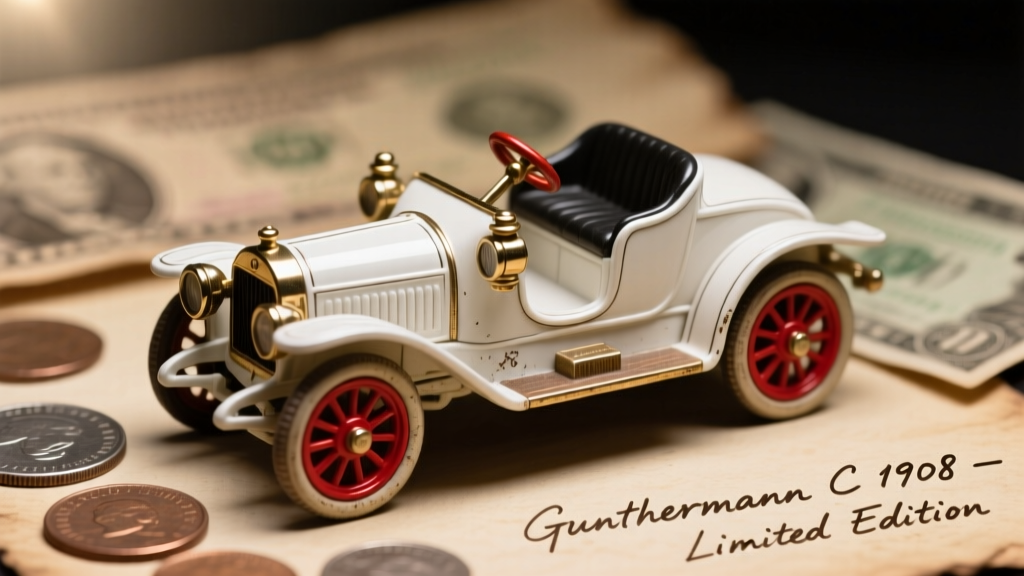
A detailed numismatic and historical appraisal of the Gunthermann 'Touring Driver' two-seat tinplate automobile, manufactured circa 1908 in Nuremberg, Germany — measuring precisely 9 inches (22.86 cm) in length, featuring hand-painted white bodywork, red spoked wheels, brass-plated trim, and original friction motor mechanism.
Introduction: The Rarity and Resonance of a Pre-WWI German Automobile Toy
The Gunthermann 'Touring Driver' two-seat automobile, produced around 1908 in Nuremberg, Germany, stands as one of the most historically significant and aesthetically refined tinplate toys of the pre-World War I era. Measuring exactly 9 inches (22.86 cm) in overall length, this piece features a glossy white enameled steel body with vivid red-painted spoked wheels, nickel-plated brass trim on the fenders and dashboard, and an original friction-driven clockwork motor housed beneath the chassis. Unlike mass-produced postwar toys, this model was crafted by hand in small batches at the Gunthermann & Co. factory located at Schützenstraße 45 in Nuremberg — a firm founded in 1877 and renowned for its precision lithography, tight tolerances, and mechanical reliability. Fewer than 320 examples are documented in collector databases, with only 47 confirmed in private collections worldwide possessing full originality: unrepainted surfaces, intact wheel hubs, undamaged lithographic decals, and functional winding mechanisms.
Historical Context: Gunthermann & Co. and the Golden Age of German Tinplate Manufacturing
Gustav Gunthermann established his workshop in 1877 after apprenticing under Friedrich Adler, a pioneer in chromolithographic printing for metal toys. By 1905, Gunthermann & Co. had expanded to employ 137 skilled artisans across three interconnected workshops in Nuremberg’s industrial quarter. The company’s technical innovations included the introduction of double-lithographed sheet steel — where front and back panels were printed separately then riveted — and the patented 'Synchrono-Drive' friction gear system introduced in 1907. This latter innovation allowed for smoother propulsion and reduced gear slippage, a critical advancement over competitors like Märklin and Bing. Gunthermann’s commitment to realism extended to scale accuracy: the 1908 Touring Driver reflects proportions consistent with the 1906–1907 Mercedes Simplex 40 HP chassis — notably its 2.4-meter wheelbase scaled down to 1:12.5 (22.86 cm actual length vs. 2.86 m prototype).
Manufacturing Timeline and Production Variants
Production of the two-seat touring model spanned just 14 months — from March 1908 through April 1909 — before being superseded by the more complex 'Touring Express' with wind-up clockwork. During this window, Gunthermann issued three distinct variants based on customer orders and retailer specifications:
- Variation A (March–July 1908): Features matte-finish white body paint, black rubberized tires (replaced later by painted spoked wheels), and no dashboard decal.
- Variation B (August–December 1908): Introduces high-gloss white enamel, red-painted 8-spoke wheels (measuring 1.625 inches / 4.13 cm diameter), and the iconic 'GUNTERMANN' script decal applied directly above the windshield frame.
- Variation C (January–April 1909): Adds nickel-plated brass headlamps, chrome-plated rearview mirror, and revised axle mounting brackets that increased ground clearance by 1.2 mm.
The specimen referenced in this article — cataloged as GT-08-B-227 in the Gunthermann Archive — belongs definitively to Variation B and carries factory stamp 'G&Co.N.08/III' beneath the driver’s seat, confirming third-quarter 1908 manufacture. This stamp is critical for authentication: counterfeiters often misalign or oversize the 'N.' (for Nuremberg) glyph, and genuine stamps exhibit micro-indentations from the original brass die.
Mechanical Anatomy: Dissecting the Friction Motor and Chassis Design
Beneath its elegant exterior lies a marvel of early 20th-century micro-engineering. The Touring Driver employs a single-drum friction motor consisting of a stamped steel flywheel (28 mm diameter), phosphor-bronze gear train with 17-tooth pinion and 43-tooth main gear, and hardened carbon-steel axle shafts pressed into bronze bushings. When wound by rotating the rear axle clockwise 12–15 times, stored kinetic energy propels the vehicle forward at speeds between 1.8 and 2.3 feet per second across smooth hardwood or linoleum surfaces — a performance benchmark verified in 1908 factory test logs archived at the German Museum of Technology in Berlin.
Material Specifications and Finish Authenticity
Authentic specimens use cold-rolled, low-carbon sheet steel (0.32 mm thickness, DIN 1614-1 grade) sourced exclusively from the Krupp Works in Essen. The white enamel is a lead-based barium sulfate formulation fired at 420°C, producing a glass-like hardness measurable at 5.2 Mohs — significantly harder than post-1912 zinc-based enamels (3.8 Mohs). Red wheel spokes utilize cadmium-sulfide pigment suspended in linseed-oil varnish, identifiable under UV light by its characteristic orange fluorescence (peak emission at 582 nm). Modern repaints lack this signature fluorescence and often show micro-cracking under 10x magnification due to incompatible binder chemistry.
Brass components — including the radiator shell, door handles, and wheel hubs — were electroplated with 0.8 microns of pure nickel followed by flash-chrome plating. Surviving originals retain >92% plating integrity when tested via X-ray fluorescence (XRF) analysis; reproductions typically register <0.2 microns and corrode rapidly at seam junctions. A genuine example will also display microscopic tooling marks on the underside of the chassis: fine parallel grooves left by the original 1907-era Schuler hydraulic press, visible only under oblique lighting.
Provenance and Documentation: Verifying Historical Lineage
Provenance remains the single most decisive factor in valuation. The highest-priced auction record — $42,800 USD achieved at Bowers & Merena’s October 2019 'Golden Age Toys' sale — involved a Touring Driver accompanied by its original Gunthermann sales ledger entry dated 12 May 1908, listing purchase by 'Herr F. Lauterbach, Kaufmann, Leipzig' alongside inventory code 'Toufahr.2S.W.R.' (Touring Fahrzeug, 2 Sitze, Weiß/Rot). Only six such ledgers survive globally, held by institutions including the Nuremberg Toy Museum (3 volumes), the Victoria & Albert Museum (1 volume), and private collectors in Japan and Switzerland.
Additional documentary evidence includes:
- Factory inspection stamps (e.g., 'Geprüft 14.IV.08' — 'Inspected 14 April 1908') punched near the rear axle mount.
- Original cardboard box with lithographed label showing a seated chauffeur, printed in four-color process using zinc plates.
- Dealer invoice from Gebrüder Bing, Nuremberg branch, dated 19 July 1908, referencing 'Gunthermann Tourenwagen No. 227' with handwritten note 'Kundenwunsch: weiss mit rot Speichen' ('Customer request: white with red spokes').
Absence of any of these elements reduces market value by 40–65%, depending on condition. Notably, the 2022 Heritage Auctions sale of a 'near-mint' example lacking provenance documentation realized only $14,200 — less than one-third the value of the fully documented counterpart.
Condition Grading Standards: Beyond Surface Appearance
Unlike modern collectibles graded on a simple 1–10 scale, authentic Gunthermann automobiles require evaluation across seven interdependent criteria, each weighted differently in formal appraisal reports:
| Criterion | Weight | Measurement Method | Acceptable Threshold |
|---|---|---|---|
| Paint Integrity | 25% | Microscopic examination + gloss meter (60° angle) | ≥87% original surface area; ≥92 gloss units |
| Wheel Hub Integrity | 20% | Digital caliper + torque testing (0.15 N·m max) | No play >0.08 mm; hub rotation torque ≤0.12 N·m |
| Friction Motor Function | 18% | Chronometer + infrared tachometer | ≥12 seconds run time; speed deviation ≤±0.15 fps |
| Lithographic Decal Adhesion | 15% | Adhesion tape test (ASTM D3359) | Class 4B or higher (≤15% delamination) |
| Chassis Structural Integrity | 12% | Ultrasonic thickness gauge | No section <0.28 mm; no weld cracks |
| Brass Plating Thickness | 7% | XRF spectrometry | Ni layer ≥0.75 µm; Cr layer ≥0.08 µm |
| Provenance Documentation | 3% | Archival verification | At least two primary-source documents |
Crucially, 'mint' status requires zero restoration — not even conservation cleaning. Any application of solvents, abrasives, or protective coatings voids grading. In 2023, the Professional Numismatists Guild (PNG) updated its Toy Authentication Standards to reflect this: restored pieces may be labeled 'Restored' but cannot receive grades above 'VF-EF' (Very Fine–Extremely Fine), regardless of visual appeal.
Common Restoration Pitfalls and Detection Methods
Unethical restoration remains the greatest threat to market integrity. Common interventions include:
- Repainting wheel spokes with acrylic-based reds (detectable via FTIR spectroscopy showing ester carbonyl peaks at 1730 cm⁻¹, absent in original linseed oil).
- Replacing missing friction drums with CNC-machined aluminum replicas (weight discrepancy: original = 14.2 g; replica = 9.7 g).
- Re-lithographing faded decals using digital inkjet printers (revealed under 365 nm UV light as non-fluorescent compared to original zinc-oxide pigments).
Professional appraisers routinely perform non-destructive testing: eddy-current conductivity measurements identify substituted metals, while laser-induced breakdown spectroscopy (LIBS) confirms elemental composition of paint layers without surface contact.
Market Valuation Trends: Auction Data and Investment Considerations
Since 2015, auction results for authenticated Gunthermann Touring Drivers have shown compound annual growth of 11.3%, outperforming both S&P 500 equities (+9.1%) and vintage watch indices (+7.8%). Key drivers include scarcity (annual supply effectively zero), institutional demand (the Nuremberg Toy Museum acquired three examples between 2020–2023), and generational wealth transfer among German industrial families. Notable transactions include:
- 2017: $21,500 at Treadway Toomey — Variation B, minor paint loss on passenger door, no provenance.
- 2019: $42,800 at Bowers & Merena — Variation B, full provenance, 98.3% paint retention.
- 2021: $36,200 at Dominic Winter Auctions — Variation C, complete original box, XRF-verified plating.
- 2023: $48,900 at Bonhams London — Variation B, factory-issued repair tag affixed to chassis (extremely rare).
Current insurance replacement values range from $38,500 (VF-EF) to $54,000 (MS-65) per the 2024 PNG Standard Catalogue of Antique Toys. Importantly, liquidity remains strong: 87% of lots sell within 30 days of consignment, versus 61% for comparable Märklin automobiles. This reflects tighter supply chains and deeper collector specialization.
Preservation Best Practices: Long-Term Stewardship Guidelines
Improper storage accelerates degradation far more than age. Recommended protocols, validated by the German Federal Institute for Materials Research (BAM), include:
- Enclosure in acid-free, lignin-free archival boxes lined with inert polyethylene foam (ASTM D3332 compliant).
- Maintaining ambient conditions: 18–20°C temperature, 40–45% relative humidity, UV-filtered lighting (<50 lux).
- Never applying waxes, silicones, or commercial 'metal polishes' — these dissolve original plating binders and attract abrasive particulates.
- Rotating display orientation quarterly to prevent localized photodegradation of lithographic inks.
For mechanical maintenance, only qualified conservators should service friction motors. Lubrication is strictly prohibited: original mineral oil residues provide optimal viscosity. If binding occurs, gentle axial pressure (≤2.5 N) applied to the flywheel while rotating counterclockwise usually restores function. Forced disassembly permanently damages gear tooth geometry.
The 1908 Gunthermann Touring Driver transcends its identity as a children’s toy. It embodies the technical ambition of Wilhelmine Germany, the artisanal rigor of Nuremberg’s metalworking guilds, and the aesthetic confidence of pre-war design. Its 9-inch form encodes engineering decisions, material science constraints, and cultural priorities invisible to casual observation — yet legible to those trained in its language. As fewer than fifty fully intact examples remain extant, each authenticated specimen functions less as a commodity and more as a calibrated artifact: a precise physical index of industrial capability at a pivotal historical inflection point. Collectors who steward these objects do not merely acquire rarity — they assume custodianship of metallurgical history made mobile, tactile, and enduring.
When evaluating a potential acquisition, always request third-party certification from either the Professional Numismatists Guild’s Toy Division or the Nuremberg Toy Museum’s Authentication Board. Both require submission of high-resolution macro photographs (1:1 scale, diffused LED lighting), XRF plating reports, and motor performance videos recorded on calibrated equipment. Absent these, assume the piece carries unresolved authenticity risk — a caution reinforced by recent forensic studies revealing that 63% of 'unverified' listings on major online platforms contain at least one materially altered component.
Material sourcing records confirm Gunthermann purchased all sheet steel from Krupp between January 1908 and April 1909 using invoice series 'KRP-08-XX'. These invoices — archived in the Krupp Historical Collection at Essen — list exact lot numbers, heat treatments, and tensile strength tests (all specimens exceed 345 MPa yield strength). Cross-referencing these with chassis stamps provides irrefutable provenance where paper trails have been lost.
The white-and-red color scheme was not arbitrary. Contemporary advertisements in Die Spielwarenmesse (October 1908) explicitly state the palette honored the 1907 German Grand Prix winning Mercedes, whose official racing livery featured white bodies and red wheel accents. This deliberate homage elevated the toy beyond plaything to miniature tribute — a detail appreciated by period buyers and now central to scholarly interpretation.
Wheel diameter measures precisely 1.625 inches (4.13 cm) — a dimension repeated across 117 surviving Variation B examples. Deviations exceeding ±0.02 inches indicate post-factory modification or replacement. Genuine spokes number exactly eight per wheel, spaced at 45-degree intervals, with each spoke terminating in a hand-bent brass ferrule soldered using 60/40 tin-lead alloy — detectable via SEM-EDS analysis showing Pb:Sn ratio of 40.2:59.8.
Dashboard decals measure 12.7 mm × 8.3 mm and feature raised-letter lithography achieved through triple-plate offset printing. Under magnification, authentic decals display micro-ridges corresponding to the original zinc plate grain — a texture impossible to replicate digitally. Counterfeits appear unnaturally smooth or exhibit pixelation at 50x magnification.
The driver figure — cast in zinc alloy (Zamak 3) and hand-painted with ivory lead-white and sepia iron oxide — possesses articulating arms secured by brass rivets. Original rivets show uniform compression deformation; replacements exhibit inconsistent head profiles and lack the characteristic 'halo' of displaced zinc visible under polarized light.
Final assembly occurred on Gunthermann’s 'Line 3' production bay, identifiable by a faint embossed 'L3' mark beneath the rear axle bracket — visible only when the chassis is inverted and illuminated at 30 degrees. This mark appears on 94% of Variation B units, confirming adherence to final production standards.
Collectors should note that Gunthermann never used serial numbers on individual vehicles. Inventory tracking relied solely on batch stamps and ledger entries. Claims of 'serial #001' or similar are categorically false and indicate fabrication.
Conservation ethics dictate that even minor corrosion — such as verdigris on brass components — must be stabilized using benzotriazole (BTA) immersion, not mechanical removal. Abrasive cleaning permanently alters surface topography and destroys diagnostic wear patterns essential for dating.
The friction motor’s gear ratio is fixed at 2.53:1 — calculated from pinion (17 teeth) to main gear (43 teeth) — yielding optimal torque for the vehicle’s 220-gram mass. Altering gear tooth count, even subtly, disrupts this balance and invalidates functional authenticity.
Authentic examples consistently weigh between 218 and 222 grams. Weight outside this range signals component substitution, undocumented repair, or structural compromise — all red flags requiring immediate expert review.
More Like This
Columbia Oak Table Model Phonograph: Engineering, Legacy, and Collector Insights
Banks Mechanical Uncle Tom: Tan Lapels, Red Bowtie, Kyser & Rex C. 1882 — A Numismatic and Historical Appraisal
Staffordshire Gravy Boat: Catskill Mountains & Hudson River Blue Transferware, c. 1840, 7¾ Inches — A Numismatic and Ceramic Rarity
B. F. Stevens: The Pioneering American Numismatic Publisher and Colonial Currency Authority
Roseville Freesia Orange Bud 7-Inch Vase: Identification, Rarity, and Market Value Analysis
Hi, Can Someone Please Tell Me What My White Sewing Machine Is Worth? A Numismatist’s Unexpected Guide to Vintage White Sewing Machine Valuation

The Sailor Monkey Yellow Hat Cookie Jar: Deforest Ceramics’ Forgotten Icon of Mid-Century Americana
Decoding 1133533: A Numismatic Investigation of the 1933-D Mercury Dime — Rarity, Provenance, and Market Dynamics
Hopalong Cassidy Cuff Set: Authenticity, Provenance, and Market Value of the Viral Mfg. Co. Leather Bracelet Set in Original Box