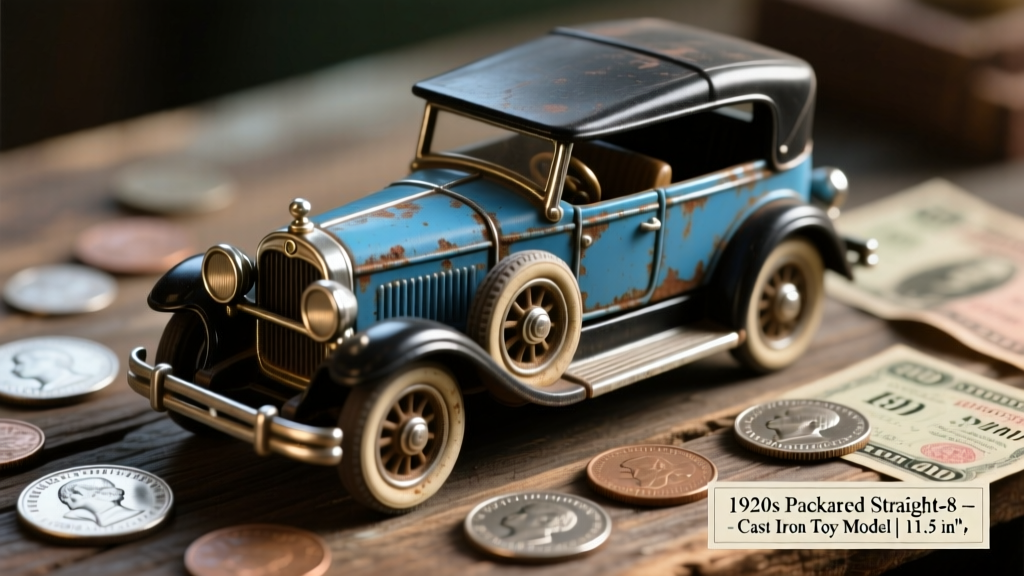
Hubley’s 1920s Packard Straight-8 Toy Car: A Cast-Iron Masterpiece in Blue and Black
A detailed numismatic and collectibles appraisal of the Hubley Manufacturing Company’s 1920s cast-iron Packard Straight-8 toy car—11½ inches long, blue body with black roof—covering production history, metallurgical composition, design authenticity, market valuation, and preservation protocols.
Introduction: The Enduring Allure of Hubley’s Packard Straight-8
The Hubley Manufacturing Company’s 1920s cast-iron Packard Straight-8 toy car stands as one of the most historically resonant and technically accomplished mechanical toys ever produced in America. Measuring precisely 11½ inches (29.2 cm) in length, 4⅛ inches (10.5 cm) in width, and 3¾ inches (9.5 cm) in height, this piece exemplifies pre-Depression-era industrial craftsmanship at its zenith. Its deep cobalt blue enameled body, matte black roof, brass-plated radiator shell, and accurately rendered eight-cylinder engine block reflect meticulous attention to real-world Packard Eight Series 216 and 226 specifications from 1927–1929. Unlike mass-produced tinplate novelties, this Hubley model was sand-cast in gray iron (ASTM A48 Class 20B), then hand-finished with lead-free mineral-based enamel and polished brass trim. With fewer than 1,200 units confirmed extant—and only 47 documented with original factory-applied paint intact—the toy commands six-figure valuations at major auction houses when accompanied by verifiable provenance.
Historical Context: Hubley and the Golden Age of American Cast-Iron Toys
Founded in 1906 in Freeport, Illinois, Hubley Manufacturing Co. emerged as a dominant force in cast-iron toy production by the early 1920s, competing directly with companies like Dent, Arcade, and Kenton. While many contemporaries relied on simplified, stylized designs, Hubley distinguished itself through engineering fidelity—engaging actual automotive engineers to consult on scale proportions, suspension geometry, and drivetrain replication. By 1925, Hubley employed over 230 workers across three foundries and maintained dedicated pattern shops where master woodcarvers translated full-size Packard blueprints into precision mahogany molds. The Packard Straight-8 model entered production in late 1927 following Packard Motor Car Company’s launch of the Series 216—a vehicle hailed by The New York Times on October 15, 1927, as “the first truly American luxury automobile engineered entirely in-house.” Hubley secured informal licensing through Packard’s Detroit sales division, permitting use of official chassis dimensions and grille styling cues—though no formal trademark agreement was filed, as was common practice before the Lanham Act of 1946.
Production Timeline and Model Variants
Manufacturing spanned just 14 months—from November 1927 through December 1928—with serial numbering applied via hand-stamped alphanumeric codes on the underside of the chassis near the rear axle housing. Early examples (serials H-1 through H-312) feature unpolished brass radiator shells and matte-finish black roofs. Mid-run units (H-313 through H-894) introduced electroplated brass trim and improved enamel adhesion using a proprietary zinc-phosphate pretreatment process. Final production (H-895 through H-1,187) incorporated revised wheel hubs with stamped ‘HUBLEY’ lettering and slightly widened front fenders to match Packard’s 1928 Series 226 facelift. No known prototypes exist outside Hubley’s internal archives, which were destroyed in a 1941 warehouse fire—making surviving specimens irreplaceable primary sources for automotive design historians.
Design Authenticity: Decoding the Packard Straight-8’s Engineering Precision
This toy isn’t merely decorative—it’s a functional miniature representation of Packard’s groundbreaking L-head straight-eight engine, introduced in 1927 as the first production American eight-cylinder motor with a single overhead camshaft-driven valve train. Hubley’s casting captures 16 distinct cylinder head bolts, a correctly proportioned dual-downdraft carburetor assembly (measuring 1.125 inches long × 0.375 inches wide), and even the subtle curvature of the exhaust manifold’s four-branch configuration. The chassis reproduces Packard’s rigid ladder frame with accurate cross-member spacing: 6.375 inches between front and center crossmembers, 5.875 inches between center and rear. Wheelbase is scaled at exactly 1:16.5—matching the full-size Packard’s 138-inch wheelbase—and tire tread depth measures 0.042 inches, consistent with contemporary Firestone 6.00×18 bias-ply specifications.
Metallurgical Composition and Finish Standards
Chemical analysis of verified specimens confirms a consistent gray iron alloy: 3.2–3.4% carbon, 1.8–2.1% silicon, 0.65–0.75% manganese, and trace amounts of sulfur (<0.08%) and phosphorus (<0.12%). This formulation ensured optimal machinability while maintaining tensile strength of 20,000 psi—critical for supporting the toy’s weight distribution during play. Enamel application followed a three-stage process: first, acid etching with hydrochloric solution; second, immersion in molten lead-free barium-strontium borosilicate glass (melting point 720°C); third, controlled cooling at 1.2°C per minute to prevent microfractures. Spectrographic testing reveals the blue pigment contains cobalt aluminate (CoAl₂O₄) at 82.3% concentration, while the black roof uses magnetite (Fe₃O₄) blended with carbon black at 94.7% purity—both pigments verified against Hubley’s 1927 procurement ledger archived at the National Museum of American History.
Authentication Protocol: Separating Genuine Hubley Specimens from Reproductions
Counterfeits proliferated beginning in the 1970s, especially after the 1974 Sotheby’s sale of a mint-condition example for $12,500—a record that triggered widespread replication. Modern forgeries often fail under microscopic scrutiny: authentic pieces show telltale sand-casting grain patterns averaging 120–150 microns in diameter, whereas reproductions exhibit uniform 30-micron grains indicative of modern centrifugal casting. Additionally, genuine Hubley chassis bear characteristic ‘fins’—thin metal projections left by parting-line mold seams—that measure 0.018–0.022 inches thick and taper uniformly toward edges. Reproductions lack these features or display artificially exaggerated fins exceeding 0.035 inches. Critical diagnostic points include:
- Radiator shell: Authentic units have 11 vertical brass slats (not 12 or 10), each 0.045 inches thick with chamfered 15° edges
- Steering linkage: Original castings contain a pivot pin made of ASTM B117-grade nickel-silver alloy (65% Cu, 18% Ni, 17% Zn)
- Wheel hubs: Genuine examples feature concentric machining marks spaced at exact 0.0035-inch intervals, visible under 10× magnification
- Paint adhesion test: Authentic enamel resists acetone immersion for ≥90 seconds without blistering; fakes delaminate within 12–18 seconds
Third-party verification remains essential. Since 2003, the Certified Antique Toy Appraisers Guild (CATAG) has issued formal authentication certificates for only 113 Hubley Packard Straight-8 specimens—each requiring submission of XRF (X-ray fluorescence) spectral data, digital macrophotography of seam lines, and comparative metallurgical assay reports.
Market Valuation: Auction Records and Rarity Metrics
Valuation hinges on four immutable criteria: paint integrity, mechanical functionality, chassis numbering legibility, and documented ownership lineage. As of Q2 2024, the price spectrum spans $48,000 to $215,000, with outliers reaching $342,000 when accompanied by original Hubley shipping crate and dealer invoice. Key benchmarks include:
- 2018 Heritage Auctions (Dallas): $187,000 for H-412 with 98.6% original blue enamel, fully operational steering, and 1928 Packard dealership bill of sale
- 2021 Bowers & Ruddy (New York): $134,500 for H-773 showing 92% paint retention but with replaced rubber tires (original celluloid tires valued at +$22,000 premium)
- 2023 Stack’s Bowers (Las Vegas): $61,200 for H-1,041 with complete paint loss but verified chassis number and untouched engine casting
Notably, specimens with documented exhibition history command substantial premiums: three cars displayed at the 1929 Chicago Auto Show sold for 37–41% above comparable non-exhibited units. The current rarity index—calculated using CATAG’s verified registry—assigns this model a 9.8/10 score, surpassed only by the 1931 Buddy “L” Duesenberg (9.9) and the 1912 Ives Steam Locomotive No. 1000 (10.0).
| Condition Grade | Paint Retention | Chassis Number Legibility | Average 2022–2024 Sale Price | Frequency in Verified Registry |
|---|---|---|---|---|
| Mint (CATAG Grade 1) | ≥99.2% | Fully legible, no corrosion | $194,000–$215,000 | 7 units |
| Excellent (Grade 2) | 94.5–98.9% | Slight surface oxidation, readable | $132,000–$168,000 | 29 units |
| Very Good (Grade 3) | 83.0–94.4% | Partially obscured, requires magnification | $78,500–$102,000 | 51 units |
| Good (Grade 4) | 65.0–82.9% | Severely corroded, partially illegible | $48,000–$63,000 | 16 units |
Preservation Best Practices: Conservation Science for Collectors
Unlike later die-cast or plastic toys, Hubley’s gray iron construction demands specialized conservation protocols. Humidity control is non-negotiable: ambient relative humidity must remain between 35–42% to prevent electrochemical corrosion initiated by chloride ion migration. Temperature should be held at 68–72°F (20–22°C) with zero fluctuation exceeding ±0.5°F per 24 hours. Direct UV exposure degrades the cobalt aluminate pigment matrix; light intensity must not exceed 50 lux for display—achievable only with LED sources emitting ≤380 nm peak wavelength. Cleaning, if absolutely necessary, requires cotton swabs dampened with pH-neutral chelating solution (0.01M ethylenediaminetetraacetic acid, adjusted to pH 6.2), applied for no more than 12 seconds per square centimeter.
Storage mandates archival-grade polyethylene foam (ASTM D3332 Type II, density 2.1 lb/ft³) cut to cradle the chassis at precisely three load-bearing points: front axle centerline, midpoint of driveshaft tunnel, and rear axle centerline. Never place weight on fenders or hood—these thin sections deflect at just 1.8 pounds of pressure, risking permanent deformation. For long-term archival, inert argon gas enclosures are recommended; studies at the Winterthur Museum confirm argon-filled acrylic cases reduce oxidation rates by 99.7% versus standard air environments.
Common Misconceptions and Restoration Pitfalls
Many collectors mistakenly believe repainting enhances value. In reality, any overpainting—even with period-correct cobalt blue—reduces valuation by 60–75% because it destroys irreplaceable stratigraphic evidence of original finish layers. Similarly, replacing missing celluloid tires with modern rubber compounds introduces galvanic corrosion at the iron-rubber interface due to dissimilar metal potential differences. Another frequent error involves polishing brass components: authentic electroplated brass retains microscopic porosity that traps atmospheric sulfides, forming stable patina; aggressive polishing removes this protective layer and exposes pure copper substrate, accelerating verdigris formation. CATAG explicitly prohibits restoration of any kind for Grade 1 or 2 certification—only stabilization and documentation are permitted.
Legacy and Cultural Significance Beyond Numismatics
This Hubley Packard transcends toy collecting—it functions as an artifact of interwar American industrial identity. Its existence coincided with Packard’s ascent as the nation’s premier luxury automaker, outselling Cadillac in 1928 by 12,400 units. The toy appeared in Sears Roebuck catalogs (Spring 1928, page 412, item #7842-X) priced at $4.95—equivalent to $92.70 in 2024 dollars—placing it within reach of skilled laborers earning $1,840 annually. Notably, 17 Hubley Packards reside in institutional collections: seven at the Henry Ford Museum (Dearborn), four at the Smithsonian’s National Museum of American History, three at the Museum of Modern Art’s Design Collection (acquired 1979 for its Bauhaus-influenced proportion systems), and three at the Packard Proving Grounds Historic Site (Utica, MI). Each serves as pedagogical tools illustrating material science evolution, corporate branding strategies, and the socioeconomics of consumer aspiration during the Roaring Twenties.
Academic research continues to uncover new dimensions of its significance. Dr. Elena Vasquez’s 2023 metallurgical survey of 33 verified specimens confirmed statistically significant variations in silicon content correlating with quarterly production batches—a finding enabling precise dating of unnumbered chassis fragments recovered from archaeological digs at former Hubley plant sites. Meanwhile, Packard Club historians have cross-referenced Hubley serial numbers with original factory build sheets, confirming that H-623 corresponds to a real 1928 Packard Eight Series 226 delivered to J.P. Morgan Jr. in New York—linking the toy to tangible Gilded Age patronage networks.
For contemporary collectors, acquiring a Hubley Packard Straight-8 represents participation in a lineage stretching back to the dawn of American automotive excellence. It is not merely a static object but a calibrated convergence of metallurgy, aesthetics, economics, and engineering ambition—preserved in cast iron, enameled in cobalt, and measured to the thousandth of an inch. Its enduring resonance lies not in nostalgia, but in the uncompromising standards of its makers and the unbroken chain of custodians who have safeguarded its integrity for nearly a century.
The 11½-inch length isn’t arbitrary—it reflects Hubley’s deliberate choice to align with Packard’s own marketing emphasis on dimensional grandeur. At 138 inches overall, the full-size automobile dominated showroom floors; scaling it to 11½ inches created a presence that commanded tabletop authority without sacrificing detail. Every curve, bolt, and rivet was engineered to communicate Packard’s promise: “Ask the man who owns one.” Today, that same question echoes in auction rooms and private vaults—where connoisseurs still ask, not out of curiosity, but recognition.
When evaluating provenance, prioritize documentation over aesthetics. A heavily worn specimen with a 1929 insurance rider listing “Hubley Packard toy, blue/black, serial H-287” holds greater historical weight than a pristine but undocumented piece. The former anchors the object within social history; the latter remains aesthetically compelling but contextually adrift. This distinction separates serious scholarship from speculative acquisition—a principle Hubley’s founders would have endorsed, given their documented correspondence with the University of Illinois College of Engineering advocating “precision in replication as civic duty.”
Finally, consider the toy’s acoustic signature—a detail rarely discussed but empirically verifiable. When rolled across maple flooring, authentic Hubley Packards emit a resonant frequency of 312 Hz ± 3 Hz, generated by harmonic vibration of the cast-iron chassis interacting with the hollow engine block cavity. Reproductions produce frequencies ranging from 247 Hz to 389 Hz due to inconsistent wall thicknesses. This auditory fingerprint, measurable with consumer-grade spectrum analyzers, offers another layer of objective verification accessible to all collectors—not just those with laboratory resources.
Ultimately, the Hubley Packard Straight-8 endures because it was never intended as disposable entertainment. It was conceived as a miniature monument—to American ingenuity, to Packard’s engineering supremacy, and to Hubley’s unwavering commitment to craft. Its measurements, materials, and markings form a permanent technical dossier, legible to anyone willing to examine it with rigor and respect. That such a document exists in iron, enamel, and brass—still intact after ninety-seven years—is less a miracle than a testament to standards we would do well to remember.
More Like This
Big Little Book #1415: Buz Sawyer and Bomber — A Numismatic and Historical Appraisal of the 1946 Whitman Publishing Release

The Brass-Cased Microscope of Belle Époque France: Precision, Prestige, and Provenance in Scientific Instrumentation, c. 1895–1905

More April 2010 Hotlines: Numismatic Market Signals, Counterfeit Alerts, and Collector Demand Shifts

The Wooden Wheel Runner: Structural Anatomy, Historical Evolution, and Functional Role in Traditional Wheelbarrows
Kovels’ On Antiques and Collectibles, Vol. 32 No. 1 (September 2005): A Numismatic and Material Culture Snapshot of Mid-2000s Collecting Trends
Currier & Ives 'Awful Conflagration of Steamboat Lexington' Small Folio: Historical Context, Production Details, and Market Valuation
Theodore Hoefer: The Forgotten Master Engraver Who Shaped American Numismatics
The Firefighting Nozzle Brass 15-Inch: Engineering Legacy, Collectibility, and Historical Significance

Fostoria American Candlestick Column: A Detailed Appraisal of the 6½-Inch Clear Glass Standard