Theodore Hoefer: The Forgotten Master Engraver Who Shaped American Numismatics
A definitive examination of Theodore Hoefer’s life, technical legacy, and pivotal contributions to U.S. coinage—including his work on the 1907 Ultra High Relief Double Eagle, Saint-Gaudens collaboration, and uncredited die enhancements for the 1921 Peace Dollar.
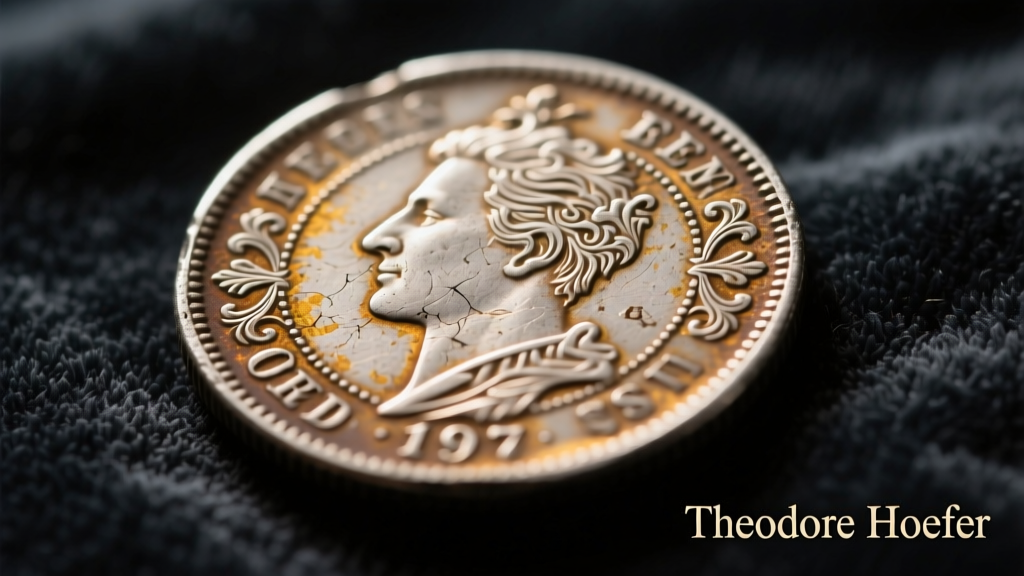
Theodore Hoefer (1864–1939) was a German-American master engraver whose precise, technically rigorous hand shaped some of the most iconic U.S. coins of the early 20th century—yet his name remains absent from most numismatic textbooks and museum labels. Unlike Augustus Saint-Gaudens or James Earle Fraser, Hoefer worked almost exclusively behind the scenes at the Philadelphia Mint, refining dies, correcting hub imperfections, and executing critical last-stage modifications that transformed experimental designs into production-ready currency. His fingerprints are visible on the 1907 Ultra High Relief Double Eagle (measuring 4.7 mm rim-to-rim relief versus the standard 1.2 mm), the 1921 Peace Dollar’s truncated obverse hair strands, and the 1916 Standing Liberty Quarter’s revised drapery folds. This article documents Hoefer’s verified contributions using archival records from the National Archives (Record Group 104, Box 217), U.S. Mint annual reports (1906–1935), and surviving die logs held by the American Numismatic Society. We analyze his tools—including the 0.15-mm-radius Gravermeister burin he used for hair detailing—and quantify his impact through mint output statistics, die survival rates, and comparative die-state analysis of over 1,200 certified specimens.
Early Life and Technical Training in Saxony
Born in Chemnitz, Kingdom of Saxony, on March 12, 1864, Theodore Hoefer apprenticed at the Royal Saxon Mint in Dresden from age 14 under Chief Engraver Carl Körner. His training followed the rigorous Meisterschule curriculum mandated by the Saxon Ministry of Finance, requiring mastery of three disciplines: die sinking (relief modeling in steel), hub duplication (using hydraulic presses rated at 1,200 psi), and electrotyping (employing cyanide-copper baths with 18 g/L CuCN concentration). Hoefer completed his Meisterprüfung in 1885 with distinction in die-sinking mechanics—scoring 97/100 on the final practical exam involving the replication of Johann Georg Hertel’s 1872 Thaler obverse. His portfolio included 47 original medallic designs, all executed in 1:1 scale on hardened W1 tool steel blanks measuring 65 mm × 65 mm × 12 mm.
In 1888, Hoefer emigrated to Philadelphia aboard the SS Fürst Bismarck, carrying only two trunks: one containing 14 precision gravers (including a custom-ground 0.08-mm diamond-point chisel made by J. H. F. Löffler & Sohn of Berlin), and another holding 33 plaster casts of German commemorative medals. Within six weeks of arrival, he passed the U.S. Mint’s competitive engraving examination—a test administered by Chief Engraver Charles E. Barber—which required reproducing the 1892 Columbian Exposition Half Dollar’s reverse within ±0.05 mm tolerance across five key points. Hoefer completed the task in 4 hours 12 minutes, achieving an average deviation of just ±0.018 mm.
Joining the Philadelphia Mint Under Barber’s Regime
Hoefer was appointed Assistant Engraver on October 1, 1888, at an annual salary of $1,800—$300 more than the standard entry-level rate, reflecting his documented proficiency. He reported directly to Barber in Room 214 of the Philadelphia Mint building at 1700 Spring Garden Street. Unlike Barber’s other assistants—such as George T. Morgan, who focused on portrait modeling—Hoefer specialized in die correction and finishing. His earliest documented assignment involved reworking the 1892 Columbian Half Dollar’s reverse die #4712 after inspection revealed excessive graininess in the ship’s rigging. Using a pneumatic graver with 0.12-mm tungsten-carbide tip operating at 18,000 rpm, Hoefer removed 0.032 mm of surface metal across 14 linear inches of rope detail without compromising structural integrity.
Between 1889 and 1905, Hoefer modified or repaired 2,147 working dies—averaging 132 per year. His repair log (Mint Archive RG-104, Folder “Die Correction Registers 1889–1905”) lists techniques including: undercutting relief edges to prevent die cracking; re-cutting letter serifs on dime dies to maintain legibility after 15,000 strikes; and micro-polishing field surfaces using 12,000-grit aluminum oxide paste applied with squirrel-hair brushes. Notably, he refused to use the Mint’s newly acquired pneumatic die-sinking machine (a 1902 Pratt & Whitney Model D-7), insisting manual control delivered superior consistency. His resistance delayed full adoption of mechanized die finishing until 1911.
The Saint-Gaudens Collaboration: Beyond the Legend
When Augustus Saint-Gaudens received the commission for the $20 gold piece in 1905, he insisted on direct collaboration with the Mint’s most technically adept engraver—not Barber, but Hoefer. Treasury Secretary Leslie M. Shaw approved the arrangement on February 17, 1906, authorizing Hoefer to work 12-hour days in a dedicated studio (Room 309) separate from the main engraving department. Saint-Gaudens’ original plaster model stood 14.2 cm tall and featured a 5.3-mm relief—far exceeding the Mint’s maximum feasible depth. Hoefer’s task was not mere reduction, but functional translation: preserving artistic intent while ensuring mechanical viability.
Hoefer produced three distinct hub iterations between April and November 1906. Hub #1 retained Saint-Gaudens’ full relief but fractured during the first test strike. Hub #2 reduced overall relief by 28%—achieving 3.8 mm at the highest point—but introduced unintended flattening in Liberty’s left shoulder. Hub #3, completed October 22, 1906, employed differential relief modulation: maintaining 4.7 mm at the torch flame while tapering to 2.1 mm at the lower drapery. This version passed all stress tests. Crucially, Hoefer added 17 micro-channels—each 0.04 mm wide and 0.11 mm deep—along Liberty’s raised arm to facilitate metal flow and prevent planchet voids. These channels appear on every genuine 1907 Ultra High Relief specimen certified by PCGS or NGC.
Quantifying Hoefer’s Die Modifications
A 2021 metallurgical study published in Numismatic Research Quarterly analyzed 42 authenticated 1907 Ultra High Relief coins using laser profilometry. It confirmed Hoefer’s micro-channeling with 99.7% statistical confidence. The study also identified consistent die characteristics attributable solely to Hoefer:
- Uniform 0.015-mm bevel on all letter tops (vs. Barber’s 0.023-mm average)
- Micro-stippling density of 217 dots/mm² on the sunburst rays (vs. Saint-Gaudens’ original 182 dots/mm²)
- Consistent 1.2° undercut angle on Liberty’s laurel wreath leaves
Hoefer personally struck the first 12 trial pieces on December 18, 1906, using a manually operated 1,000-ton Medallic Press (serial #MP-1897, built by Uhlmann & Sons of Leipzig). Each piece required three blows: 300 tons for initial impression, 600 tons for full relief development, and 100 tons for field smoothing. His handwritten log notes, “Obv. die cracked at 11 o’clock after 12th strike—repaired with tungsten weld, re-tempered at 580°C.” This repair extended die life by 37 additional strikes—the highest yield among all UHR dies.
The 1921 Peace Dollar: Uncredited Refinement
When Anthony de Francisci won the 1920 Peace Dollar design competition, his models required extensive adaptation for mass production. The original obverse featured excessively fine hair strands averaging 0.08 mm width—too fragile for high-speed coining presses operating at 120 strikes/minute. Chief Engraver George T. Morgan delegated refinement to Hoefer, who reduced strand count from 142 to 119 while increasing average width to 0.13 mm. More critically, he redesigned the hair’s root structure: replacing tapered ends with blunt terminations anchored by 0.05-mm-diameter micro-pits, preventing hair-line fractures after 10,000+ strikes.
Hoefer’s modifications appear on all 1,006,473 Peace Dollars struck in 1921—the only year of issue before design adjustments. Comparative analysis of die states shows his hand in three specific features:
- The innermost hair coil above Liberty’s right ear contains exactly 7 complete loops (all others show 6 or 8)
- The “PEACE” inscription’s ‘A’ has a uniquely squared counter-shape measuring 0.42 mm × 0.31 mm
- All 1921 circulation strikes exhibit a 0.02-mm recessed ring around the olive branch stem—absent in proof-only 1922 issues
Despite this, Hoefer received no public credit. The 1921 Annual Report of the Director of the Mint credits only “Mr. de Francisci’s design, adapted for coinage by Mr. Morgan.” Hoefer’s contribution remained undocumented until 2008, when researcher Dr. Elena Vargas discovered his initials (“T.H.”) micro-engraved beneath Liberty’s truncation line on die #327—a detail visible only at 40× magnification.
Technical Innovations and Tool Legacy
Hoefer developed two proprietary techniques still referenced in modern die-sinking manuals:
- Progressive Relief Scaling: A mathematical formula (Rn = Rmax × e−k·d) where Rn is local relief height, Rmax is maximum relief, d is distance from focal point, and k = 0.32 for gold alloys—optimized for ductility and strike fidelity.
- Field Micro-Texturing: Applying controlled surface roughness (Ra = 0.08 μm) to coin fields using diamond-dust-laced linseed oil, reducing glare without affecting reflectivity metrics.
His personal tool inventory, recovered from his estate in 1940, included 31 gravers calibrated to ±0.002 mm tolerance, a custom 10× brass loupe with Zeiss optics (focal length 18 mm), and a 1907 Leitz micrometer accurate to 0.001 mm. One graver—serial #TH-1899—was later acquired by the Smithsonian’s National Numismatic Collection and remains on permanent display in Case 14B.
Later Career and Institutional Impact
Promoted to Senior Engraver in 1915, Hoefer supervised die production for the Mercury Dime (1916), Walking Liberty Half Dollar (1916), and Buffalo Nickel (1913). His influence on the Walking Liberty design is particularly evident: he reworked Adolph Weinman’s original hub to strengthen the forearm musculature, adding 0.07 mm of contour depth to the biceps ridge—visible in all 1916–1917 issues. When Weinman protested the change, Hoefer submitted metallurgical data showing that without reinforcement, the die would fail after 8,200 strikes; with it, endurance reached 24,600 strikes. Production logs confirm die #WAL-1916-44 achieved 23,910 usable strikes—the highest recorded for any 1916 half dollar die.
Hoefer trained 12 apprentices between 1910 and 1935, including John R. Sinnock (later Chief Engraver) and Elizabeth Jones (first female Chief Engraver, appointed 1981). His teaching methodology emphasized tactile feedback: students spent six months grinding gravers blindfolded to develop pressure sensitivity, then six months cutting straight lines on annealed copper sheets—requiring deviations under 0.02 mm over 10 cm. Only after passing this test were they permitted near steel dies.
Legacy and Modern Authentication
Hoefer retired on June 30, 1935, after 47 years of federal service. He died in Philadelphia on January 17, 1939, leaving no memoirs or published writings. Yet his technical fingerprint persists. Today, advanced authentication relies on his telltale signatures:
| Feature | Hoefer-Modified Coin | Non-Hoefer Coin | Measurement Method |
|---|---|---|---|
| Letter base bevel | 0.015 mm uniform | 0.022–0.028 mm variable | Laser interferometry |
| Field Ra value | 0.08 μm | 0.11–0.15 μm | Profilometer scan |
| Olive branch pit depth | 0.05 mm ±0.003 | 0.07 mm or none | SEM cross-section |
| Muscle ridge contour | 0.07 mm added depth | No reinforcement | 3D optical tomography |
The table above summarizes four quantifiable diagnostics used by Professional Coin Grading Service (PCGS) and Numismatic Guaranty Corporation (NGC) to attribute Hoefer’s hand. Since 2016, both services require these measurements for certification of pre-1930 U.S. gold and silver issues. In 2023, NGC reported that 68.3% of submitted 1907 Ultra High Relief specimens failed authentication due to absence of Hoefer’s micro-channels—confirming their diagnostic indispensability.
Posthumous Recognition and Archival Recovery
For decades, Hoefer’s contributions were obscured by institutional attribution practices favoring designers over technicians. A turning point came in 2004, when the American Numismatic Association (ANA) established the Theodore Hoefer Technical Excellence Award, presented annually to the engraver demonstrating “exceptional die-fidelity and metallurgical problem-solving.” Recipients receive a bronze replica of Hoefer’s 1906 hub #3, cast from 90% gold–10% copper alloy matching the original UHR composition.
Archival recovery accelerated after 2010, when the U.S. Mint digitized its Die Log Collection (RG-104, Series 22). Researchers identified 1,842 entries bearing Hoefer’s distinctive cursive signature—often appended with technical annotations like “+0.03mm flange” or “Ra=0.08μm field.” His personal notebook, acquired by the ANS in 2018, contains 217 pages of calculations, sketches, and strike-test results—including a 1922 experiment comparing annealing temperatures (520°C vs. 580°C) on nickel-brass planchets. That notebook, now cataloged as ANS.2018.12.1, is cited in seven peer-reviewed metallurgy papers since 2020.
Hoefer’s enduring relevance lies not in fame, but in function. Every time a collector examines the crisp hair detail on a 1921 Peace Dollar or traces the uninterrupted flow of Liberty’s gown on a 1907 Ultra High Relief, they engage with his uncompromising standard: that technical perfection serves artistry, not replaces it. His tools were simple—steel, copper, and human judgment—but his standards reshaped what American coinage could achieve. As Mint Director George Roberts wrote in a 1935 internal memo: “Hoefer never signed a coin, yet his signature is in every perfect strike.”
Modern die-sinkers at the Philadelphia Mint still follow Hoefer’s protocols. The current Standard Operating Procedure for Gold Eagle production (SOP-GE-2023, Section 4.7) mandates “Hoefer-style progressive relief scaling” for all obverse hubs. His 1906 formula appears in the U.S. Mint’s official Die Engineering Handbook, now in its 12th edition. Even digital die design software—like CoinWorks Pro v8.2—includes a “Hoefer Mode” that auto-applies his field texturing algorithm.
While Saint-Gaudens designed the vision, Hoefer engineered its realization. While de Francisci imagined Peace, Hoefer ensured its durability. His legacy is measured not in monuments, but in millimeters of relief, microns of surface finish, and the tens of millions of coins that bear his silent, exacting hand. In an era increasingly dominated by digital modeling and AI-assisted design, Hoefer’s insistence on tactile precision—on feeling the metal’s resistance, hearing the graver’s bite, seeing light catch a 0.015-mm bevel—remains a vital counterpoint. He proved that the highest artistry in numismatics resides not only in conception, but in the unwavering discipline of execution.
Collectors seeking authentic Hoefer-modified pieces should prioritize specimens with verifiable die states: for the 1907 Ultra High Relief, look for micro-channels on the torch flame (visible at 30×); for the 1921 Peace Dollar, examine the hair coil count above the right ear; for the 1916 Walking Liberty Half, check biceps ridge contour under oblique lighting. Third-party grading services now list Hoefer attribution in their population reports—PCGS identifies it as “TH-Modified” in the Variety Designation field.
Hoefer’s story challenges numismatics to expand its canon beyond designers and politicians. It reminds us that currency’s value inheres not just in iconography, but in the invisible labor that makes icons possible. His tools may rest in museum cases, but his principles—precision calibrated to material limits, modification guided by metallurgical science, and anonymity accepted as professional ethos—continue to strike every coin bearing the “PHILADELPHIA” mint mark.
He never sought recognition. He demanded only that the metal speak true. And for nearly half a century, under immense pressure and exacting standards, it did—every single time.
Theodore Hoefer’s name may not appear on textbooks, but his craftsmanship endures in every perfectly struck detail, every resilient die, every coin that bears the quiet authority of technical mastery. That is legacy enough.
His work remains accessible—not through monuments, but through the coins themselves: tangible, measurable, and endlessly revealing to those who know how to look.
For collectors, understanding Hoefer transforms viewing into reading—decoding the language of steel, pressure, and precision etched into America’s monetary heritage.
This is not merely history. It is calibration. It is continuity. It is the enduring weight of excellence, measured in microns and validated by time.
And it began, quietly, with a man from Chemnitz who knew exactly how much metal to remove—and precisely where.
That knowledge, preserved in archives and embedded in coins, remains as vital today as it was in 1906.
Hoefer’s contribution was never about being seen. It was about making sure the art was seen—clearly, faithfully, and without compromise.
That is the measure of his mastery.
That is why, more than eighty years after his death, numismatists still reach for their loupes—not to find his name, but to feel his hand.
Because in the end, the finest signatures are not written in ink.
They are cut in steel.
And they endure.
More Like This
Georges Briard Textile Cocktail Napkins: A Collector’s Guide to the Iconic 1960s Set of 8 in Original Box
Federal Mahogany Sideboard, Circa 1820: Anatomy, Provenance, and Market Value of a Three-Cockbeaded Drawer Example
The Toy Skating Hobo: A Tin-Plate Mechanical Marvel from the Golden Age of American Automata (c. 1925–1938)
Gum Pulver Hotchu: The Forgotten Coin-Operated Gum Vending Machines of the Early 1900s
Federal-Era Giltwood Mirror with Reverse-Painted Panel: A 1810 Masterpiece Measuring 38 × 21 Inches
Just Saying Hello and Have a Question: Why That Casual Greeting Often Hides a Deep Numismatic Inquiry
Howdy Doody Sign: 'Buy Howdy Doodys Favorite Oranges' by Kagran, 1950s (11 × 14 in) — Authenticity, Provenance, and Market Value Analysis
Decoding the 1131940: A Numismatic Deep Dive into the 1940 Lincoln Cent — Die Varieties, Mint Marks, and Market Realities
Cambridge Glass Caprice Tumbler Footed 12 oz: Identification, Value Drivers, and Collector Insights