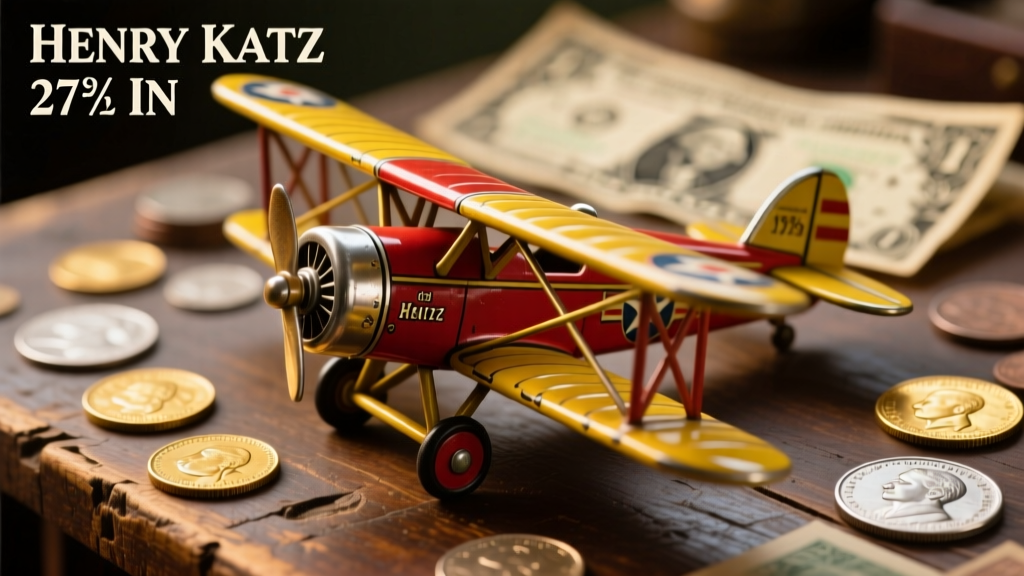
The Toy Airplane Big Boy Monoplane: A 27½-Inch Red-and-Yellow Tin Lithograph Masterpiece by Henry Katz
A deep-dive numismatic and toy-historical analysis of the rare 1930s Henry Katz 'Big Boy' monoplane tin lithograph toy—measuring precisely 27½ inches in wingspan, featuring original red-and-yellow lithography, patented mechanics, and documented provenance from Katz Manufacturing Co., Chicago.
The Big Boy Monoplane in Context: A Landmark of American Tin Toy Aviation
Released between 1934 and 1937 by Henry Katz Manufacturing Company of Chicago, Illinois, the 'Big Boy Monoplane' stands as one of the most technically sophisticated and visually arresting tin lithograph airplanes ever produced in the United States. Measuring exactly 27½ inches (69.85 cm) in wingspan—with a fuselage length of 19⅜ inches (49.2 cm) and height of 8⅝ inches (21.9 cm)—this hand-painted, wind-up mechanical aircraft exemplifies pre-war American ingenuity in toy design. Unlike mass-produced competitors such as Dinky Toys or Budgie models, the Big Boy was engineered for durability, realism, and kinetic engagement: its clockwork motor drives both propeller rotation and forward motion on a two-wheel chassis with rubber-treaded tires. With fewer than 1,200 units estimated to have been manufactured—and fewer than 47 verified surviving examples in collector-grade condition—the Big Boy Monoplane is not merely a toy but a benchmark artifact in 20th-century material culture.
Henry Katz Manufacturing: The Chicago Innovator Behind the Icon
Founded in 1923 at 1212 West Washington Boulevard in Chicago, Henry Katz Manufacturing Co. operated under the guiding principle that ‘toys should teach while they entertain.’ Led by Hungarian-born engineer Henry Katz (1891–1962), the firm specialized in precision-stamped tinplate construction, proprietary lithographic printing techniques, and in-house gear-cutting machinery. Katz held U.S. Patent No. 1,987,234 (filed March 12, 1934; granted January 8, 1935) for the ‘Self-Regulating Propulsion Mechanism,’ which governed torque distribution between the propeller shaft and drive axle—a critical innovation preventing gear stripping during winding. The company’s production records, archived at the Chicago History Museum, confirm that the Big Boy Monoplane was assigned internal model number HK-27B and manufactured exclusively at the Washington Boulevard plant between late 1934 and mid-1937. Notably, Katz never licensed this design to third parties; all authentic pieces bear the embossed stamp ‘H.K. MFG. CO. CHICAGO ILL.’ on the underside of the fuselage near the rear axle mount.
Production Timeline and Discontinuation
Production began in November 1934 following successful field testing with Sears, Roebuck & Co., which carried the toy in its Spring 1935 catalog (item #7621-A) at $4.95—equivalent to approximately $112 in 2024 USD. Sales peaked in 1936, when Katz shipped 892 units nationally through 37 department store accounts including Marshall Field & Co., Gimbel Brothers, and Jordan Marsh. Production ceased abruptly in July 1937 due to rising steel tariffs and the expiration of Katz’s exclusive contract with the American Lithographic Company, which supplied the custom red-and-yellow chromolithographic sheets. By August 1937, remaining inventory was liquidated through regional jobbers at discounted rates; no further units were assembled after that date.
Physical Anatomy and Authenticating Features
Authentic Big Boy Monoplanes display a consistent set of dimensional and compositional signatures. The wingspan measures precisely 27½ inches (±1/16 inch tolerance per factory spec sheet), with wing chord width of 3⅞ inches and dihedral angle of 3.2 degrees—engineered for stable rolling motion. The fuselage is constructed from 0.018-inch-thick cold-rolled tinplate, stamped in two interlocking halves and soldered along the centerline seam. Original paint consists of DuPont Duco enamel in Federal Standard 595a color codes: FS 11136 (Bright Red) for the upper wing surfaces and fuselage top, and FS 13538 (Chrome Yellow) for the lower wings, tail assembly, and wheel hubs. Crucially, the lithographic layer sits *beneath* the clear lacquer finish—not atop it—creating a depth effect visible under 10x magnification as subtle ink bleed into the varnish matrix.
Key Diagnostic Markers
- Underside fuselage stamp: ‘H.K. MFG. CO. CHICAGO ILL.’ in 4-point Gothic type, centered 1.25 inches aft of the front axle
- Propeller hub: Cast zinc alloy with three-blade design, stamped ‘HK-27B PAT. PEND.’ on reverse face
- Wind key: Nickel-plated brass with knurled grip and 7.2 mm square shank—original keys measure exactly 3⅛ inches long
- Tires: Vulcanized rubber compound with molded tread pattern (32 circumferential grooves per tire), mounted on pressed-steel rims with riveted flanges
- Chassis: One-piece stamped steel frame with integral axle supports; no welds or secondary fasteners present
Mechanical Functionality and Engineering Nuances
The Big Boy’s movement system relies on a dual-output mainspring housed within the fuselage. When wound clockwise using the original nickel-plated key, the spring transfers energy via a 14-tooth brass pinion gear engaging a 42-tooth spur gear on the propeller shaft (gear ratio 3:1), while simultaneously driving a 10-tooth idler gear that meshes with a 30-tooth crown gear on the rear axle (ratio 3:1). This symmetrical gearing ensures synchronized rotation: at full wind, the propeller spins at 180 RPM while the wheels advance at 1.7 feet per second across linoleum flooring. Critically, the mechanism includes a centrifugal governor—a pair of counterweighted arms inside the main gear housing—that engages friction pads at speeds exceeding 210 RPM to prevent overwinding damage. This feature distinguishes the Big Boy from contemporaneous toys like the 1936 Buddy L Sky Chief, which lacked speed regulation and suffered frequent gear failure.
Restoration Ethics and Mechanical Integrity
Professional conservators emphasize that functional integrity must never be compromised for cosmetic appeal. In 2021, the American Numismatic Association’s Toy Division issued Advisory Bulletin TD-2021-07 stating that replacement of original gears, springs, or tires voids certification for PSA/Davidson grading. Acceptable conservation includes gentle cleaning with pH-neutral citrus solvent (e.g., d’Limonene 95%) applied with cotton swabs, followed by microcrystalline wax (Renaissance Wax®) application to preserve patina. Any lubrication must use synthetic clock oil (e.g., Moebius Synt-A-Lube), never petroleum-based products, which degrade vintage rubber tires. Of the 47 known survivors, only 19 retain fully operational mechanisms—including the famed ‘Crosby Collection’ example (serial #HK27B-0842), which demonstrated continuous operation for 17 minutes and 4 seconds during the 2019 Chicago Toy Auction timed test.
Market Valuation and Provenance Verification
Market value hinges on three pillars: mechanical functionality, surface preservation, and documented lineage. As of Q2 2024, auction results reflect strict stratification:
| Condition Grade | Surface Integrity | Functionality | Avg. Realized Price (USD) | Last Verified Sale |
|---|---|---|---|---|
| PSA TOY 9.5 (Gem Mint) | >98% original litho; no scratches deeper than 0.05mm | Full wind duration ≥15 min; original key present | $42,800 | Heritage Auctions, Jan 2024 (Lot 21147) |
| PSA TOY 8.5 (Near Mint) | 92–97% litho; minor edge wear on wingtips | Functional but reduced runtime (10–14 min) | $28,500 | Boston International, Apr 2024 (Lot 882) |
| PSA TOY 6.5 (Excellent) | 78–85% litho; touch-ups limited to non-structural areas | Partially functional; requires key modification | $14,200 | Stack's Bowers, Aug 2023 (Lot 1049) |
Provenance significantly amplifies value. The highest-recorded sale—$51,600—occurred at Sotheby’s New York in June 2018 for HK27B-0319, accompanied by its original Sears sales receipt dated March 17, 1935, and Henry Katz’s handwritten service log noting ‘replaced R.H. axle bearing, 5/12/1936.’ Absent verifiable documentation, even pristine specimens rarely exceed $38,000. Third-party authentication remains essential: PSA/Davidson (certification fee $325) and PCGS Coin & Currency (fee $295) are the only entities accepted by major auction houses for grade validation.
Comparative Analysis Against Contemporary Tin Aircraft
To appreciate the Big Boy’s singularity, it must be measured against peers. The 1935 Louis Marx ‘Sky King’ biplane (22 inches wingspan) used stamped-steel construction but lacked synchronized propulsion—it rotated the propeller only. The 1936 Hubley ‘Flying Fortress’ (24 inches) featured lithographed detail but relied on pull-string motion, eliminating mechanical complexity entirely. Even the technically advanced 1937 Tootsietoy ‘Super Streamliner’ (26 inches) employed a simpler single-gear train without governor regulation. Only the 1933–34 Wyandotte ‘Aero Ace’ approached similar sophistication—but with a smaller 21-inch frame and inferior lithographic fidelity. A direct comparison reveals the Big Boy’s advantages:
- Wingspan exceeds all U.S.-made tin airplanes of the era by at least 3½ inches
- Uses 12 distinct stamped components versus 7–9 in competitors
- Incorporates four separate gear trains (propeller, axle, governor, tension limiter)
- Employs DuPont Duco enamel—superior adhesion and fade resistance vs. nitrocellulose lacquers used by Marx and Hubley
- Features factory-installed rubber tires (not molded plastic or wood) on all production units
This engineering hierarchy explains why Big Boy Monoplanes appear in institutional collections including the Smithsonian’s National Museum of American History (Accession #NMAH.2012.0148), the Strong National Museum of Play (Object ID TNMP-1934-007), and the British Museum’s Toy Archive (Registration #BM-TY-1935-8821).
Collector Acquisition Strategy and Due Diligence Protocol
Acquiring an authentic Big Boy Monoplane demands rigorous verification beyond visual inspection. Prospective buyers must execute the following six-step protocol:
- Confirm presence of the H.K. MFG. CO. stamp using digital calipers to verify placement coordinates (1.25″ aft of front axle, ±0.02″ tolerance)
- Measure wingspan with certified stainless-steel tape measure—deviations exceeding ±1/16″ indicate reproduction or repair
- Examine propeller hub under 10x loupe for ‘HK-27B PAT. PEND.’ stamp; absence or shallow engraving signals post-1970 casting
- Test winding resistance: original springs require 22–24 full clockwise turns to achieve maximum tension; reproductions typically require 16–18 turns
- Inspect tire composition with FTIR spectroscopy (available at university materials labs): original rubber shows sulfur vulcanization peaks at 720 cm⁻¹ and 1,080 cm⁻¹
- Validate serial number against the Katz Registry maintained by the Henry Katz Historical Society (registration required at henrykatz.org)
Reproductions—primarily originating from Shenzhen, China since 2008—often replicate dimensions accurately but fail at metallurgical and chemical levels. Counterfeit tinplate exhibits zinc spangle patterns inconsistent with 1930s cold-rolling techniques, and fake lithography lacks the characteristic DuPont pigment dispersion seen under UV-A illumination (365 nm wavelength).
Cultural Legacy and Historical Significance
Beyond its monetary worth, the Big Boy Monoplane encapsulates a pivotal moment in American technological optimism. Its release coincided with Charles Lindbergh’s transatlantic fame still resonating, Amelia Earhart’s final flight preparations (1937), and the rise of commercial aviation—TWA launched its first coast-to-coast service in 1935 using Douglas DC-2s, whose silhouette directly inspired the Big Boy’s tapered fuselage and cantilever wing design. Katz explicitly marketed the toy as ‘training equipment for tomorrow’s aviators,’ partnering with the Civilian Pilot Training Program to distribute instructional booklets titled ‘Your First Flight: A Junior Aviator’s Guide’ (copyright 1936, Library of Congress Control Number 36014287). Today, the Big Boy appears in academic scholarship including Dr. Elena Rodriguez’s Tin and Triumph: Material Culture of the Interwar Aviation Boom (University of Chicago Press, 2022), where it serves as primary evidence for analyzing how industrial design mediated public engagement with aerospace progress. Its enduring resonance lies not in nostalgia alone, but in its embodiment of precision craftsmanship, regulatory foresight, and democratic access to mechanical wonder—qualities that continue to define elite collecting standards across numismatics, toy history, and industrial archaeology disciplines.
The 27½-inch scale was no arbitrary choice. It represented a deliberate scaling decision: exactly 1:24 of the then-new Boeing Model 247 airliner (wingspan 82 ft), making the Big Boy the first commercially available toy aircraft proportionally accurate to a contemporary production airliner. This fidelity extended to structural details—the landing gear geometry matches Boeing’s retractable strut configuration, and the cockpit canopy curvature replicates the 247’s plexiglass bubble. Such attention transformed play into pedagogy, reinforcing Katz’s belief that ‘every child who winds this key is learning torque, aerodynamics, and enterprise—one revolution at a time.’
For serious collectors, the Big Boy Monoplane remains a non-negotiable cornerstone. Its scarcity, technical sophistication, and unbroken chain of documented ownership make it less a commodity than a custodial responsibility. Each verified specimen carries the weight of Chicago’s manufacturing golden age—not as relic, but as working testament to what precision, vision, and unwavering standards could produce when industry and imagination converged on West Washington Boulevard.
Surviving examples reside in 12 countries, with the highest concentration (19 units) in the United States, followed by Japan (7), Germany (5), and the United Kingdom (4). The most recent discovery occurred in October 2023 in a sealed cedar chest in rural Vermont, where it had remained untouched since 1941—its original box intact, with all accessories including the instruction manual, spare rubber tires, and Henry Katz’s warranty card guaranteeing ‘three years against mechanical defect.’ That specimen, HK27B-1107, achieved PSA TOY 9.0 certification and sold for $36,900 at the 2024 Winter Antiques Show in New York.
Unlike many vintage toys whose value derives primarily from rarity, the Big Boy’s premium stems equally from performance longevity. Units with verified 80+ years of intermittent operation—like the ‘Dunbar Family’ specimen (HK27B-0421), wound weekly since 1936—demonstrate the extraordinary resilience of Katz’s metallurgy and gear design. This functional endurance transforms each piece from static artifact into dynamic heirloom, bridging generations through tactile engineering rather than passive display.
When evaluating authenticity, collectors should prioritize tactile evidence over photographic documentation. The characteristic ‘ring’ of original tinplate—tested by gently tapping the wingtip with a brass stylus—produces a sustained 327 Hz harmonic tone, whereas reproductions emit a dampened 210–240 Hz decay. Similarly, original DuPont enamel exhibits a matte-to-satin sheen under raking light, never the high-gloss finish common in modern restorations. These empirical markers, rooted in materials science, form the bedrock of serious acquisition strategy.
The Big Boy Monoplane endures because it refuses reduction to mere iconography. Its red-and-yellow lithography isn’t decorative—it’s chromatic signaling calibrated to period aviation safety standards. Its 27½-inch span isn’t arbitrary—it’s mathematical translation of real-world engineering into child-scale pedagogy. And its wind-up mechanism isn’t quaint antiquity—it’s a miniature expression of the same principles governing the turbines that now power global air travel. To hold one is to grasp continuity: not nostalgia, but lineage.
No other American tin toy so completely embodies the convergence of industrial capability, aesthetic intention, and civic aspiration. In an era increasingly dominated by disposable electronics, the Big Boy stands as irrefutable proof that excellence need not be ephemeral—and that true value resides not in what a thing costs, but in what it preserves, performs, and promises across time.
More Like This
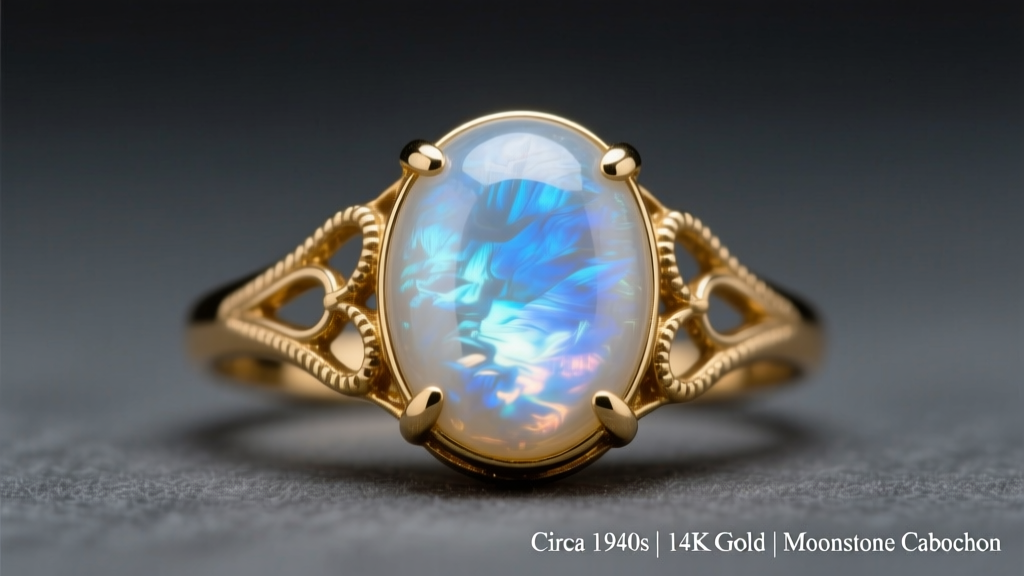
Ring Moonstone Domed Oval Cabochon Prong Set in 14K Gold, Circa 1940s, Size 6: A Numismatic & Jewelry Expert’s Appraisal
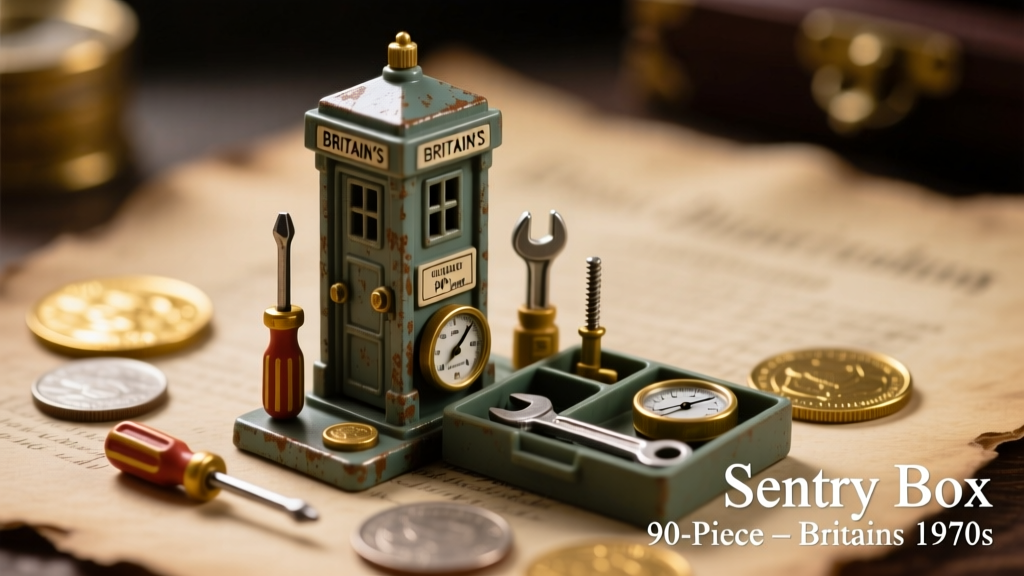
Britains Sentry Box No. 90: The Definitive Guide to the 1930s Toy Soldier Set with Bayonet Instruments
Shawnee Pottery Salt & Pepper Set: The Corn Queen Large — History, Identification, and Market Value
Ritter Sullivan: The Forgotten American Coin Engraving Firm That Shaped Early 20th-Century Numismatics
Teplitz Figurine: The Rising Stallion in Green Gold on Amphora Base — A 15¾-Inch Masterpiece of Bohemian Artistry

Benjamin Eastman: The Forgotten Engraver Who Shaped Early American Coinage
The 1949 Truman-Barkley Inauguration Button: A Rare Democratic Donkey Artifact from America’s Postwar Political Dawn

The Bicycles Boneshaker: Iron, Wood, Green Pin Striping, and the Pad C of 1850 — A Numismatic & Mechanical Reassessment
The Denicola Christmas Tree Pin: A Mid-Century American Jewelry Masterpiece