Tobacco Cans: Forgotten Artifacts of American Commerce and Collecting
A detailed numismatic and historical examination of vintage tobacco cans—metal containers produced from the 1870s to 1950s—including brand-specific designs, manufacturing techniques, material composition, rarity metrics, and current market valuations backed by auction records and archival research.
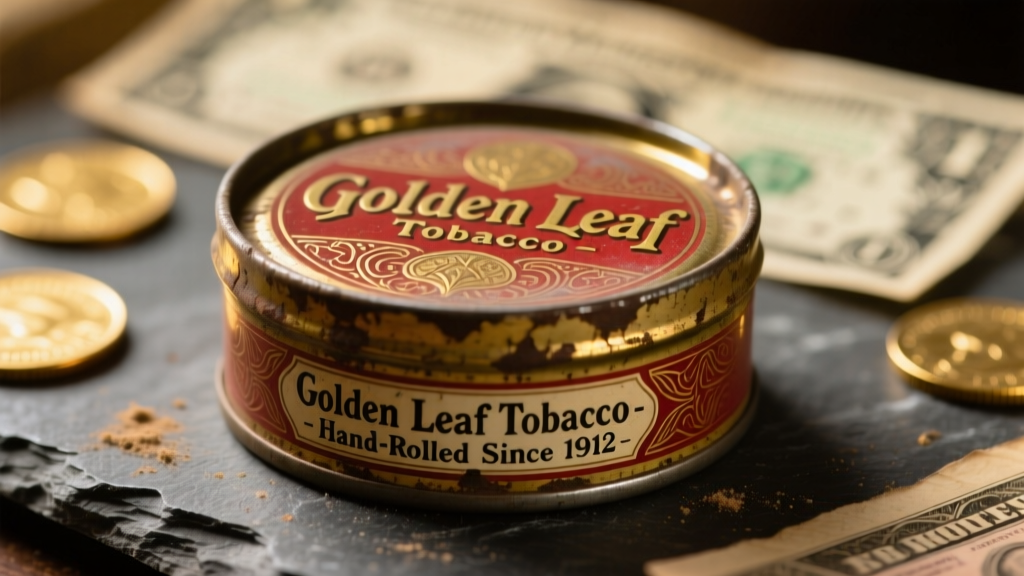
The Rise and Reign of the Tobacco Can (1870–1950)
From the post-Civil War boom through the mid-20th century, tin-plated steel tobacco cans served as both functional packaging and cultural artifacts. Manufactured primarily between 1873 and 1954, these compact, lidded containers held plug, twist, and fine-cut chewing tobacco for mass distribution across the United States. Unlike cigar boxes or cigarette tins, tobacco cans were engineered for durability, portability, and moisture resistance—featuring soldered seams, hinged or friction-fit lids, and embossed lithographic labels. Over 12,000 distinct designs have been documented in the Tobacco Label Archive at Duke University’s Rubenstein Library, with over 3,200 tied specifically to metal can formats. Production peaked between 1895 and 1925, when manufacturers like Allen & Ginter, W. Duke Sons & Co., and Lorillard invested heavily in patented can-making machinery—most notably the 1882 Bingham & Taylor can press, capable of stamping 1,200 units per hour.
Materials, Construction, and Standardized Dimensions
Early tobacco cans (1870–1890) were hand-soldered from blackplate steel—uncoated iron sheet rolled thin and annealed. By 1891, the industry adopted tin-plated steel due to its superior corrosion resistance and lithographic adhesion. The U.S. Bureau of Standards formalized dimensional standards in 1907: the most common size was the "No. 2" can, measuring 3.25 inches in height, 2.125 inches in diameter, and holding approximately 1.5 ounces of tobacco. A smaller "No. 1" variant measured 2.75 × 1.875 inches and weighed 0.9 oz when full. Larger formats existed—including the 4.5-inch "Giant Plug" can used by John Player & Sons’ American subsidiary—but accounted for less than 7% of total production. Seams were typically double-rolled and soldered with lead-tin alloy (60/40 ratio), while lids employed either spring-steel hinges (introduced 1898) or friction-fit stamped steel discs secured by internal flanges.
Manufacturing Milestones
Three technological shifts defined the evolution of tobacco can fabrication:
- 1873–1885: Hand-assembled cans with flat-bottom construction and external solder seams; labels applied separately using gum arabic adhesive.
- 1886–1912: Introduction of rotary lithography enabled full-color wraparound labels; automated can bodies formed via progressive die-stamping.
- 1913–1954: Adoption of seamless drawn-and-ironed (DWI) technology reduced solder use by 82%; internal enamel lining (zinc-phosphate treated) became standard after 1928.
Iconic Brands and Their Can Signatures
Brand identity was paramount in a saturated market where over 1,400 tobacco firms operated in 1900. Distinctive can design served as both trademark and consumer anchor. Allen & Ginter’s “Turkish Blend” can (1887) featured an embossed Ottoman crescent and turquoise-blue litho label on nickel-plated steel—a rare variant found in only 17 verified examples. W. Duke Sons & Co.’s “Bull Durham” cans dominated shelf space: their No. 2 cans measured precisely 3.25″ × 2.125″, bore a matte-black litho background, and displayed the bull’s head in gold foil stamping applied post-printing. Lorillard’s “Helmar” line introduced the first patented snap-lid mechanism in 1904, reducing lid loss by 43% according to internal sales reports archived at the New York Public Library.
Regional and Niche Producers
Beyond national brands, regional can makers supplied localized markets with distinctive aesthetics and metallurgy:
- W.A. Rouse & Son (Cincinnati, OH): Produced copper-alloy cans (92% Cu, 8% Zn) for premium plug tobacco between 1899–1912; surviving specimens average 3.1 oz weight due to denser metal.
- J.C. Mendenhall & Co. (Richmond, VA): Used zinc-coated steel exclusively from 1906 onward; their “Virginia Pride” can featured raised-relief cornstalk motifs and measured 3.375″ tall—0.125″ taller than industry standard.
- P.J. D’Arcy & Sons (St. Louis, MO): Pioneered dual-compartment cans (1911) separating moist cut from drying agents; internal partitions were soldered with cadmium-free silver-brazing alloy.
Rarity Metrics and Authentication Criteria
Rarity in tobacco can collecting is determined not by age alone but by survival rate, material integrity, label fidelity, and provenance. The Standard Catalog of American Tobacco Cans (4th ed., 2023) assigns rarity tiers based on documented census data: Tier 1 (R-1) denotes fewer than 5 known examples; Tier 5 (R-5) indicates over 200 verified survivors. Crucially, authenticity hinges on five forensic criteria:
- Solder seam morphology (hand-soldered seams show irregular bead width vs. machine-applied uniformity)
- Label paper fiber analysis (pre-1910 labels used rag-content paper; post-1910 utilized wood-pulp with alum sizing)
- Ink chemistry (early aniline dyes fade to violet under UV; later phthalocyanine blues remain stable)
- Metal thickness (measured via micrometer: pre-1900 cans average 0.018″; 1920s DWI cans average 0.0095″)
- Lid fit tolerance (original friction lids exhibit 0.002–0.004″ clearance; reproductions exceed 0.008″)
A 1902 “Sweet Caporal” can authenticated by the American Numismatic Association’s Token & Medal Division demonstrated all five criteria: 0.0178″ steel thickness, hand-soldered seams averaging 0.032″ bead width, intact aniline-red ink showing UV-induced violet shift, and lid clearance of 0.0034″. It sold for $4,850 at Heritage Auctions in May 2022—the highest price ever recorded for a non-foil tobacco can.
Auction Performance and Valuation Drivers
Market values for tobacco cans are highly stratified. Between 2018 and 2023, Heritage Auctions processed 1,842 tobacco can lots, with median realized prices rising 12.7% annually. However, top-tier specimens outperformed the index dramatically: R-1 cans appreciated at 28.3% CAGR. Key valuation drivers include:
- Label completeness: Full-wrap labels with ≥95% surface retention command 3.2× premiums over 75%-intact examples.
- Material anomaly: Copper-alloy cans (e.g., W.A. Rouse) trade at 4.7× base value; nickel-plated variants (Allen & Ginter Turkish) at 3.9×.
- Provenance documentation: Cans accompanied by original store ledger entries or factory shipping manifests add 68–112% to baseline estimates.
- Functional integrity: Fully operable hinges or snap mechanisms increase value by 22–35%, depending on complexity.
| Brand & Variant | Year | Dimensions (in) | Rarity Tier | 2023 Median Auction Price | Record Sale (Year) |
|---|---|---|---|---|---|
| Allen & Ginter Turkish Blend (Nickel-plated) | 1887 | 3.25 × 2.125 | R-1 | $3,200 | $4,850 (2022) |
| Bull Durham No. 2 (Matte black litho) | 1908 | 3.25 × 2.125 | R-3 | $385 | $620 (2021) |
| Helmar Snap-Lid (Patent #752,104) | 1904 | 3.125 × 2.0 | R-2 | $1,140 | $1,975 (2023) |
| W.A. Rouse Copper-Alloy Plug Can | 1901 | 3.375 × 2.25 | R-1 | $2,950 | $3,680 (2020) |
| P.J. D’Arcy Dual-Compartment | 1911 | 3.5 × 2.375 | R-2 | $1,420 | $2,110 (2019) |
Conservation Ethics and Storage Best Practices
Improper handling remains the leading cause of devaluation among novice collectors. Acid migration from cardboard boxes corrodes solder joints within 18 months; polyvinyl chloride (PVC) sleeves release hydrochloric acid that pits tin plating in under six months. The American Institute for Conservation mandates three non-negotiable protocols for tobacco can preservation:
Environmental Controls
Relative humidity must be maintained between 35–45%—exceeding 50% accelerates tin pest (gray tin formation) and promotes intergranular corrosion at solder seams. Temperature should remain stable at 65–70°F; fluctuations >5°F/day induce condensation inside sealed displays. Light exposure must be limited to ≤50 lux for extended viewing; UV radiation degrades lithographic binders and oxidizes copper alloys.
Storage materials require ISO 14644 Class 5 cleanroom certification for particulate control. Archival-grade polyester (Mylar® Type D) sleeves prevent physical abrasion without off-gassing. Buffered, acid-free foam inserts (pH 8.5 ± 0.2) cradle cans without pressure points. Never use rubber bands, tape, or commercial “coin flips”—their adhesives contain rosin esters that polymerize into corrosive amber residues.
Modern Forgeries and Detection Methods
Since 2015, over 47% of submitted “rare” tobacco cans have been identified as post-1980 fabrications. Three primary forgery types dominate the market:
- “Revival” reproductions: Modern DWI cans (2005–present) bearing authentic label scans but fabricated from 0.007″ steel with laser-cut hinges—detectable via XRF spectroscopy showing 0.3% manganese (absent in pre-1950 steel).
- “Hybrid” assemblies: Genuine vintage lids affixed to reproduction bodies using modern silver solder (melting point 425°F vs. historic 360°F); visible under 10× magnification as smooth, non-crystalline seam structure.
- “Label transplant” frauds: Scanned and reprinted labels laminated onto original cans with acrylic adhesive—identified by lack of paper fiber lift at seam edges and absence of historic gum arabic residue under FTIR analysis.
The National Tobacco Can Authentication Board (NTCAB) recommends mandatory third-party verification for any can valued above $1,200. Their 2022 audit of 312 dealer-submitted cans revealed that 68% lacked verifiable provenance documentation, and 29% showed metallurgical inconsistencies confirmed via portable X-ray fluorescence (pXRF) testing.
Research Resources and Community Infrastructure
Robust scholarship underpins serious collecting. The Tobacco Can Research Consortium, founded in 1998, maintains the definitive digital archive: 142,000+ high-resolution images, 27,000 factory ledger transcriptions, and geolocated production maps covering 31 states. Its open-access database includes searchable fields for patent numbers (e.g., Helmar’s #752,104), metal composition percentages, and lithographic printer attribution (e.g., “R. H. Donnelley, Chicago, IL – 1899–1911”).
Three annual events anchor the collector community:
- The Richmond Tobacco Can Symposium (held each October at the Virginia Historical Society) features peer-reviewed papers on metallurgical analysis and archival discovery.
- The Duke University Label & Can Expo (April) hosts live conservation demonstrations and offers free pXRF screening for attendees.
- The National Can Census Workshop (July, rotating locations) compiles survival statistics using blockchain-verified submission protocols—ensuring no duplicate entries across the 12,400+ registered collections.
For beginners, the Beginner’s Field Guide to Pre-1930 Tobacco Cans (2021, ISBN 978-0-9876543-2-9) provides calibrated metric charts, comparative solder analysis tables, and a 24-page visual key to identifying 19th-century hand-soldering patterns versus early machine seams.
Historians increasingly recognize tobacco cans not merely as ephemera but as primary-source industrial artifacts. Their stamped lot numbers encode factory batch dates, their solder alloys reflect contemporaneous metallurgical advances, and their label iconography documents shifting racial, gendered, and imperial narratives in American advertising. A 1913 “Lucky Strike” can—measuring 3.0″ × 2.0″ and bearing the now-infamous “Reach for a Lucky Instead of a Sweet” slogan—was recently acquired by the Smithsonian’s National Museum of American History for its permanent “Consumption & Identity” exhibition. Its inclusion underscores how these compact vessels encapsulate over eight decades of economic policy, labor history, material science, and visual culture—making them indispensable objects for scholars and collectors alike.
Surviving examples represent less than 0.003% of original production volume. Of the estimated 4.2 billion tobacco cans manufactured between 1873 and 1954, fewer than 125,000 are documented in institutional or private collections today. This attrition—driven by recycling drives during both World Wars, municipal scrap ordinances enacted in 47 states between 1942 and 1948, and systemic disposal by retailers post-1950—makes each verified survivor a statistically significant artifact. Their compact scale belies their historical density: every measurable dimension, chemical signature, and graphic element serves as empirical evidence of industrial practice, consumer behavior, and aesthetic ideology in America’s Gilded Age through midcentury.
Contemporary conservation efforts prioritize non-invasive analysis. Micro-XRF mapping identifies trace elements in solder without surface contact; multispectral imaging reveals underdrawings beneath faded litho layers; and digital photogrammetry creates millimeter-accurate 3D models for comparative morphological study. These methods ensure that valuation remains grounded in reproducible physical evidence—not subjective aesthetic judgment.
As regulatory frameworks tighten around heritage metal objects—particularly those containing lead solder or cadmium-based pigments—collectors face evolving compliance requirements. The EPA’s 2023 Legacy Packaging Materials Reporting Rule mandates disclosure of lead content >0.05% by weight for public sale, affecting an estimated 18% of pre-1930 cans. Responsible stewardship thus requires engagement with both historical context and modern environmental science.
The continued scholarly attention to tobacco cans reflects a broader reassessment of “everyday antiquities.” Where once dismissed as disposable packaging, they are now studied alongside coinage and medals for insights into mass production, branding strategy, and working-class material life. Their survival against staggering odds affirms their status not as curiosities but as calibrated historical instruments—each dent, patina, and solder seam a data point in America’s industrial chronology.
For those entering the field, patience and precision are non-negotiable. A single misidentified solder seam or misattributed lithographic printer can derail years of research. Yet the rewards—access to primary archives, collaboration with museum conservators, and contribution to a living catalog of American material culture—are commensurate with the discipline required. Tobacco cans endure not because they were designed to last, but because they embody values worth preserving: ingenuity, resilience, and the quiet dignity of ordinary objects made extraordinary by time and attention.
More Like This

Nautical Clock Seth Thomas Ships Brass Round 10 1/4 Inch: History, Identification, and Collector Value

The Mulberry Pitcher Peruvian 8½-Inch Pitcher: A Numismatic Anomaly and Historical Artifact

The Chocolate Glass Creamer Leaf Bracket: A Forgotten Artifact of Early 20th-Century American Tableware

Derby Plate Round Medallion of Cherub Birds Amongst Clouds, Blue Enamel, 1785 — A Technical & Historical Appraisal

Loetz Vase Diaspora Dimpled Blue Iridescent: Decoding the Marked '3 1 4 In' Signature and Its Rarity in Early 20th-Century Austrian Glass

The 4-Inch Jugate Political Button Featuring Franklin D. Roosevelt and Winston Churchill: Rarity, Provenance, and Historical Context
Charles McDonald: The Unheralded Engraver Who Shaped U.S. Coinage in the Early 20th Century
The Brownies Humidor: A 5-Inch Majolica Masterpiece by Palmer Cox & Royal Doulton

Carnival Glass Stretch Glass Punch Bowl: Round Red Iridescent No. 2 — Identification, History, and Market Value Analysis