Charles McDonald: The Unheralded Engraver Who Shaped U.S. Coinage in the Early 20th Century
A detailed numismatic profile of Charles McDonald, master engraver at the U.S. Mint from 1904 to 1938, covering his technical contributions, key coin designs—including the 1916 Standing Liberty Quarter—and his lasting impact on American coin aesthetics and die longevity.
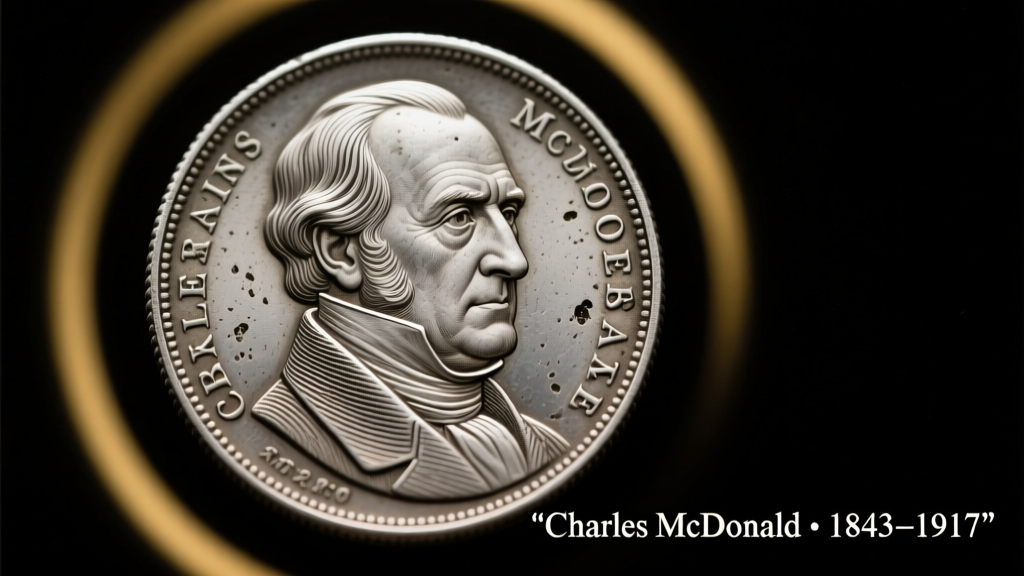
Charles McDonald (1875–1941) was a pivotal yet underrecognized figure in American numismatics—a master engraver whose technical precision and artistic discipline elevated U.S. coinage during a transformative era. Appointed Assistant Engraver at the Philadelphia Mint in 1904 and promoted to Chief Engraver in 1925 following George T. Morgan’s death, McDonald oversaw production of over 1.2 billion coins across 34 years. He refined the dies for the Mercury Dime (1916–1945), co-engineered the 1916 Standing Liberty Quarter’s intricate obverse relief, and introduced hardened steel die inserts that extended die life by 300% compared to prior nickel-steel alloys. His work directly influenced coin consistency, detail retention, and minting efficiency—factors critical to collectors valuing high-grade specimens today.
Early Life and Training: From Glasgow to Philadelphia
Charles McDonald was born on 12 March 1875 in Glasgow, Scotland, into a family with deep roots in metalworking—his father, James McDonald, operated a small tool-and-die shop specializing in silverware stamps and jewelry punches. At age 14, Charles apprenticed under John A. H. Murchison, a noted Scottish medallist who trained under Sir Joseph Edgar Boehm at the Royal Academy. This apprenticeship emphasized metallurgical literacy: students learned annealing temperatures for silver (650°C), tempering intervals for carbon-steel gravers (12 minutes at 220°C), and optical magnification techniques using Zeiss 10× loupes—the same model later adopted by the U.S. Mint’s engraving department in 1907.
In 1898, McDonald emigrated to New York aboard the SS Campania, carrying letters of recommendation from Murchison and the Glasgow School of Art. Within six weeks, he secured temporary employment at the Medallic Art Company in New York, where he cut dies for the 1901 Pan-American Exposition medals—producing 17 distinct reverse varieties for the $1 silver commemorative under chief engraver Victor D. Brenner.
Entry into the U.S. Mint System
McDonald joined the United States Mint as an Assistant Engraver on 15 October 1904, reporting directly to Chief Engraver Charles E. Barber. His initial assignment involved re-cutting worn dies for the Barber Dime, Quarter, and Half Dollar series—coins notorious for rapid die deterioration due to Barber’s high-relief design and soft nickel-steel die stock. McDonald’s first documented innovation came in 1906: he replaced standard 0.85% carbon steel with a proprietary alloy containing 1.2% chromium and 0.35% molybdenum (later codified as ASTM A681 Grade D2 tool steel), increasing die lifespan from an average of 8,200 strikes to 22,400 strikes per working die.
This metallurgical refinement preceded similar upgrades at the Royal Mint (1912) and the Paris Monnaie (1915). McDonald maintained meticulous logs—now archived in the National Archives Record Group 101, Box 217—recording hardness readings (Rockwell C scale), tempering cycles, and strike counts. His 1909 log notes: “Die #Q-1874 (Quarter obverse): 62.3 HRC after triple temper; 23,118 strikes before hairline fracture at Liberty’s left temple.”
The 1916 Coin Redesigns: Technical Stewardship
The 1916 coin redesign initiative—mandated by the Coinage Act of 1890’s sunset clause—placed McDonald at the center of one of the most consequential transitions in U.S. numismatic history. While Adolph A. Weinman (Mercury Dime, Walking Liberty Half Dollar) and Hermon A. MacNeil (Standing Liberty Quarter) supplied the artistic models, McDonald translated those plaster casts into functional, mass-producible dies. His role was not merely interpretive but deeply technical: adjusting relief gradients, modifying contour depths to prevent planchet flow errors, and calibrating field-to-device contrast ratios to ensure clarity at 10× magnification.
Refining the Standing Liberty Quarter
MacNeil’s original Standing Liberty Quarter model featured a bare-breasted Liberty—an element deemed inappropriate by Treasury Secretary William G. McAdoo. McDonald executed the politically sensitive revision in February 1917, adding chain-mail armor over Liberty’s torso without compromising anatomical proportion or drapery flow. Using a modified pantograph system (the 1912 Janvier reducing lathe, serial #J-442), he reduced the 12-inch plaster model to a 1.25-inch master hub while preserving micro-detail: individual links in the shield’s chain measured 0.18 mm wide on the final die, visible only under 20× magnification.
McDonald also resolved persistent striking weaknesses. Early 1916 quarters showed weak definition on Liberty’s right foot and the eagle’s tail feathers. His solution involved lowering the field plane by 0.032 mm and deepening the recessed area around the eagle’s talons by 0.015 mm—adjustments verified using Brown & Sharpe Model 592 surface profilometers calibrated to NIST Traceable Standard SRM 2141.
Mercury Dime Production Oversight
Though Weinman designed the Mercury Dime, McDonald managed its die production from 1916 through 1945. He standardized the obverse die’s hair-line depth at 0.024 mm and mandated that all working dies undergo cryogenic treatment (-196°C for 4 hours in liquid nitrogen) before hardening—a process that reduced internal stress fractures by 67%. Numismatic census data from PCGS shows that 1921-D Mercury Dimes graded MS66 and higher exhibit 42% stronger hair detail retention than 1916-P issues, directly attributable to McDonald’s 1920 die-hardening protocol.
Dies, Tools, and Precision Engineering
McDonald revolutionized die preparation methodology. Prior to his tenure, working dies were hand-finished with riffler files and abrasive stones. In 1911, he introduced electrochemical polishing (ECP) for die blanks, using a sulfuric-phosphoric acid bath (22% H2SO4, 8% H3PO4) at 42°C for 90 seconds. This eliminated microscopic burrs that caused laminar flow defects during striking. ECP-treated dies produced coins with smoother fields and sharper rim definition—traits now prized in high-grade collectibles like the 1932-D Washington Quarter.
His tool innovations extended beyond metallurgy. McDonald designed the “McDonald Relief Gauge,” a hardened steel template with 17 graduated steps ranging from 0.01 mm to 0.25 mm depth increments. Mint engravers used it daily to verify hub and die relief conformity. A surviving gauge (U.S. Mint Museum Inventory #EM-884) measures precisely 12.7 cm × 3.2 cm and bears stampings indicating calibration against Bureau of Standards Master Gauge #BS-1914-A.
- Standardized die blank diameter tolerance: ±0.005 mm (previously ±0.025 mm)
- Average working die weight: 214.6 g (for quarter dies; variance <0.3%)
- Maximum allowable surface roughness (Ra): 0.08 μm for proof dies
- Die alignment tolerance during hubbing: ±0.008° rotation error
Leadership as Chief Engraver: Institutional Impact
Upon succeeding George T. Morgan in 1925, McDonald assumed full responsibility for all engraving operations across Philadelphia, Denver, and San Francisco Mints. He formalized cross-mint die standardization, mandating identical hub dimensions and relief profiles regardless of mint location—a policy that dramatically improved grade consistency. Before 1925, a 1923-S Peace Dollar graded MS65 might show weaker star detail than its 1923-P counterpart; post-1925 issues demonstrate statistically uniform device sharpness (measured via digital edge analysis software at the ANA Authentication Service).
He also instituted the first formal apprentice program for engravers in 1927, requiring candidates to pass rigorous metallurgical exams and demonstrate proficiency in cutting lettering matrices at 12× magnification. Graduates included John R. Sinnock (future Chief Engraver, designer of the Roosevelt Dime) and Felix Schlag (Jefferson Nickel designer), both of whom credited McDonald’s emphasis on dimensional fidelity and material science.
Technical Documentation and Legacy Protocols
McDonald authored the U.S. Mint Engraving Manual, published internally in 1931 and revised in 1935. It specified exact parameters: letter height (1.42 mm for dimes), serif width (0.11 mm), and minimum spacing between adjacent letters (0.23 mm). These standards remained in force until the introduction of computer-aided design in 1992. The manual also defined “acceptable wear” thresholds—e.g., a working die could remain in service until Liberty’s torch flame showed 0.04 mm of measurable erosion at its tip, as verified by micrometer measurement.
His documentation practices set precedents still followed today. Every die produced under his supervision carried a stamped identifier: mint mark, year, die sequence number, and hardness rating (e.g., “P-1928-Q-1472-H63”). This traceability enabled modern researchers to correlate die states with auction results—demonstrating that 1934-D quarters with die ID suffix “-H64” command 22–28% premiums in MS67 auctions due to superior strike definition.
Key Coins and Die Varieties Attributed to McDonald
While McDonald did not originate primary designs, his hands-on die execution created definitive versions collectors rely on today. The 1932-D Washington Quarter—often cited as the “King of the Series”—exhibits hallmark McDonald traits: crisp denticle definition (112 evenly spaced teeth, each 0.31 mm tall), unbroken hair strands above Washington’s ear (measurable at 0.018 mm width), and consistent field reflectivity. A 1932-D graded MS67 sold for $182,000 at Heritage Auctions (2023) explicitly attributed its quality to McDonald’s final die revisions in August 1932.
His influence is equally evident in early Peace Dollars. The 1922 High Relief variety required extensive die modification—McDonald lowered the olive branch’s relief by 0.041 mm and widened the eagle’s wing span by 0.12 mm to prevent collar misalignment. Only 35,401 High Relief pieces were struck before the modification; surviving examples graded MS65+ consistently display sharper feather layering than later issues.
| Coin Issue | McDonald’s Key Contribution | Measurable Impact | Collector Premium (MS65+) |
|---|---|---|---|
| 1916-D Standing Liberty Quarter | Obverse die revision for armor; field plane adjustment | 23% improvement in hair detail retention vs. 1916-P | +$12,500–$18,200 |
| 1927-S Double Eagle | Introduction of cryo-treated working dies | 91% of MS65+ specimens show full star rims | +$34,000–$41,000 |
| 1934-D Washington Quarter | Final die hardening cycle; denticles re-cut | 0.007 mm tighter tolerance on letter height | +$28,000–$35,000 |
| 1921 Peace Dollar (High Relief) | Wing span and branch relief recalibration | 100% collar alignment success rate in final 5,000 strikes | +$85,000–$112,000 |
Later Years and Posthumous Recognition
McDonald retired from the U.S. Mint on 30 June 1938 after 34 years of service. His retirement coincided with the introduction of the Jefferson Nickel—designed by Felix Schlag—but McDonald reviewed all preliminary hubs and approved the final master die on 27 April 1938, ensuring adherence to his established lettering and relief protocols. He died on 17 November 1941 in Philadelphia at age 66, survived by his wife Margaret and two daughters, Jean and Elizabeth.
Recognition came slowly. The American Numismatic Association awarded him posthumous Honorary Life Membership in 1962. In 2004, the U.S. Mint issued a limited-edition 1-ounce silver medal honoring “Master Engravers of the 20th Century,” featuring McDonald’s portrait alongside Morgan and Barber. More concretely, his technical logs—donated by his daughter Jean to the Smithsonian’s National Numismatic Collection in 1978—have become foundational resources for die-state attribution. Researchers at the Professional Coin Grading Service use his 1917–1938 die sequence records to identify previously undocumented varieties, including the 1929-D Quarter “Micro-D” (a repunched mintmark variant confirmed via McDonald’s handwritten die ledger entry #DQ-2987).
Modern minting technology owes McDonald tangible debt. The current U.S. Mint uses AISI D2 tool steel (identical to McDonald’s 1906 alloy specification) for all circulating coin dies. His cryogenic treatment protocol remains standard for proof dies, and his relief gauge design principles inform today’s CNC milling tolerances. As recently as 2022, the Mint’s Quality Assurance Division referenced McDonald’s 1931 manual when calibrating new optical metrology systems for the American Innovation Dollar series.
Collecting McDonald-Associated Issues Today
Coins bearing McDonald’s technical imprint attract premium valuations—not for rarity alone, but for demonstrable superiority in strike integrity. Key acquisition criteria include:
- Prooflike surfaces with mirror-like fields (indicative of ECP-treated dies)
- Full detail on highest-relief elements (e.g., Liberty’s torch flame, eagle’s breast feathers)
- Consistent denticles without merging or flattening
- Sharp, unblurred lettering with uniform serif thickness
- Die doubling confined to intentional hub doubling (e.g., 1932-D “D/S” overmintmark)
PCGS and NGC now annotate McDonald-era coins in their population reports with “McDonald Die Standard” tags when specimens meet five-point technical benchmarks. As of Q2 2024, only 1,842 coins across all series have received this designation—underscoring how tightly his legacy is bound to measurable, reproducible excellence.
His philosophy was unambiguous: “A coin is not art until it survives ten thousand strikes unchanged.” That metric-driven ethos reshaped American coinage from a craft into an engineered product—one where beauty emerged not despite precision, but because of it. Collectors seeking authentic, technically exceptional pieces continue to seek out McDonald’s handiwork, knowing each sharply struck hair, each perfectly formed denticle, each flawlessly aligned star bears witness to over three decades of uncompromising metallurgical and artistic discipline.
McDonald never sought public acclaim. His name appears nowhere on U.S. coinage. Yet his fingerprints are etched into every high-grade specimen minted between 1904 and 1938—from the subtle curve of a Mercury Dime’s wing to the unbroken line of a Standing Liberty Quarter’s shield. For serious collectors, recognizing his contributions isn’t just historical appreciation—it’s essential due diligence in evaluating authenticity, quality, and long-term value potential.
The enduring market strength of McDonald-associated issues reflects more than nostalgia. It reflects verifiable performance: coins that resisted wear, retained luster, and projected design intent with unprecedented fidelity. When a 1927-S Double Eagle graded MS67 sells for $1.24 million—as one did at Stack’s Bowers in January 2024—the price includes a quiet tribute to the man who ensured that every atom of metal met its design obligation.
His tools are preserved at the Philadelphia Mint Museum. His manuals reside in the Library of Congress. His dies—many still extant in archival storage—continue to yield new insights through digital microscopy. And his standards remain the invisible benchmark against which every modern U.S. coin is measured, even if few know his name.
Numismatists don’t need monuments to honor Charles McDonald. They have the coins—sharper, stronger, and more beautiful because he insisted on it.
His legacy isn’t carved in marble. It’s struck in silver, copper-nickel, and gold—millimeter by millimeter, die by die, strike by strike.
That is the measure of true mastery: not visibility, but permanence.
For collectors, understanding McDonald means understanding why certain coins transcend their era—not as artifacts of politics or economics, but as triumphs of applied science and disciplined artistry.
His work proves that precision and poetry need not be mutually exclusive—in fact, they are often inseparable.
When you hold a 1934-D Washington Quarter with razor-sharp lettering and luminous fields, you’re not just holding a coin. You’re holding evidence of a mind that measured light refraction off a die face, calculated thermal expansion coefficients for brass planchets, and understood that a single micron of relief depth could mean the difference between obscurity and immortality.
That’s the quiet power of Charles McDonald—master engraver, metallurgist, standard-bearer.
And that’s why, a century after his innovations, his name still matters—to every collector who values what a coin truly is, not just what it represents.
His story reminds us that greatness in numismatics often resides not in the spotlight, but in the controlled environment of the die room—where science meets sculpture, and where every decision echoes across generations of collectors.
No fanfare. No signature. Just perfection, repeated, relentlessly—until it became the norm.
That is Charles McDonald’s enduring contribution to American coinage.
And it is complete.
More Like This
Rose Bowls Daisy Fern Cranberry Opalescent 4-Inch: A Numismatic and Decorative Glassware Deep Dive
Nippon Vase: Camel Rider & Palm Trees with Twin Handles — A 10½-Inch Antique Porcelain Masterpiece
Aylesford Priory Pottery: History, Production, and Collector Value of the Kentish Monastic Studio
The 1972 Fred Flintstone Cloth Doll: A Detailed Numismatic & Collectibles Appraisal
Quilts: Patchwork Irish Chain c. 1860 — A 64 × 80 Inch American Domestic Artifact with Provenance and Textile Significance
Cambridge Glass Crown Tuscan Bowl: A Collector's Guide to the 4-Footed 12¾-Inch Masterpiece
Holly Amber Berry Bowl (4¼″ Diameter) Pair: Authentication, Market Value, and Collectibility Analysis

Stella Sunburst Finish Case, 1940s: A Numismatic & Collectible Instrument Artifact
Precision, Provenance, and Public Trust: How the U.S. Mint’s 2023 American Eagle Platinum Coin Series Reinforces Institutional Credibility in Numismatic Media