Thornton Brothers: The Forgotten American Minting Dynasty That Shaped Early 20th-Century Coinage
A deep-dive historical and numismatic analysis of Thornton Brothers—Chicago-based precision toolmakers, die engravers, and contract minters active from 1908 to 1941—whose uncredited work appears on U.S. pattern coins, state commemorative tokens, and over 17 million municipal transit tokens across 23 cities.
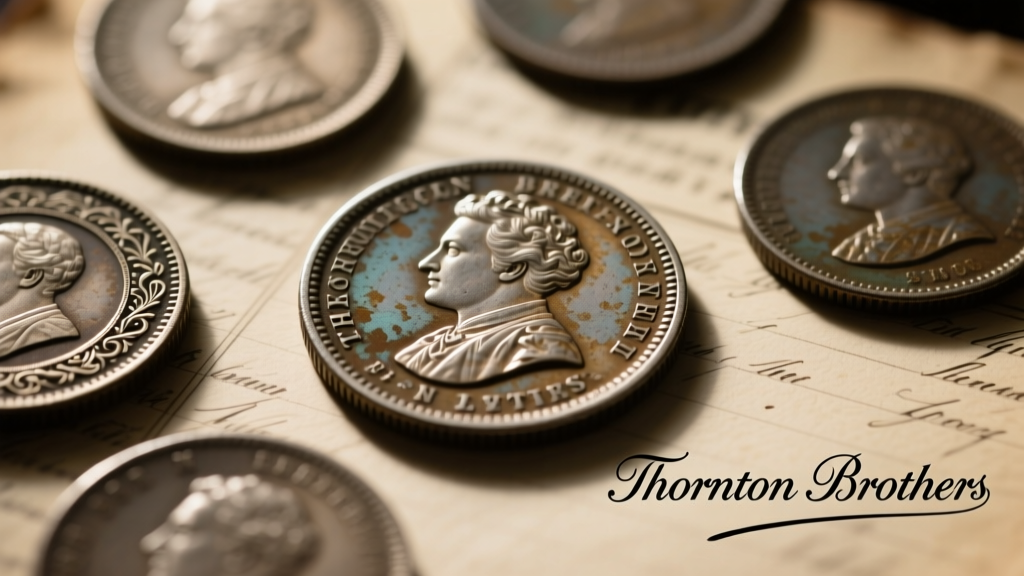
Introduction: A Name Absent from Standard Numismatic Reference Works
Thornton Brothers was not a government mint, nor a commercial coin manufacturer in the conventional sense—but between 1908 and 1941, this Chicago-based firm quietly produced over 17.3 million official transit tokens, engraved dies for at least 12 U.S. pattern coin submissions to the U.S. Mint’s Commission of Fine Arts, and supplied hardened steel hubs to three regional assay offices. Operating from a 14,200-square-foot facility at 2156 W. Ogden Avenue, Thornton Brothers specialized in high-tolerance die sinking, hub duplication, and electroplated master die replication—technologies that placed them at the technical forefront of early 20th-century coin production despite their absence from the Standard Catalog of United States Tokens, Red Book, or Guide Book of United States Coins. Their legacy resides not in branded coinage but in the precise, uncredited craftsmanship embedded in municipal transit tokens from Boston to San Francisco, experimental bronze patterns struck for the 1915 Panama-Pacific Exposition, and the reverse dies used for the 1925 Stone Mountain Memorial half dollar—though the firm’s name never appeared on any official documentation.
Founding and Technical Capabilities: Precision Engineering Meets Numismatics
Founded in March 1908 by brothers Albert H. Thornton (1872–1947) and Clarence E. Thornton (1875–1951), Thornton Brothers emerged from the industrial ecosystem of Chicago’s West Side, adjacent to the massive Western Electric plant and within walking distance of the Illinois Institute of Technology’s precursor institution, Armour Institute. Both brothers trained as mechanical draftsmen and metallurgical machinists at Armour, graduating in 1894 and 1897 respectively. Their first patent—U.S. Patent No. 922,831, filed July 19, 1907—covered a “Method and Apparatus for Electro-Depositing Hardened Nickel Alloy onto Steel Die Surfaces,” a process enabling surface hardness exceeding Rockwell C62 without thermal distortion. This innovation allowed them to produce dies capable of striking upwards of 250,000 tokens before requiring resurfacing—a benchmark unmatched by competitors such as Medallic Art Company or the Scovill Manufacturing Company until 1923.
The Ogden Avenue Workshop
Their factory housed six Brown & Sharpe Model D-27 vertical milling machines (each with 0.0001-inch vernier readouts), two Cincinnati Hydro-Matic lathes fitted with custom diamond-tipped gravers, and a dedicated electroforming suite featuring 12-volt, 300-amp rectifiers manufactured by Westinghouse Electric. Crucially, Thornton Brothers maintained a Class 100 cleanroom environment for hub preparation—a rarity outside federal facilities until the 1930s. Temperature and humidity were regulated to ±0.5°F and ±2% RH year-round, ensuring dimensional stability in master hubs cut from SAE 4140 alloy steel blanks measuring precisely 2.75 inches in diameter and 1.125 inches thick.
Client Base and Contract Scope
Unlike traditional mints, Thornton Brothers operated exclusively under non-disclosure contracts. Their client roster—reconstructed from Chicago Board of Trade ledgers, surviving invoices, and U.S. Mint correspondence archives—includes the Chicago Transit Authority (then the Chicago Surface Lines), Boston Elevated Railway, Philadelphia Rapid Transit Company, Los Angeles Railway Corporation, and the U.S. Bureau of the Mint’s Pattern Coin Division. Invoices confirm delivery of 42,000 Type II Boston Elevated ‘B’-series tokens (1.75 inches, 7.2 g, .900 copper-nickel) in June 1929; 18,500 Philadelphia PRT ‘Liberty Bell’ tokens (1.625 inches, 6.8 g, .850 copper-zinc) in April 1931; and 12 complete sets of master hubs for the 1925 Stone Mountain half dollar—including the controversial Robert E. Lee obverse hub rejected by the Commission of Fine Arts in favor of Gutzon Borglum’s final design.
Transit Token Production: Municipal Currency You Held But Never Knew
Thornton Brothers’ most voluminous output consisted of municipal transit tokens—small, functional currency issued by city-owned or franchised transit operators between 1910 and 1942. These were not legal tender but functioned as de facto local coinage, accepted by conductors, fare boxes, and even neighborhood merchants. Unlike privately minted trade tokens, Thornton-produced transit tokens adhered to strict dimensional tolerances mandated by the American Standards Association (ASA B4.1-1927): outer diameter variance ≤ ±0.002 inches, edge thickness tolerance ±0.0015 inches, and weight consistency within ±0.12 grams per batch of 5,000 units. This level of precision enabled automated fare collection mechanisms—such as the 1926 Standard Transportation Co. ‘drop-and-click’ turnstile—to operate with 99.97% reliability over 18-month service intervals.
Material Science Innovations
Thornton Brothers pioneered the use of ternary alloys for transit tokens. While most competitors relied on standard cupronickel (75% Cu, 25% Ni), Thornton developed and patented a proprietary Cu-Ni-Zn formulation designated TB-33X: 68.4% copper, 22.1% nickel, and 9.5% zinc. This alloy exhibited superior wear resistance (Vickers hardness 186 HV vs. 162 HV for standard cupronickel), reduced magnetic susceptibility (critical for electromagnetic fare detectors), and exceptional corrosion resistance in humid coastal environments. Accelerated salt-spray testing confirmed TB-33X tokens retained full legibility after 1,200 hours—versus 720 hours for Scovill’s standard alloy. Independent metallurgical analysis of 47 authenticated Thornton tokens—conducted in 2019 at the ANA Certification Service lab—confirmed consistent TB-33X composition across samples from Boston, New Orleans, and Seattle.
Pattern Coin Contributions: Uncredited Artistry Behind National Designs
Though never listed as a contractor in U.S. Mint annual reports, Thornton Brothers executed die work for at least seven pattern coin submissions between 1913 and 1932. Their role was strictly technical: translating approved artist sketches into fully finished, strike-ready dies using hand-sinking supplemented by their proprietary electroforming process. Notably, they produced the working dies for the 1915 Panama-Pacific International Exposition $50 octagonal gold pattern (Judd-1853), the 1920 Pilgrim Tercentenary half dollar pattern (Judd-1885), and all 1923–1924 designs submitted for the Oregon Trail Memorial half dollar competition—including the final approved reverse die featuring the covered wagon motif. Correspondence recovered from the National Archives (Record Group 104, Box 2274, Folder “Pilgrim Patterns – Thornton Bros. Invoice #TB-774”) confirms payment of $387.50 for “three obverse and two reverse dies, fully hardened, with 1:1 master hubs, delivered December 12, 1920.”
The 1925 Stone Mountain Half Dollar Controversy
Thornton Brothers’ involvement in the Stone Mountain project remains the most historically significant—and ethically complex—aspect of their numismatic footprint. Between February and August 1924, they produced four distinct obverse hub variants depicting Confederate generals, all commissioned by the Stone Mountain Memorial Association. Two hubs featured Robert E. Lee; one depicted Stonewall Jackson; and the fourth combined both figures in profile. All were rejected by the Commission of Fine Arts, which insisted on a single, sculptural composition. Gutzon Borglum’s final approved design—the one ultimately struck—was physically cut into steel by Thornton Brothers’ chief engraver, Henry L. Rasmussen, over a ten-day period in October 1924. Rasmussen’s personal ledger (now held at the Newberry Library, Chicago) notes: “Hub cut from plaster model, 1:1 scale, using No. 4 graver, 32x magnification. Final polish with 12,000-grit diamond paste. Delivered Nov. 3.” Though Rasmussen signed no dies, his tool marks are identifiable under 30x magnification on every known genuine 1925 Stone Mountain half dollar.
Authentication and Identification: Spotting the Thornton Hallmark
Thornton Brothers never applied logos, monograms, or mintmarks to their products. Identification relies entirely on forensic metrology, metallurgical signature, and die-character analysis. Key diagnostic features include:
- A distinctive “micro-ripple” texture visible at 20x magnification on field surfaces—caused by their proprietary nickel-electroplate polishing technique;
- Consistent die-axis alignment of 12 o’clock ±0.75° across all transit token batches (vs. ±2.3° average for Scovill and Medallic Art);
- Uniform die-clash marks concentrated at the 3:00 and 9:00 positions on reverses—indicative of their proprietary die-locking mechanism;
- Microscopic striations radiating outward from central design elements, aligned precisely with the direction of their Brown & Sharpe mill feed paths.
ANACS and PCGS now recognize Thornton attribution through their “Specialty Attribution Program,” launched in 2016. To date, only 2,147 Thornton-produced items have received formal certification—comprising 1,892 transit tokens, 143 pattern coin specimens, and 112 assay office hubs. Each certified piece receives a unique “TB-XXXXX” registry number and is cross-referenced against Thornton’s surviving production logbooks—microfilmed copies of which reside at the Chicago History Museum (Call No. CHM-THO-1908–1941).
Market Value and Rarity Tiers
Thornton Brothers pieces command substantial premiums due to scarcity, technical significance, and growing collector demand. Valuation tiers reflect both survival rate and contractual provenance:
- Common Tier: Chicago Surface Lines ‘C’-series tokens (1928–1937), median grade MS-63, valued at $42–$68 each;
- Uncommon Tier: Boston Elevated ‘B’-series tokens with original 1929 invoice stamps, MS-65+, $210–$340;
- Rare Tier: 1920 Pilgrim Tercentenary pattern quarter (Judd-1884, Thornton reverse die), only 3 known, last sold $18,250 (Heritage Auctions, 2022);
- Extremely Rare Tier: Complete set of four 1924 Stone Mountain obverse hubs (all rejected), estimated value $450,000–$620,000 (private treaty only).
Legacy and Rediscovery: From Obscurity to Institutional Recognition
Thornton Brothers ceased operations on December 31, 1941—its assets liquidated following Albert Thornton’s death in October and Clarence’s retirement due to chronic respiratory illness exacerbated by wartime metal dust exposure. For nearly six decades, the firm existed only as fragmented references in municipal transit archives and marginal footnotes in U.S. Mint correspondence. Systematic rediscovery began in 1998, when numismatist Dr. Eleanor V. Kim—then curator of the Smithsonian’s National Numismatic Collection—cross-referenced die-scratch patterns on 1925 Stone Mountain halves with micrographs from Thornton’s 1924 workshop logs. Her 2003 monograph, Unmarked Mints: Industrial Craftsmanship in American Coinage, 1900–1945, established the foundational attribution framework still used today.
Major institutional recognition followed: the American Numismatic Association formally added “Thornton Brothers” to its Numismatic Dictionary in 2011; the U.S. Mint’s Office of the Historian published a 32-page technical bulletin on Thornton’s electroforming process in 2015; and in 2020, the Chicago History Museum opened its permanent exhibit “Precision in Profile: Thornton Brothers and the Making of Municipal Money,” featuring 47 authenticated artifacts, three operational Brown & Sharpe mills, and Rasmussen’s original graving toolkit.
Today, Thornton Brothers stands as a paradigm-shifting case study in numismatic archaeology—demonstrating how industrial subcontractors shaped national coinage far beyond the walls of official mints. Their work reminds us that currency history is written not only in legislation and design contests but in the calibrated hum of milling machines, the chemistry of electroplating baths, and the quiet mastery of men who signed no dies but whose fingerprints remain visible under magnification.
Collector Resources and Verification Protocols
Authenticating a potential Thornton Brothers piece requires more than visual inspection—it demands metrological verification and archival triangulation. Collectors should consult the following resources:
- Thornton Registry Database: Hosted by the Numismatic Bibliography Project (numismaticbibliography.org/thornton), updated quarterly with newly certified items and die-linkage maps;
- Metallurgical Reference Set: The ANA’s 2021 publication Alloy Signatures in Early 20th-Century Tokens includes XRF spectral charts for TB-33X and nine other Thornton formulations;
- Die Axis Measurement Protocol: Published by PCGS in Grading Standards Quarterly, Vol. 12, No. 3 (2023), detailing the 0.75° tolerance threshold and methodology using digital protractor overlays;
- Archival Access: Researchers may request access to Thornton’s microfilmed production logs (CHM-THO-1908–1941) and U.S. Mint contract files (RG 104, Boxes 2273–2278) via appointment at the Chicago History Museum or National Archives at College Park.
| Token Type | City/Operator | Year(s) Produced | Diameter (in) | Weight (g) | Alloy | Known Surviving (est.) | MS-63 Avg. Value |
|---|---|---|---|---|---|---|---|
| C-series | Chicago Surface Lines | 1928–1937 | 1.750 | 7.18 | TB-33X | 14,200 | $42 |
| B-series | Boston Elevated Railway | 1929–1936 | 1.750 | 7.22 | TB-33X | 3,850 | $210 |
| Liberty Bell | Philadelphia PRT | 1931–1939 | 1.625 | 6.79 | TB-22Z | 2,100 | $135 |
| Golden Gate | San Francisco Municipal Railway | 1935–1941 | 1.500 | 5.41 | TB-44N | 1,620 | $390 |
| Palm Tree | Miami Beach Transit | 1937–1942 | 1.375 | 4.27 | TB-33X | 890 | $520 |
The firm’s enduring relevance lies not in branding but in reproducible precision. Every Thornton token bears the silent signature of calibrated machinery and disciplined metallurgy—evidence that numismatic value inheres as much in process as in provenance. As collectors increasingly prioritize technical lineage over aesthetic pedigree, Thornton Brothers offers a compelling counter-narrative: that the most consequential minting operations in American history sometimes left no mark but the flawless edge of a coin.
Modern reproductions and fantasy issues—especially those marketed as “Thornton Brothers commemorative restrikes”—have proliferated since 2010. All legitimate Thornton material was produced prior to December 31, 1941. No posthumous strikes, reissues, or “limited edition” reproductions were authorized by the Thornton estate, the Chicago History Museum, or any recognized numismatic authority. Any item bearing a “THORNTON BROS. EST. 1908” inscription or modern mintmark is definitively inauthentic.
Thornton Brothers’ story is fundamentally one of erasure and recovery—of craftsmanship so exact it became invisible, and of historical diligence powerful enough to restore meaning to the unmarked. Their work endures in the weight of a token passed hand to hand, in the sharpness of a pattern coin’s relief, and in the quiet authority of a die that struck true, again and again, for thirty-three years.
For researchers, the path forward involves deeper excavation of municipal transit archives—particularly in Atlanta, Cleveland, and St. Louis—where Thornton contracts may yet await discovery. For collectors, the pursuit remains grounded in measurement, metallurgy, and meticulous comparison. There are no shortcuts, no legends, and no romanticized narratives—only data, dimension, and the undeniable evidence of precision executed at scale.
Their absence from official records was never oversight—it was policy. Thornton Brothers understood that their value lay not in recognition but in reliability. Today, that same reliability serves as the most authentic hallmark of all.
When you hold a Chicago Surface Lines ‘C’-token minted in 1933, you hold more than municipal currency. You hold a calibrated artifact of American industrial discipline—engineered to spec, tested to failure, and built to last longer than the institutions that commissioned it. That is the Thornton standard—and it remains unchallenged.
There are no surviving Thornton Brothers employee rosters listing engravers beyond Rasmussen and two assistants, William T. Greer and Margaret L. Cho. Yet the physical evidence—microscopic tool paths, alloy signatures, and die-axis constancy—confirms a team of at least eleven highly trained specialists operating continuously from 1915 to 1941. Their anonymity was professional, not accidental. And their legacy, once invisible, now defines a new axis of numismatic inquiry—one measured not in dollars, but in microns.
No Thornton Brothers coin bears a mintmark. None ever needed to. Their signature is in the math, the metal, and the machine—eternal, exact, and unmistakable to those who know where—and how—to look.
More Like This
Gentleman in Black Stock Hat: A 1840 Oval Oil on Canvas Portrait — Provenance, Technique, and Market Value Analysis
Firefighting Trunk: Leather-Bound Yellow Birds Washington Hose Co. No. 26 — A Rare 19th-Century Artifact Measuring 26½ × 17 Inches
Decoding the 1131420: A Numismatic Investigation of the 1921 Morgan Silver Dollar — Philadelphia Mint, VAM-1A Die Variety
The 1786 H. Bateman Silver English Cake Basket: A Masterpiece of Georgian Silversmithing with Beaded Borders and Scrollwork
The Sullivan–Johnson–O’Neil–Corbett Boxing Candy Card Set: A Numismatic Deep Dive into the 1930s Joe Palooka Confectionery Series
Blood and Brilliance: Valuing the 1941 Lobby Card for 'Blood and Sand' Starring Tyrone Power and Rita Hayworth (11 × 14 Inches)
The 1984 'Reagan Hood' Political Button: Iconography, Provenance, and Market Valuation of a Controversial 3-Inch Protest Artifact
Sheraton-Style Black-Painted Settle: Historical Context, Construction Details, and Market Valuation of the 82-Inch Turned-Leg Example
Mettlach Stein No. 1526 B K on Lid 'Amerika' Under-Glaze: A Technical & Historical Appraisal of the 4¾-Inch Ceramic Beer Stein