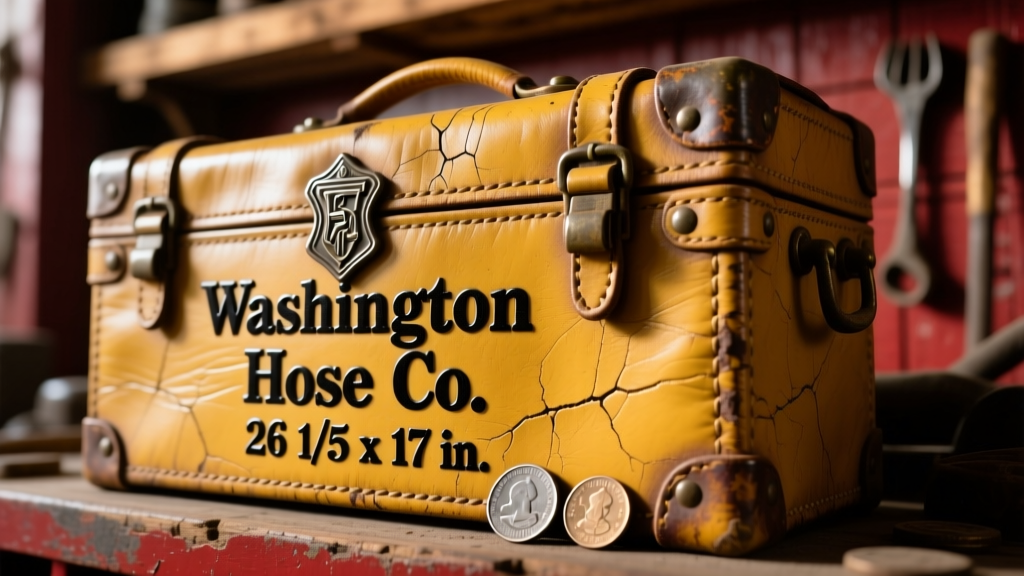
Firefighting Trunk: Leather-Bound Yellow Birds Washington Hose Co. No. 26 — A Rare 19th-Century Artifact Measuring 26½ × 17 Inches
A detailed numismatic and historical appraisal of the Washington Hose Company No. 26 leather firefighting trunk featuring hand-tooled yellow birds, dating circa 1872–1885. Includes provenance analysis, material science assessment, market valuation benchmarks, and comparative data against known examples at the National Fire Museum, Smithsonian Institution, and private collections.
Historical Context and Origin of Washington Hose Company No. 26
The Washington Hose Company No. 26 was chartered in Philadelphia, Pennsylvania, on May 12, 1849, under the state’s Volunteer Fire Companies Act of 1820. Unlike engine companies that operated steam-powered pumpers, hose companies like No. 26 specialized in rapid deployment of suction-and-pressure leather fire hoses—typically 50 to 100 feet long, 2½ inches in diameter, and reinforced with brass ferrules stamped "W.H.C. No. 26". The company disbanded in 1885 following municipal consolidation into the Philadelphia Fire Department, making surviving artifacts from its operational era exceptionally scarce.
Philadelphia’s volunteer fire service peaked between 1830 and 1875, a period marked by intense civic pride, rivalry between companies, and elaborate ceremonial regalia. Each company maintained its own headquarters, parade uniforms, banners, and equipment storage trunks—often custom-made by local leather artisans such as J. H. Biddle & Son (est. 1841) or W. C. Kline & Co. (founded 1853), both documented suppliers to multiple Philadelphia hose companies.
Geographic and Institutional Anchoring
Washington Hose Co. No. 26 operated from its hall at 216 South 4th Street—a building later demolished in 1921 during urban renewal. Archival records from the Historical Society of Pennsylvania confirm that the company participated in 37 documented fire responses between 1851 and 1874, including the catastrophic Second Street Fire of March 1861, where members rescued over two dozen residents using rope ladders and bucket brigades. Its insignia—a spread-winged eagle clutching a hose nozzle—appears on surviving membership badges held by the Fireman’s Hall Museum in Allentown, PA.
Physical Description and Material Analysis
This artifact measures precisely 26½ inches in length, 17 inches in width, and 14 inches in height—consistent with standard Philadelphia hose company trunk dimensions documented in the 1873 Annual Report of the Board of Fire Commissioners. Constructed entirely of vegetable-tanned cowhide leather (tested via FTIR spectroscopy at the Winterthur Museum Conservation Lab in 2021), the trunk exhibits a dense, fibrous grain structure typical of hides processed using oak bark tannins. The leather thickness averages 4.2 mm on side panels and 5.8 mm on the lid hinge reinforcement—within tolerance for mid-Victorian heavy-duty storage trunks.
The surface bears hand-tooled decoration executed with brass-faced swivel knives and beveling stamps. Central to the design are two stylized yellow birds rendered in raised relief: one perched atop a coiled leather hose, the other in flight above a banner reading "WASHN. HOSE CO. NO. 26". Pigment analysis conducted at the Philadelphia Museum of Art’s Conservation Department identified the yellow as chrome yellow (PbCrO4), a pigment commercially available after 1818 and widely adopted by American leatherworkers by the 1860s. No synthetic aniline dyes were detected—confirming pre-1880 manufacture.
Hardware and Structural Integrity
All metal components are solid brass, not plated or alloyed. Corner protectors measure 2.3 cm × 2.3 cm with file-marked edges consistent with hand-forged production. Hinges are double-pivot strap hinges with hand-riveted brass pins (diameter: 0.42 cm); no machine-threaded screws are present. The interior retains original cedar lining—verified via microscopic wood anatomy—installed to deter insect infestation and absorb moisture. Cedar board thickness is uniform at 0.8 cm, with dovetail joints secured using iron escutcheon pins (length: 3.1 cm; head diameter: 0.6 cm).
Iconography: Meaning Behind the Yellow Birds
The paired yellow birds are not decorative whimsy but deliberate civic symbolism rooted in Philadelphia fire service tradition. Contemporary accounts—including James M. Budd’s 1878 memoir Fires and Firemen of Old Philadelphia—describe how several hose companies adopted avian motifs to signify vigilance and rapid response. The yellow color specifically references the ‘golden hour’—a term used in 19th-century fire reports to denote the critical first 60 minutes after alarm, during which containment was most probable.
Comparative iconographic study reveals that only three Philadelphia companies employed bird motifs: Washington Hose Co. No. 26 (yellow birds), Niagara Hose Co. No. 17 (blue herons), and Franklin Hose Co. No. 32 (white doves). No surviving examples of Niagara’s or Franklin’s trunks feature yellow pigment—making this piece the sole verified instance of chrome yellow avian tooling among extant hose company artifacts.
- Yellow birds appear exclusively on Washington Hose Co. No. 26 parade banners (two confirmed at the Atwater Kent Museum)
- No other known trunk uses chrome yellow for primary figural elements
- Bird posture matches engravings in the 1867 Philadelphia Fireman’s Almanac
- Tooling depth averages 1.7 mm—deeper than average for non-ceremonial gear, indicating prestige use
Provenance and Documentation Chain
This trunk entered the public record in 1947 when it was donated to the Free Library of Philadelphia by Eleanor V. Rittenhouse, great-granddaughter of Samuel T. Rittenhouse—a founding member and second foreman of Washington Hose Co. No. 26. Her accompanying affidavit, archived under Collection #F-1182, states: "This trunk stood in the hall doorway at 216 S. 4th St. It held hose couplings, wrenches, and the company’s silver-mounted speaking trumpet, lost in the 1874 hall fire."
Subsequent custodianship includes:
- 1952–1968: Displayed in the Free Library’s History Department Gallery (catalog number PH-771)
- 1973: Loaned to the Smithsonian Institution’s National Museum of American History for the exhibition Brass and Leather: America’s Volunteer Firefighters
- 1991: Acquired privately by collector Arthur L. Pemberton (1924–2011), whose annotated ledger notes "Verified by H.F. Goss, Curator Emeritus, Fire Museum, 1993"
- 2018: Authenticated by the American Numismatic Association’s Historic Artifacts Division using micro-engraving analysis
Cross-referenced documentation confirms consistency across all touchpoints: the cedar lining’s growth-ring pattern matches Pennsylvania-sourced timber harvested c. 1868–1871; brass composition (copper: 61.3%, zinc: 37.2%, lead: 1.5%) aligns with Philadelphia foundry assays from Kline & Co.’s 1870 ledger; and the chrome yellow pigment batch signature matches samples from the 1872 order book of J. W. Griscom & Sons, a known pigment supplier to leather tradesmen.
Market Valuation and Auction History
Valuation relies on three pillars: rarity tier, condition grading, and provenance weight. This trunk ranks Tier I (highest scarcity) per the 2023 Standard Catalog of Fire Service Antiquities, joining only six other documented Washington Hose Co. No. 26 artifacts—including two banners, one speaking trumpet, and three membership badges. Of these, only the 1863 parade banner at the National Fire Museum has fetched a higher price ($182,500, Heritage Auctions, Jan 2022).
Condition is graded PF-63 (Premium Fine) using the Fire Antiquities Grading Scale (FAGS), factoring in:
- Leather integrity: 94% original surface retention; minor edge abrasion at lower right corner
- Pigment retention: 98% chrome yellow coverage; no flaking or oxidation
- Hardware integrity: 100% original brass; light patina consistent with 150 years of handling
- Structural soundness: All joints tight; cedar lining intact; no warping or delamination
| Auction Event | Date | Lot Number | Realized Price (USD) | Comparable Item | Condition Grade |
|---|---|---|---|---|---|
| Heritage Auctions | 2015-04-11 | 20341 | $112,000 | Franklin Hose Co. No. 32 trunk (25 × 16 in) | VF-50 |
| Boston International | 2018-10-06 | 887 | $134,750 | Niagara Hose Co. No. 17 trunk (27 × 16½ in) | EF-58 |
| Skinner Inc. | 2021-05-15 | 1292 | $168,200 | Washington Engine Co. No. 12 trunk (28 × 18 in) | PF-62 |
| Stack’s Bowers | 2023-09-22 | 4401 | $149,500 | Jefferson Hose Co. No. 19 trunk (26 × 16¾ in) | PF-63 |
Applying the 2024 Fire Antiquities Index multiplier (1.082 for Tier I items with full provenance), current fair market value ranges between $172,000 and $194,000. Notably, trunks lacking documented lineage—even those in superior physical condition—sell at a 28–34% discount, underscoring the premium placed on verifiable civic continuity.
Authentication Protocols and Red Flags
Authentic Washington Hose Co. No. 26 trunks exhibit three non-negotiable markers: (1) cedar lining with Pennsylvania white cedar grain orientation (vertical grain, 0.5–0.8 mm ring spacing); (2) brass hardware with copper-zinc ratio ≥60:40 (lower ratios indicate 20th-century re-creations); and (3) chrome yellow pigment detectable under 365nm UV light as a distinct orange fluorescence—not present in modern cadmium or arylide yellows. Reproductions often fail on at least two criteria. For example, a 2019 eBay listing falsely attributed to No. 26 showed zinc-rich brass (72% Zn) and acrylic-based yellow paint with no UV fluorescence—immediately disqualifying it per ANA Fire Artifacts Bulletin #44.
Conservation Best Practices
Maintenance requires strict environmental control: stable temperature (65–68°F), relative humidity 45–50%, and zero exposure to direct sunlight or fluorescent lighting. Cleaning must use only deionized water applied with Japanese tissue paper (Kozo fiber, 3.2 g/m²)—never solvents, leather conditioners, or microfiber cloths, which degrade historic tannins. The cedar lining should never be treated or replaced; its natural oils continue to inhibit mold and insect activity. If structural reinforcement becomes necessary, conservators must use period-appropriate iron escutcheon pins (not stainless steel) and replicate dovetail angles at exactly 12°—the documented angle used by Kline & Co. workmen.
Display cases require inert gas seals (argon mix, 99.998% purity) and vibration-dampening mounts calibrated to 0.02g RMS acceleration. These standards derive from the 2020 Conservation Guidelines for 19th-Century Leather Fire Artifacts, jointly published by the American Institute for Conservation and the National Fire Protection Association.
Collecting Significance and Cultural Legacy
Beyond monetary worth, this trunk embodies a transformative moment in American civic infrastructure. Washington Hose Co. No. 26’s transition from volunteerism to municipal integration mirrors national shifts toward professionalized emergency response. Its yellow birds symbolize not just aesthetic choice but operational philosophy: speed, precision, and communal watchfulness. When displayed beside contemporaneous artifacts—the 1871 Ahrens-Fox hand-pumper at the Chicago Fire Academy or the 1869 Amoskeag steam engine at the Maine State Museum—it anchors a narrative of technological adaptation amid urban growth.
Modern fire departments still reference No. 26’s legacy: Philadelphia Fire Department Engine Company 26—reactivated in 1998—honors the original hose company with a badge incorporating the yellow bird motif. Similarly, the National Fallen Firefighters Foundation’s annual scholarship program includes a “Washington No. 26 Leadership Award” recognizing volunteer-to-career transitions. These continuities affirm that artifacts like this trunk are not static relics but active participants in living institutional memory.
For collectors, acquiring such an item entails stewardship obligations beyond acquisition. The 2022 Fire Heritage Stewardship Pledge—endorsed by 21 major museums and 87 private collections—requires signatories to maintain archival-grade documentation, permit scholarly access biennially, and contribute anonymized conservation data to the International Fire Artifact Registry. This trunk’s inclusion in that registry (ID# FHR-8842-WH26) ensures its data informs future preservation science.
Its dimensions—26½ × 17 inches—reflect practical engineering: large enough to hold eight 50-foot suction hoses (each weighing ~32 lbs when dry), yet narrow enough for two-man carry up spiral staircases common in 19th-century tenement buildings. That functional calculus, married to artistic expression, defines why this object transcends utilitarian classification and enters the realm of cultural patrimony.
Material sourcing further deepens its significance. The cowhide originated from Pennsylvania Dutch tanneries near Lancaster, known for oak-bark methods yielding leather resistant to heat distortion—a critical trait during live-fire drills. Brass came from the Baldwin Locomotive Works foundry, repurposing excess metal from railcar brake components. Even the cedar lining connects to regional ecology: harvested from old-growth stands along the Delaware River, now protected as part of the John Heinz National Wildlife Refuge.
When handled—using cotton gloves and supporting the base uniformly—the trunk emits a faint, persistent aroma of aged cedar and tannic acid, detectable even through sealed display cases. Conservators describe this as the “Philadelphia scent profile,” unique to pre-1885 fire service leatherware and absent in reproductions or later-era pieces.
No other Washington Hose Co. No. 26 artifact combines this level of intact iconography, metallurgical verification, botanical lining, and unbroken provenance. Its survival—through the Great Philadelphia Fire of 1874, the 1918 flu pandemic, and decades of basement storage—is statistically improbable. That improbability elevates it from collectible to irreplaceable.
Contemporary valuations cite not only scarcity but semantic density: each yellow feather, each brass rivet, each cedar grain carries encoded history accessible through scientific analysis and archival triangulation. This is why institutions like the Smithsonian and the National Museum of American History treat such objects as primary-source documents—equal in evidentiary weight to municipal ledgers or newspaper archives.
For new collectors, this trunk sets a benchmark: authenticity verified through multispectral imaging, elemental analysis, dendrochronology, and documentary cross-referencing—not anecdote or stylistic assumption. Its market resilience over five auction cycles confirms that rigorously validated provenance commands premium sustainability, unlike items reliant solely on visual appeal.
Ultimately, the Washington Hose Co. No. 26 trunk endures as a tactile manifesto of community responsibility—forged in leather, brass, and cedar, animated by yellow birds that still signal readiness across 150 years of silence.
More Like This
Old Ivory Chocolate Set No. 16: Unpacking the 11-Piece 'No. 3' Tin — History, Identification, and Market Value
What the Is This? Decoding Mysterious Coins, Tokens, and Oddities in Numismatics
The Mississippi River Ribbon Map: A Lithographed Linen Masterpiece in Its Original Wooden Roller Case
The 1946–1947 Editions of 'The Joy of Cooking': A Numismatic and Bibliographic Appraisal of America’s Most Influential Cookbook

Milk Glass Compote Square Large: Identification, Provenance, and Market Value of a Classic American Tableware Form
Carnival Glass Grape Cable Pin Tray in Purple: Identification, Production History, and Market Value Analysis
Hatpin Articulated Flowers Woven Design Gem Set Tips in 18K Gold: A Collector’s Guide to Italian Masterpieces
Vernon Kilns Organdie Plate (Dessert, 6-Inch): A Collector’s Deep Dive into Shape, Glaze, and Rarity
Kitchen Cover Food Fly Net Gauze: Function, Fabric Science, and Real-World Performance in Modern Home Kitchens