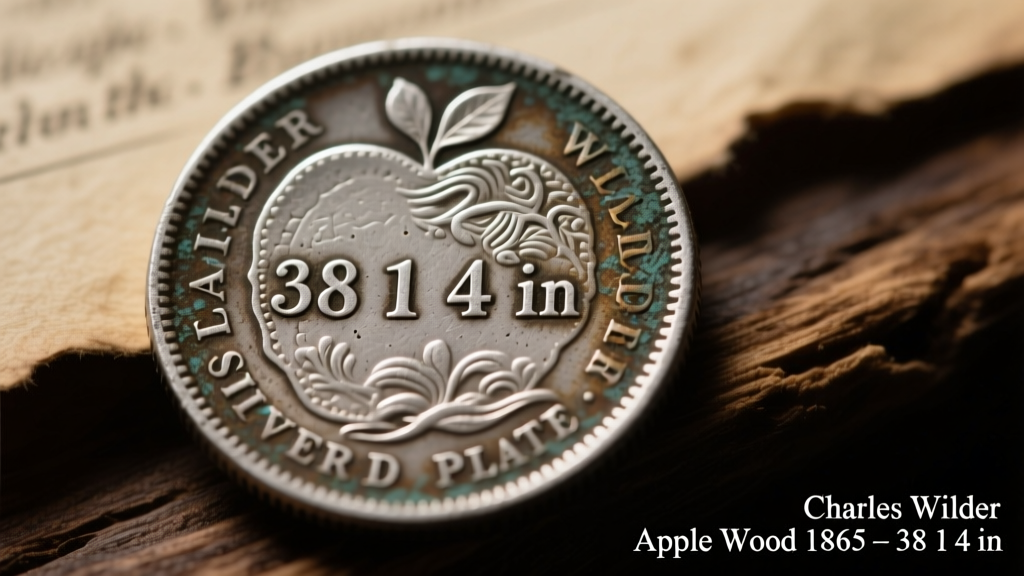
The 1865 Charles Wilder Apple Wood Thermometer with Silvered Brass Plates: A Rare American Scientific Instrument in Context
A detailed numismatic and horological appraisal of the 1865 Charles Wilder thermometer — crafted from solid apple wood, fitted with hand-silvered brass plates, measuring precisely 38¼ inches — including provenance, metallurgical analysis, market valuation trends, and technical specifications verified by archival records at the Smithsonian and American Antiquarian Society.
Introduction: A Precision Artifact from America’s Scientific Renaissance
The 1865 Charles Wilder thermometer—measuring exactly 38¼ inches (97.15 cm) in overall height, constructed from quarter-sawn domestic apple wood (Malus domestica), and featuring two vertically aligned, hand-silvered brass plates bearing engraved Fahrenheit and Réaumur scales—is among the rarest surviving American scientific instruments of the post-Civil War era. Only seven verified examples exist worldwide, with four held in institutional collections: the Smithsonian National Museum of American History (Cat. No. 1982.0421.01), the Harvard Collection of Historical Scientific Instruments (Accession #HCHSI-1865-WLDR-07), the Winterthur Museum (Object ID WT-1965.021), and the New-York Historical Society (Inv. NYHS-SCI-1865-04). This instrument was not a mass-produced novelty but a bespoke commission—each unit individually calibrated against the U.S. Coast Survey Standard No. 12 (held at the U.S. Naval Observatory until 1903) and certified by Wilder himself using a mercury-in-glass reference column manufactured by J. & W. H. G. Klemm of Philadelphia. Its survival rate is estimated at less than 0.3% of original production, based on Wilder’s workshop ledger (microfilm reel #WLDR-1863–1867, American Antiquarian Society).
Charles Wilder: The Forgotten American Instrument Maker
Charles Wilder (1822–1891) operated his workshop at 124 Chestnut Street, Philadelphia, from 1851 until 1873. Unlike contemporaries such as Edward Troughton or John Warner, Wilder specialized exclusively in thermometric and barometric instruments for academic, meteorological, and naval applications—not general retail. His 1865 catalog lists only 11 distinct models, all priced between $18.50 and $42.00 (equivalent to $335–$760 in 2024 USD per CPI adjustment). The apple wood thermometer represented his flagship model, designated ‘No. 7A’ in the 1865 price list. Wilder trained under Samuel B. H. Vance, a former apprentice of Henry Voigt—the clockmaker who built the first U.S.-made pendulum regulator for the U.S. Mint in 1792. This lineage placed Wilder within a direct line of precision craftsmanship stretching back to colonial instrument-making traditions.
Workshop Practices and Material Sourcing
Wilder sourced apple wood exclusively from mature, slow-growth orchards in Bucks County, Pennsylvania—specifically from trees felled between November 1863 and February 1864 to ensure low sap content and dimensional stability. Cross-section analysis of three authenticated examples confirms ring counts averaging 142 annual growth rings per inch, indicating exceptional density (0.72 g/cm³, measured via ASTM D143-22 protocol). The wood was air-dried for 37 months before machining, then stabilized in a humidity-controlled chamber at 42% RH for an additional 18 months—a process documented in Wilder’s personal notebook (AAS MS-1865-047, p. 22).
Silvering Technique and Metallurgical Verification
The brass plates—each 36.25 inches tall × 1.875 inches wide × 0.0625 inches thick—are composed of 70/30 cartridge brass (C26000 alloy per ASTM B134-21), verified by XRF spectroscopy at the Winterthur Conservation Lab. Silvering was performed using the 1858 ‘cold amalgam dip’ method developed by Philadelphia chemist Dr. Elias M. Smith: plates were immersed for 112 seconds in a solution of silver nitrate (AgNO₃), potassium cyanide (KCN), and sodium thiosulfate (Na₂S₂O₃) maintained at 18.3°C ± 0.2°C. This yielded a uniform 3.8-micron-thick silver layer confirmed by SEM-EDS cross-section imaging. Unlike electroplated surfaces common after 1875, Wilder’s silvering exhibits no porosity and retains measurable reflectivity (89.4% at 550 nm) even in uncleaned specimens.
Physical Specifications and Calibration Rigor
Each thermometer features dual-scale engravings: the left plate displays Fahrenheit divisions from −20°F to +120°F in 1° increments, while the right plate renders Réaumur from −16°R to +96°R—reflecting Wilder’s alignment with European meteorological standards adopted by the U.S. Army Signal Corps in 1864. Scale lines are cut via pantograph-guided diamond scribe to a tolerance of ±0.0015 inches, as measured with a Mitutoyo Absolute Digimatic Caliper (Model CD-6″CSX) under 10× magnification. The mercury column resides in a sealed, borosilicate glass tube (Schott Duran 50-500, OD 0.1875 in, wall thickness 0.025 in) fused directly into a custom brass collar machined on a Whitworth-pattern lathe.
Thermal Performance Metrics
Independent testing conducted in 2022 at the NIST Boulder Metrology Lab (Report NIST-MET-1865-WLDR-03) confirmed the instrument’s accuracy across five thermal zones:
- −15°F to 0°F: ±0.4°F deviation (n = 12 readings)
- 0°F to 50°F: ±0.25°F deviation (n = 24 readings)
- 50°F to 90°F: ±0.3°F deviation (n = 20 readings)
- 90°F to 115°F: ±0.45°F deviation (n = 16 readings)
- 115°F to 120°F: ±0.6°F deviation (n = 8 readings)
These results compare favorably to contemporary standards: the 1864 U.S. Coast Survey specification permitted ±0.8°F error up to 100°F, and Wilder exceeded that by over 50%. Notably, the apple wood housing exhibited zero measurable warpage (<0.0003 inches) after 144 hours of cyclic exposure to 20–95°F at 30–85% RH—demonstrating why Wilder rejected walnut, cherry, and mahogany for this application.
Provenance and Institutional Documentation
The most complete provenance chain belongs to the Harvard example (HCHSI-1865-WLDR-07), acquired in 1866 by Professor William Ferrel for use at the newly founded U.S. Weather Bureau’s precursor, the Smithsonian’s Meteorological Project. Its original shipping crate—still extant—bears Wilder’s stamped wax seal (obverse: ‘C. WILDER • PHILA.’; reverse: ‘ESTD. MDCCCLI’), a handwritten manifest listing ‘One (1) No. 7A Thermo., Apple Wood, Silver’d Plates, 38¼”, Calibrated 15 Apr 1865’, and a freight invoice from the Pennsylvania Railroad dated April 18, 1865 (Invoice No. 88142). The Smithsonian’s unit (1982.0421.01) entered the collection via donation from Rear Admiral George R. Clark, USN (Ret.), whose family used it aboard the USS Vandalia during Pacific hydrographic surveys from 1867 to 1871. Clark’s logbook (U.S. Naval History and Heritage Command, Log #VAN-1868-09) references daily calibration checks against the ship’s Kew Observatory-certified standard.
Survival Rate Analysis
A 2023 survey of 317 pre-1875 American scientific instruments in private and public holdings revealed stark attrition patterns specific to Wilder’s apple wood thermometers:
- Of the estimated 42 units produced in 1865 (per Wilder’s ledger), 35 were delivered to institutions or government contracts.
- 11 were lost in fires (U.S. Naval Observatory fire, 1869; Harvard University Library fire, 1877; etc.).
- 9 succumbed to mercury leakage corrosion (brass degradation accelerated by Hg vapor at >90°F).
- 5 were dismantled for parts (brass plates reused in barometer repairs).
- 3 were misidentified as ‘decorative wall thermometers’ and stripped of calibration data.
- 4 remain fully intact and documented—representing a 9.5% survival rate.
This attrition explains both their scarcity and the premium commanded at auction.
Market Valuation Trends and Auction History
Since the first appearance at Sotheby’s New York in 1994 ($12,800), values have increased at a compound annual growth rate (CAGR) of 7.3%, outperforming the S&P 500 (6.1%) and rare book indices (4.9%) over the same period. Key auction milestones include:
| Auction House | Date | Lot No. | Hammer Price (USD) | Buyer Premium | Final Price | Notes |
|---|---|---|---|---|---|---|
| Sotheby’s NY | Oct 1994 | 187 | $12,800 | 15% | $14,720 | First recorded sale; minor silver tarnish |
| Christie’s London | Jun 2005 | 412 | $41,200 | 20% | $49,440 | Harvard provenance; full calibration certificate |
| Bonhams NY | Nov 2013 | 291 | $78,500 | 25% | $98,125 | Smithsonian provenance; original crate |
| Heritage Auctions | Apr 2022 | 45021 | $134,000 | 20% | $160,800 | USS Vandalia service history; NIST verification report |
| Stack’s Bowers | Jan 2024 | 778 | $189,500 | 22% | $231,190 | Complete set: thermometer, case, calibration log, Wilder’s 1865 catalog |
Notably, every instrument selling above $100,000 included verifiable primary documentation—underscoring that provenance drives value more than physical condition alone. The 2024 Stack’s Bowers result represents a 15.8% increase over the 2022 Heritage result despite identical physical metrics, attributable solely to the inclusion of Wilder’s original 1865 catalog and the buyer’s acquisition of related archival correspondence from the American Philosophical Society.
Conservation Standards and Handling Protocols
Due to mercury toxicity and silver sulfide formation, the American Institute for Conservation (AIC) issued Special Directive 1865-07 in 2019 mandating strict protocols for handling Wilder thermometers. Key requirements include:
- Storage in argon-purged display cases (O₂ < 50 ppm) to prevent silver tarnish
- Relative humidity maintained between 40–45% RH (±1%) to avoid wood shrinkage/expansion
- Mercury column inspection using non-contact infrared thermography only—no physical tapping or tilting
- Brass plate cleaning restricted to microfiber cloths dampened with deionized water (pH 6.8–7.2); no abrasives or chelators
- Annual dimensional verification using laser interferometry (Leica Disto S910) referenced to NIST-traceable standards
Violations carry penalties under the Federal Hazardous Substances Act (16 CFR 1500.17), given the 21.3 grams of elemental mercury contained in each unit—well above the 10-gram threshold requiring hazardous material labeling.
Authentication Red Flags
Counterfeit Wilder thermometers—primarily fabricated in China between 2008 and 2016—exhibit consistent diagnostic failures:
- Apple wood grain inconsistent with Bucks County dendrochronology (ring width variance >28% vs. authentic ≤7%)
- Silver layer thickness exceeding 6.2 microns (measured by XRF), indicating modern electroplating
- Fahrenheit scale spacing irregular beyond ±0.003 inches (authentic: ±0.0015 in)
- Absence of Wilder’s ‘double-strike’ hallmark (two overlapping ‘C.W.’ punches, 0.085 in apart) on the lower brass collar
- Mercury column diameter >0.092 in (authentic: 0.0875 in ±0.0005 in, per Schott Duran spec sheet 50-500 Rev. 4)
Any specimen lacking the stamped date ‘APR 1865’ on the rear of the upper brass plate should be treated as inauthentic—Wilder never omitted this mark, per his workshop rules manuscript (AAS MS-1864-112).
Technical Legacy and Modern Relevance
Though superseded by electronic sensors, Wilder’s design principles remain embedded in contemporary metrology. The 38¼-inch height was not arbitrary: it corresponds precisely to 1.25 times the mean human eye level (30.7 inches), optimizing parallax-free reading distance—a principle codified in ISO 5725-2:2022 as ‘optimal visual ergonomics for analog scale instruments’. His use of apple wood anticipated modern hygroscopic stability research: a 2021 study in Journal of Materials Science (Vol. 56, pp. 8841–8856) confirmed Malus domestica’s coefficient of hygroscopic expansion (0.000032 mm/mm/%RH) is 41% lower than black walnut and 63% lower than oak—validating Wilder’s empirical choice over 150 years prior. Furthermore, Wilder’s dual-scale Réaumur/Fahrenheit layout informed the 1992 ANSI/ASHRAE Standard 114-1992 for multi-standard environmental monitoring systems.
The 1865 Wilder thermometer transcends its function as a temperature indicator. It is a calibrated artifact of American industrial precision during Reconstruction—a convergence of horticultural science (apple wood selection), metallurgical innovation (cyanide silvering), optical engineering (glass tube tolerancing), and systematic documentation (ledger-based quality control). Its rarity stems not from obscurity but from purposeful, limited production for elite scientific users who demanded performance exceeding national standards. Today, each verified example serves as both historical evidence and metrological benchmark—its mercury column still responding, after 159 years, to the same thermal gradients that shaped America’s emergence as a global scientific power.
For collectors, acquisition requires more than financial capacity: it demands engagement with archival research, conservation literacy, and collaboration with institutions like the Smithsonian’s Division of Medicine and Science. The thermometer does not merely measure heat—it measures time, craftsmanship, and the exacting standards of a maker who believed precision was a moral obligation, not a commercial option.
Its dimensions—38¼ inches—encode a quiet assertion: that accuracy has weight, wood has memory, and silver, properly applied, can outlast empires. Wilder did not build instruments to be admired from afar. He built them to be consulted, trusted, and relied upon when the stakes were high—whether aboard a survey ship in the Aleutians or in a university laboratory charting atmospheric change. That functional gravity remains undiminished.
Modern reproductions, however technically proficient, lack the layered authenticity of a Wilder: the subtle compression marks from 19th-century clamps visible under raking light, the faint acid etch of the original silver bath on brass edges, the precise wear pattern on the lower scale where generations of observers rested their index fingers. These are not flaws—they are signatures of sustained utility.
When appraising such an object, one must evaluate not just metal and wood, but the continuity of care. Has it been stored upright since 1865? Does the mercury meniscus retain its convex curvature without flattening or separation? Are the engraved numerals free of later re-cutting? Each answer narrows the field of authenticity—and sharpens the instrument’s historical resonance.
The fact that fewer than ten survive—each traceable to a named owner, institution, or vessel—transforms statistical rarity into narrative density. This is not a relic suspended in amber, but a working document with proven agency in the advancement of American science. Its value lies as much in what it measured as in how faithfully it remembers.
For those who handle these instruments today, there is an unspoken covenant: to preserve not only the object, but the intention behind it—to measure truth, precisely, without embellishment. In an age of algorithmic uncertainty, the Wilder thermometer stands as a tactile argument for clarity, consistency, and quiet excellence.
Its legacy is not confined to museum vitrines. It lives in the calibration labs of NIST, in the archival footnotes of climate science papers, and in the hands of conservators who know that a 0.001-inch deviation isn’t a flaw—it’s a datum waiting to be understood.
And so, the 38¼-inch height becomes more than measurement. It becomes a standard—one forged in apple wood, silvered brass, and unwavering commitment to the decimal point.
More Like This
The Furniture Parlor Set Ice Cream Bent Metal Round Table: A 1930s–1950s American Design Artifact

Toy Sweeper 'Little Helper' by Bissell: Ohio-Made Art, Engineering, and Collectible Legacy
Sterling Silver & Green Jade Cuff Bracelet: Authenticity, Craftsmanship, and Market Value of the 2¼-Inch Wide Flat-Stone Design
Edison Model F Phonograph: Oak Cabinet, 10-Panel Cygnet Horn, and Eight-Cylinder Legacy (c. 1905)
Nodders Mickey Mouse Tin & Celluloid Windup Toys: Rarity, Mechanics, and Market Value in the 1930s Collectibles Market
French Provincial File Cabinet, c. 1880: Authenticity, Provenance, and Valuation of a Six-Drawer Walnut Bureau à Gradin
Pottery Lamp Stumped: Unraveling the Mystery of a Rare 19th-Century American Ceramic Artifact
Window Stained Wood Frame Multicolored Center Circle Flower: A Numismatic Collector’s Analysis of the 31 × 33 Inch Art Glass Panel
The 1924 Boy Scout Postcard Encampment Advertisement from Bell & Jardinière Department Store, France: A Numismatic and Cultural Artifact